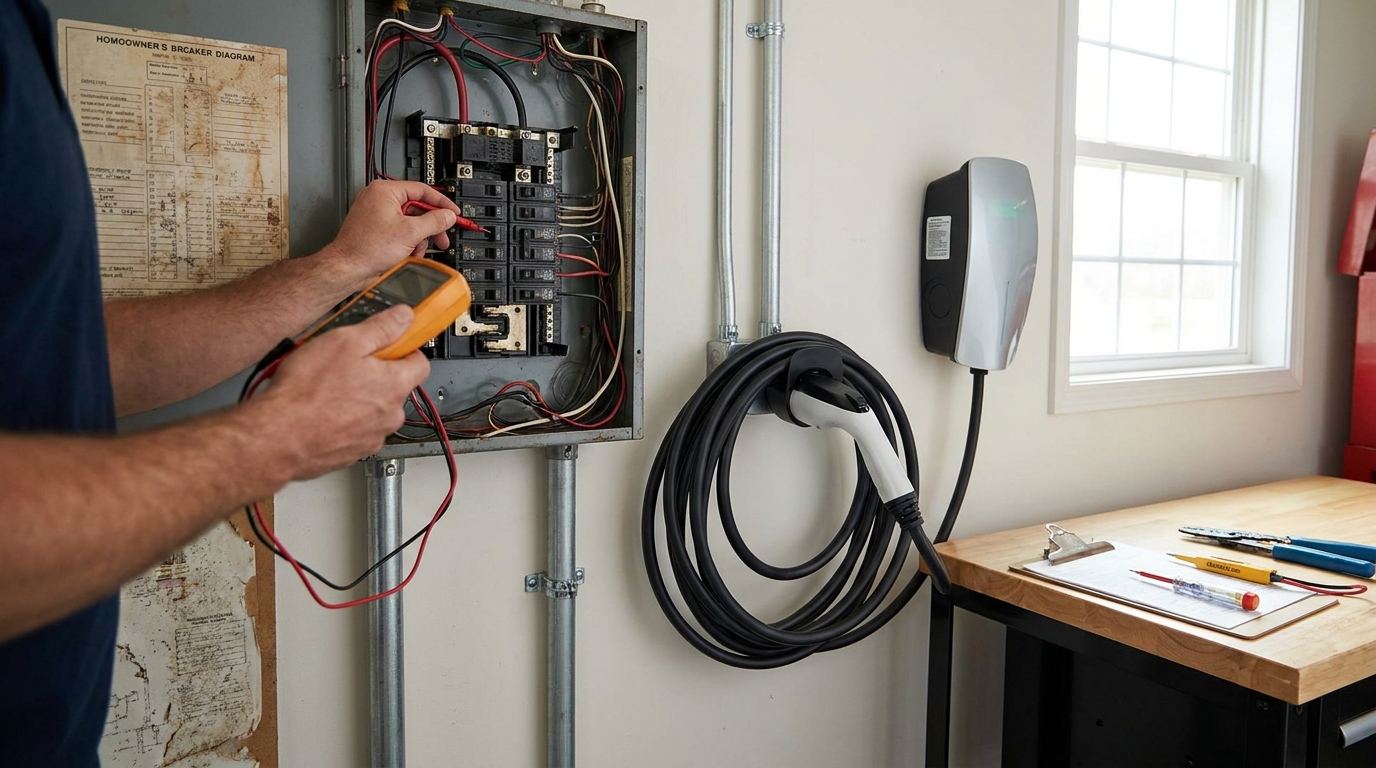
You called around for a Level 2 EV charger install and the first numbers sounded reasonable. Maybe $800 on the low end, somewhere around $1,700 for a typical job, perhaps $3,000 if your garage is far from the panel. Then one electrician walks the property, glances at your breaker box, and the quote balloons to $4,000 or more. The reason is almost always one line item: a panel or electrical service upgrade.
Here is the part most homeowners never hear. A large share of homes, commonly cited at around 70% in industry load-calculation analyses, may already have enough spare capacity to add a charger without touching the panel at all. That figure comes from EV-industry vendors rather than a government agency, so treat it as an estimate, not gospel. But the underlying point holds: the panel upgrade is the single variable most likely to double or quadruple your bill, and it is the one most worth questioning before you sign.
This guide walks you through what a Level 2 install really costs, why the panel line item gets added, and the one document you should demand before paying for an upgrade you might not need.
Level 2 basics: what you are actually paying to install
A Level 2 home charger runs on 240V service, the same kind of circuit that feeds an electric dryer or range. It needs its own dedicated branch circuit, meaning a wire and breaker that serve the charger and nothing else.
The wrinkle that drives sizing is this: the National Electrical Code treats EV charging as a continuous load, because the charger can pull full power for hours at a stretch. To handle that, the code requires the circuit to be sized at 125% of the charger's rating. In plain terms, a 40-amp charger needs a dedicated 50-amp circuit (NEC Article 625, specifically 625.42). That is not padding. It is a safety margin baked into the code.
Most residential Level 2 chargers draw somewhere between 16 and 80 amps, with 30 to 40 amps being the most common choice for home use. According to EPA and DOE guidance, a home with at least a 200-amp panel and two open breaker slots for a double-pole breaker likely has the capacity to add a Level 2 charger. "Likely" is the operative word, and confirming it is where the real money gets decided.
The cost anatomy: where your dollars go
A typical professional Level 2 install lands in the range of about $800 to $3,000. Qmerit, a national EV install network, cites roughly $800 to $2,500 for a standard job, with about $1,700 as a typical figure. Here is how that usually breaks down:
-
Charger hardware: about $300 to $900 for the unit itself
-
Labor and permitting: roughly $500 to $1,200
-
Conduit and wire: about $200 to $500, depending on the run length from your panel to the charger
Now the line item that changes everything. Upgrading a home's electrical service or panel, for example from 100 amps to 200 amps, commonly adds about $1,500 to $3,000. In higher-cost markets like California, New York, and the Pacific Northwest, that same upgrade can run $3,000 to $5,000. Stack that on top of a base install and you can see exactly how an $800 quote becomes a $4,000 project. Corroborating 2026 cost data from EcoFlow shows typical installs of $1,200 to $3,000 before incentives, with panel upgrades pushing complex jobs past $4,000.
So the question is not whether a panel upgrade is expensive. It is whether you need one at all.
The capacity myth: why a 200-amp panel often has room to spare
Here is where many homeowners get talked into spending money they did not need to. The assumption goes: "Your panel is already busy with the AC, the dryer, the oven, the water heater, so we will need to upsize it for the car." That assumption skips the actual math.
The NEC includes an "optional method" load calculation in section 220.82 that reflects how homes really use power. The key feature is a demand factor. The first 10,000 VA of general load is counted at 100%, but everything above that is counted at just 40%. The logic is simple and true to life: you do not run the oven, dryer, AC, and EV charger all at full blast at the exact same moment.
When an electrician runs this calculation honestly, a typical 200-amp home often turns out to have 40 to 80 amps of spare capacity already available. That is frequently more than enough for a 30 to 40 amp charger. This is the basis for the widely repeated claim that around 70% of homes can add a charger without a service upgrade. That percentage comes from vendor load-calc analyses (ChargeRight publishes a plain-language walkthrough of the 220.82 method), so frame it as an industry estimate rather than an official statistic. Even so, the practical takeaway stands: do not assume you need an upgrade until someone shows you the numbers.
AI workflows for revenue teams
Placeholder house ad for Conservus.ai. Swap with final creative when brand assets are ready.
Partner with Conservus.aiGet a real load calc before you pay
The single most valuable thing you can ask for is a written NEC 220.82 load calculation. This is the document that either justifies a panel upgrade or proves you can skip it.
What to ask for, in your own words: "Before we talk about a panel upgrade, can you run a 220.82 load calculation and show me the numbers?" A straightforward electrician will check your panel's amperage rating, count your open breaker slots, add up your existing loads, apply the 40% demand factor, and tell you how much headroom is left.
What the numbers should show is simple math: your panel rating minus your calculated demand equals your spare capacity. If that spare capacity comfortably exceeds the circuit your charger needs, you do not need a service upgrade. A written calc protects you because it turns a sales pitch into a verifiable figure you can get a second opinion on.
When you genuinely need an upgrade, and the EVEMS alternative
Sometimes the load calc really does come back tight. An older 100-amp panel, a full breaker box, or an all-electric home with heavy existing loads can genuinely run short on capacity. Before you accept a full service upgrade, ask about one more option.
An EV Energy Management System, or EVEMS, manages how much power the charger draws so it never exceeds the capacity your home actually has available. The NEC explicitly allows this. Under 625.42(A) and 625.48 (which reference load-management provisions), the design can be based on the managed maximum demand rather than the charger's full nameplate rating. In practice, that means a managed charger can fit into a home that looks tight on paper, often avoiding a panel or service upgrade entirely, as long as the managed limit is properly documented.
So if an electrician says you need an upgrade, a fair follow-up is: "Could load management or an EVEMS let us avoid that?" The honest answer might still be no, but a quote that never mentions the option is a quote worth a second look.
Permits, GFCI, and inspection: real costs, not padding
Not every added line item is an upsell. A few are required by code and exist for your safety:
-
GFCI protection: EV charger receptacles must be GFCI protected under NEC 625.54. This is a legitimate requirement.
-
Permit and inspection: most jurisdictions require a permit and an inspection for a new circuit. A contractor who pulls a permit is following the rules, and that inspection is your independent check that the work was done right.
If you see these on a quote, they belong there. A contractor willing to skip the permit to save you a few dollars is not doing you a favor. Unpermitted electrical work can create insurance and resale headaches later.
AI workflows for revenue teams
Placeholder house ad for Conservus.ai. Swap with final creative when brand assets are ready.
Partner with Conservus.aiMoney on the table: the 30C tax credit and its 2026 deadline
There is a federal incentive that could trim your cost, but it comes with a tight clock and a catch. The 30C Alternative Fuel Vehicle Refueling Property Credit for individuals covers 30% of your cost, up to $1,000 per charging port, claimed on IRS Form 8911.
Two important conditions:
-
Eligibility is location-based. The credit only applies to chargers placed in service at homes in eligible low-income or non-urban census tracts. Many suburban homes do not qualify, so check your address against the eligibility maps before counting on it.
-
The deadline is firm. The credit is scheduled to expire June 30, 2026. To claim it, the installation must be completed by that date.
If your home qualifies and you have been on the fence, the calendar matters. Consumer guidance from Rewiring America covers the eligibility details and the expiration. Beyond the federal credit, many states and local utilities offer their own EV charger rebates, so it is worth a quick check with your utility before you book the work.
Honest electrician vs. upsell: your pre-signing checklist
You do not need to be an electrician to spot the difference. Watch for these red flags:
-
Quoting a panel upgrade without performing or showing a written 220.82 load calculation
-
Ignoring or dismissing EVEMS and load-management options when capacity is tight
-
Sizing for the charger's full nameplate rating when a managed limit would do the job
And here are the honest signals that you are dealing with a straight shooter:
-
They give you the actual load-calc numbers, not just a verdict
-
They physically check your panel amperage and count your open breaker slots
-
They pull a permit and schedule an inspection
The bottom line
A panel upgrade can be a real and necessary cost, but it is also the line item most likely to inflate your EV charger bill, sometimes from $800 to $4,000. Before you accept it, do three things:
-
Demand a written NEC 220.82 load calculation and ask the electrician to show you the spare-capacity number.
-
Ask whether an EVEMS or load management could let you avoid a panel or service upgrade if capacity is tight.
-
Check your 30C tax credit eligibility and deadline (30%, up to $1,000, expiring June 30, 2026, eligible tracts only), plus any state or utility rebates.
Get at least two quotes, and treat any panel upgrade that arrives without a load calc behind it as a number to question, not a number to pay.
AI workflows for revenue teams
Placeholder house ad for Conservus.ai. Swap with final creative when brand assets are ready.
Partner with Conservus.aiRelated reading
Sources
-
DOE Alternative Fuels Data Center — Electric Vehicle Charging Stations
-
Qmerit — Understanding Your EV Home Charging Station Installation Costs
-
[EcoFlow — Level 2 Charger Installation Cost in 2026](https://energy.ecoflow.com/us/blog/level-2-charger-installation-cost)
-
ChargeRight — NEC 220.82 Calculator and Step-by-Step Walkthrough (2026)
-
IRS — Alternative Fuel Vehicle Refueling Property Credit for Individuals (30C)
-
Rewiring America — 30C EV Charger Tax Credit: A Guide for Homeowners
Note: This article contains AI-assisted content and has been reviewed by our editorial team.
ABOUT THIS SERVICE: CallTheLocal.com is a directory and lead generation service, not a contractor or service provider. Submitting this form does not obligate you to hire anyone or purchase any service. Your information will be shared with licensed, insured home service professionals in your area who may provide quotes for your project. CallTheLocal.com does not guarantee the quality, timeliness, or outcome of any work performed by service providers you connect with through this service. Always verify licensing, insurance, and references before hiring. Get everything in writing before work begins.