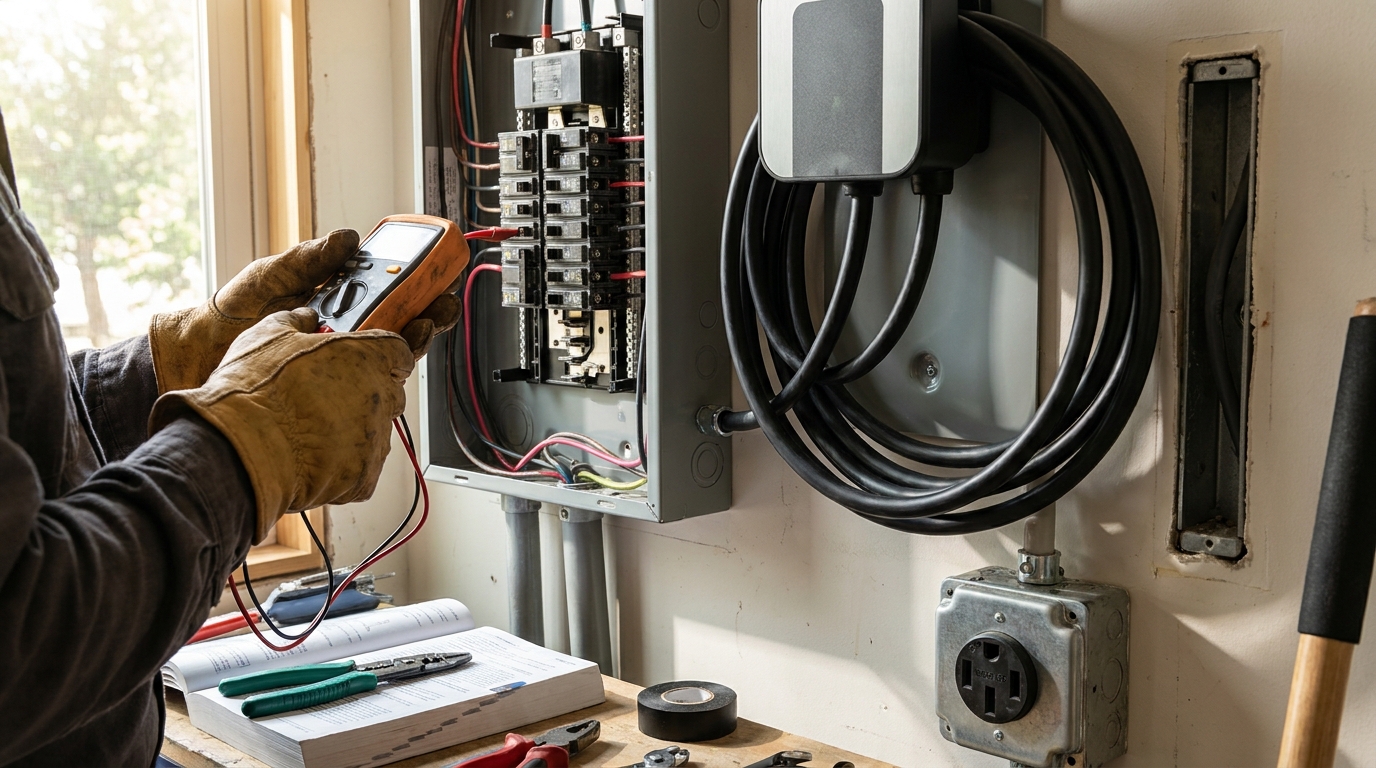
If you have seen a headline claiming the 2026 electrical code just made DIY EV charger installs illegal everywhere and forces every new home to come pre-wired, you are half right. The 2026 National Electrical Code (NFPA 70, 2026 edition) does include two real changes that affect home charging. But the way those changes get reported online misses two important details that determine whether they apply to you at all.
Here is the short version before we dig in. First, the NEC has no single national effective date. It is a model code, and it only becomes law where your state or city adopts it. Second, the so-called DIY ban applies to hardwiring and adding a new circuit, not to plugging a portable charger into an outlet that is already there. Get those two facts straight and the rest of this makes a lot more sense.
Article 625.4: the qualified person rule
The change everyone is talking about is Article 625.4 in the 2026 NEC. It says permanently installed EV power transfer equipment (the hardwired charging gear) must be installed by a qualified person. The code defines a qualified person by skills, knowledge, and safety training, not literally by the words licensed electrician. In practice, most jurisdictions and trade experts read this as requiring a licensed electrician or qualified contractor, which effectively ends unpermitted homeowner hardwire installs where the rule is adopted.
This is where the headlines overreach. Two things matter for a homeowner:
-
What is covered: hardwiring a wall charger and opening the panel to add a new dedicated circuit. That is electrician territory under 625.4.
-
What is not covered: plugging a portable, cord-connected Level 2 charger into a 240V receptacle that was already installed under permit. Charging your car itself is not banned. If you have a properly installed NEMA 14-50 outlet in the garage, using it is still your call.
So the accurate way to say it is this: the 2026 code, where adopted, ends unpermitted DIY hardwire and new-circuit work, not home charging. A trade explainer from ChargeRight walks through the qualified person language and these scope limits in more detail.
Section 210.17: new homes must be EV ready
The second change is Section 210.17. It requires new one- and two-family dwellings to be built EV ready. That means a dedicated 50-amp, 240V branch circuit with the wiring run and a receptacle (a NEMA 14-50 or equivalent) placed in the garage or designated parking area, installed during construction.
Notice what that does and does not include. It mandates the infrastructure, the rough-in and the outlet, not the charger unit itself. The buyer still purchases and installs the actual Level 2 charging station later. Think of it as the house arriving charger-ready rather than charger-included.
The reason this matters for your wallet is timing. Roughing in the EV circuit during construction is cheap. Trade sources put it at roughly $280 to $450 added to a new home's electrical work, depending on how far the panel sits from the garage. Retrofitting that same circuit into a finished home costs several times more, which is the whole argument for doing it up front. A residential code breakdown from Buildermuse covers the 210.17 requirement and rough-in cost.
The state-by-state reality nobody mentions
This is the correction that changes everything above. The NEC is a model code with no automatic nationwide effective date. Each state and local jurisdiction adopts it, amends it, or declines it on its own schedule. As of now, only some states are on the 2026 cycle. Many are still enforcing the 2020 or 2023 editions, and specific provisions within the 2026 code can even carry different effective dates.
What that means in plain terms: none of the 625.4 or 210.17 rules apply to you until your jurisdiction adopts the 2026 NEC. The DIY hardwire limitation only exists once your area is on that cycle. So the single most useful action here is to call your local building department and ask which code edition they currently enforce and when they plan to move to 2026. A rundown of the 2026 revisions from City Electric Supply confirms both the 625.4 installer requirement and that provisions carry different effective dates.
Worth knowing: 2026 is a broadly stricter residential cycle, not just an EV update. It expands AFCI protection to essentially all dwelling branch circuits and widens GFCI requirements too. EV charging is just the headline piece.
What Level 2 charging really costs in 2026
Now the practical part. A home Level 2 install has three cost buckets: the charger unit, the labor and materials to install it, and permits. Here are realistic 2026 ranges based on installer data:
-
Charger unit: roughly $300 to $700 for a solid residential Level 2 station. Premium and smart-feature models run higher.
-
Install labor: commonly $800 to $3,000 before equipment, depending on wiring distance and panel work.
-
All-in median: for a straightforward install, expect a total in the neighborhood of $1,400 to $2,200.
If you have seen figures like $400 to $1,000 for the charger alone, that sits on the higher, premium end of the market. Most homeowners land lower on the unit and spend the real money on labor if the run is long or the panel needs attention. Installer-network cost data from Qmerit and a 2026 cost breakdown from EcoFlow both back up these ranges.
The panel upgrade wildcard
The single biggest swing in your total cost is whether you need a service panel upgrade. Here is how to think about it.
The deciding factor is not just your panel's amperage. It is a load calculation under NEC Article 220. That calculation adds up your home's existing electrical demand and checks whether there is room for a 40 to 60 amp EV circuit on top. Older homes, often pre-1980 with 100-amp service, may already be loaded with a heat pump, electric water heater, and range. Adding an EV circuit without capacity can be a code violation and a genuine fire risk, which is exactly why a qualified installer runs the numbers first.
On price, a 100-amp to 200-amp upgrade typically runs about $1,500 to $4,000 installed. In high-labor markets like California, New York, and the Pacific Northwest, it can reach $3,000 to $5,000. If you have seen a flat $3,000 to $5,000 quoted as the norm, that is the high-cost-market figure, not the national typical. The good news: homes that already have 200-amp service with spare capacity usually skip the upgrade entirely.
Red flag to watch for: an installer who quotes a panel upgrade without doing a load calculation, or one who dismisses the need for one on an older, heavily loaded home. Both are signs to get a second opinion.
The 30C tax credit trap
The federal 30C credit is real and generous, but it comes with a catch that most coverage leaves out. Here are the facts:
-
It covers 30% of your charger plus installation cost, capped at $1,000 for homeowners.
-
Your charger must be operational by June 30, 2026. The Inflation Reduction Act had extended this credit to 2032, but the One Big Beautiful Bill Act, signed in July 2025, moved the residential sunset up to June 30, 2026.
Now the part that disqualifies most people. Since the IRA rewrite, the 30C credit only applies if your charger is installed in an eligible low-income or non-urban (rural) census tract. Most suburban and urban homeowners do not qualify. Before you assume you are getting 30% back, check your address against the IRS and Department of Energy 30C census-tract mapping tool. Do not budget around this credit until you have confirmed your tract is eligible.
Two homeowner-facing guides lay this out clearly: Plug In America and Rewiring America, both of which cover the amount, the June 30, 2026 deadline, and the census-tract requirement.
Your action checklist
-
Verify local code adoption. Call your building department and ask which NEC edition they enforce and whether a permit is required for an EV circuit. This determines whether the 2026 rules apply to you at all.
-
Get a qualified-installer quote that includes a load calculation. A proper quote tells you up front whether a panel upgrade is in play, so there are no surprises later.
-
Check your census-tract eligibility for the 30C credit. Use the DOE mapping tool before you count on the 30%.
-
New-home buyers, confirm the EV rough-in. If you are building or buying new where 210.17 is adopted, the 50-amp circuit and receptacle should already be there. That saves you from paying for a retrofit down the road. Ask the builder to point it out.
Bottom line: the 2026 NEC does tighten the rules, but only where it is adopted, and mostly around the wiring work rather than charging itself. Match your plan to your local code, get a load calculation, and confirm the tax credit before you assume it applies. Do those three things and you will know your real number before you commit.
Related reading
-
[One in Three Skilled Tradespeople Are Immigrants: How the 2026 Labor Crackdown Is Stretching Your Project Timeline and Quote](/guides/immigration-crackdown-construction-labor-shortage-homeowner-timelines-2026)
-
[The Heat Pump Tax Credit Just Vanished: Why a 2026 Install No Longer Qualifies for the $2,000 You Were Counting On](/guides/heat-pump-tax-credit-vanished-2026-install)
Sources
-
[NEC 2026 EV Charger Rules: What Changed and What It Means for Your Install (ChargeRight)](https://evchargeright.com/blog/nec-2026-ev-charger-rules)
-
The 2026 NEC: 39 Revisions, Updates, and New Codes (City Electric Supply)
-
2026 NEC Residential Code: AFCI, EV & Solar Updates (Buildermuse)
-
NEC Article 625 - Electric Vehicle Charging Systems (NYSERDA)
-
Federal Tax Credits for EV Charging Infrastructure 30C (Plug In America)
-
30C EV Charger Tax Credit: A Guide for Homeowners (Rewiring America)
-
The Ultimate Guide to Level 2 EV Charger Installation Costs (Qmerit)
Note: This article contains AI-assisted content and has been reviewed by our editorial team.
ABOUT THIS SERVICE: CallTheLocal.com is a directory and lead generation service, not a contractor or service provider. Submitting this form does not obligate you to hire anyone or purchase any service. Your information will be shared with licensed, insured home service professionals in your area who may provide quotes for your project. CallTheLocal.com does not guarantee the quality, timeliness, or outcome of any work performed by service providers you connect with through this service. Always verify licensing, insurance, and references before hiring. Get everything in writing before work begins.