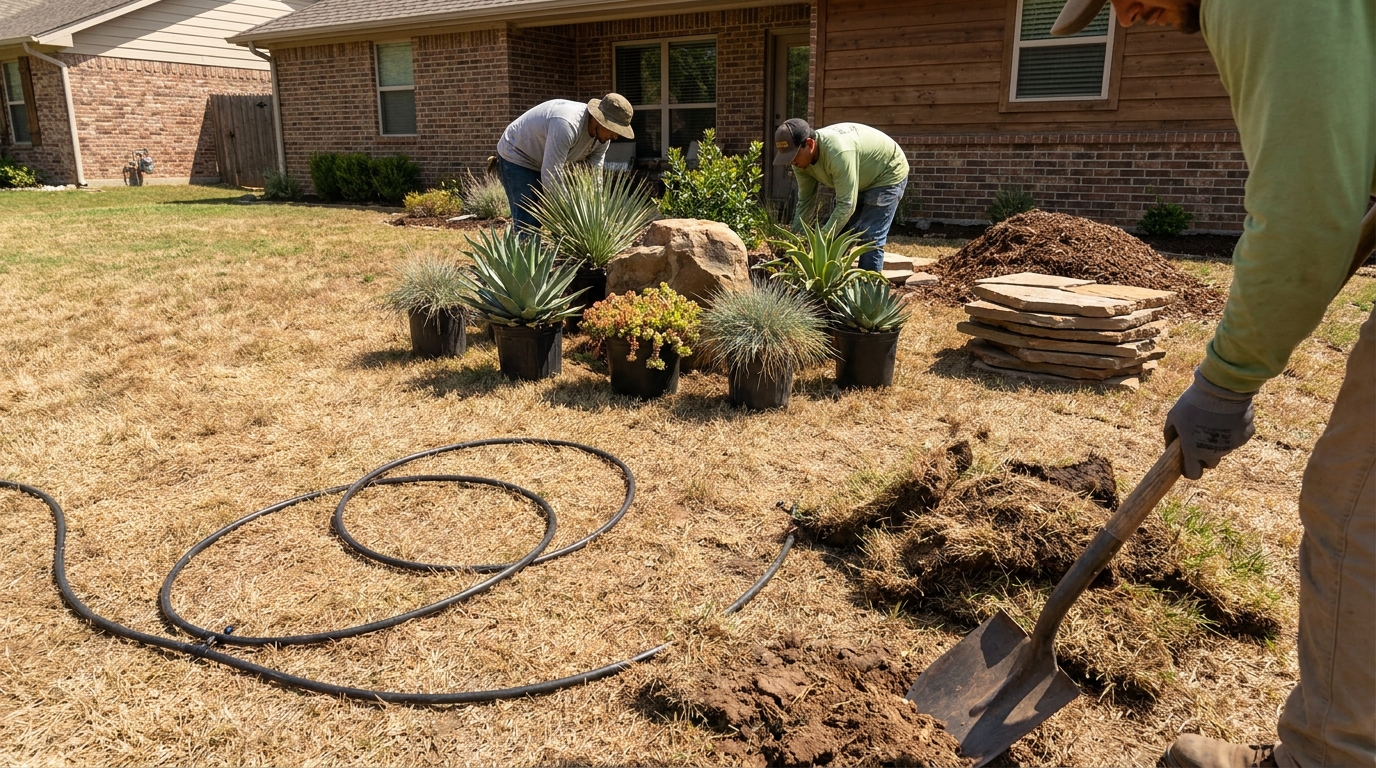
If your sprinkler timer is sitting idle this summer, you are not alone. As of early June 2026, the U.S. Drought Monitor classifies roughly 58.38% of the Lower 48 as being in drought, with the Southeast logging its driest fall-through-spring recharge season since records began in 1895. The result: lawn watering restrictions have spread from the entrenched Southwest into a 14-state-plus footprint, with mandatory bans now in force from Erie, Colorado to Southwest Florida.
For landscape contractors, the pile-up of municipal orders has done what a decade of conservation messaging could not. Phones are ringing with homeowners ready to swap turf for native plantings and drip irrigation. The going rate sits between $4,000 for a DIY-assist project and $18,000 for a full design-build conversion, and rebates from $1.50 to $7 per square foot are taking the edge off in the cities with the deepest drought pain.
The restriction map this summer
Three orders anchor the 2026 landscape. Erie, Colorado escalated to a Level 4 Emergency in March, the harshest Front Range posture on the books: all residential sprinkler systems are prohibited, period. In Florida, the Southwest Florida Water Management District imposed a Modified Phase III order limiting irrigation to one day per week from April 3 through July 1, 2026. Utah's governor's drought executive order has triggered community-level rules tracked by KSL across the Wasatch Front.
The newer story is the East. April 2026 readings showed 100% of North Carolina, 99.95% of Virginia, 98.13% of Georgia, and 93.65% of Tennessee in drought, per recent reporting on the eastward spread. That has pushed restrictions into the Carolinas, Virginia, and parts of the Mid-Atlantic that have rarely had to think about summer watering caps before.
Why this summer is different
The numbers explain the urgency. NOAA confirms that May 2025 through April 2026 was the warmest 12-month period on record for the contiguous United States, a stretch that quietly cooked through soil moisture across the Eastern Seaboard. Heavier evaporation plus a missed winter recharge in the Southeast is what tipped places like Raleigh and Richmond into restriction territory.
The U.S. Drought Monitor map for early June shows D3 and D4 (extreme to exceptional) drought entrenched across the Plains and Intermountain West, with rapid expansion into the Upper Midwest and Great Lakes. The NOAA Climate Prediction Center seasonal outlook suggests these conditions are unlikely to break before fall in most of the affected zones.
What landscapers are actually quoting
A full xeriscape conversion typically lands between $5 and $20 per square foot installed, with materials-only running about $9 to $11 per square foot, according to LawnStarter's 2026 cost data. For a standard 1,000 to 2,000 square foot front yard, that translates to roughly $15,120 to $18,400 for a turnkey project, with independent confirmation from Angi and Fixr.
Here is how the pricing tiers tend to break out in practice:
-
$4,000 to $7,000: DIY-assist projects where the homeowner handles demolition and mulch, and the contractor installs drip lines and key plantings. Best for small front yards under 800 square feet.
-
$8,000 to $12,000: Mid-range full installs with decomposed granite paths, native and adapted plants, drip irrigation conversion, and one season of establishment care.
-
$15,000 to $18,000+: Full design-build with hardscape elements, boulders, larger specimen plants, smart controllers, and a two-year establishment plan.
The biggest line item after labor is usually the irrigation conversion. Pulling a spray system and replacing it with low-flow drip is rarely a swap-in-place job. Most contractors are quoting it as a separate trench-and-rebuild line.
AI workflows for revenue teams
Placeholder house ad for Conservus.ai. Swap with final creative when brand assets are ready.
Partner with Conservus.aiWhere the rebate money is
Cash-for-grass programs are uneven, and they change as utility budgets get drained. The most generous program in 2026 remains the Southern Nevada Water Authority, where Las Vegas property owners get $5 per square foot at the base rate, climbing to $7 inside the city proper, with a step-down to $1.50 per square foot above 10,000 square feet. Other current programs worth knowing about:
-
Santa Monica, CA: $3.50 per square foot, capped at $6,000.
-
Metropolitan Water District of Southern California: $2 per square foot base, with local utility top-ups available in many member cities.
-
Albuquerque, NM: $3 per square foot through the Albuquerque Bernalillo County Water Utility Authority.
-
Tucson, AZ: $5 per square foot for commercial conversions.
-
Chandler, AZ: $1.50 per square foot, capped at $2,000 for residential properties.
One catch worth knowing: a UC Riverside study on the cost-effectiveness of these programs found that long-term water savings depend heavily on what replaces the lawn. Rock-only conversions can actually increase neighborhood heat-island effects without delivering the conservation gains utilities expect, which is why most current programs require a minimum percentage of living plant material. Confirm the plant-cover requirement before you sign anything.
Biggest red flag to watch for: rebate pre-approval. Almost every program requires you to apply and pass an inspection of the existing lawn before demolition. Ripping out grass first and applying later usually disqualifies the project.
HOAs cannot stop you the way they used to
Nine states now have laws limiting HOA bans on water-wise landscaping, and the list keeps growing. The key statutes:
-
Texas: Property Code 202.007 plus HB 517 (2025) closed the aesthetic-standard loopholes HOAs had been using to deny xeriscape plans.
-
Colorado: SB23-178 requires HOAs to allow water-wise landscaping and limits how much turf they can mandate.
-
Maryland: HB 322 bars HOAs from mandating turf grass.
-
Florida, Illinois, Maine, and Nevada also have homeowner-side protections on the books.
The pushback is real, though. HOA boards still lean on aesthetic-standards clauses and architectural-review timelines (often 30 to 60 days) to slow projects down. Texas closing those loopholes is the model other states are watching. If you live in a covenant community, ask your contractor to bundle the architectural review submission into their design phase. The good ones already have HOA-compliant plant lists ready to drop into the application.
The year-two surprise no one warns you about
Low maintenance is not no maintenance. Year one is mostly about plant establishment, which means watering deeply on a temporary schedule and pulling weeds before they can take hold in disturbed soil. Year two is where homeowners get caught off guard:
-
Monthly weed patrol is non-negotiable until plants fully fill in, usually by year three.
-
Mulch top-ups every spring and fall, typically two to three inches.
-
Drip line repairs run $100 to $500 per incident. Emitters clog, lines get nicked by digging, and rodents chew tubing.
-
Spring pruning and fall cleanup on flowering natives and ornamental grasses.
Hiring a pro for ongoing care runs $50 to $150 per month, with landscapers billing $50 to $100 per hour for one-off work. That is cheaper than the $200 to $400 per month most homeowners spend on traditional turf maintenance, but it is not free. Budgeting zero for upkeep is how nice xeriscapes turn into weed lots by year three.
AI workflows for revenue teams
Placeholder house ad for Conservus.ai. Swap with final creative when brand assets are ready.
Partner with Conservus.aiHomeowner checklist before signing a contract
-
Confirm rebate pre-approval first. Get the utility inspection on your existing lawn before any demolition begins.
-
Ask for the native-plant percentage in writing. Many programs require 50% or more living plant coverage at maturity.
-
Request a two-year establishment plan. The contract should spell out which return visits, replacements, and adjustments are included after install.
-
Check your HOA's architectural-review timeline. Submit early; some boards take 60 days even when state law is on your side.
-
Get the irrigation warranty separately. Drip-line work should carry its own one to three year coverage.
-
Verify licensing and insurance. Always pull the contractor's license number and confirm general liability coverage before anyone touches your yard.
-
Get every line item in writing. Verbal upgrades and we-will-figure-that-out-later allowances are how budgets blow up.
What comes next
The forecast question is whether the Mid-Atlantic and Carolinas restrictions stick into 2027 or fade with a wet fall. NOAA's seasonal outlook leans toward persistence in the worst-hit zones, which would mean a second straight summer of restricted irrigation budgets for homeowners who have never had to think about it. If that holds, expect regional landscape pricing to climb as demand pulls contractors into busier shoulder seasons and drip-irrigation supply tightens. Locking in a fall 2026 install slot now is probably cheaper than waiting for spring 2027 quotes.
Related reading
AI workflows for revenue teams
Placeholder house ad for Conservus.ai. Swap with final creative when brand assets are ready.
Partner with Conservus.aiSources
Note: This article contains AI-assisted content and has been reviewed by our editorial team.
ABOUT THIS SERVICE: CallTheLocal.com is a directory and lead generation service, not a contractor or service provider. Submitting this form does not obligate you to hire anyone or purchase any service. Your information will be shared with licensed, insured home service professionals in your area who may provide quotes for your project. CallTheLocal.com does not guarantee the quality, timeliness, or outcome of any work performed by service providers you connect with through this service. Always verify licensing, insurance, and references before hiring. Get everything in writing before work begins.