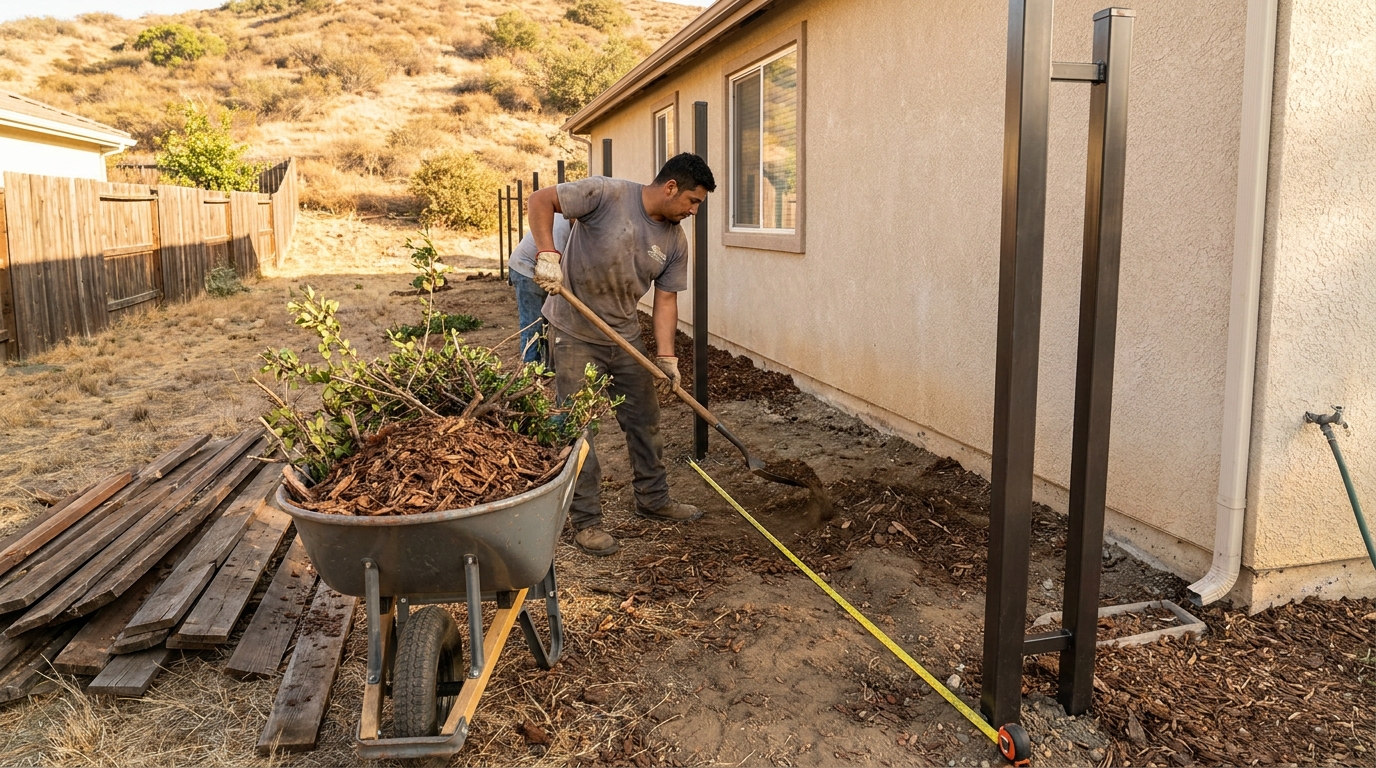
Look at the strip of ground that hugs the base of your house. The bark mulch under the front windows, the shrubs pressed against the foundation, the wood fence that ties into the side of the garage. In parts of California, that first 5 feet is now the difference between a home that meets code, keeps its insurance, and stands a better chance in a wildfire, and one that does not. The concept is called Zone 0, and if you live in a high fire area it is worth understanding before a permit reviewer or an insurance adjuster explains it to you first.
Here is the practical breakdown: what Zone 0 actually requires, which deadlines are real versus still up in the air, what has to go and what can stay, and why your insurance company may care about this before the law does.
What Zone 0 is and where it came from
Zone 0 is the name for an "ember-resistant zone," the first 5 feet measured out from the walls of a structure. The idea is that most homes in a wildfire do not burn because a wall of flame reaches them. They burn because wind-blown embers land in something flammable right next to the house, like a mulch bed or a stack of firewood, and that small fire climbs into the building.
The legal foundation goes back to Assembly Bill 3074, signed on September 29, 2020. It directed California's Board of Forestry and Fire Protection to add this ember-resistant zone to the state's defensible space rules, on top of the existing zones that reach farther out from the home. The goal is to keep the 0 to 5 foot band clear of the material that lets embers take hold.
The timeline truth: what is live and what is not
This is where a lot of coverage gets muddy, so here is the honest version.
The statewide rule is not final yet. Governor Newsom's Executive Order N-18-25, issued in February 2025, told the Board to adopt the Zone 0 regulation by December 31, 2025. The Board missed that deadline. As the Wildfire Los Angeles and Oakland Firesafe Council reported, the Board paused the work in early 2026 and planned to reconvene around March. So if you hear that a statewide Zone 0 mandate is fully in effect everywhere, that is not accurate as of this writing.
San Diego moved ahead on its own. The City of San Diego did not wait for the state. Per Times of San Diego and University City News, the rules now work like this in the city's Very High Fire Hazard Severity Zones:
-
New construction: effective in February 2026, any new structure built in a Very High Fire Hazard Severity Zone has to show Zone 0 compliance at permit review.
-
Existing homes: a compliance deadline of roughly February 2027.
This is not a small slice of the city. According to Times of San Diego, more than 220,000 San Diego homeowners are affected, which is roughly two-thirds of the city sitting inside these high hazard zones. NBC 7 San Diego covered the same rollout.
If you are outside San Diego, the takeaway is not "ignore this." It is that your local deadline depends on your jurisdiction, and the statewide framework is still being finalized. Under the draft state phasing, existing homes in State Responsibility Area high hazard zones would follow on a later timeline, around 2028. Verify your own city or county rules rather than assuming a single statewide date applies.
What has to go, and what gets to stay
Inside that 5 foot band, CAL FIRE describes the banned material as "woody vegetation, wood products, and petroleum-based products." In plain terms, according to Times of San Diego, the things that typically have to leave include:
-
Bark mulch, wood mulch, and wood chips
-
Firewood stacked against or near the house
-
Dead leaves, pine needles, and other dead plant debris
-
Combustible shrubs growing against the foundation
Now the reassuring part, because Zone 0 is not a demand that you gravel over your whole yard. Based on the same reporting, several things can generally stay:
-
Wooden decks and porches are usually treated as extensions of the structure rather than as landscaping to be cleared.
-
Healthy mature trees do not have to be cut down, as long as the flammable vegetation around them is cleared.
-
Hardscape such as gravel, stone, pavers, and bare soil is exactly the kind of non-combustible ground cover the rule is steering you toward.
So the common fix is a swap, not a teardown: pull the wood mulch and replace it with gravel or stone, move the woodpile away from the wall, and trade the shrubs hugging the foundation for spacing and non-combustible ground cover.
Fences specifically: the part people miss
Fences get their own set of rules, and this catches homeowners off guard because the fence is often the one thing physically touching the house.
Here is what the guidance lays out, per the Oakland Firesafe Council and San Diego reporting:
-
No new combustible fences or gates may be built inside the Zone 0 area.
-
Where an existing wood fence attaches to the home, you generally need a 5 foot non-combustible section at that connection point. The reasoning is straightforward: a wood fence is a fuse, and this puts a break between the fuse and your siding.
-
Repairs to existing fences are allowed, so this is not an order to rip out every wood fence on the property.
Timing matters too. Under the draft state phasing, removing mulch, firewood, and vegetation falls in Phase 1, targeted for within about 3 years. Fence and gate changes fall in Phase 2, with up to about 5 years and the exact timeline set by the local jurisdiction. So the woodpile and mulch are usually the first, cheaper, most urgent items, and the fence work often has a longer runway. Confirm the specific phasing where you live.
Compliant swaps, and an honest note on cost
If you do need to replace a fence section, contractors point to a few non-combustible options, as described by Fantastic Fence:
-
Wrought iron or ornamental steel for an open, decorative look
-
Galvanized chain link, generally the most budget-friendly route
-
Class A fire-rated steel privacy panels (product lines such as Colorbond or DuraBond) when you still want a solid, private barrier
On the landscaping side, the parallel move is swapping wood mulch for gravel, decomposed granite, stone, or other non-combustible ground cover.
A straight-shooting caveat on price: we are not going to hand you specific dollar figures here, because we did not find reliable primary-source cost data for these fence replacements or hardscape conversions. Costs vary widely by fence length, material, terrain, and local labor. The right move is to get two or three written estimates from licensed contractors for your exact yard rather than trusting a number pulled from thin air. If a bid feels off, that is a reason to get another quote, not to accept the first one.
The insurance red flag hiding behind all of this
Here is the part that often matters sooner than the legal deadline. Your insurance company does not have to wait for 2027, or for the state, to care about defensible space.
Insurers can require defensible space compliance at your next renewal, on their own schedule, independent of the local or state timeline. In fire-prone areas, non-compliant homes have been receiving non-renewal notices, and defensible space has been used as grounds for that non-renewal. In other words, the practical deadline for many homeowners is whenever their policy comes up for renewal, which could be well before any government date.
There is an upside lever too. The California Department of Insurance runs a "Safer from Wildfires" program that offers premium discounts for documented mitigation work, with figures commonly cited in the range of 4 percent to 40 percent depending on what you have done and your insurer. The keyword is documented. Keep photos, receipts, and dates for the mulch removal, the cleared vegetation, and any fence upgrade, so you can prove the work at renewal.
One honest correction to a claim you may see floating around: the idea that Zone 0 rules apply "even in low-risk areas." Legally, Zone 0 applies in Very High and High Fire Hazard Severity Zones. What crosses into lower-risk framing is the insurance side, where carriers set their own requirements, and even there the non-renewals are concentrated in fire-prone regions. So treat the legal rule and the insurer's renewal terms as two separate clocks.
Where this is heading beyond California
California is out front on the ember-resistant zone idea, and the concept is being watched across other Western wildfire states. That said, we are not going to name a specific state as "adopting Zone 0" without a source for it. If you live outside California and hear that your state is copying this rule, ask for the actual ordinance or regulation before you spend money based on it.
Your homeowner action checklist
-
Find out if you are in a high hazard zone. Confirm whether your property sits in a Very High or High Fire Hazard Severity Zone, since that determines whether the rule applies to you at all.
-
Do the free stuff first. Pull wood mulch away from the walls, move the woodpile, and clear dead leaves and needles from the 5 foot band. This is usually Phase 1 and costs little more than a weekend.
-
Look at where your fence meets the house. If a wood fence attaches to the structure, plan for a non-combustible section at that connection, and get written quotes rather than guessing at cost.
-
Call your insurer before they call you. Ask what defensible space documentation they want at renewal and whether you qualify for a Safer from Wildfires discount.
-
Document everything. Before-and-after photos, receipts, and dates protect both your compliance record and your discount claim.
-
Verify local rules at the source. Check your city or county defensible space page and CAL FIRE for the exact requirements and deadlines that apply where you live. In San Diego, start with the City of San Diego defensible space page.
Related reading
-
[Your Home Sale Could Freeze on September 30: The Federal Flood Insurance Program Hits Its Deadline Again, and 40,000 Closings a Month Hang on It](/guides/nfip-flood-insurance-september-30-2026-deadline-home-closings)
-
[New 2026 Tariffs Just Reached Your Floors and Cabinets: Why That Vinyl Plank and Imported Tile Quote Jumped 10 to 25%](/guides/2026-tariffs-flooring-cabinet-quotes-vinyl-tile-price-increase)
Sources
-
Most San Diego homeowners will have to comply with new wildfire law in 2027 — Times of San Diego
-
State-Mandated 'Zone Zero' Requirements Set to Go into Effect — University City News
-
City of San Diego will implement state-mandated Zone Zero fire clearance — NBC 7 San Diego
-
Board of Forestry Pauses Zone 0 Decision — Wildfire Los Angeles
-
Zone 0: When the Deadline Passed and What That Means Now — Oakland Firesafe Council
-
Your Fence May Be Illegal and Your Insurance Might Drop You — Fantastic Fence
-
Guide to Defensible Space: Property Owners — City of San Diego
Note: This article contains AI-assisted content and has been reviewed by our editorial team.
ABOUT THIS SERVICE: CallTheLocal.com is a directory and lead generation service, not a contractor or service provider. Submitting this form does not obligate you to hire anyone or purchase any service. Your information will be shared with licensed, insured home service professionals in your area who may provide quotes for your project. CallTheLocal.com does not guarantee the quality, timeliness, or outcome of any work performed by service providers you connect with through this service. Always verify licensing, insurance, and references before hiring. Get everything in writing before work begins.