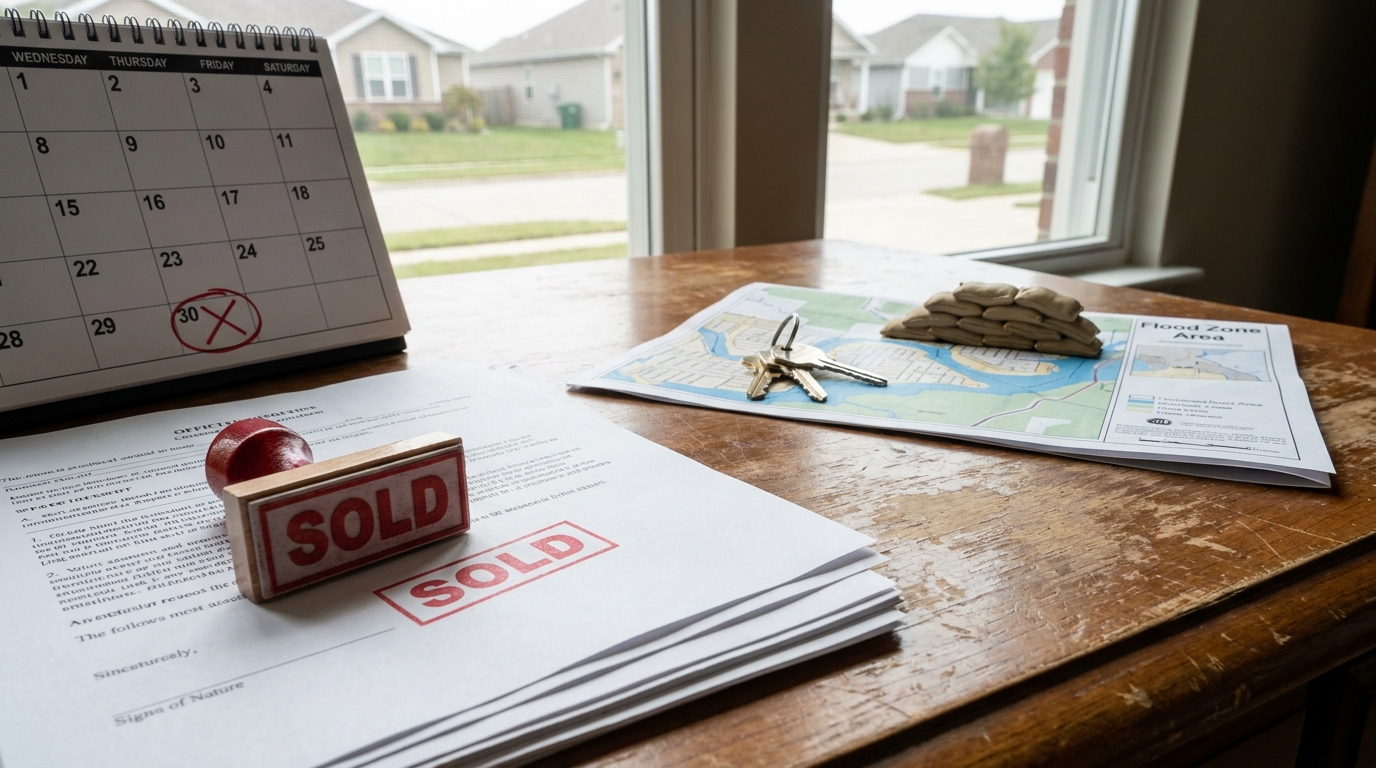
If you are buying, selling, or refinancing a home in a flood zone this fall, put one date on your calendar in bold: September 30, 2026. At 11:59 p.m. Eastern that night, the federal government's authority to write and renew flood insurance policies is set to expire. If Congress does not act before then, the National Flood Insurance Program stops selling and renewing coverage, and that quietly stalls home closings across the country.
The National Association of Realtors estimates that roughly 1,300 to 1,360 property sales a day depend on the program, which works out to about 40,000 closings a month. That is the number hanging on whether lawmakers extend the deadline one more time.
Here is the good news for readers who already carry flood coverage: a lapse is not the disaster it sounds like for your existing policy. This guide walks through what actually happens, what does not, and how to time a transaction so a Washington deadline does not derail your closing.
The deadline, explained
The current expiration date comes from the Consolidated Appropriations Act, 2026 (H.R.7148), which President Trump signed on February 3, 2026. That law extended the flood program's authority to issue new and renewal contracts through September 30, 2026. NAR's homeowner FAQ phrases it as the program expiring "at midnight on September 30, 2026."
If it feels like you have heard this before, you have. This is a recurring cliff, not a one-time event. The program has been extended dozens of times since 2017 and has lapsed repeatedly. It went dark on October 1, 2025 during the 43-day federal government shutdown, was reauthorized into late January 2026, then briefly lapsed again around January 30, 2026 before H.R.7148 restored it. Trade reporting counted the February bill as the 35th short-term extension and the 5th lapse since 2017. That is why the deadline keeps arriving "again."
One wrinkle worth knowing: the February law extended the program's authorization to write policies through September 30, but the package left out full-year Homeland Security appropriations, which fund the program's operations, flood mapping, and mitigation work. Those were initially funded only through February 13, 2026. In plain terms, the authority to sell policies and the money to run the program travel on two separate legislative tracks, and both matter.
What a lapse actually does, and what it does not
This is where a lot of homeowners talk themselves into a panic they do not need. Let us separate the myth from the mechanics.
What a lapse does: FEMA stops selling and renewing flood policies nationwide. No new contracts, no renewals.
What a lapse does not do:
-
It does not cancel your existing policy. Coverage remains in effect until its expiration date, including the standard 30-day grace period.
-
It does not stop claims. FEMA continues paying valid claims as long as it has available funds.
The Congressional Research Service, the nonpartisan explainer arm of Congress, lays out the same mechanics: when authorization lapses, the authority to write new contracts expires, existing policies continue, and FEMA can still pay valid claims with the money it has on hand. So if you already have flood coverage and you are not in the middle of a transaction, a lapse is largely a headline, not an emergency.
Why closings freeze even when your current policy is fine
If existing policies keep working, why do home sales stall? Because of the buyers who need a new policy to close.
Here is the chain. Federally regulated or federally backed mortgages on property in a Special Flood Hazard Area require flood insurance in order to close. For many of those properties, the federal program is the only coverage option available. So when FEMA cannot bind a new policy, a buyer cannot satisfy the lender's requirement, and the closing gets delayed or falls apart. Pending sales and refinances are the ones caught in the freeze.
There is an important nuance to get right here, because it is often reported incorrectly. During a lapse, most federal lending regulators suspend the mandatory flood insurance purchase requirement. That leaves it up to each individual lender to decide whether to originate a loan in a flood zone without coverage in place. In practice, many lenders will not take that risk, so closings still stall. But the requirement is not automatically absolute during a lapse. The decision shifts to your lender, which is exactly why you want to be talking to them early.
By the numbers
The scale is what makes this more than a niche issue. NAR's economists estimate that a lapse could stall roughly 1,300 to 1,360 property sales per day. Their more precise figure is about 1,360 daily closings, or roughly 41,300 per month, that depend on the flood program.
The pain is not spread evenly. NAR's state breakdown estimates a lapse threatens about:
-
13,460 monthly closings in Florida
-
3,140 monthly closings in Texas
-
1,840 monthly closings in California
Zoom out and the program itself is enormous. It provides about $1.3 trillion in coverage to roughly 4.7 million policyholders across about 23,000 communities. NAR ties the program to nearly half a million home sales a year, around 1 million jobs, and about $70 billion in economic activity. When the program hiccups, a lot of local economies feel it.
How to time a purchase, sale, or refinance around September 30
You cannot control what Congress does. You can control your timeline. If you are mid-transaction as fall approaches, here is a practical playbook.
-
Bind or renew early. If you can lock in a new or renewal policy before the deadline, do it. A policy that is already in force is not affected by a lapse in the program's authority to write new contracts.
-
Know your exact dates. Pull your policy and confirm its effective date and expiration date. Remember the 30-day grace period on renewals so you understand your real window.
-
Ask your lender the direct question. "If the program lapses on September 30, will you still close my loan in a flood zone without a new federal policy in place?" Because regulators suspend the mandate during a lapse, the answer is up to the lender, and you want it in writing.
-
Ask your insurance agent about timing. Confirm how far ahead of your closing a policy can be bound and what the effective date would be, so coverage is active when you need it.
-
Build in buffer. If your closing is scheduled right around the deadline, talk to your agent and lender about moving it earlier rather than betting on a last-minute extension.
Premiums and Risk Rating 2.0: why you do not want to let coverage lapse
There is a second, quieter reason to keep your own policy continuously in force, and it comes down to price.
Under FEMA's current pricing approach, called Risk Rating 2.0, there is a statutory cap on how fast your premium can climb. For most primary residences, annual increases are capped at 18 percent. For most non-primary residences and commercial properties, the cap is 25 percent. Those increases continue each year only until a property reaches its individual full-risk rate, and then they stop. Independent analysis from the U.S. Government Accountability Office confirms the statutory rate-increase caps and the move toward full-risk pricing.
The catch is that this capped path, often called a glidepath, depends on keeping your policy going. Maintaining an active policy keeps you on the capped glidepath. Letting coverage lapse can forfeit that protection and expose you to the property's full-risk rate. So even setting aside the deadline drama, allowing your own flood policy to drop is a decision that can cost you.
The water-damage angle: who this really affects
If you are reading Call The Local for water-damage guidance, here is the part that matters most. Standard homeowners insurance does not cover flood loss. Flood damage is excluded from a typical policy, which is why a separate flood policy exists in the first place. The homeowners most exposed to a lapse are the ones who need that separate coverage: people buying or refinancing in a flood zone who have to secure a new policy to close.
If you already carry flood coverage and you are staying put, a lapse mostly means you should not let your policy expire during the gap. If you are mid-transaction, this is the moment to get ahead of the calendar rather than behind it.
What to watch as September approaches
Given the track record, the most likely outcome is that Congress attaches yet another extension to broader appropriations rather than letting the program stay dark for long. But "likely" is not "certain," and the program has genuinely lapsed multiple times in the recent past, including during the fall 2025 shutdown. Keep an eye on whether an extension gets folded into the next spending package as the deadline nears, and remember that the program's authorization and its funding move on separate tracks, so watch both.
The bottom line for homeowners: your existing coverage is more durable than the headlines suggest, but a pending closing in a flood zone is genuinely exposed. Plan your timing around September 30, talk to your lender and agent early, and keep your own policy continuously in force.
Related reading
-
[New 2026 Tariffs Just Reached Your Floors and Cabinets: Why That Vinyl Plank and Imported Tile Quote Jumped 10 to 25%](/guides/2026-tariffs-flooring-cabinet-quotes-vinyl-tile-price-increase)
Sources
-
FAQ: National Flood Insurance Program Expires September 30, 2026 — National Association of Realtors
-
Congressional Reauthorization for the National Flood Insurance Program — FEMA.gov
-
H.R.7148 — Consolidated Appropriations Act, 2026 — Congress.gov
-
How Many Home Sales Will Be Affected by an NFIP Lapse? — NAR Economists' Outlook
-
NFIP by the Numbers: The Economic Ripple Effect of a Lapse — NAR Magazine
-
Congress Ends Partial Shutdown, Extends NFIP Through 2026 — National Mortgage Professional
-
NAR Myth Buster: FEMA Risk Rating 2.0 — National Association of Realtors
Note: This article contains AI-assisted content and has been reviewed by our editorial team.
ABOUT THIS SERVICE: CallTheLocal.com is a directory and lead generation service, not a contractor or service provider. Submitting this form does not obligate you to hire anyone or purchase any service. Your information will be shared with licensed, insured home service professionals in your area who may provide quotes for your project. CallTheLocal.com does not guarantee the quality, timeliness, or outcome of any work performed by service providers you connect with through this service. Always verify licensing, insurance, and references before hiring. Get everything in writing before work begins.
Related reading
- A Drone Photographed Your Roof and an Insurer Dropped You Over It: The 2026 Roof-Age Crackdown and the New Laws Fighting Back
- Your Old AC Still Runs, but a 2026 R-410A Recharge Now Runs $100 to $400: The Refrigerant Squeeze Nobody Warned You About
- The 30% Solar Tax Credit Is Gone for 2026 Buyers: Why a Cash or Loan Install Now Costs Thousands More
- A 'Super El Niño' Just Cut the 2026 Hurricane Forecast to One Major Storm, and It's Quietly Moving Your Home Risk From Wind to Water