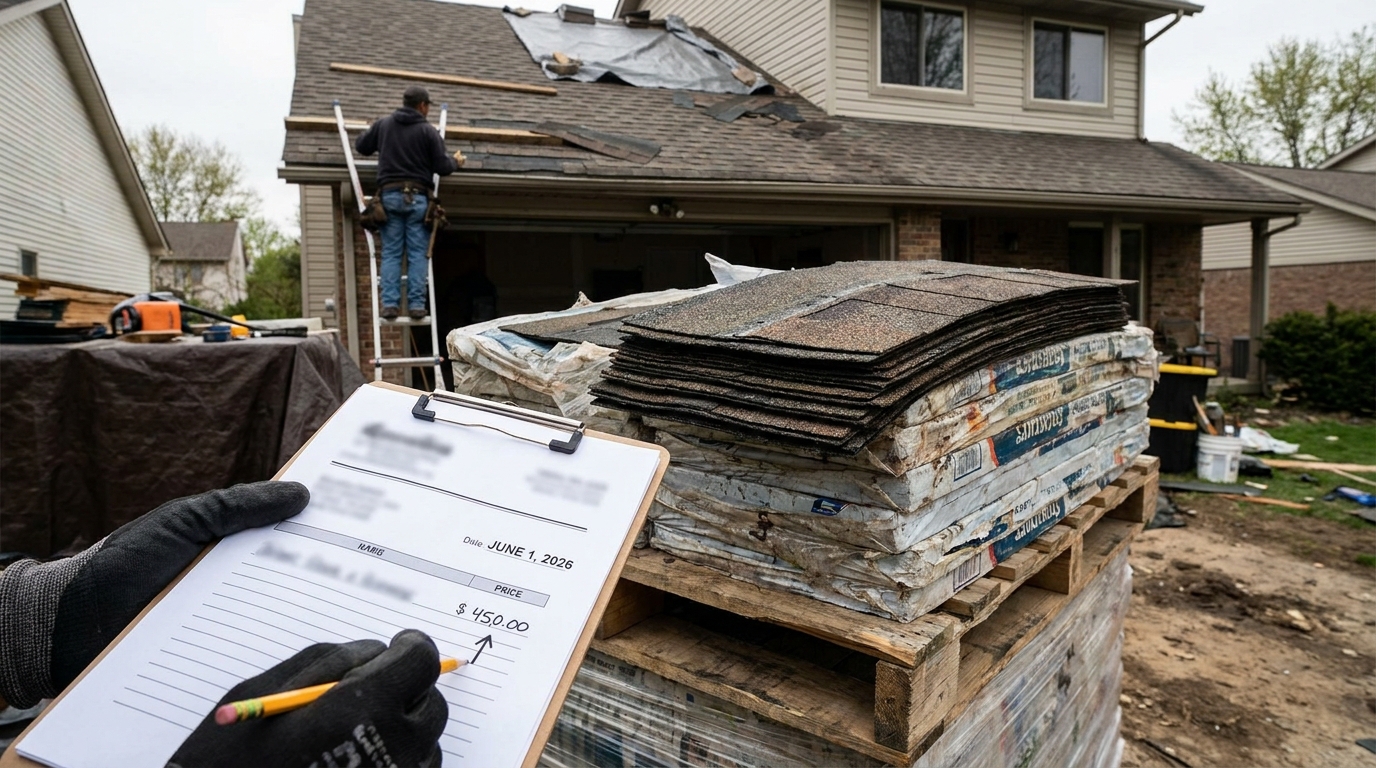
If you sat on a roofing quote for a few weeks this spring and went back to sign it, you may have found the number had crept up. You are not imagining it, and your contractor is not playing games. On June 1, 2026, the three largest asphalt-shingle manufacturers in the country all put a fresh price increase into effect on residential roofing products. This is the second round of increases in 2026, and it stacks on top of the first.
Here is the plain-English version of what happened, why your quote moved, and the handful of things a homeowner can actually do about it before signing anything.
What exactly changed on June 1
GAF, Owens Corning, and CertainTeed, the big three names you will see on most shingle bundles, all raised prices on residential shingles and accessories effective June 1, 2026. The increases have been widely reported in the 6 to 9 percent range, with CertainTeed cited at up to roughly 10 percent. Distributor announcement logs, such as the price-increase tracker kept by Mid-Atlantic Roofing Supply, confirm those June 1 effective dates across the major brands.
The key thing to understand is that this is not a one-off. It is the second 2026 round. Back in April, the same manufacturers pushed through a 4 to 8 percent increase. According to RoofVista, GAF added 5 to 8 percent effective April 15, Owens Corning added 4 to 8 percent effective April 1, CertainTeed added 4 to 8 percent effective April 15, and Atlas added 4 to 8 percent effective April 1.
These increases are cumulative. The June bump did not replace the April one. It got added on top of it.
The cumulative math: how it adds up
This is where the sticker shock comes from. When you stack the April increase, the June increase, and the increases that already landed in 2025, most homeowners are now paying noticeably more than they would have a couple of years ago. RoofVista reports that most people are paying roughly 15 to 25 percent more for a roof replacement in 2026 than they would have in 2024, with the national average project landing somewhere around $20,500 to $21,500 after the April increases.
On the material side, RoofVista puts asphalt-shingle cost at around $4.50 to $8.00 per square foot before the recent tariff-related pressure, rising to roughly $5.10 to $9.20 per square foot. (A quick note on numbers you might see floating around: some per-bundle figures get passed around online, but the cost guides we trust express increases per square foot or per roofing square, because per-bundle pricing swings a lot by region and product.)
What does that mean for a real roof? On a typical 25 to 30 square home (a square is 100 square feet of roof area), the stacked 2026 increases can legitimately add hundreds to a few thousand dollars compared to a quote you got last fall or in January. That is the single biggest reason an older quote no longer holds.
Why prices are rising
Trade and contractor sources point to two main forces.
1. Steel and aluminum tariffs. Section 232 tariffs on imported steel and aluminum were doubled from 25 percent to 50 percent, effective June 4, 2025, according to the law firm White & Case. (Products from the UK stayed at 25 percent.) If you have read older articles that still cite 25 percent, that figure is out of date. The current headline rate is 50 percent.
A roof is not just shingles. It includes a lot of metal: flashing around chimneys and valleys, drip edge along the eaves, roof vents, and the steel fasteners that hold everything down. Those components are exactly what the tariffs touch. Metal roofing prices in particular have reportedly climbed around 60 percent since the tariff doubling. You can see the current scope of what the steel and aluminum tariffs cover in the U.S. Customs and Border Protection FAQ. Some trade sources also point to chemical-input tariffs that affect roofing, including anti-dumping duties on MDI adhesive (60 percent on China) and TCPP flame retardant (272.7 percent).
2. Petroleum-based asphalt costs. Asphalt shingles are made with petroleum-based asphalt, so the price of those inputs feeds directly into what manufacturers charge.
The honest caveat: read the reason carefully
Here is something worth knowing before you accept any explanation at face value. According to RoofSmart, the manufacturer price-increase letters that went out in early 2026 (in the 5 to 8 percent range) often gave no specific reason at all. They leaned on general language like inflation, supply-chain pressure, and import costs rather than naming tariffs outright.
So the clean story that prices are rising purely because of tariffs is partly contractor and trade-press interpretation, not always the manufacturer's stated cause. The tariff and petroleum pressures are real, but the exact split between tariff-driven and general inflation is not something the manufacturers themselves always spell out.
Why does this matter to you? Because it gives you a reason to be skeptical of a vague "tariff surcharge" line item on a bid. If a contractor tacks on a surcharge, it is fair to ask what it actually covers and how it maps to the real cost increase.
What homeowners should do right now
-
Lock your pricing in writing before material delivery. With increases landing twice in one year, a verbal price is worth very little. Get the agreed material price documented before the order is placed.
-
Confirm the bid already includes the latest increase. Ask directly: does this quote reflect the June 1 manufacturer pricing, or was it built on older numbers? A bid built on stale pricing can come back to bite you at delivery.
-
Audit any surcharge line items. If you see a "tariff surcharge," ask the contractor to explain what it covers and whether it reflects actual cost increases on the metal and material in your job. A reasonable pro will walk you through it.
-
Understand why an old quote no longer holds. If you are comparing a quote from last fall to one from this month, the gap is not necessarily one contractor gouging you. Stacked increases over the past year can account for a real difference on a full roof.
-
Get a few quotes close together in time. Quotes pulled within the same few weeks are far more comparable than quotes spread across months of price changes.
What to expect for the rest of 2026
One sobering pattern: tariff-driven price increases have historically tended to stick rather than reverse. The 2018 to 2019 round is the usual reference point, where increases became the new baseline rather than a temporary spike. With two rounds already in the books for 2026, the practical takeaway is that waiting for prices to fall back to 2024 levels is probably not a strategy. If your roof genuinely needs work, the planning question is less about timing a dip and more about getting firm, written pricing and a contractor you trust.
Related reading
Sources
-
Price Increase Announcements & Letters, Mid-Atlantic Roofing Supply
-
How Much Have Manufacturers Increased Roof Material Prices in 2026?, RoofSmart
-
Trump administration increases steel and aluminum Section 232 tariffs to 50%, White & Case LLP
-
Section 232 Tariffs on Steel and Aluminum FAQ, U.S. Customs and Border Protection
Note: This article contains AI-assisted content and has been reviewed by our editorial team.
ABOUT THIS SERVICE: CallTheLocal.com is a directory and lead generation service, not a contractor or service provider. Submitting this form does not obligate you to hire anyone or purchase any service. Your information will be shared with licensed, insured home service professionals in your area who may provide quotes for your project. CallTheLocal.com does not guarantee the quality, timeliness, or outcome of any work performed by service providers you connect with through this service. Always verify licensing, insurance, and references before hiring. Get everything in writing before work begins.