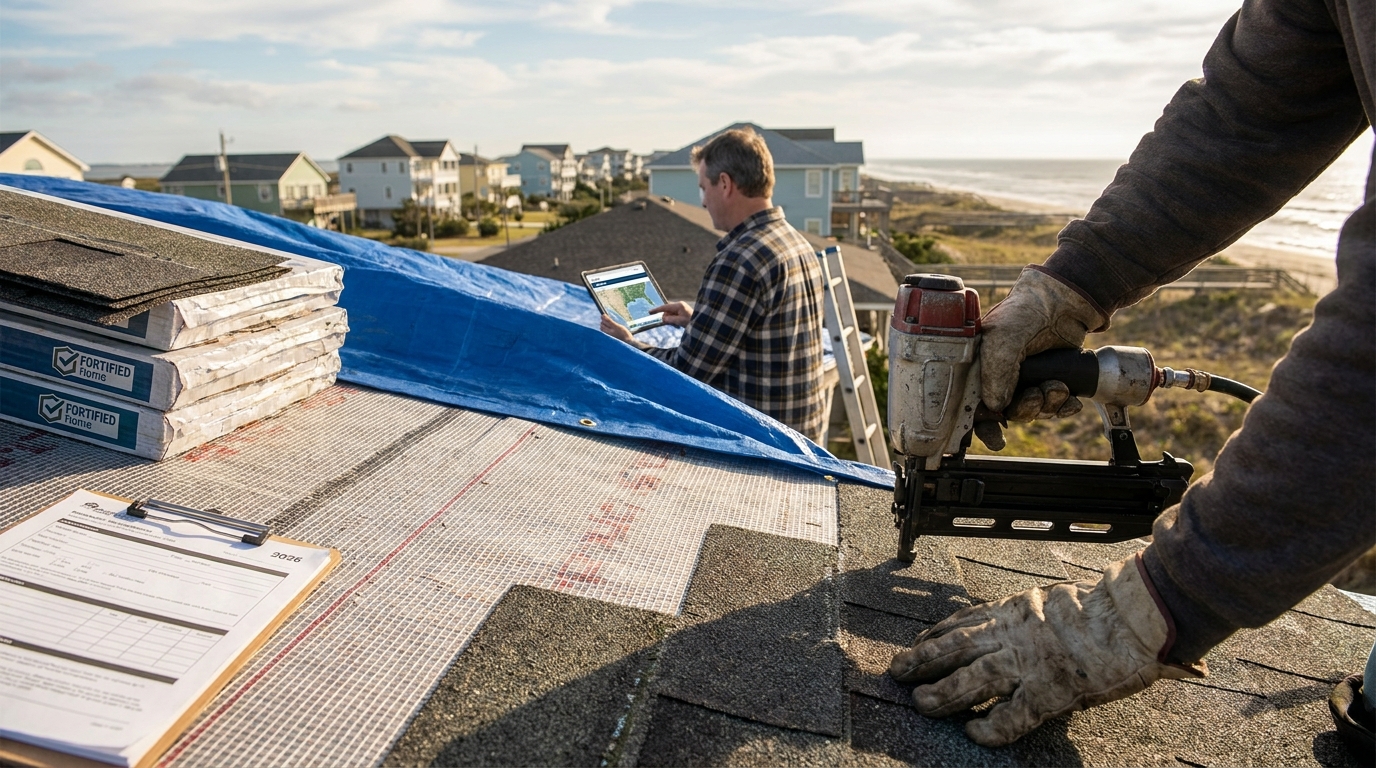
If you own a home along the Gulf or Atlantic coast, there may be up to $10,000 waiting to help you put on a stronger roof this year. In Texas the number can reach $17,000. Seven states now run grant programs that pay homeowners to re-roof to a stronger standard called FORTIFIED, and 2026 is one of the busiest years yet for these programs.
Here is the catch, and it is the whole reason timing matters: most of this money does not sit around waiting. Several programs are first-come-first-served and the online portal closes the instant the money runs out. Others use a random lottery with a short registration window. Miss the timing and it does not matter how much your roof needs the work. This guide walks through what a FORTIFIED roof actually is, which state pays what, the two big asterisks people get wrong (Texas and Mississippi), the real insurance savings, and exactly how to be ready when your state's window opens.
What a FORTIFIED roof actually is
FORTIFIED is a construction standard developed by the Insurance Institute for Business & Home Safety (IBHS). For the roof level that these grants pay for, it comes down to three upgrades:
-
Reinforced roof-deck attachment. The plywood or OSB decking is nailed down with a tighter, stronger pattern so wind cannot peel it off.
-
A sealed roof deck. A secondary water barrier goes on top of the decking so that if shingles blow off, water still cannot pour into your attic and ceilings.
-
Locked-down edges and roof covering. The edges and the shingles or metal are fastened to resist high winds.
The Oklahoma Insurance Department cites this package as able to reduce severe-storm damage by up to roughly 80 percent. One more step is non-negotiable across every program: a FORTIFIED-certified evaluator has to inspect the completed work and issue the official FORTIFIED designation through IBHS before any grant money is released. That evaluator is separate from your roofer, and in most programs you pay for the evaluation yourself. Build that into your budget from day one.
The seven programs at a glance
Every program targets the same FORTIFIED roof upgrade, but they differ sharply on how much they pay, how they hand out the money, who is eligible, and where you have to live. Here is the 2026 picture.
| State / Program | Dollar cap | How awarded | Geography | 2026 status / dates | Where to apply |
|---|---|---|---|---|---|
| Oklahoma — Strengthen Oklahoma Homes (OKReady) | Up to $10,000 | First-come | Statewide | Opened Jan 12, 2026 at 12:00 p.m. CT | oid.ok.gov/okready |
| Louisiana — Fortify Homes | Up to $10,000 | Random lottery (3,000 grants) | Eligible parishes | Registration June 1–19, 2026; selection notices from June 22 | FortifyHomes.La.Gov |
| Alabama — Strengthen Alabama Homes (SAH) | Up to $10,000 | First-come (rolling by county) | Participating counties | County dates through 2026 (e.g. Mobile July 7, Baldwin July 9) | StrengthenAlabamaHomes.com |
| South Carolina — SC Safe Home | $7,500 non-matching / $6,000 matching (FORTIFIED roof) | First-come | Coastal-focused | Reopened Feb 2026; not accepting new applicants as of June 2, 2026 — prep for next window | online.scsafehome.sc.gov |
| North Carolina — Strengthen Your Roof / Strengthen Your Coastal Roof (NCIUA) | Up to $10,000 (Outer Banks) / up to $6,000 (coastal) | First-come | NCIUA policyholders in named territories | Approved installs must earn FORTIFIED designation by July 31, 2026 | strengthenyourroof.com |
| Mississippi — Strengthen Mississippi Homes (SB 2409) | Up to $10,000 | Phased rollout (see below) | Coastal wind-pool first (Hancock, Harrison, Jackson) | Effective July 1, 2026 | mid.ms.gov |
| Texas — FHLB Dallas FORTIFIED Fund | Up to $17,000 | First-come (via member bank) | Income-capped, not a state program | 2026 windows Jan 26 and July 1 until funds run out | fhlb.com (through a member bank) |
A few program-specific details worth knowing before you count on the money:
-
Oklahoma requires a homestead exemption on file, an owner-occupied single-family primary home in good repair, and active homeowners plus wind insurance (flood too, if you are in a flood zone). Funds are paid directly to your contractor after the IBHS FORTIFIED certificate is submitted.
-
Louisiana is a true random draw. Registering early gives you no advantage, and entries do not roll over, so if you did not win a prior round you have to re-register. Several newly eligible parishes were added for 2026, including Acadia, Jefferson Davis, and Lafayette.
-
Alabama has no income limits and is insurance-industry funded, but it is owner-occupied single-family only. No rentals, condos, townhomes, or mobile homes. Counties open on scheduled quarterly dates and the portal closes the moment that county's grants are gone.
-
North Carolina ties eligibility to holding an NCIUA policy, allows one grant per policyholder, and added another $20 million to the pot (announced July 2025).
The two asterisks people get wrong
Two of these programs get described inaccurately in a lot of coverage, and the difference could waste your time.
Texas is not a state "Strengthen Homes" program. The up-to-$17,000 Texas grant is the FORTIFIED Fund run by the Federal Home Loan Bank of Dallas, a federal member-bank program, not a Texas agency. You do not apply to the state directly. You work through an FHLB Dallas member bank or credit union, along with a certified FORTIFIED evaluator and roofer. It is income-capped at 120 percent of your area median income, and FHLB Dallas allocated $10 million for 2026 across two first-come windows (January 26 and July 1) that stay open only until the money is gone.
Mississippi's brand-new program does not launch as an open statewide lottery. Strengthen Mississippi Homes was created by SB 2409 in the 2026 regular session and takes effect July 1, 2026, with up to $10,000 per home and roughly $16 million a year in insurance-industry funding. Some trade coverage calls it a statewide lottery, but the Mississippi Insurance Department's official rollout begins with Mississippi Wind Underwriting Association (wind pool) policyholders in three coastal counties (Hancock, Harrison, and Jackson), phasing out to six coastal counties. Wind-pool applicants need three consecutive years of coverage, and homeowners obtain the FORTIFIED evaluation at their own expense. Treat the coastal wind-pool phased rollout as the real starting point.
What the insurance savings actually look like
A big reason these programs exist is that a FORTIFIED roof files far fewer claims (cited figures include around a 73 percent reduction), and insurers pass some of that back as premium discounts. Just be clear on how the discount works: it applies to the wind (and often hail) portion of your premium, not your entire bill.
Typical discounts run in the neighborhood of 10 to 35 percent on that wind portion depending on your state and carrier. Alabama is at the high end, where carriers discount the wind portion 25 to 35 percent for a FORTIFIED Roof and up to 55 percent for higher FORTIFIED tiers, and the state adds a tax deduction of up to $3,000. In Oklahoma, officials cite premium cuts of roughly 20 to 30 percent, and pilot participants averaged about $750 a year in savings. Stretch that over the life of the roof and the savings can quietly add up to real money on top of the grant itself.
The honest caveat: exact discounts vary by carrier and state, so call your own insurer and ask what a FORTIFIED Roof designation does to your specific wind premium before you assume a number.
What the grant does not cover
These grants are targeted, not blank checks. Across programs, the money generally covers only the roof-deck and sealed-roof upgrade to the FORTIFIED standard, up to the cap. That usually means it does not pay for gutters, rotted decking that has to be replaced, cosmetic extras, or a full re-roof beyond the grant amount. If your total project costs more than the cap, you pay the difference. And remember the separate FORTIFIED evaluator fee, which in most programs comes out of your pocket, plus the documentation requirements: a homestead exemption or primary-residence proof and active wind or homeowners insurance are almost always required.
How to actually claim one
The homeowners who land these grants are the ones who did the boring prep before the window opened. A practical checklist:
-
Confirm eligibility first. Check that you have a homestead exemption or primary-residence proof and the required wind or homeowners insurance. For Texas, check your income against 120 percent of your area median income. For NCIUA and Mississippi's wind pool, confirm you hold the right policy.
-
Line up your team early. You need a FORTIFIED-certified evaluator and a FORTIFIED-trained roofer. Good ones book up fast once a window opens, so make the calls in advance.
-
Get your documents ready before the portal opens. Insurance declarations, proof of ownership and occupancy, and homestead paperwork. Have them scanned and in one folder.
-
Know the scope. Budget for costs above the cap and for the evaluator fee so a partial grant does not surprise you.
First-come versus lottery: two different strategies
The award method changes your game plan entirely.
First-come states (Oklahoma, Alabama, South Carolina, North Carolina, and the Texas FHLB fund) reward speed. The portal can close within a very short time of opening, so be logged in and ready to submit the minute it goes live. Alabama adds a wrinkle: it opens county by county on rolling dates, so watch your specific county's date, not the statewide calendar. North Carolina applicants who are approved should also mind the July 31, 2026 deadline to complete the roof and receive the FORTIFIED designation.
Lottery states (Louisiana, and Mississippi's rounds) reward persistence, not speed. Register any time inside the window, since early entry gives you no edge, but do re-register each round if you were not selected, because entries do not carry over.
Bottom line
The 2026 FORTIFIED grant wave is real money, up to $10,000 in most states and up to $17,000 through the Texas federal fund, for a roof that can dramatically cut storm damage and shave your wind premium for years. The people who miss out are not the ones who did not qualify. They are the ones who were not ready when the short window opened, or who assumed Texas or Mississippi worked differently than they do. Get your eligibility and documents squared away now, line up a FORTIFIED evaluator and roofer, and apply through the official program site for your state rather than a third-party roofer promising to handle it for you.
Related reading
Sources
-
OKReady | Strengthen Oklahoma Homes — Oklahoma Insurance Department
-
Louisiana Fortify Homes Program opens new lottery — WGNO / Louisiana Dept. of Insurance
-
Louisiana homeowners can apply for grants to upgrade, protect roofs against storms — WAFB
-
Incentives for Residents of Alabama — FORTIFIED (a program of IBHS)
-
SC Safe Home Mitigation Grant Program — South Carolina Department of Insurance
-
SC Safe Home Grant Program reopens with expanded funding — WRDW
-
Strengthen Mississippi Homes — Mississippi Insurance Department
-
Lawmakers look to 'Strengthen Mississippi Homes' with new mitigation program — Magnolia Tribune
-
FHLB Dallas FORTIFIED Fund — Federal Home Loan Bank of Dallas
-
FORTIFIED Fund Grant Program 2026 User Guide (PDF) — FHLB Dallas
-
Available Roofing and Home Hardening Grants by State — Smart Home America
Note: This article contains AI-assisted content and has been reviewed by our editorial team.
ABOUT THIS SERVICE: CallTheLocal.com is a directory and lead generation service, not a contractor or service provider. Submitting this form does not obligate you to hire anyone or purchase any service. Your information will be shared with licensed, insured home service professionals in your area who may provide quotes for your project. CallTheLocal.com does not guarantee the quality, timeliness, or outcome of any work performed by service providers you connect with through this service. Always verify licensing, insurance, and references before hiring. Get everything in writing before work begins.