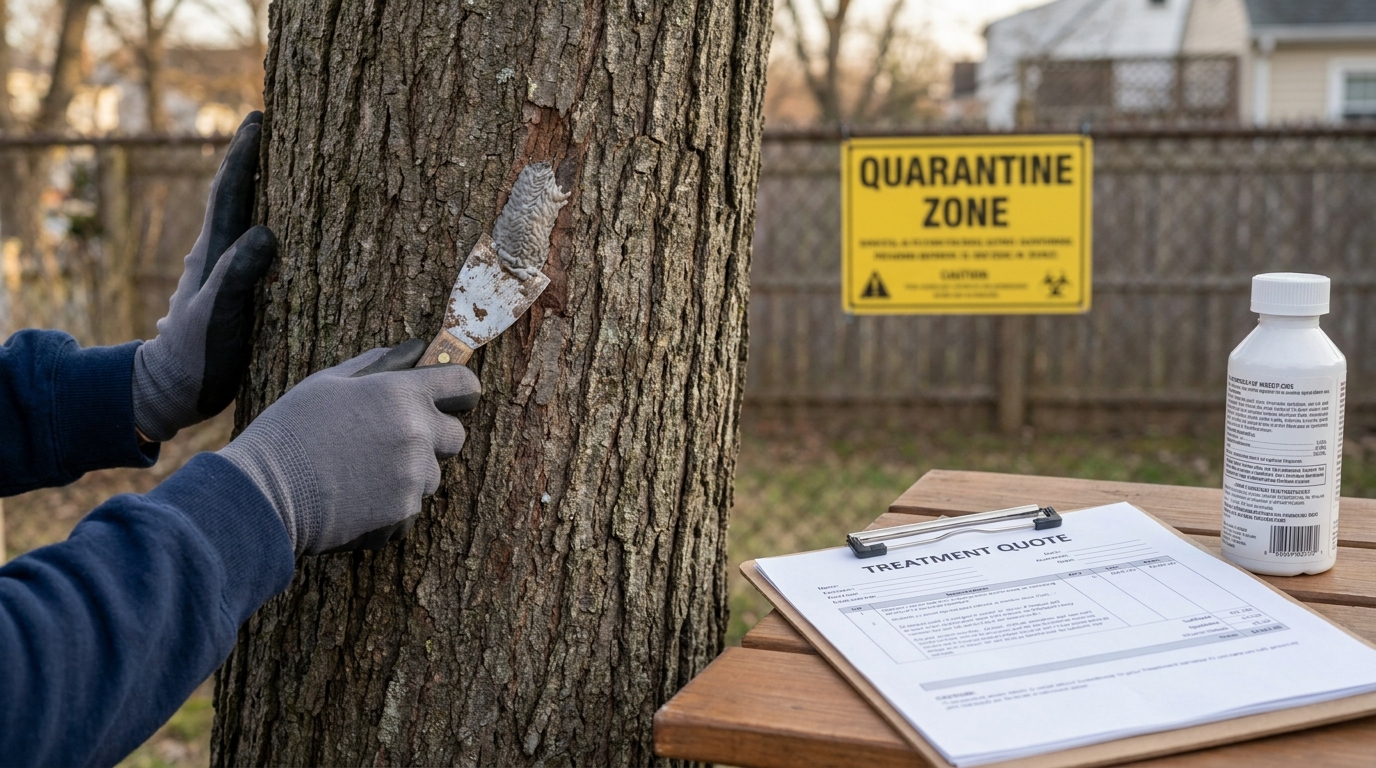
If you live east of the Mississippi, the spotted lanternfly is no longer somebody else's problem. As of spring 2026, established populations are recognized in 19 states plus the District of Columbia, and two big quarantine expansions this year mean millions more homeowners are now living inside regulated zones. Ohio rolled out its first full statewide quarantine on February 17, 2026, jumping from 18 counties to all 88. A few weeks later, Maryland's March 6, 2026 expansion added Dorchester, St. Mary's, Somerset, and Worcester counties, making Maryland's quarantine effectively statewide.
Here is the part that surprises most people: the cost of dealing with this bug almost always lands on the homeowner. Standard insurance does not cover it. This guide walks through what the 2026 quarantines actually restrict, what licensed treatments cost, and where you can save real money without falling for an upsell.
The 19 states under spotted lanternfly quarantine in 2026
Per the USDA APHIS spotted lanternfly program and the National Invasive Species Information Center, the following states have established populations and active quarantine zones:
-
Connecticut
-
Delaware
-
Georgia
-
Illinois
-
Indiana
-
Kentucky
-
Maryland (effectively statewide as of March 2026)
-
Massachusetts
-
Michigan
-
New Jersey
-
New York
-
North Carolina
-
Ohio (statewide as of Feb 17, 2026)
-
Pennsylvania
-
Rhode Island
-
South Carolina
-
Tennessee
-
Virginia
-
West Virginia
Plus Washington, DC.
What a quarantine actually restricts
A quarantine is not a pesticide mandate. It is a movement rule. If you live inside one, you are responsible for not transporting items that could carry egg masses out of the regulated zone. Regulated articles typically include:
-
Nursery stock and landscaping plants
-
Green lumber and firewood
-
Landscaping waste and yard debris
-
Outdoor household items: grills, lawn furniture, RVs, kids' play sets
-
Construction materials stored outdoors
-
Any vehicle or trailer that has been parked under host trees
Ohio's new rule, for example, means nursery stock and trees cannot leave the state without a compliance agreement, permit, or inspection certificate, per the Ohio Department of Agriculture's announcement. Ohio cited protection of its roughly $6 billion wine industry as a key driver, since grapevines are among the most economically damaged hosts.
Most state agriculture departments publish a free homeowner self-inspection checklist. New Jersey's portal at nj.gov/agriculture and Delaware's at agriculture.delaware.gov are good models. The firewood rule of thumb is the simplest one to remember: do not move it.
Why homeowners insurance will not pay a dime
This is the question that catches everyone off guard. Standard homeowners policies do not cover pest infestation, pest removal, or pest-related tree decline. Insurers classify infestations as a maintenance issue, the same way they classify mold from a slow leak or rot from neglected siding.
An independent analysis from Policygenius confirms there is no carrier offering meaningful coverage for spotted lanternfly treatment, removal, or even the sticky honeydew cleanup that ruins decks and patio furniture. Industry guidance from Horan Insurance spells out the reasoning: anything classified as an ongoing maintenance condition gets carved out.
The one narrow exception is a tree falling on an insured structure. If a lanternfly-weakened maple drops a limb on your roof, the resulting roof damage is typically a covered loss. The tree itself, the treatment, and the removal are still your bill.
AI workflows for revenue teams
Placeholder house ad for Conservus.ai. Swap with final creative when brand assets are ready.
Partner with Conservus.aiThe tree-of-heaven decision: remove it or weaponize it?
Tree-of-heaven (Ailanthus altissima) is the spotted lanternfly's preferred host. According to Michigan State University Extension, nymphs and adults survive at higher rates and females lay more eggs when feeding on it. If you have ToH on your property, you have a lanternfly magnet.
Identification cues:
-
Long compound leaves with 11 to 41 leaflets
-
Small glandular teeth at the base of each leaflet (other lookalikes do not have these)
-
A distinct rancid peanut butter smell when leaves or twigs are crushed
-
Smooth gray bark on young trees, becoming rougher with age
You have two reasonable paths once you confirm it:
-
Full removal. Cutting alone does not work because ToH suckers aggressively from the roots. The standard approach is herbicide treatment first (cut-stump or basal bark with a triclopyr product), then mechanical removal once the root system dies.
-
Trap-tree method. Per Penn State Extension, you can remove the female ToH (those producing seeds) and keep one or two males to systemically treat with imidacloprid or dinotefuran. The lanternflies feed on the treated trees and die.
Many county extension offices will identify ToH for free. Take advantage of that before paying anyone for an inspection.
2026 treatment menu and what it really costs
Pricing here pulls from Angi's 2026 cost data and the active-ingredient guidance in Penn State Extension's pesticide safety guide.
DIY contact sprays: $30 to $80 in materials
Hardware-store products with bifenthrin or carbaryl can knock down nymphs and adults on contact. Coverage is short, you have to reapply, and you have to be careful around pollinators and water. This is a legitimate option for one or two infested trees if you are comfortable handling pesticides.
Pro spray treatments: $150 to $300
A licensed applicator brings stronger formulations and proper PPE. Expect a few hours of work and 3 to 6 weeks of residual control. You will likely need 2 to 4 visits across a season for heavy pressure.
Pro systemic injection or soil drench: $250 to $1,000
This is the workhorse for serious infestations. A certified arborist injects imidacloprid or dinotefuran into the trunk or applies it as a soil drench. The tree itself becomes toxic to the lanternfly. One application typically lasts a full season. Cost scales with tree size and number of trees treated.
Annual preventative contracts: $400 to $1,200 or more for multi-tree properties
Homeowners with multiple host trees (maples, walnuts, willows, birches, plus any retained ToH trap trees) often end up on a quarterly or monthly preventative program. Angi's 2026 benchmark is $40 to $70 per month or $100 to $300 per quarter. A larger property with several mature trees and quarterly visits commonly lands in the $400 to $1,200+ band, which is the figure most people remember when they tell neighbors what they spent.
Spring 2026 timing windows
Spotted lanternfly management is calendar-driven. Miss the window and you wait a year.
-
Egg-mass scraping. The window runs roughly September through May. In the Mid-Atlantic, eggs typically begin hatching in late March, which means scraping should be wrapped up before then. The Penn State Extension method is to scrape egg masses into a container of rubbing alcohol or hand sanitizer. Virginia's forestry agency offers a similar DIY scouting and scraping guide, and the New York State Department of Agriculture urges homeowners to do the same.
-
Nymph emergence. Late March through April. Watch for tiny black-and-white spotted nymphs on host plants.
-
Banding and sticky traps. May through June, when small nymphs are climbing tree trunks. Use circle traps with built-in collection bags rather than open sticky bands, which can catch birds and bats. Cornell IPM recommends this for the Northeast.
-
Systemic injections. Mid-spring before adult flight is the sweet spot. The chemical needs time to translocate through the tree before peak feeding.
AI workflows for revenue teams
Placeholder house ad for Conservus.ai. Swap with final creative when brand assets are ready.
Partner with Conservus.aiWhat utilities and your municipality will not do
This catches a lot of homeowners by surprise. Most utilities and public-works departments only manage tree-of-heaven and other host trees inside their right-of-way (along roads, under power lines, on utility easements). Anything on private property is the homeowner's responsibility.
What your local government may offer:
-
Free tree-of-heaven identification through your county extension office
-
Free property inspections in newly quarantined counties
-
Reporting hotlines and online forms for sightings
-
Public education events with hands-on egg-mass demonstrations
What they almost never offer: free treatment or removal of trees on your land.
Cost-saving tactics that actually work
-
Get a free ToH ID first. Do not pay for an inspection just to find out whether you have the host tree. County extension offices will tell you for free.
-
Group-buy with neighbors. Arborists often discount when they can treat multiple adjoining properties in one visit. A block of three or four homes can save 15 to 25 percent per property.
-
Choose systemic over repeat sprays. A single $250 to $400 trunk injection that lasts a season usually beats four spray visits at $150 to $300 each. Run the math before signing a contract.
-
Watch for upsells on non-host species. Lanternflies feed on dozens of plants but only seriously damage a short list (tree-of-heaven, grapevines, maples, walnuts, willows, birches). If a contractor wants to treat your dogwoods and ornamental cherries every quarter, get a second opinion.
-
Do the egg-mass scraping yourself. It is genuinely free. A putty knife, a jar of rubbing alcohol, and a Saturday afternoon can knock out hundreds of future hatches.
Red flags when hiring a treatment company
-
No state pesticide applicator license number on the proposal
-
No certificate of insurance offered before work starts
-
Active ingredients not listed in writing
-
Pressure to sign a multi-year preventative contract during the first visit
-
Refusal to itemize per-tree pricing
-
Claims that treatments are guaranteed to eliminate lanternflies (no honest applicator promises that)
AI workflows for revenue teams
Placeholder house ad for Conservus.ai. Swap with final creative when brand assets are ready.
Partner with Conservus.aiBottom line for 2026
Spotted lanternfly is now a homeowner expense in 19 states plus DC, with Ohio and Maryland the big newcomers this year. Budget $250 to $1,000 if you have a couple of host trees and want a single round of systemic treatment, or $400 to $1,200+ for a multi-tree property on an annual preventative program. Insurance is not coming to help. Your best free tools are egg-mass scraping right now, your county extension office for ToH identification, and a small bit of homework before you sign anything.
Related reading
Sources
-
Ohio launches statewide quarantine to slow invasive, damaging spotted lanternfly (StateNews)
-
Ohio Department of Agriculture issues statewide quarantine (Ohio Country Journal)
-
Maryland Department of Agriculture News Release, March 6, 2026
-
Michigan State University Extension: Tree of Heaven and Spotted Lanternfly
-
Policygenius: Does Homeowners Insurance Cover Spotted Lanternflies
-
Horan Insurance: Insect Infestation and Pest Damage Coverage
Note: This article contains AI-assisted content and has been reviewed by our editorial team.
ABOUT THIS SERVICE: CallTheLocal.com is a directory and lead generation service, not a contractor or service provider. Submitting this form does not obligate you to hire anyone or purchase any service. Your information will be shared with licensed, insured home service professionals in your area who may provide quotes for your project. CallTheLocal.com does not guarantee the quality, timeliness, or outcome of any work performed by service providers you connect with through this service. Always verify licensing, insurance, and references before hiring. Get everything in writing before work begins.