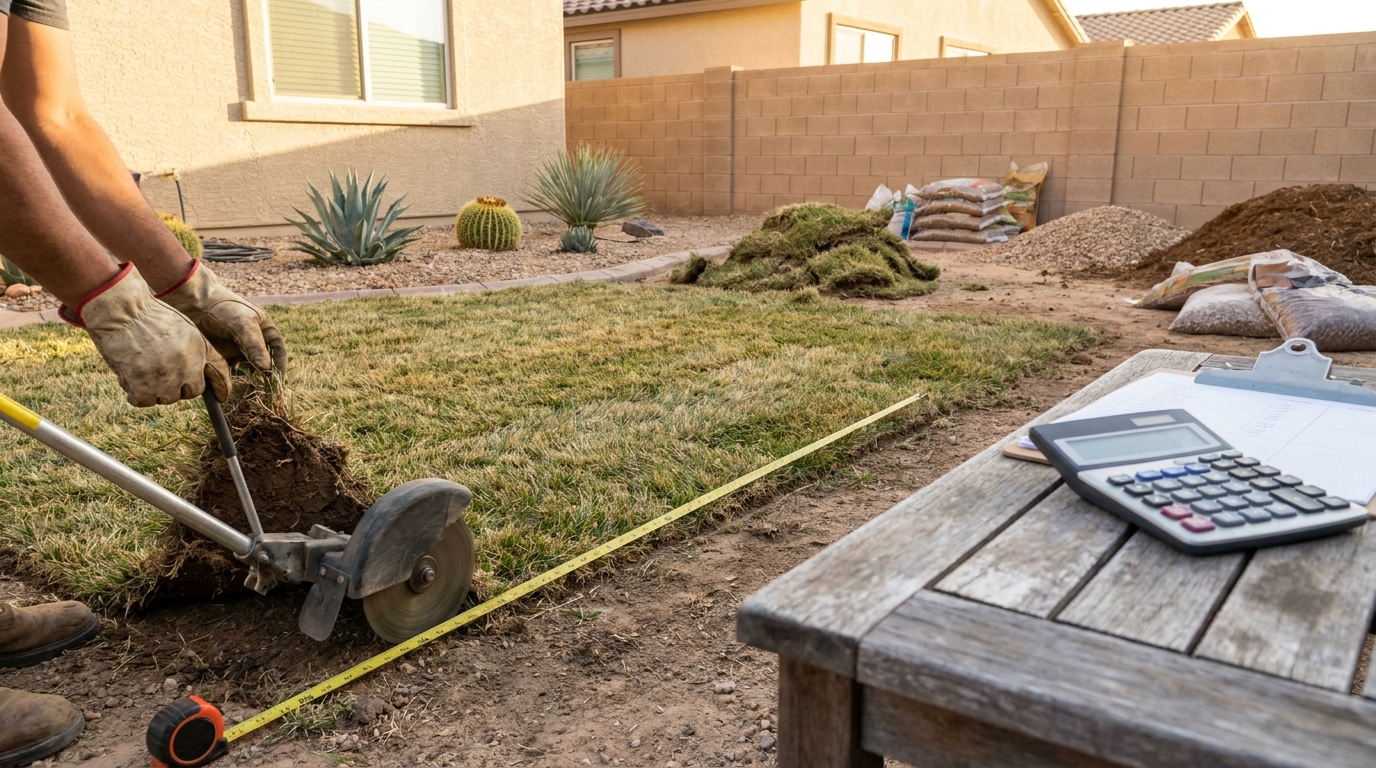
If you have been hearing that cities pay "three or four dollars a square foot" to tear out your grass, that number is stale in one direction and too generous in another. Here is where it actually stands right now.
Southern Nevada raised its Water Smart Landscapes rebate to $5.00 per square foot for the first 10,000 square feet converted, effective for new single-family applicants as of September 18, 2025. If you are a Las Vegas Valley Water District residential customer, the district adds another $2.00 per square foot on top, for $7.00 per square foot up to 10,000 square feet. That extra money comes out of the excessive-use charges paid by the valley's heaviest water users.
Meanwhile, most of Southern California pays $2.00 per square foot. Not $4. The $4 figure that floats around San Diego coverage is a county top-up available only to customers in unincorporated areas, and there are signs it has been paused. More on that below.
The headline math, worked out
The Coachella Valley Water District's own FAQ puts a typical conversion at "moderate estimates … $3 to $6 per square foot of landscape." Contractor pricing surveys from Angi run wider, roughly $5 to $20 per square foot, with full design-build work in California quoted at the top of that range. Use the district number as your conservative anchor and the contractor range as your reality check if you want a designer involved.
Run a 1,000 square foot front lawn through that:
Where you areRebate rateRebate on 1,000 sq ftTypical install ($3 to $6/sq ft)Your net
Las Vegas Valley Water District$7.00/sq ft$7,000$3,000 to $6,000You come out ahead $1,000 to $4,000 Other SNWA member agencies$5.00/sq ft$5,000$3,000 to $6,000Break even to ahead $2,000 Metropolitan Water District area (incl. City of San Diego)$2.00/sq ft$2,000$3,000 to $6,000Out of pocket $1,000 to $4,000 Santa Clara County (Valley Water)$2.00/sq ft, $3,000 cap$2,000$3,000 to $6,000Out of pocket $1,000 to $4,000
That contrast is the whole story. In Southern Nevada, converting a lawn can be genuinely cash-positive. Everywhere else on this list, the rebate is a meaningful discount on a project you are still paying for.
The two deadlines, stated correctly
Nevada: January 1, 2027
Nevada's AB 356, passed in 2021, says that on and after January 1, 2027, Colorado River water delivered by the Southern Nevada Water Authority or its member agencies may not be used to irrigate nonfunctional turf on any parcel not used exclusively as a single-family residence. SNWA's board was required to develop a phased removal plan before December 31, 2026, which is where the "December 31" date you may have seen comes from. The authority explains the rule and the exemptions on its laws and ordinances page.
Two things homeowners get wrong here:
-
Single-family homes are exempt from the mandate. Your front and back yard grass is not illegal. You are, however, still eligible for the biggest rebate in the region, which is a much better deal than the people who are being forced to convert are getting.
-
HOAs, commercial property and multifamily are the ones on the clock. SNWA defines nonfunctional turf as streetscapes along roads, driveways and medians, frontage and courtyard areas at non-residential buildings, and HOA-managed landscape with no recreational use. Functional turf, which is protected, includes athletic fields, playgrounds, active recreation areas of 1,500 contiguous square feet or more, golf course play areas, designated cemetery areas, and pet relief zones up to 200 square feet. Owners can request a waiver by showing their turf meets the functional definition.
Nevada also banned new grass installation in new commercial and residential developments back in December 2021, which SNWA credits with avoiding roughly 27,000 acre-feet of demand.
California: 2027, then 2028, then 2029
California's AB 1572 does not do what a lot of summaries claim. Under the statute (Water Code section 10608.14, full text at California Legislative Information), the ban on using potable water to irrigate nonfunctional turf phases in by property type:
-
January 1, 2027: Department of General Services property, local governments, local and regional public agencies, and public water systems.
-
January 1, 2028: other institutional, commercial and industrial property.
-
January 1, 2029: HOA and common-interest-development common areas.
-
January 1, 2031 (or when state funding is available, whichever is later): disadvantaged-community property.
So why are HOA boards talking about 2027? Because public water systems have to revise their ordinances and policies and notify customers by January 1, 2027. The notice arrives two years before the HOA obligation does.
The law carves out cemeteries entirely, and it lets you keep using potable water as needed to keep trees and other perennial non-turf plantings alive, or to address an immediate health and safety need. The State Water Board can also postpone a deadline up to three years for good cause, including economic hardship.
Rate by rate, region by region
The advertised headline rate is almost always a base rate plus a local top-up. The top-up is the part that disappears.
-
Southern Nevada (SNWA): $5.00/sq ft for the first 10,000 square feet, $2.50/sq ft after that, per property per fiscal year running July 1 to June 30. Businesses, HOAs and multifamily get $5.00 for the first 10,000 and $1.50 after. LVVWD residential customers add $2.00/sq ft ($4.50 after 10,000). If you applied before September 18, 2025, you have to reapply to get the enhanced rate.
-
Metropolitan Water District / SoCal Water$mart: $2.00/sq ft base, up to 5,000 square feet per household per year, plus $100 per tree for up to five trees.
-
City of San Diego: residential rebates run through SoCal Water$mart at the $2.00 base rate plus the tree bonus. The city's commercial program pays $2.00/sq ft capped at 50,000 square feet per meter year. The city also puts lawn demand at roughly 44 gallons per square foot per year on its conservation rebates page.
-
Unincorporated San Diego County: the Waterscape Rebate Program has advertised up to $4/sq ft for turf or high-water-use shrub replacement, plus $1/sq ft more for California natives, with lifetime caps of $5,000 residential and $10,000 commercial. Call before you count on it. There is a 2026 notice indicating the county top-up was suspended for projects issued a Notice to Proceed in July and August 2026, and the county's pages are not reliably readable online. Get the current rate from a person on the phone.
-
Santa Clara County (Valley Water): $2/sq ft for landscape conversion, $1/sq ft for lawn-to-mulch. Caps are $3,000 for single-family and small multifamily ($6,000 under cost-sharing) and $100,000 for commercial and multifamily of five or more units.
These rates move. Southern Nevada's $5 rate was originally funded by a $24 million American Rescue Plan Act grant that covered applications through December 31, 2024, as the Las Vegas Sun reported. It lapsed after that, then came back in September 2025. Treat today's rate as today's rate.
AI workflows for revenue teams
Placeholder house ad for Conservus.ai. Swap with final creative when brand assets are ready.
Partner with Conservus.aiThe rule that disqualifies the most people
Do not touch the lawn first. SNWA's residential terms are blunt about it: "Do not remove the existing lawn until the Authority completes a pre-conversion inspection and authorizes you to proceed." Valley Water requires a pre-inspection plus a written Notice to Proceed. SoCal Water$mart requires you to reserve funds before work begins, and then gives you 180 days to finish and request payment.
No program on this list pays retroactively. If a contractor tells you to rip it out now and file after, you are being told to forfeit your rebate.
Design rules that catch people
Southern Nevada's residential terms require:
-
A minimum of 400 square feet converted (smaller allowed at SNWA's discretion if the property simply has less).
-
At least 50 percent living plant cover at maturity, from the approved plant list.
-
The whole area permeable to air and water, covered with mulch: rock, bark, ungrouted pavers, permeable artificial turf or living groundcover. Plastic sheeting and concrete are prohibited.
-
Drip irrigation with a filter, a pressure regulator, and emitters rated at 20 gallons per hour or less.
-
Written planning-department approval for commercial and HOA projects over a quarter acre (10,890 square feet).
SoCal Water$mart has its own list: minimum three plants per 100 square feet transformed, no hardscape in the transformed area except permeable hardscape, replacement or modification of overhead spray sprinklers, and at least one stormwater retention feature.
The fine print nobody reads
Three conditions do more damage than the rest combined.
The clock. In Southern Nevada you have 12 months from the pre-conversion inspection to finish the work and request the final inspection, with extensions up to 90 days. In MWD territory it is 180 days from the funding reservation.
The easement. The SNWA rebate is conditioned on granting a conservation easement that restricts the converted area in perpetuity. No reinstalling grass there. No putting a pool there in five years. That is a permanent decision on that part of your property, and it should factor into which section of yard you convert.
The caps. Per-property annual limits, lifetime limits, one conversion per fiscal year mechanics. Groundwater-well users in Southern Nevada are limited to 2,500 square feet per fiscal year and depend on special-fund availability.
AI workflows for revenue teams
Placeholder house ad for Conservus.ai. Swap with final creative when brand assets are ready.
Partner with Conservus.aiWhat the rebate does not cover
Design fees. Permits. Plan review. Hardscape beyond the permitted permeable share. Pool removal, in most programs. Anything you started before approval.
And tree protection. This is the one that surprises people. Mature trees in and around a lawn have often been living off the lawn's irrigation for years. Pull the turf and the sprinklers and you can lose a 30-year-old shade tree, which costs thousands to remove and decades to replace. SNWA publishes a tree protection checklist specifically for turf removal projects. Read it before the crew shows up, and make sure the new drip system puts water where those roots actually are.
The honest maintenance picture
Decomposed granite is not a zero-work yard. SNWA's own watering guidance asks you to test, adjust and repair drip emitters weekly in summer and monthly in winter, flush clogged emitters by hand, and change drip lines and filters at least twice a year when you change the watering schedule. Desert plantings still get watered four days a week in summer, two in spring and fall, one or less in winter.
Then there is weeding. Rock and decomposed granite need pre-emergent and hand-pulling, because seeds blow in and germinate happily in gravel. Organic mulch needs replacing every year or two. Budget a few hundred dollars a year and a handful of Saturdays. It is less work than mowing, but it is not nothing, and the homeowners who are unhappy two years later are usually the ones who were told it would be maintenance free.
What it does to your water bill
SNWA puts the savings at 55 gallons per square foot per year when you convert turf to drip-irrigated desert landscape, a figure that traces back to the Xeriscape Conversion Study and represents roughly a 75 percent cut against turf demand. On a 1,000 square foot conversion that is about 55,000 gallons a year.
Against LVVWD's tiered rates of $1.61, $2.87, $4.27 and $6.33 per 1,000 gallons across tiers one through four, shaving 55,000 gallons off your upper tiers is worth roughly $235 to $350 a year. It can be worth considerably more if it keeps your household under the seasonal excessive-use threshold that triggers a $9 per 1,000 gallon surcharge. Since 1999, the program has removed 250 million square feet of grass and saved 203 billion gallons.
AI workflows for revenue teams
Placeholder house ad for Conservus.ai. Swap with final creative when brand assets are ready.
Partner with Conservus.aiThese programs run out of money
SoCal Water$mart states plainly that rebate amounts "are subject to change at any time and are based on availability at the time of application approval." Southern Nevada's $5 rate already lapsed once when the grant behind it ran out. Valley Water issued 149 landscape rebates worth about $490,000 in a single quarter of 2026, which tells you how small these budgets are relative to the number of lawns in a county.
The practical advice: apply before you plan, not after. The reservation is what protects your rate.
Your checklist
-
Find out who your water agency actually is and whether it offers a top-up over the regional base rate. This is the single biggest variable in your check.
-
Confirm the rate on the phone, this week. Rates change mid-year. Ask specifically about caps, the fiscal year reset, and whether a top-up is currently funded.
-
Book the pre-inspection before you get quotes. Some agencies will walk the yard with you and tell you what qualifies.
-
Get the plant list approved before you buy a single plant, and check the plant density requirement (50 percent living cover at maturity in Nevada, three plants per 100 square feet in MWD territory).
-
Get bids in writing that specify drip components, mulch depth, plant count and sizes, and who is responsible for meeting rebate specs. "Meets rebate program requirements" belongs in the contract.
-
Ask about tree protection explicitly, and plan irrigation for existing trees.
-
Photograph everything before, during and after, and keep every receipt.
-
Re-confirm the rate the day you apply. Not the day you decided to do it.
One more note for HOA boards and mixed-use owners in Nevada: AB 356's original language referred to property "not zoned exclusively for a single-family residence," and AB 220 in 2023 changed it to "not used exclusively as a single-family residence." That wording shift matters for properties with a home office, a duplex arrangement or unusual zoning. Have your association's counsel check the enrolled text against your specific parcel rather than relying on a summary.
Related reading
-
[California's 'Zone 0' Is Here: Why the First 5 Feet Around Your House Now Has to Be Bare](/article/california-zone-0-first-5-feet-fences-mulch-insurance)
-
[Your Home Sale Could Freeze on September 30: The Federal Flood Insurance Program Hits Its Deadline Again, and 40,000 Closings a Month Hang on It](/article/nfip-flood-insurance-september-30-2026-deadline-home-closings)
AI workflows for revenue teams
Placeholder house ad for Conservus.ai. Swap with final creative when brand assets are ready.
Partner with Conservus.aiSources
-
Water Smart Landscapes Rebate, Southern Nevada Water Authority
-
AB 1572 (2023) full text, California Legislative Information
-
Residential rebates and programs, San Diego County Water Authority
-
How much does a typical conversion cost? Coachella Valley Water District
-
How much does xeriscaping cost? Angi (contractor pricing survey data)
-
Navigating Nevada's turf restrictions, FirstService Residential (industry source)
Note: This article contains AI-assisted content and has been reviewed by our editorial team. Rebate rates, caps and program terms change frequently and without notice. Confirm current figures directly with your water agency before making a decision.
ABOUT THIS SERVICE: CallTheLocal.com is a directory and lead generation service, not a contractor or service provider. Submitting this form does not obligate you to hire anyone or purchase any service. Your information will be shared with licensed, insured home service professionals in your area who may provide quotes for your project. CallTheLocal.com does not guarantee the quality, timeliness, or outcome of any work performed by service providers you connect with through this service. Always verify licensing, insurance, and references before hiring. Get everything in writing before work begins.