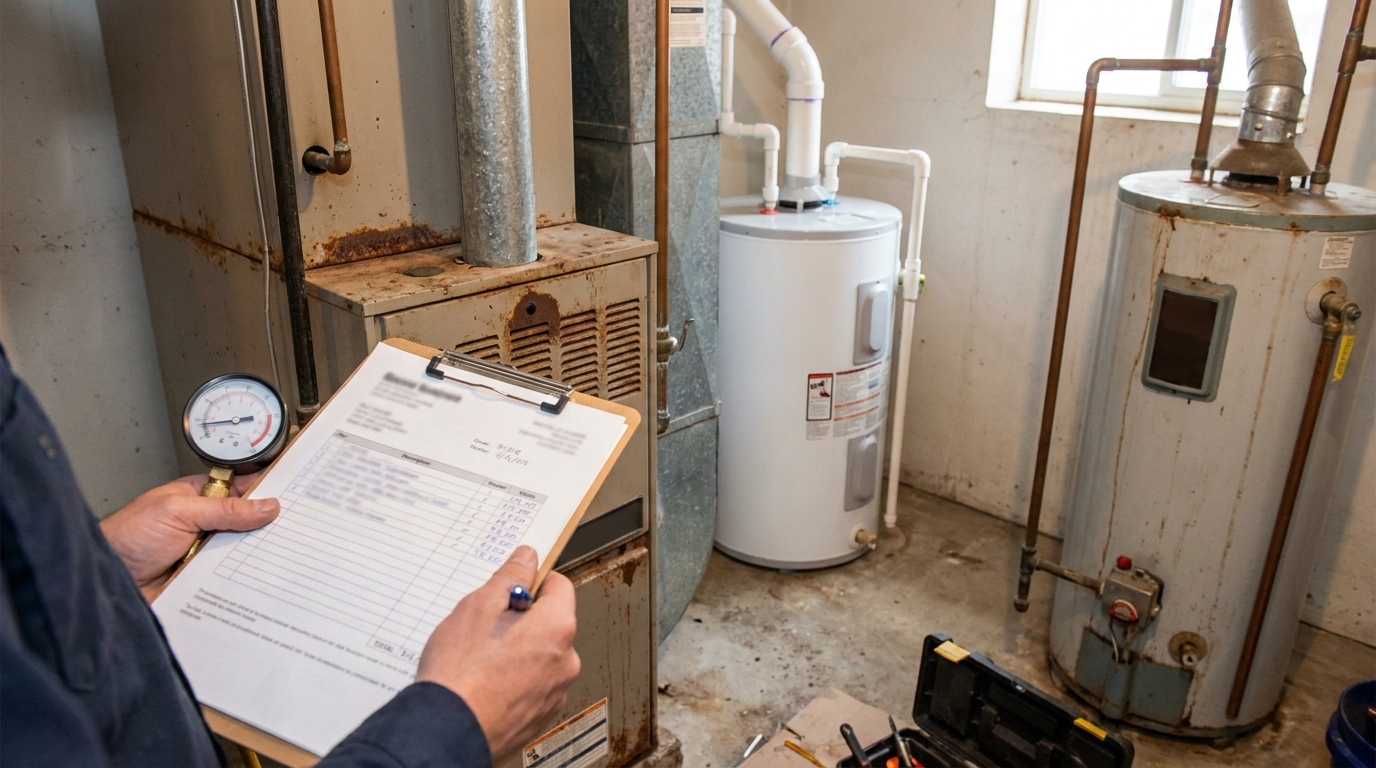
If you have priced a furnace or water heater in Colorado since January 1, you may have heard some version of this: the old style water heater is illegal now, the straight swap is off the table, and you need to move up to a high efficiency condensing furnace. The number on the quote follows that story, sometimes by several thousand dollars.
The law behind it is real. HB23-1161, signed in 2023, set ultra-low-NOx emission limits on new gas water heaters and fan-type central furnaces sold or leased in Colorado, and those limits took effect January 1, 2026.
But that sales pitch overstates what the statute actually does. Compliant natural draft water heaters exist. Compliant 80 percent AFUE non-condensing furnaces exist and are sold for the Colorado market by name. The honest story is narrower: fewer models, fewer sizes, fewer brands, higher prices, and longer waits. That still costs money. It just costs less than the panic version, and knowing the difference is worth a few hundred to a few thousand dollars on your next bid.
What HB23-1161 actually requires
The rule sets NOx (nitrogen oxide) emission ceilings measured in nanograms per joule of heat input:
-
10 ng/J for gas water heaters up to 75,000 BTU/h, and for any power-assist unit. That covers essentially every standard residential tank.
-
14 ng/J for water heaters from 75,000 BTU/h up to 2 million BTU/h.
-
14 ng/J for fan-type central furnaces.
Gas fireplaces are covered separately. There is also an alternative compliance path that gets left out of most conversations: equipment carrying current ENERGY STAR certification qualifies in place of meeting the ULN number, as the contractor association ACCA notes in its writeup of the rule. Manufacturers also do not have to separately demonstrate compliance if the product is listed in the NEEP state appliance standards database.
Here is the part that matters most to homeowners: the prohibition runs against manufacturing, distributing, selling, offering for sale, or leasing new non-compliant equipment. It does not run against you. Nothing in the law requires anyone to replace a working furnace or water heater. If your 2014 unit is running fine, it is still legal, and it stays legal until you replace it.
Enforcement falls on the seller side. The bill treats each transaction and each online for-sale listing as a separate violation, with CDPHE running spot checks and the Attorney General bringing civil actions. Reported penalties run up to $2,000 per violation. The state's appliance efficiency standards page hosts the FAQ and guidance documents if you want to read the government's own language rather than a contractor's summary of it.
Two things you may hear that are not true
1. "Atmospheric vent water heaters are done."
They are not. Ultra-low-NOx natural draft tank water heaters have been mainstream product since California's air district rules pushed manufacturers there in the 2000s. A current example is the Rheem Professional Classic PROG40-38U, a 40 gallon, 38,000 BTU ultra-low-NOx unit described by its own spec sheet as an atmospheric vent design using natural draft venting into an approved vertical vent or chimney, with a 3-inch or 4-inch vent connection, listed around $963.
One caveat worth handling directly: that particular listing is captioned for California use. The product category is not California-only, but ask your contractor or a local supply house to confirm the equivalent Colorado-market SKU before you sign anything.
2. "You have to go condensing now."
Also not true. Carrier's Infinity 80 ultra-low-NOx gas furnace, model 58CU0, is 80 percent AFUE, non-condensing, and states on the manufacturer's own product page that it complies with the 14 ng/J NOx limit found in SCAQMD Rule 1111 and SJVAPCD Rule 4905. Colorado is named on that page. Comparable ultra-low-NOx 80 percent models exist from Bryant (Evolution 80, 830CA), Payne (PG80ESUA), Coleman and Champion (TL8E), and Lennox.
Write those model numbers down. If a bidder tells you a like-for-like 80 percent replacement is now illegal in Colorado, that is a sales position, not the statute. You can hand them a model number and ask them to price it.
So what actually changed
Selection and price. ACCA's read is that ultra-low-NOx equipment "typically carries higher costs, fewer model options, and tighter supply constraints," and that is the accurate version of the scarcity claim, coming from an industry body rather than a company selling you the upgrade.
In practice that means the failure point is rarely legality. It is fit. Fewer brands making fewer sizes means the odd application is where you get stuck: an unusual BTU capacity, a tight closet footprint, a specific cabinet width that used to have three options and now has one. If your install is standard, you will likely find a compliant unit. If it is unusual, budget extra time for your contractor to source it.
The sell-through window is why 2026 quotes are all over the map
Non-compliant units that were already sitting in Colorado distributor inventory before January 1, 2026 can still be sold and installed. Alex Allen, service manager at Olson Plumbing & Heating in Colorado Springs, described that stock to KOAA News 5 as effectively grandfathered.
That single fact explains a lot of confusion. Two contractors can quote the same house this spring and be thousands apart, and both can be quoting legal work. One is pulling from warehouse stock and one is ordering new. It also tells you the direction of travel: as that grandfathered inventory drains, the cheap option quietly stops being available, and the spread narrows upward rather than downward.
The one genuine dead end: propane
This is the part that has gotten the least attention and deserves the most. According to ACHR News reporting on the rule, there are currently no residential propane water heaters on the U.S. market that meet the ultra-low-NOx limits, because the testing protocols behind the standard were developed for natural gas products. The National Propane Gas Association has called it a compliance headache for manufacturers. The ENERGY STAR off-ramp does not rescue the situation either, since very few propane units carry the certification and those that do cost considerably more.
If you heat water with propane, which describes a lot of mountain and rural Colorado, this is worth acting on before your tank fails, not after:
-
Ask your supply house or installer what remains in Colorado inventory from before January 1, and whether a unit can be set aside for you.
-
Start pricing an electric transition on your own schedule instead of an emergency one. A heat pump water heater or a standard electric tank sidesteps the issue entirely, but both may need electrical work, so you want that scoped while you still have hot water.
-
Get a real answer on your panel capacity now. That is the item that turns a one-day job into a two-week one.
What it costs
The most reliable Colorado-specific numbers available come from that KOAA report: compliant furnace and water heater installs running roughly $7,000 to $10,000, versus around $5,000 for jobs using older non-compliant stock.
A few things to understand about that gap before you accept it as your number:
-
Part of it is the sell-through window described above, not the appliance itself. As inventory clears, the low end of that comparison goes away.
-
If a quote jumps because of a condensing furnace or a heat pump water heater, most of the increase is usually not the box. It is venting, gas line sizing, condensate handling, and electrical. Ask for those broken out.
-
For heat pump water heaters specifically, installed costs vary enough by house that a national average is close to useless. Get two Colorado quotes with the electrical scope itemized rather than trusting a number from a comparison site.
The orphaned vent trap, which is a legitimate upcharge
If your water heater and your 80 percent furnace share a chimney flue, pulling the water heater off that flue changes the math for the appliance left behind. The vent can end up oversized for the remaining load, which invites condensation inside the chimney. Fixing it usually means relining or resizing.
This is a real reason a bid comes back higher than a neighbor's, and it is worth asking about by name. "If we move the water heater, does that orphan the furnace on the flue, and is the liner in this quote?" A contractor who has an immediate answer has looked at your chimney. One who has not may come back with a change order mid-job.
The altitude wrinkle
Gas appliances in Colorado need altitude derating, commonly around a 4 percent input reduction per 1,000 feet above 2,000 feet, and getting it wrong or skipping it is a common field error. With a shorter list of compliant models to choose from, confirming that the specific unit is rated for your elevation is a genuine constraint rather than a formality. Ask for it in writing with the model number.
Incentives in 2026, honestly
Most rebate roundups you will find online are stale. Read carefully:
-
The federal 25C credit is gone. The Energy Efficient Home Improvement Credit, worth up to $2,000 for heat pumps and heat pump water heaters, expired permanently for property placed in service after December 31, 2025 under the One Big Beautiful Bill Act passed in July 2025. Any 2026 quote or blog telling you to "stack the $2,000 federal credit" is out of date. If a salesperson uses it to justify a price, that is a red flag about the rest of the bid.
-
Colorado's heat pump tax credit still exists: $1,000 for air-source and $2,000 for ground-source, per EnergySage's 2026 Colorado summary. The mechanism matters. It is claimed by a contractor registered with the Colorado Energy Office, who must pass at least one third of the value through to you as a separate, itemized upfront discount. So you should see roughly $333 (air-source) or $667 (ground-source) as a line item on the invoice. You do not claim it yourself, and if it is not on the bid, ask why.
-
Xcel Energy Colorado rebates, per the official rebate portal: $800 for a heat pump water heater (residential electric, gas, or combo customers; contractor must submit; units over 80 gallons are not eligible; deadline is September 30 of the year following installation). Standard gas tanks get $50 at the 0.64 or 0.68 UEF tiers, tankless gets $100. If you see a $2,250 heat pump water heater rebate quoted on a third-party HVAC blog, it does not match the official program page.
The bid checklist: eight things to make every contractor itemize
-
Exact model number, plus its NOx rating or ENERGY STAR listing. This is the single most useful line on the quote, because it lets you verify compliance yourself instead of taking anyone's word.
-
Venting assumption. Does the price assume existing venting, or a conversion? Who pays if the liner turns out to be shared with the furnace?
-
Gas line sizing. Included or excluded.
-
Electrical scope, for any heat pump water heater. New 240V/30A circuit, a panel load calculation, or a full panel upgrade are three very different numbers. Get which one.
-
Condensate routing, including whether a pump is needed.
-
Permit and inspection, pulled by the contractor, priced on the bid.
-
Altitude rating confirmed for your address elevation.
-
The Colorado heat pump credit pass-through shown as its own line, if you are going that route.
To verify a water heater model independently, South Coast AQMD maintains a certified products list tied to its Rule 1121, the California rule Colorado's 10 ng/J water heater limit mirrors. It is a practical way to check whether a specific model really meets the number.
Do not do this in January with no heat
The worst version of this decision is the one made at 11pm in a cold house, where the only real option is whatever is on the truck. You have no leverage, no time to compare model numbers, and no ability to price a second bid.
The counter-move is boring and works. Decide your replacement path while the house is warm. Get the model number and full scope priced now, even if you are not buying yet. And if you are considering a heat pump water heater, find out ahead of time whether your basement can actually host one: it needs space, enough ambient air volume, somewhere for condensate to go, and tolerance for the noise. Those are answerable questions in October and terrible ones to discover in an emergency.
If you are reading this from another state
This is not a Colorado-only conversation. California has run these exact limits for years, 10 ng/J on residential water heaters under SCAQMD Rule 1121 (with a 40 ng/J carve-out for mobile home units) and 14 ng/J on furnaces under Rule 1111, matched by San Joaquin Valley APCD's Rule 4905. Utah has similar requirements. SCAQMD circulated proposed amendments to both rules through 2025 aimed at pushing further toward zero NOx, so the California version is still moving.
Which means two things. Your state may get a version of this. And when it does, you will likely hear the same overstated pitch. The response is the same: ask for the model number and the emissions rating, and check it yourself.
The bottom line
A compliant, like-for-like gas swap is still legal and still available in most Colorado basements. The equipment costs more, comes from fewer brands, and can take longer to source, and the cheapest quotes floating around right now are drawing on grandfathered stock that will not last. Verify the model number against its emissions rating, get the venting, gas, and electrical scope itemized, confirm the altitude rating, make sure any Colorado heat pump credit shows up as a line item, and do not buy under duress in January.
Related reading
-
[California's 'Zone 0' Is Here: Why the First 5 Feet Around Your House Now Has to Be Bare](/guides/california-zone-0-first-5-feet-fences-mulch-insurance)
Sources
-
HB23-1161, Environmental Standards For Appliances, Colorado General Assembly
-
Efficiency Standards for Appliances, Colorado Department of Public Health and Environment
-
Colorado's New Emissions Law Leaves Residential Water Heater Market Scrambling, ACHR News
-
Colorado's ultra-low NOx furnace rule signals a new threat to fuel choice, ACCA HVAC Blog
-
New state law raises cost of furnaces and water heaters, KOAA News 5
-
Rheem Professional Classic 40 Gal. Ultra Low NOx Natural Gas Water Heater (PROG40-38U)
-
Colorado Heat Pump Incentives, Tax Credits, and Rebates (2026), EnergySage
-
Xcel Energy Colorado Residential Water Heater Rebates, official rebate portal
Note: This article contains AI-assisted content and has been reviewed by our editorial team.
ABOUT THIS SERVICE: CallTheLocal.com is a directory and lead generation service, not a contractor or service provider. Submitting this form does not obligate you to hire anyone or purchase any service. Your information will be shared with licensed, insured home service professionals in your area who may provide quotes for your project. CallTheLocal.com does not guarantee the quality, timeliness, or outcome of any work performed by service providers you connect with through this service. Always verify licensing, insurance, and references before hiring. Get everything in writing before work begins.