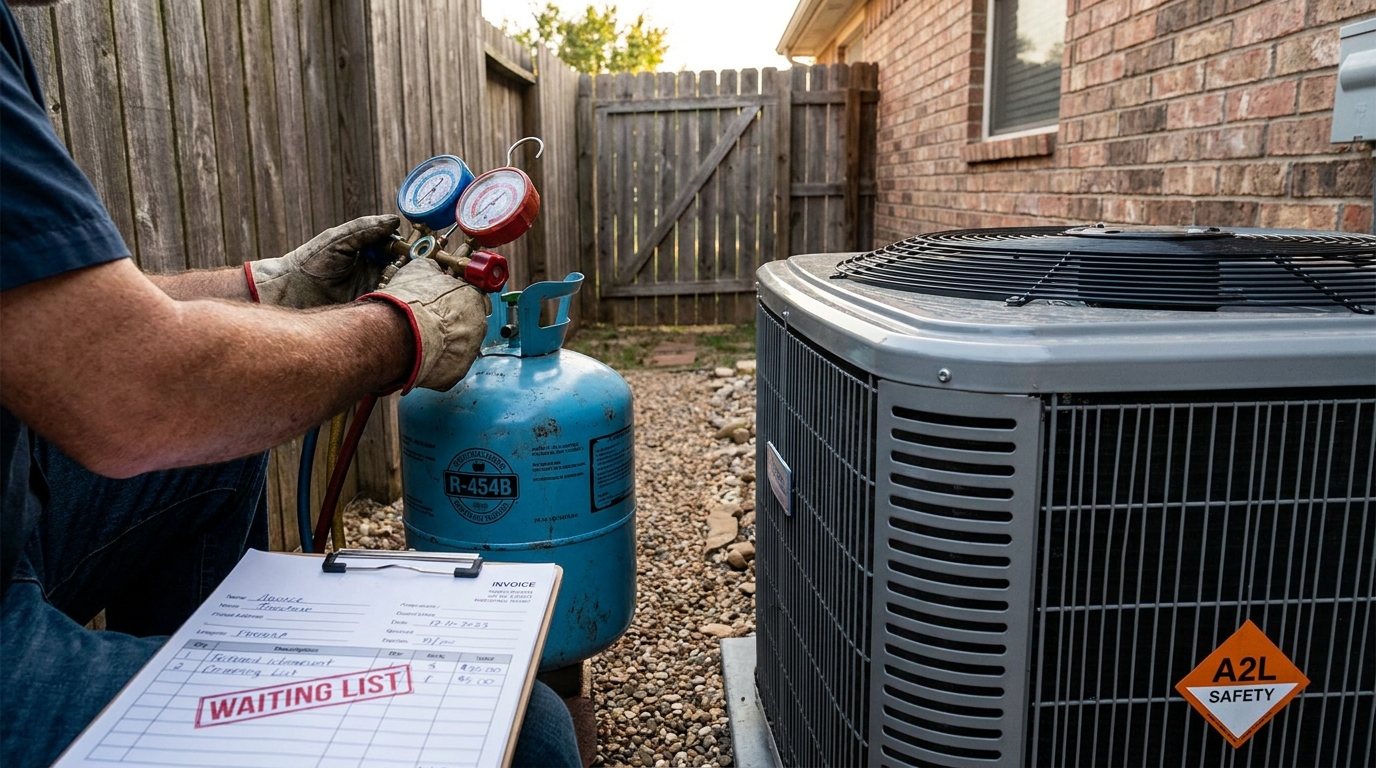
Walk into a Phoenix HVAC dealer in May 2026 asking for a straight 3-ton replacement and you'll hear the same story playing out from Atlanta to Sacramento. A mid-tier 14.3 SEER2 system that quoted around $7,000 last summer is still roughly $7,000 in many markets, but now it comes with a refrigerant surcharge on the invoice and a six-week wait for install crews juggling a thin supply of A2L service cylinders. The metal box on the side of the house looks roughly the same as it did two years ago. What changed is the stuff inside it, and the regulatory clock squeezing how much of that stuff anyone can buy.
Here's what every homeowner shopping for AC in 2026 needs to understand before signing anything.
What Changed on January 1, 2025
As of January 1, 2025, new U.S. residential and light-commercial air conditioning equipment can no longer be manufactured with R-410A, the refrigerant that's been standard in home AC for roughly two decades. Manufacturers had to switch to A2L-class refrigerants, which have a much lower global warming impact. Most of the big OEMs (Carrier, Trane, Lennox, Rheem, York) moved to R-454B. Daikin went a different direction with R-32. Lennox's own transition guidance confirms the manufacturing cutover date.
That sounds like a straightforward swap. It isn't. R-454B is mildly flammable (the "2L" in A2L), so new equipment requires leak-detection sensors and revised charge limits that pushed estimated equipment manufacturing costs up 15 to 20 percent versus the older R-410A platforms. Finished equipment prices at the homeowner level are up roughly 8 to 10 percent because of that.
The trickier issue is the refrigerant itself. There's a real difference between bulk R-454B sitting in a chemical plant tank and the 20-pound service cylinders contractors actually need to charge a system in your driveway. The bulk supply has loosened. The cylinder supply has been the persistent choke point, and it's the reason your install crew may be doing more juggling than you'd expect.
The EPA AIM Act in Plain English
The federal rule driving all of this is the American Innovation and Manufacturing (AIM) Act. It tells refrigerant producers and importers how much HFC refrigerant they're allowed to put into U.S. commerce each year, measured against a baseline set in the early 2010s.
From 2024 through 2028, that allowance sits at 40 percent below baseline. On top of that, the EPA accelerated an additional 15 percent step-down so it has to be in effect by September 30, 2026, six months earlier than originally scheduled. A regulatory tracker from law firm Hunton lays out the phase-down schedule in detail, and trade coverage of the accelerated 2026 cut spells out the timeline.
For a homeowner, the practical translation is this: the legal supply of HFC refrigerants in the U.S. is being squeezed on a published schedule, and the squeeze tightens this fall. Producers know it. Distributors know it. That knowledge shows up in price, and it shows up in who gets cylinders allocated to them and how quickly.
The EPA has issued a proposed rule reconsidering parts of the Technology Transitions Program in response to industry concerns about A2L supply and affordability. As of early 2026, the final disposition is still pending. Don't count on it loosening anything in time for this cooling season.
The Pricing Story: Honeywell, Chemours, and What Contractors Actually Pay
Two refrigerant producers set the tone for 2025 to 2026 pricing.
Honeywell announced a 42 percent surcharge on all R-454B orders placed on or after February 15, 2025. Then it added a $4 per pound base price increase effective April 9, 2025, with the 42 percent surcharge layered on top of the new higher base. Trade publication ACHR News documented the announcement.
Chemours followed with a $2.85 per pound increase on open and new R-454B orders shipping starting May 1, 2025, confirmed by industry reporting.
What does that mean for the contractor on your driveway? Reported R-454B pricing has ranged from roughly $17 to $20 per pound at the low end to as high as $60 per pound in tight markets. Some distributors only released cylinders to buyers who also purchased a complete system from them, a tactic known as "tied" allocation. So even when bulk supply normalized, the specific cylinder a service tech needs for your job might still be on backorder.
That's why a 2026 quote often includes a refrigerant surcharge line item. The contractor isn't padding. They're hedging against the difference between what they quote you today and what they'll actually pay for the cylinder when they pull the truck up to your house.
AI workflows for revenue teams
Placeholder house ad for Conservus.ai. Swap with final creative when brand assets are ready.
Partner with Conservus.aiWhy Your Install Is 4 to 10 Weeks Out
Four to ten weeks has been the realistic range homeowners are running into this year, depending on market and system size. The reasons stack:
-
20-pound A2L cylinder shortages. The bulk refrigerant exists. The right-size service cylinders haven't kept pace. Industry coverage has flagged this distinction repeatedly.
-
Distributor allocation. When supply tightens, distributors ration. Smaller independent contractors often wait longer than large national chains.
-
OEM-tied cylinder release. Some distributors required a full equipment purchase to release cylinders, which boxed out service-only buyers.
-
OEM-level admissions. Carrier and Trane both publicly cited A2L supply bottlenecks as a drag on residential equipment volume during the April to May 2025 window. Trade coverage traced the R-454B-specific squeeze in detail.
HARDI, the industry's main distributor association, signaled in late 2025 that the acute phase of the shortage had eased. Their assessment is worth weighing, but consistency of supply still varies week to week and market to market. If a contractor tells you the wait is six weeks, ask whether that's their crew schedule or their cylinder backlog. Different problems, different fixes.
Fair 2026 Install Pricing by Tonnage
Here's what reasonable installed pricing looks like in 2026, based on independent cost data from HomeGuide and Angi. Ranges assume a mid-efficiency 14.3 SEER2 system with a standard install (no major ductwork rework).
-
3-ton: $4,900 to $8,500 installed. The most common residential size.
-
3.5-ton: Roughly $5,500 to $9,000 installed.
-
4-ton: $6,500 to $9,800 installed.
-
5-ton: $7,500 to $11,000 installed.
Step up to premium 18+ SEER2 variable-speed systems and you're looking at $9,000 to $14,000 or more, regardless of tonnage in the residential range. Regional data from a Dallas distributor pegs the most common 3-ton install at $5,200 to $8,500, which lines up with the national pattern.
Regional variation matters here. Sunbelt markets (Texas, Florida, Arizona, the Carolinas) tend to sit at the lower-middle of the range because volume is high and competition is fierce. Northern markets with smaller residential AC inventories often run 10 to 15 percent higher for the same equipment.
If your quote sits well above these ranges and the contractor blames "the refrigerant situation," ask for the surcharge as a separate, written line item. A 10 to 20 percent system-cost bump tied to A2L equipment is reasonable. A 50 percent bump is not.
The R-410A Trap: "Last-Chance Inventory" Pitches
Here's where it gets interesting. R-410A equipment manufactured before January 1, 2025 can still be sold and installed legally. Some distributors still have inventory, and some contractors are pitching it as a "save money before the rules hit" deal. This is technically allowed.
Be careful. R-410A systems already in homes can be legally operated and serviced. Reclaimed R-410A and replacement parts will be available for years. But new-production R-410A is winding down, and the historical pattern is not friendly.
R-22, the refrigerant R-410A replaced, sat around $20 per pound when production was still active. After production halted, reclaimed-only supply pushed service prices to $150 to $250 per pound. A modest 2-pound leak repair that used to be a few hundred dollars in refrigerant becomes a $400 to $500 refrigerant bill alone, before labor.
If you install a brand-new R-410A system in 2026, you might save $500 to $1,500 on the equipment up front. You're also signing yourself up for 10 to 15 years of service calls where the refrigerant cost trend is moving in only one direction. Industry timelines are clear about the trajectory, and ICC's Q4 2025 update on the Technology Transitions Program reinforces the broader regulatory picture.
AI workflows for revenue teams
Placeholder house ad for Conservus.ai. Swap with final creative when brand assets are ready.
Partner with Conservus.aiWhat You Can't Do: Retrofit an R-410A System
If a contractor tells you they can "convert" your existing R-410A unit to R-454B or R-32, that's not a real product. R-410A and the A2L refrigerants operate at different pressures, use different oils, and the A2L safety design (mild flammability, leak sensors, charge limits) requires equipment built for it from the start. A field "refrigerant swap" on an R-410A condenser is non-compliant and unsafe. Walk away from that pitch.
Questions to Ask Before You Sign
A few quick checks separate fair 2026 quotes from sketchy ones:
-
What refrigerant does the nameplate specify? Get it in writing on the quote. "R-454B" or "R-32" for new equipment. If it says "R-410A," ask explicitly whether the unit was manufactured before January 1, 2025 and confirm that in writing.
-
Who owns install-delay risk? If the cylinder is backordered, do you pay storage or hold fees? Does your price lock?
-
Is there a written refrigerant surcharge policy? A reputable contractor will show you exactly how surcharges are calculated and capped.
-
What does the warranty require? A2L systems include leak-detection electronics. Some warranties void if those sensors are disabled or bypassed during service.
-
If you're buying a leftover R-410A unit, what will service refrigerant cost? Ask the contractor to disclose their current reclaimed R-410A rate per pound. That number is going up.
Red flags to watch for: a contractor who can't tell you which refrigerant the equipment uses, a quote with a vague "market adjustment" line item that isn't tied to refrigerant pounds, or pressure to sign same-day on a leftover R-410A unit without time to compare against an A2L quote.
Outlook: When Does This Normalize?
New R-454B production capacity has been announced for 2026, and bulk supply has continued to improve through late 2025. The cylinder choke point should ease as fillers catch up, though no one in the industry is promising a specific month. The EPA's pending reconsideration rule could adjust some Technology Transitions Program deadlines, but the underlying AIM Act phase-down is still on the books, so don't expect a sudden return to cheap, abundant refrigerant.
Realistic homeowner expectations for the rest of 2026:
-
Install lead times improving from 4 to 10 weeks toward 2 to 4 weeks by late season in most markets.
-
Refrigerant surcharges sticking around in some form, even if the percentage shrinks.
-
Continued upward pressure on reclaimed R-410A service rates as the September 30, 2026 HFC step kicks in.
If your current AC system is limping into summer and you can replace before peak demand hits, that's still the smarter play than waiting for prices to "come back down." They probably won't, not meaningfully, until 2027 at the earliest.
AI workflows for revenue teams
Placeholder house ad for Conservus.ai. Swap with final creative when brand assets are ready.
Partner with Conservus.aiRelated reading
Sources
-
R-32 Touted as A2L-Compliant While R-454B Shortage Persists (Facilities Dive)
-
EPA Advances 2026 HFC Cut, Signaling R-410A Phaseout (HVAC365)
-
Status Update on the AIM Act and EPA HFC Regulations (Hunton)
-
R-410A in 2026: Repairs and Rising Refrigerant Costs (AC Direct)
-
Can R-410A HVAC Units Still Be Installed After 1/1/26? (Surplus City)
-
[How Much Does AC Replacement Cost? 2026 (HomeGuide)](https://homeguide.com/costs/install-ac-unit-cost)
-
[R-454B Refrigerant Shortage and Price Surge (New HVAC Guide)](https://www.newhvacguide.com/post/r-454b-refrigerant-shortage-and-price-surge-navigating-the-2025-hvac-crisis)
Note: This article contains AI-assisted content and has been reviewed by our editorial team.
ABOUT THIS SERVICE: CallTheLocal.com is a directory and lead generation service, not a contractor or service provider. Submitting this form does not obligate you to hire anyone or purchase any service. Your information will be shared with licensed, insured home service professionals in your area who may provide quotes for your project. CallTheLocal.com does not guarantee the quality, timeliness, or outcome of any work performed by service providers you connect with through this service. Always verify licensing, insurance, and references before hiring. Get everything in writing before work begins.