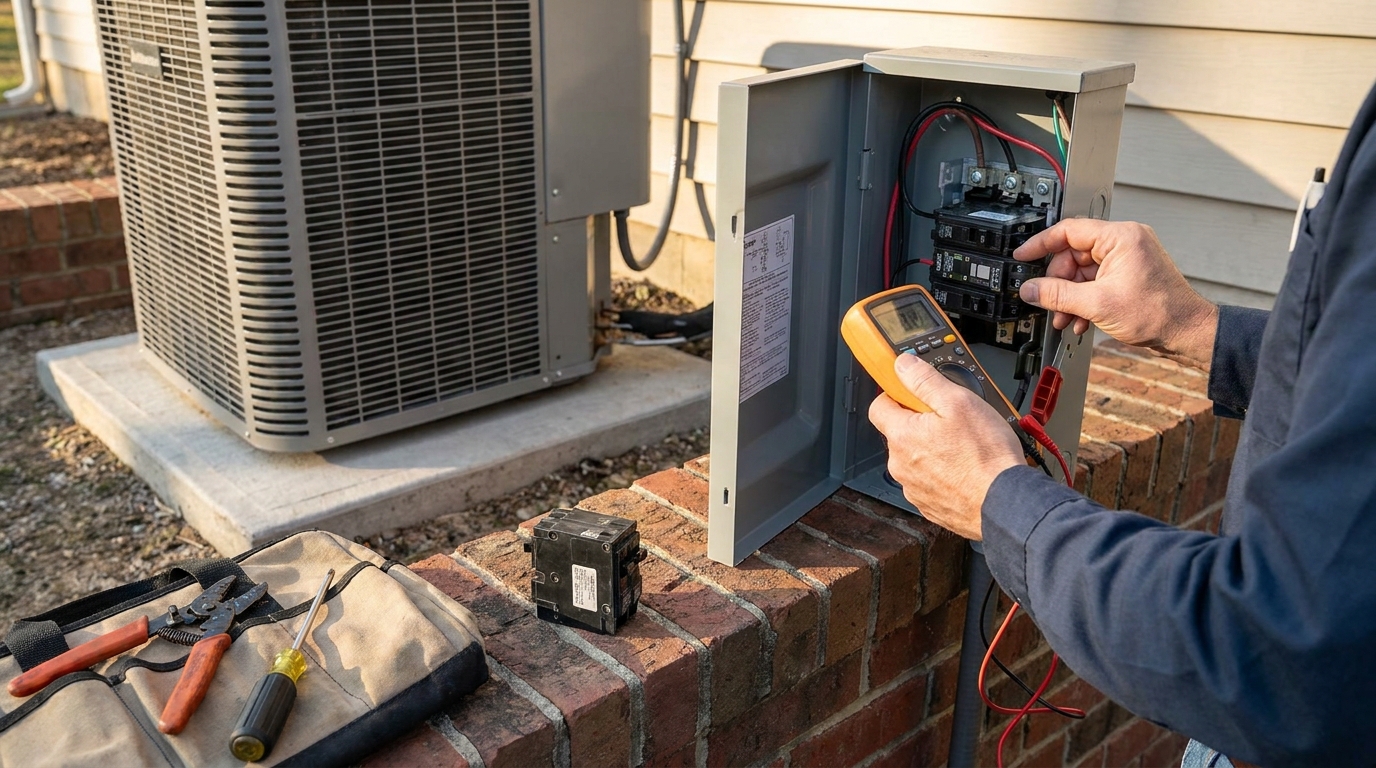
If you are planning to replace your outdoor air conditioner or heat pump anytime soon, there is a code change worth knowing about before you get quotes. Starting September 1, 2026, a temporary exemption that let outdoor HVAC equipment skip ground-fault protection expires. After that date, new installations and permitted replacements will need GFCI protection on the disconnect. Here is the catch that trips people up, literally: the inexpensive GFCI breaker most stores sell is the exact device that has been shutting off modern variable-speed systems for years. This article walks through what actually changes, who it affects, and what it adds to your bill.
What actually changes on September 1, 2026
The rule at the center of this is National Electrical Code section 210.8(F). First added in the 2020 code, it requires GFCI protection for outdoor dwelling outlets rated 150 volts to ground or less and 50 amps or less. In plain terms, that sweeps in your 240-volt central AC condenser, your heat pump, and your mini-split outdoor unit. It applies to the "outlet," meaning the point where the equipment connects, not just a plug-in receptacle.
When the rule first landed, the industry pushed back hard because the required GFCIs kept nuisance-tripping HVAC gear. So the code granted listed outdoor HVAC equipment a temporary exemption. That exemption expires September 1, 2026. From that date forward:
-
New installations and permitted major replacements must have a compliant GFCI protection path.
-
Existing equipment that stays untouched is grandfathered. If your current outdoor AC disconnect was installed before the deadline and you leave it alone, you do not have to retrofit it.
-
The requirement triggers on new work, so the moment you replace the condenser or do permitted work on the circuit, the new rule applies.
Myth-buster: this is not just a "2026 code" thing
It is easy to assume this only hits states that adopted the newest 2026 edition of the electrical code. That is not how it works. The September 1, 2026 deadline was created through a code amendment (a Tentative Interim Amendment) that was carried into both the 2023 and the 2026 editions. So the cliff arrives on the same date regardless of which of those editions your state enforces, as confirmed in code discussions covering the 2023 edition.
The simple way to think about it:
-
If your jurisdiction is on the 2020, 2023, or 2026 code, the deadline applies to you.
-
If your jurisdiction is still on the 2017 code or earlier, there is no outdoor HVAC GFCI requirement yet, because 210.8(F) did not exist before the 2020 edition.
Why the old-style GFCIs kept tripping inverter systems
To understand the fix, it helps to know why there was a problem in the first place. The standard GFCI everyone knows is a Class A device (built to UL 943). It is designed to protect people and trips at roughly 4 to 6 milliamps of ground-fault current. That is great for a bathroom or patio receptacle.
Modern variable-capacity, inverter, and ECM (brushless) HVAC equipment is a different animal. Its power electronics naturally leak more high-frequency current to ground than an older single- or two-speed unit does. According to the Air Conditioning Contractors of America, this harmonic leakage from variable-speed drives can exceed the tiny threshold a Class A GFCI trips at, even when nothing is actually wrong. The result is a system that shuts itself off, sometimes repeatedly, in the middle of a hot afternoon. Single-speed and two-speed units are mostly fine. The newer high-efficiency inverter units are where the trouble shows up. This nuisance-tripping problem is exactly what earned the equipment its temporary exemption in the first place, which the National Association of Home Builders called a win over nuisance tripping back in 2022. The delay was meant to give manufacturers time to make listed HVAC systems GFCI-compatible.
The fix the code offers: a special-purpose GFCI
The 2026 code's real contribution is recognizing a different kind of device as an approved path for listed HVAC equipment: a Class C special-purpose GFCI, or SPGFCI, built to the UL 943C standard. According to UL Solutions, a Class C device works on a different scheme than the familiar Class A breaker. It trips at a higher threshold (UL describes a band of greater than 6 up to 15 milliamps) and monitors the equipment grounding conductor for continuity, tolerating more of the harmless high-frequency leakage that inverter units produce before it reacts.
You may see this described online as a "20 milliamp trip versus 5 milliamp" swap. That is an oversimplification. The honest version is that a Class C device trips at a higher, HVAC-tolerant threshold and watches the ground path, rather than reacting to the small leakage that makes a standard breaker cut out. The 2026 code also requires the disconnect to be labeled: "Warning: Class C SPGFCI Protection Provided for HVAC Unit."
The catch nobody is advertising
Here is the part that matters most for your wallet and your comfort. As of mid-2026, there are essentially no residential-panel circuit breakers listed as Class C SPGFCI. The true Class C protection that exists is sold mostly as industrial "systems" (names like Littelfuse Shock Block and Bender detector-plus-contactor combos), which are far more expensive and are not a simple swap into a home breaker panel.
So the practical reality in 2026 and into 2027 is a squeeze:
-
The cheap, widely available compliance route is a two-pole Class A GFCI breaker. It is the device prone to nuisance-tripping inverter units.
-
The HVAC-friendly Class C route is code-approved but barely available for home panels and costs much more when it is.
What that means for you: if you have a single- or two-speed system, a standard GFCI breaker will likely behave fine. If you are installing a modern variable-speed heat pump or high-efficiency inverter AC, the cheap breaker is a real gamble on repeat trips, and the better-behaved device may not be easy to source yet. This is worth discussing openly with your contractor before the work starts.
What it adds to the bill
For a straightforward compliance job on a new or replaced outdoor AC disconnect, expect roughly $250 to $500 total, based on a contractor cost breakdown out of New Jersey. That typically breaks down as:
-
Hardware: $80 to $150 for a two-pole GFCI breaker.
-
Labor: about 1 to 2 hours.
-
Permit: added on top, varies by town.
Costs climb from there if your panel does not have space, or if it is an off-brand panel that does not accept a compatible GFCI breaker. In those cases you are looking at panel work on top of the breaker. And if you go the true listed Class C "system" route to avoid nuisance trips, that is a much bigger number than a simple breaker swap because those devices are built for industrial installations, not residential panels.
Which states this actually bites
Because the deadline lives in both the 2023 and 2026 editions, adoption of the newest 2026 code specifically is not the deciding factor. Most states already enforcing the 2023 code are affected too. To figure out where you stand, check which code cycle your jurisdiction enforces:
-
On the 2020, 2023, or 2026 code: the September 1, 2026 deadline applies.
-
On the 2017 code or earlier: no outdoor HVAC GFCI requirement yet.
The most reliable way to confirm your state's current edition is the NFPA electrical code enforcement maps. A handful of states had adopted the 2026 edition by mid-2026 (trackers list a set including Colorado, Idaho, Massachusetts, New Hampshire, Oregon, Utah, Vermont, and Washington, though running trackers disagree on the exact count). New Jersey is a concrete example where the requirement applies to outdoor AC, heat pump, and mini-split disconnects on new installs and permitted work starting September 1, 2026. Your local building department can tell you your exact cycle in one phone call.
Checklist: getting a compliant quote
-
Ask which code edition your town enforces before you sign anything. It determines whether the rule even applies to your job.
-
Tell the contractor whether your new unit is variable-speed or inverter. This is the single biggest factor in whether a standard GFCI breaker will nuisance-trip.
-
Get the GFCI approach in writing: Class A GFCI breaker versus a listed Class C SPGFCI path, and what happens if the standard breaker trips after install.
-
Confirm the disconnect will be labeled correctly if a Class C device is used, and that a permit is being pulled.
-
Ask about your panel: Does it have space, and does it accept the needed breaker? Off-brand panels can add cost.
-
Get the full price broken out: hardware, labor, permit, and any panel work.
Red flag to watch for
Be wary of any electrician who waves off the listing details with "a GFCI is a GFCI." It is not. Using the wrong class of device on a modern inverter system gets you one of two bad outcomes: a system that keeps tripping off, or a failed inspection. A contractor who can clearly explain the difference between a Class A breaker and a Class C SPGFCI, and who asks about your equipment type, is one who understands the actual problem.
Bottom line
If an AC or heat pump replacement is on your horizon in the next 12 to 18 months, put this on your list. The requirement is real, it is not limited to states on the newest code, and it lands on a specific date. Budget an extra $250 to $500 for a standard compliance job, more if your panel needs work. Most importantly, if you are moving to a modern variable-speed system, have a frank conversation about which GFCI device your contractor plans to use, because the cheap one and the reliable one are not the same thing yet. A little planning now beats a system that shuts itself off next summer.
Related reading
-
[The 2026 Electrical Code and Home EV Charging: What DIY Installs, Pre-Wired Homes, and Level 2 Costs Really Look Like Now](/guides/2026-nec-ev-charger-diy-rules-level-2-costs)
Sources
-
UL Solutions: Special Purpose Ground-Fault Circuit Interrupters (SPGFCI / UL 943C)
-
[2026 NEC Code Changes for GFCI and Receptacles](https://sygfci.com/2026/03/20/2026-nec-code-changes-critical-updates-for-gfci-and-receptacle-installations/)
-
NAHB: A Big Win in the Electrical Code Over Nuisance Tripping
-
210.8(F) GFCI Protection for Outdoor Outlets (NEC text and commentary)
-
2023 NEC 210.8(F) discussion including the TIA and September 1, 2026 exception
-
[NEC 2026 GFCI Requirement for Outdoor AC Units (NJ cost breakdown)](https://malfettoneelectric.com/blog/nec-2026-gfci-outdoor-ac-nj)
Note: This article contains AI-assisted content and has been reviewed by our editorial team.
ABOUT THIS SERVICE: CallTheLocal.com is a directory and lead generation service, not a contractor or service provider. Submitting this form does not obligate you to hire anyone or purchase any service. Your information will be shared with licensed, insured home service professionals in your area who may provide quotes for your project. CallTheLocal.com does not guarantee the quality, timeliness, or outcome of any work performed by service providers you connect with through this service. Always verify licensing, insurance, and references before hiring. Get everything in writing before work begins.