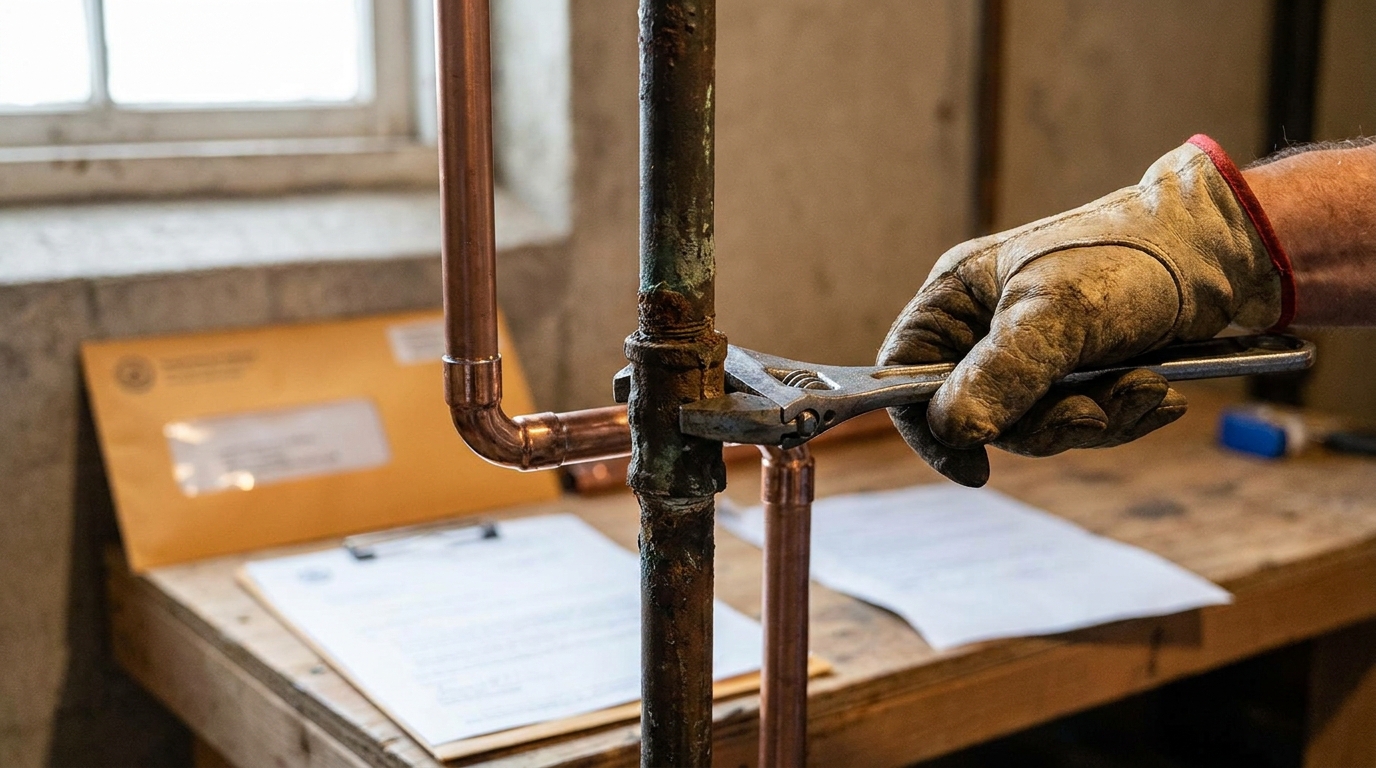
If you live in an older home and you open your mailbox this November to find a letter from your water utility with the words "lead," "galvanized requiring replacement," or "unknown" on it, you are not alone, and you are not in trouble. You are one of the millions of homeowners getting the second of three annual notification letters required by EPA's Lead and Copper Rule Improvements (LCRI), the federal rule finalized in October 2024 that finally puts a hard timeline on getting lead pipes out of the ground.
The letter usually arrives plain and a little alarming. A week later, someone may knock on your door offering a "free lead inspection" and try to sell you a $20,000 whole-home repipe. This guide walks through what the rule actually requires, what a real lead service line replacement costs, which states will pay the bill for you, and how to tell a legitimate utility crew from a high-pressure sales pitch.
What the November 2026 letter actually means
Under LCRI, every community water system in the country had to build an inventory of its service lines (the pipe that runs from the water main in the street to your house) and notify customers whose lines fall into one of three categories. Per the EPA's official inventory fact sheet, the four classifications you'll see are:
-
Lead: The utility has confirmed your service line is made of lead.
-
Galvanized Requiring Replacement (GRR): Your line is galvanized steel and was at some point downstream of a lead pipe, so it gets treated as lead because it can absorb and re-release lead particles.
-
Non-lead: Confirmed copper, plastic, or other non-lead material. You will generally not get a letter for this.
-
Unknown: The utility could not confirm the material from records, and nobody has dug it up to check yet.
Utilities are required to send these notification letters every November in 2025, 2026, and 2027. If you got one last year and your status hasn't changed, expect another. The letter does not mean you have to do anything immediately. It means your line is on the utility's list to be addressed.
What the rule requires of your utility vs. what it requires of you
This is the part most homeowners get wrong. The LCRI puts the legal obligation on the utility, not on you. According to regulatory analysis of the final rule, here's the actual timeline your water system is working against:
-
October 16, 2024: Initial service line inventory was due (this is what generated your letter).
-
November 1, 2027: LCRI becomes effective. Utilities must submit a baseline inventory, a full lead service line replacement plan, a list of connections to schools and childcare facilities, and a sampling plan.
-
By roughly 2037: Most full lead service line replacements must be complete (a 10-year window from the effective date).
What does the rule require of you as a homeowner? Almost nothing, legally. You are not required to pay for, schedule, or initiate replacement on your own. The catch is that many service lines are split: the utility owns the section from the main to your property line, and the homeowner owns the section from the property line to the meter or the house. Whether the utility pays for your side of that split is a state and local question, not a federal one.
What it costs and what drives the price
A full lead service line replacement typically runs between $1,200 and $12,300 per home, with the homeowner-side portion alone usually landing in the $2,500 to $8,000 range according to engineering-firm analysis of cost-sharing models and national cost estimates from Brookings.
The big cost drivers:
-
Length of the run: A short connection from a city sidewalk to a small bungalow is cheap. A 100-foot run across a long suburban front yard adds up fast.
-
Depth and soil: Cold-climate cities bury lines four to six feet down to avoid freezing. Rocky or clay soil slows the dig.
-
Surface restoration: Tearing up and replacing a concrete driveway, sidewalk, or mature landscaping can easily double the bill.
-
Method: Trenchless directional drilling is faster and gentler on landscaping but costs more upfront than open-trench digging.
-
Permits and inspections: Vary by city.
If a contractor quotes you something dramatically higher than $12,300 for a standard residential service line (with nothing unusual going on), that is a flag to get a second quote.
AI workflows for revenue teams
Placeholder house ad for Conservus.ai. Swap with final creative when brand assets are ready.
Partner with Conservus.aiThe funding map: who actually pays
The Bipartisan Infrastructure Law put roughly $15 billion specifically toward lead service line replacement, distributed through state Drinking Water State Revolving Funds. The EPA maintains a list of funding sources utilities can tap. How that money reaches your specific pipe depends entirely on which state and city you live in.
States and cities where you may pay nothing
-
New York State: Governor Hochul announced nearly $90 million in grant funding designed to cover both the public and private sides at no cost to qualifying homeowners.
-
Newark and other New Jersey programs: Newark's model (full public-and-private replacement at no charge to the homeowner) has been widely copied across the state.
-
Providence, Rhode Island: Providence Water replaces the public side for free when the homeowner replaces the private side, and offers low-interest financing for the private portion.
-
Wisconsin: The state DNR runs a private-side replacement program with at least $63 million in principal forgiveness specifically for homeowner-side work.
-
Chicago (Equity LSLR Program): The Equity Lead Service Line Replacement Program covers 100% of the cost for income-qualified households at or below 80% of area median income, prioritizing homes with children or documented elevated lead levels.
-
California: The State Water Board offers up to 100% principal forgiveness for disadvantaged community water systems and 0% interest loans for everyone else.
-
Massachusetts (MWRA service area): MWRA added $100 million in 2024 with a 25% grant component for communities that fund private-side replacement.
Where you may be on the hook
Plenty of utilities, especially smaller systems in states without strong private-side funding, will replace only the public portion (main to property line) and leave the homeowner-side portion to you. In those areas, you'll be quoted somewhere in that $2,500 to $8,000 range to finish the job.
How to find out what your utility will pay before you spend a dollar
-
Call the utility directly. Use the phone number on the notification letter or on your water bill. Ask three specific questions: "Is my address on the replacement schedule, and what year?" "Do you cover the private side, the public side, or both?" "Are there state or federal funds (DWSRF or IIJA) my home qualifies for?"
-
Look up your utility's public service line inventory map. Most systems now publish a searchable map by address.
-
Ask whether income-qualified or equity programs apply. Even in cities without universal coverage, lower-income households, homes with children, or homes with confirmed elevated lead levels often qualify for full coverage.
-
Get any homeowner-side quote in writing from a licensed plumber. Not from someone who knocked on your door.
The scam wave riding on the notification letters
This is the part that catches people off guard. Within days of those November letters going out, door-to-door sales crews start working the same neighborhoods. The pitch usually starts with a "free lead inspection" or "free water quality test" and escalates into a same-day quote to repipe the entire house for $15,000 to $40,000.
According to trade-source guidance on plumbing scam warning signs and consumer alerts on water testing scams, the red flags are consistent:
-
Unsolicited door-to-door visits claiming to be "with the city" or "EPA-certified." EPA does not certify door-to-door inspectors.
-
On-the-spot chemical "tests" that dramatically change your water's color or cloudiness. Many of these tricks use reagents that react with normal harmless minerals to produce alarming results.
-
Pressure to sign that day, often with a "discount" that expires if you don't.
-
Quotes for whole-home repipe instead of just the service line. The LCRI is about the service line from the main to your house, not your interior plumbing.
-
No written, itemized estimate, no license number, no proof of insurance.
-
Any claim of an "EPA-required" immediate replacement. EPA does not order homeowners to replace anything on a deadline.
The questions that make a scammer walk away: "What's your Master Plumber license number?" "Can I see your proof of liability insurance?" "Can you email me a written itemized estimate I can compare to other quotes?" "Who at the city water department can I call to verify this?"
AI workflows for revenue teams
Placeholder house ad for Conservus.ai. Swap with final creative when brand assets are ready.
Partner with Conservus.aiWhat to do while you decide
Even if your line is confirmed lead, there are real steps you can take today to reduce exposure without rushing into a $5,000 decision:
-
Use a filter certified to NSF/ANSI Standard 53 for lead reduction. Pitcher filters, faucet-mount filters, and under-sink units all come in lead-rated versions. Check the box for the standard.
-
Flush the tap before drinking or cooking when water has been sitting in the pipes for several hours. Run the cold tap until it gets noticeably colder.
-
Never use hot tap water for drinking, cooking, or mixing infant formula. Hot water dissolves lead more readily. Heat cold water on the stove or in a kettle instead.
-
Request a free lead test from your utility. Most are required to offer one to homes on the inventory, and the results help confirm whether your filter and flushing routine are enough in the meantime.
What to do this week
-
Keep the letter. File it with your home records. If you ever sell, this is part of disclosure in many states.
-
Call the utility and ask the three questions above (replacement year, who pays, what funding applies).
-
Install or upgrade a certified lead-reduction filter for drinking and cooking water as an interim measure.
-
If anyone knocks on your door about lead pipes, do not sign anything, do not let them test your water, and do not give them a credit card. Get their company name, write it down, and call the utility to verify before doing anything else.
-
If you do need a private-side quote, get at least two from licensed local plumbers (not door-knockers), in writing, itemized, with line items for excavation, pipe, restoration, and permits.
The deadlines are real, but the timeline is years long, the legal pressure is on the utility (not on you), and in a growing list of states the work is genuinely free for homeowners. Take the week, make the phone call, and let the people knocking on your door wait.
Related reading
AI workflows for revenue teams
Placeholder house ad for Conservus.ai. Swap with final creative when brand assets are ready.
Partner with Conservus.aiSources
-
EPA Final LCRI Fact Sheet: Service Line Inventory (October 2024)
-
EPA Issues Final Lead and Copper Rule Improvements — Beveridge & Diamond
-
What would it cost to replace all the nation's lead water pipes? — Brookings
-
Identifying Funding Sources for Lead Service Line Replacement — US EPA
-
Lead Service Line Replacement Funding Program — California State Water Resources Control Board
-
Private Lead Service Line Replacement Program — Wisconsin DNR
-
Equity Lead Service Line Replacement Program — Lead Safe Chicago
-
Governor Hochul Announces Nearly $90M to Replace Lead Service Lines — NY Governor's Office
-
Lead Service Line Replacement Program — MWRA (Massachusetts)
-
How to Recognize and Avoid Plumbing Scams — All City Plumbers
-
What You Need to Know About Water Quality Testing Scams — Kings Water Alliance
Note: This article contains AI-assisted content and has been reviewed by our editorial team.
ABOUT THIS SERVICE: CallTheLocal.com is a directory and lead generation service, not a contractor or service provider. Submitting this form does not obligate you to hire anyone or purchase any service. Your information will be shared with licensed, insured home service professionals in your area who may provide quotes for your project. CallTheLocal.com does not guarantee the quality, timeliness, or outcome of any work performed by service providers you connect with through this service. Always verify licensing, insurance, and references before hiring. Get everything in writing before work begins.