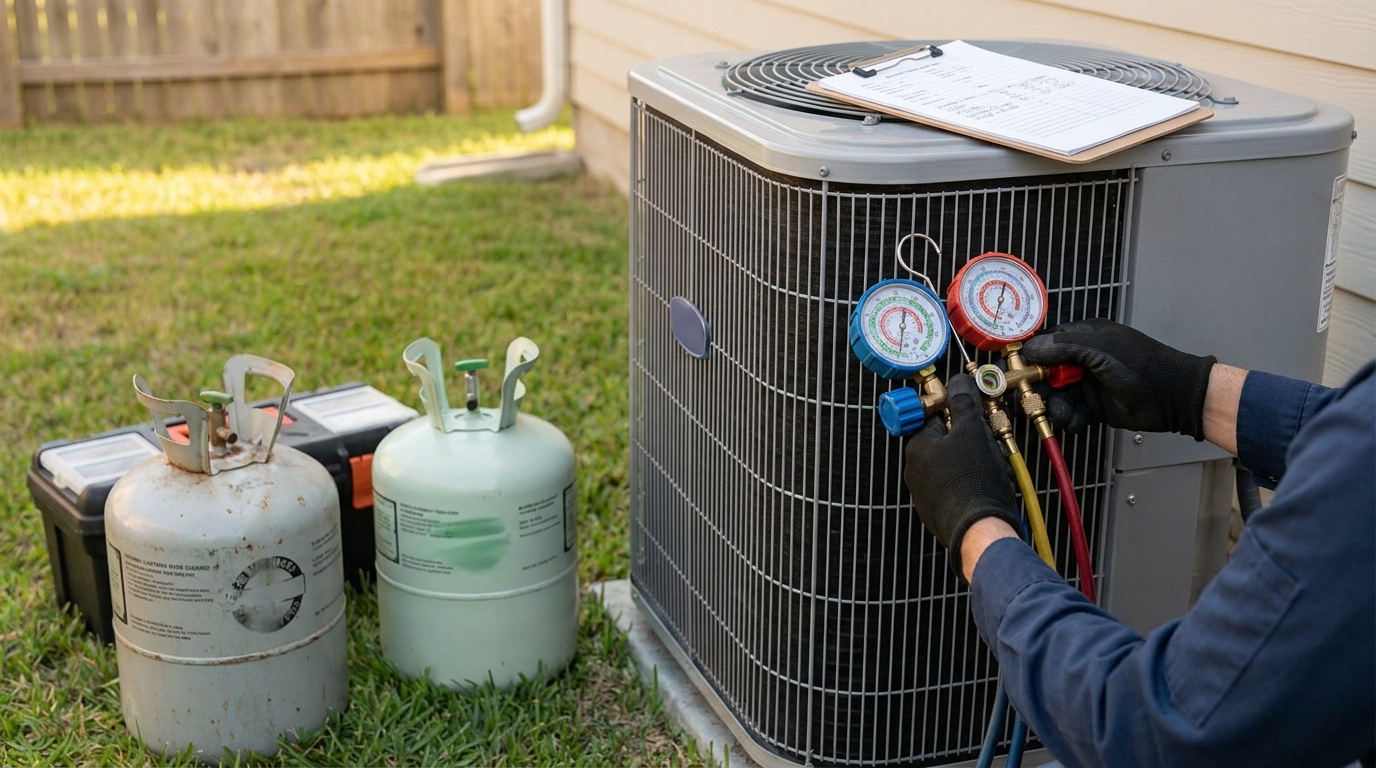
If you priced out a new central air conditioner this year and felt sticker shock, you are not imagining it. A comparable system costs roughly 10 to 20% more than it did last year, and the biggest reason has nothing to do with labor rates or inflation alone. It is the refrigerant under the hood. New residential systems sold in 2026 ship with a refrigerant called R-454B instead of the R-410A that ran most homes for the past two decades, and that switch carries real costs.
Here is what changed, why your quote went up, and how to make a smart decision whether you are nursing an older system along or shopping for a replacement.
What actually happened, and when
The driver is a federal law called the American Innovation and Manufacturing (AIM) Act, passed in 2020. It directs the EPA to phase down high-GWP (global warming potential) refrigerants over time. This is not a sudden 2026 ban. It is a planned, multi-year wind-down.
The milestone that matters most: as of January 1, 2025, manufacturers could no longer build new residential HVAC equipment using R-410A. That is a manufacturing cutoff, not a rule that your existing system suddenly became illegal. What it means in practice is that the new systems you buy in 2026 come charged with the replacement refrigerant, R-454B, by default. You can read a plain-English version of the AIM Act milestones in AC Direct's R-410A phase-out timeline.
What R-454B is, and why it costs more to install
R-454B is a blend of about 68.9% R-32 and 31.1% R-1234yf. Its GWP is around 466, compared with R-410A's roughly 2,088. That is about 78% lower, which is the whole point of the transition. For a homeowner-level breakdown of the chemistry and what it means for buying equipment, AC Direct's 2026 homeowner guide is a useful reference.
The catch is that R-454B is classified as an A2L, or "mildly flammable," refrigerant. That classification adds real hardware and labor to an install. New systems require leak detection sensors, A2L-certified installers, and code-compliant handling. Those safety requirements are a meaningful part of why the new equipment carries a premium. A new R-454B/A2L system runs about 10 to 20% more than a comparable R-410A model would have, according to cost figures compiled by Barrie Heating & Cooling.
The 2025 price spike, and where prices landed
Part of the cost story is a supply crunch that hit when the transition arrived. In April 2025, Honeywell said it could not keep up with what it called "unprecedented demand" for R-454B and would import the refrigerant to fill the gap, which pushed prices up more than 40%. Cylinders that should have been routine purchases ran roughly $650 to $700, and in some cases as high as $700 to $2,000 per 20-pound cylinder, with manufacturer surcharges reaching around 42%. The trade publication Contracting Business documented the whole episode in its report, ["Cold Truth: The R-454B Shortage."](https://www.contractingbusiness.com/refrigeration/article/55288344/cold-truth-the-r-454b-shortage)
The good news is that the worst of it passed. By August 2025, online R-454B prices were reported 50 to 60% below their June peaks as supply caught up. The tightness eased, but it did not fully reverse the equipment price increases. That is the situation you are buying into in 2026: supply is largely normalized, but elevated equipment and refrigerant costs have stuck around.
If you still own an R-410A system
First, the reassuring part: your existing R-410A system is still legal to run, and it is still legal to service. R-410A remains available for topping off and repairing existing units. You do not need to rip out a working system because the calendar flipped.
The nuance is the long game. R-410A production is scheduled to decline to roughly 15% of current levels by 2036. As that legacy supply tightens over the years, the refrigerant used in leak repairs gets pricier. So a major leak repair on an older unit may cost more down the road than it would today. For now, repair costs on older units commonly land somewhere around $500 to $1,500, influenced heavily by refrigerant pricing and surcharges.
Repair vs. replace: how to think about it
There is no single right answer, but a few factors tip the scale:
-
Age of the system. If your unit is well into its second decade, sinking money into a refrigerant-heavy repair often buys you only a short reprieve.
-
The size of the repair. A small fix on a unit with years of life left usually wins. A large refrigerant recharge or compressor job on an aging R-410A system is where replacement starts to make sense, especially as legacy refrigerant tightens.
-
Efficiency gains. Newer systems can lower your monthly bills, which offsets some of the higher upfront cost over time.
The honest rule of thumb: if a single repair costs a large fraction of a new system and your unit is old, replacement is the better value. If the repair is modest and the system is otherwise healthy, fix it and wait.
Realistic 2026 budgets
Here is what most homeowners are looking at this year for a full replacement:
-
Central AC replacement: roughly $5,500 to $12,000 installed.
-
Heat pumps: higher, around $7,500 to $15,000 installed.
-
A common mid-efficiency 3-ton system: often lands around $6,500 to $8,500 with a standard install.
What drives the spread within those ranges? Tonnage (how much cooling your home needs), SEER2 efficiency rating, the condition of your existing ductwork, and the A2L safety upgrades that come with the new refrigerant. Manufacturer Carrier's 2026 pricing resource and Barrie Heating & Cooling's cost breakdown both put these ranges and the refrigerant-transition premium in context.
The EPA's July 2026 rule and the state-by-state wrinkle
In May 2026, the EPA finalized a rule that eased the installation picture. It allows contractors to install HVAC units that were manufactured or imported before January 1, 2025 and use R-410A "until existing supplies are depleted." That rule takes effect July 27, 2026, and it removed an earlier provision that would have barred installing pre-2025 R-410A split systems after January 1, 2026. In plain terms, that pre-2025 R-410A inventory can be sold through rather than stranded. The National Association of Home Builders has a clear summary of the final rule.
But there is a state-by-state catch. New York enacted its own law keeping the original January 1, 2026 deadline, which effectively bans new R-410A installs statewide regardless of the federal sell-through allowance. So your options genuinely depend on where you live. Before you assume you can buy a discounted R-410A unit, check your state and local rules.
Incentives that offset the cost
A couple of credits can take some of the edge off:
-
A $600 federal tax credit is available for qualifying high-efficiency central air conditioners.
-
Heat pumps qualify for larger credits under separate provisions, which can make the higher upfront price of a heat pump more competitive than it first appears.
Red flags and how to vet a contractor
The transition has created a specific sales pressure worth watching for. Some contractors push a full system swap "before summer" to clear inventory, whether that is legacy R-410A stock or new A2L equipment, rather than because your system actually warrants replacement. A working system does not need to be replaced on someone else's inventory schedule.
To protect yourself:
-
Get a repair-first second opinion when a contractor recommends a full replacement on a system that still runs.
-
Confirm A2L certification. Any installer putting in an R-454B system should be certified to handle the refrigerant.
-
Ask for itemized quotes. You want to see equipment, refrigerant, safety hardware, and labor broken out, not a single lump sum.
-
Be skeptical of urgency. "Buy now before the price jumps" is a sales tactic, not a diagnosis.
The bottom line
The refrigerant change is real, and so is the 10 to 20% bump on new systems. But it is a planned transition, not an emergency. If your R-410A system works, you can keep running and servicing it. If you are facing a big repair on an aging unit, run the numbers on replacement honestly. And whatever you do, vet the contractor, get it in writing, and don't let inventory pressure make the decision for you.
Related reading
-
The HVAC Tariff Got Cut From 25% to 15% in June, So Why Did Your AC Quote Still Go Up?
-
[Canadian Lumber Duties Just Roughly Doubled: Why Your 2026 Deck, Fence, and Framing Quotes Are Climbing Again](/guides/canadian-lumber-duties-2026-deck-fence-framing-costs)
Sources
-
EPA Finalizes Refrigerant Rule Update to Allow Older HVAC Unit Installation — NAHB
-
R-454B Is Here: What Every Homeowner Buying HVAC Equipment in 2026 Needs to Know — AC Direct
-
R-410A Phase-Out 2026: EPA Timeline + What Homeowners Should Do Now — AC Direct
-
[How Much Does a New Air Conditioner With R-454B Refrigerant Cost in 2026? — Barrie Heating & Cooling](https://barrieheatingcooling.ca/blog/how-much-does-a-new-air-conditioner-with-r-454b-refrigerant-cost-in-2026/)
Note: This article contains AI-assisted content and has been reviewed by our editorial team.
ABOUT THIS SERVICE: CallTheLocal.com is a directory and lead generation service, not a contractor or service provider. Submitting this form does not obligate you to hire anyone or purchase any service. Your information will be shared with licensed, insured home service professionals in your area who may provide quotes for your project. CallTheLocal.com does not guarantee the quality, timeliness, or outcome of any work performed by service providers you connect with through this service. Always verify licensing, insurance, and references before hiring. Get everything in writing before work begins.