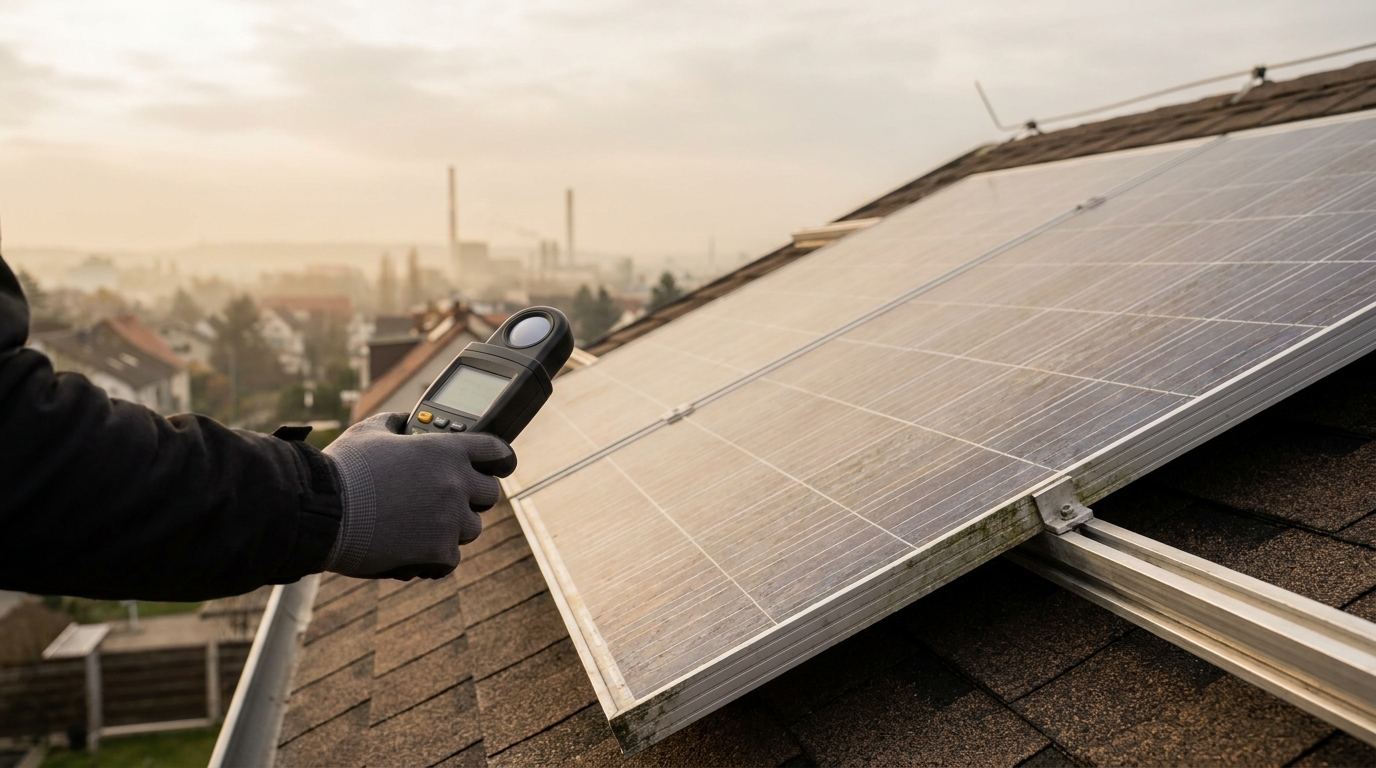
If you bought rooftop solar in the last five years, the production estimate you signed off on probably assumed clean skies. A study published in May 2026 in Nature Sustainability suggests that assumption is costing real money for homeowners in coal-heavy parts of the country, and no amount of panel cleaning will fix it.
Researchers at the University of Oxford, University College London (Mullard Space Science Laboratory), and the University of Bath analyzed more than 140,000 solar PV installations worldwide using satellite imagery and atmospheric data. Their conclusion: aerosol pollution cut global solar electricity output by 5.8 percent in 2023, the equivalent of 111 terawatt-hours of lost generation. That is roughly what 18 medium-sized coal plants produce in a year. The study, led by Dr. Rui Song, is the most comprehensive look yet at how the same coal plants propping up the grid are quietly suppressing the output of the panels homeowners spent $20,000 to install (Phys.org coverage of the Oxford/UCL paper).
What the study actually found
The headline number is global. The regional numbers are where it gets interesting for homeowners. In China, where coal-fired power and solar are most densely co-located, aerosols cut solar output by 7.7 percent, and roughly 29 percent of that loss was attributed specifically to coal-fired power plant emissions. Between 2017 and 2023, the world added roughly 246.6 terawatt-hours per year of new PV capacity while aerosol losses climbed to about 74 terawatt-hours per year. In rough terms, dirty air is erasing nearly one-third of the gains from new panels going up (Mirage News summary).
The mechanism the researchers describe has two parts. First, sulfate aerosols and black carbon (soot) scatter and absorb sunlight in the atmosphere before it ever reaches a rooftop. Second, those same particulates eventually deposit on panel glass as soiling. The paper also notes that aerosols change how clouds form and reflect light, which compounds the problem (Euronews coverage).
Two losses, two very different fixes
This distinction matters because one kind of loss you can fix, and the other you cannot.
Atmospheric attenuation happens above your roof. Sulfate haze and soot in the air column reduce the irradiance reaching your panels. There is no cleaning, no tilt change, and no inverter setting that recovers this loss. It only improves when upstream emissions drop.
Soiling is what builds up on the glass itself. National Renewable Energy Laboratory and industry data put typical US soiling losses at 3 to 5 percent annually in most settings, with urban or industrial sites capable of losing 3 to 5 percent per month if panels are never cleaned. Tilts between 15 and 35 degrees let rain do most of the cleaning work; arrays mounted under 10 degrees collect significantly more particulate (pv magazine USA: guide to solar production losses). The chemistry of how anthropogenic particulates settle on PV glass has been modeled in detail in the peer-reviewed literature (Bessho et al., PMC; Bergin et al., Environmental Science & Technology Letters).
Where in the US this matters most
The Oxford paper does not publish state-by-state US output deltas, so anything region-specific here is inference from their global findings combined with what is already known about US air quality and soiling. With that caveat, the homeowners most exposed today are in coal-heavy grid regions: the Ohio Valley, parts of Appalachia, and segments of the MISO and SPP footprints in the Midwest. Homeowners in the Desert Southwest and most of California operate under cleaner skies and see less atmospheric attenuation, though desert dust soiling is a separate problem there.
The Energy Information Administration projects that most planned US coal retirements through the early 2030s are concentrated in the Midwest and Mid-Atlantic. Cumberland in Tennessee, a 2,470 megawatt plant, retires in phases in 2026 and 2028. EPA greenhouse gas rules are projected to drive roughly 104,000 megawatts of coal retirement by 2035, with state implementation plans due in June 2026 (EIA: planned coal retirements). For homeowners in those grid regions, those retirement dates are a leading indicator of when local irradiance, and therefore panel output, should start to improve. You can look up scheduled retirements near you on the EPA Power Plant Retirements dashboard.
AI workflows for revenue teams
Placeholder house ad for Conservus.ai. Swap with final creative when brand assets are ready.
Partner with Conservus.aiHow to read your own inverter data
You do not need a consultant to spot underperformance. A handful of numbers from your monitoring app will tell you most of what you need to know.
-
Performance Ratio (PR): A healthy residential system runs a PR around 0.80 to 0.85. A sustained PR below roughly 0.75 is worth investigating.
-
kWh per kWp: Compare your system's daily yield to a PVWatts estimate for your zip code and tilt. Big gaps on clear-sky days point to losses your modeling did not account for.
-
Underperformance thresholds: Industry monitoring practice flags output below 80 percent of expected for 7 consecutive clear days as a minor issue, and below 60 percent for 3 consecutive clear days as a major issue worth a service call (pv magazine International).
Panel-level monitoring (microinverters or DC optimizers) makes it easier to separate soiling from a failing module or shading. String-level monitoring tells you something is wrong but not exactly which panel.
What you can actually offset
You cannot scrub sulfate out of the sky from your roof, but you can shrink the losses you do control.
-
Tilt: Aim for 15 to 35 degrees if your roof allows. Flatter arrays trap more particulate and lose more output between rains.
-
Cleaning cadence: One to two washes per year is usually enough to hold annual soiling losses near 1.2 to 1.5 percent in most temperate US climates. Industrial or high-dust sites need more frequent cleaning. Some production guarantees actually require 2 to 4 washes per year, and skipping them can void coverage (Aurora Solar).
-
Shade and trees: A single growing branch can knock more output off a string than a year of dust. Trim before summer.
Contract red flags before you sign a 25-year deal
If you are still shopping, the Oxford findings change what you should be reading in the fine print. A production guarantee is only as good as its exclusions, and soiling is one of the most commonly excluded line items in the industry (SolarInsure: gaps in production guarantees; pv magazine: soiling as a financial issue).
-
Compensation rate: Installers typically pay roughly $0.10 to $0.20 per under-produced kWh. At the low end, a 5 percent annual shortfall on a 10,000 kWh system pays you only about $50. Read the rate.
-
Duration: Guarantee terms run anywhere from 5 to 25 years. A 5-year guarantee covers the easy years.
-
Soiling clauses: Many guarantees exclude soiling losses unless you document a cleaning schedule. Ask whether atmospheric losses are excluded under force-majeure language.
-
Modeling source: Ask whether your production estimate uses generic Typical Meteorological Year (TMY) data or site-measured irradiance. TMY datasets were built on historical clear-sky averages and may not reflect current local aerosol loading.
AI workflows for revenue teams
Placeholder house ad for Conservus.ai. Swap with final creative when brand assets are ready.
Partner with Conservus.aiHow this shifts the payback math
The average 2026 US residential solar system runs $17,430 to $23,870 after the 30 percent federal Investment Tax Credit, at roughly $2.50 to $3.80 per watt installed. National payback averages around 8.7 years at an average residential electricity price near 16.4 cents per kWh (EnergySage 2026 cost data).
If your actual output runs 4 to 7 percent below modeled output every year, that 8.7-year payback shifts later by roughly 6 to 9 months. Over 25 years it is real money, but it does not break the case for solar. It changes what you should negotiate before you sign and what you should monitor after you switch on.
A practical buyer's checklist
-
Ask your installer which irradiance dataset they used for your production estimate, and whether it accounts for local aerosol trends.
-
Get the production guarantee compensation rate, duration, and exclusions in writing before you sign.
-
Confirm whether your monitoring is panel-level or string-level, and set up automated alerts for the 7-day 80 percent and 3-day 60 percent underperformance thresholds.
-
Plan one to two cleanings per year unless your contract requires more or your local air is unusually dusty.
-
If you live in a coal-retirement region, check the EPA's retirement dashboard so you know which year your local skies are expected to clean up.
The Oxford study is not an argument against rooftop solar. It is an argument for going in with your eyes open: the panels are doing their job, and the air above them is the variable nobody quoted you on.
Related reading
AI workflows for revenue teams
Placeholder house ad for Conservus.ai. Swap with final creative when brand assets are ready.
Partner with Conservus.aiSources
-
Coal pollution is cutting solar power output worldwide, study finds (Phys.org)
-
Blocked sunlight and changing clouds: how coal pollution is damaging our solar potential (Euronews)
-
Coal Pollution Cuts Solar Power Output, Study Finds (Mirage News)
-
The impact of air pollutant deposition on solar energy system efficiency (Bessho et al., PMC)
-
Guide for understanding solar production losses (pv magazine USA)
-
What are the Gaps in a Solar Production Guarantee? (SolarInsure)
-
Solar Power Production Guarantees: The Complete Guide (Aurora Solar)
-
Most planned coal capacity retirements are in the Midwest or Mid-Atlantic (US EIA)
Note: This article contains AI-assisted content and has been reviewed by our editorial team.
ABOUT THIS SERVICE: CallTheLocal.com is a directory and lead generation service, not a contractor or service provider. Submitting this form does not obligate you to hire anyone or purchase any service. Your information will be shared with licensed, insured home service professionals in your area who may provide quotes for your project. CallTheLocal.com does not guarantee the quality, timeliness, or outcome of any work performed by service providers you connect with through this service. Always verify licensing, insurance, and references before hiring. Get everything in writing before work begins.