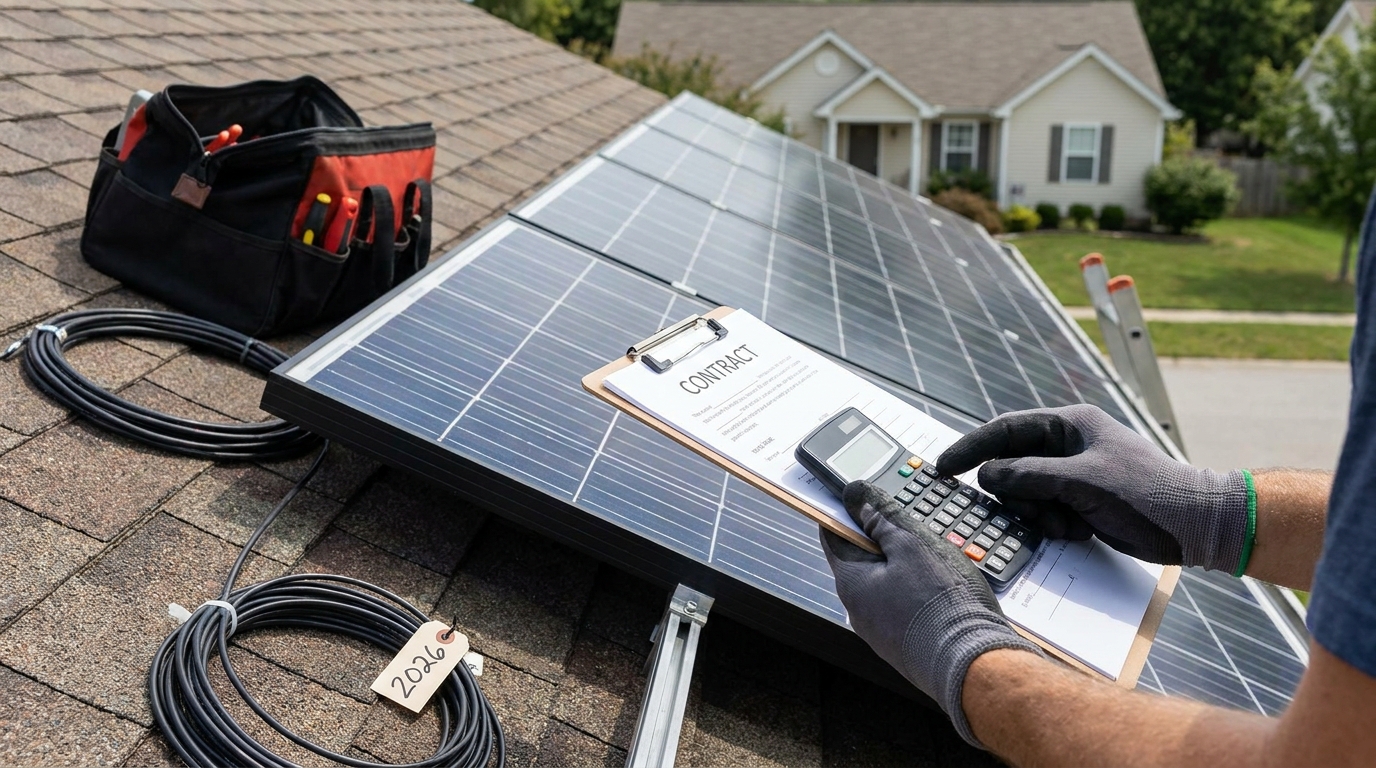
If you were planning to go solar this year and pay with cash or a loan, here is the news that changes your math: the 30% federal solar tax credit no longer exists for you. It ended on December 31, 2025, and it did not phase down gradually. It just stopped.
For a typical home system, that lost credit adds somewhere between $7,500 and $9,000 to your out-of-pocket cost. Same panels, same roof, same installer, thousands more. So before you sign anything in 2026, it is worth understanding exactly what changed, who is still protected, and the one financing path that quietly keeps a version of the credit alive.
What actually changed, and when
The One Big Beautiful Bill Act (OBBBA) was signed into law on July 4, 2025. Buried in it was the end of the Section 25D Residential Clean Energy Credit, the 30% federal credit that homeowners have leaned on for years when they bought their own solar systems.
Under the new law, that credit terminated for expenditures made after December 31, 2025. There was no glide path, no 26% then 22% step-down like we saw in past years. On January 1, 2026, the value for a customer-owned residential system dropped straight to 0%. As the EnergySage breakdown of the 2026 rules puts it plainly, the credit is simply gone for owned systems this year.
One detail matters a lot here: eligibility hinged on the installation being completed by December 31, 2025, not merely signed or contracted. The IRS treats the expenditure as made when the original installation is finished. So a contract you signed in late 2025 for a system that gets installed in February 2026 does not qualify. The panels had to be up and done by the deadline.
Good news if you already went solar
If you installed and lawfully claimed the credit for a pre-2026 system, you are fine. The repeal is not retroactive. Nothing about your past claim changes.
The same goes for carryforward. If you had more credit than you could use against your 2025 tax bill, the normal rules for carrying that unused amount into future years still apply. The Congressional Research Service lays out the termination and carryforward treatment for anyone who wants the official government read. Short version: the law closed the door for new owned systems, but it did not reach back and take anything away from people already inside.
The real 2026 quote: what losing 30% costs you
Let us put numbers on it. A typical residential solar install runs about $25,000 to $30,000 before any incentives. The federal credit used to knock 30% off that at tax time.
Here is the before-and-after for a $27,000 system:
-
2025 buyer (cash or loan): $27,000 gross, minus about $8,100 federal credit, for a net near $18,900.
-
2026 buyer (cash or loan): $27,000 gross, minus $0 federal credit, for a net of $27,000.
That is roughly $7,500 to $9,000 in extra real cost across the typical price range, depending on your system size and local pricing. It does not make solar a bad decision. Panels still cut your utility bill and still pay themselves off over time. But the payback period stretches out, and any 2026 quote needs to reflect that reality honestly.
The one workaround still left: leases and PPAs
Here is where it gets interesting. The federal credit did not vanish everywhere. It moved.
When you buy your own system, you are the owner, and you claimed the now-dead Section 25D credit. But if a company owns the system on your roof and you simply pay for the power or lease the equipment, that company is the owner. And a business owner can claim a different, still-active credit: the commercial Section 48E Clean Electricity Investment Credit.
That is the mechanics behind the two most common third-party ownership (TPO) arrangements:
-
Solar lease: You pay a fixed monthly rate to use the system. The installer or financier owns it and claims the credit.
-
Power Purchase Agreement (PPA): You pay only for the electricity the panels produce, usually at a rate 20% to 40% below your utility from day one, often with no money down.
The Section 48E credit starts at a 30% base and can climb to 40% to 50% with domestic content or energy community adders. The owner captures that value and reflects it in your lower lease or PPA pricing. You never see a tax form, but you feel it in the monthly number. Industry reporting from Utility Dive on the shift to third-party ownership details exactly this pass-through, and notes that TPO already makes up roughly 45% of residential installs, with growth projected around 25% in 2026 as 25D disappears.
This pathway has a clock on it too
The 48E route is not open forever, and the deadlines are specific:
-
Projects that begin construction on or before July 4, 2026 can be placed in service through the end of 2029.
-
Projects that begin construction after July 4, 2026 must be placed in service by December 31, 2027.
In practice, that gives new lease and PPA deals a safe window running through roughly 2027. If an installer is offering TPO, ask directly how their timeline lines up with these dates, because the value depends on it.
Lease or PPA versus owning: the trade-offs
A third-party deal is not a free lunch, just a different set of pros and cons. Weigh them before you decide the workaround is the answer.
What you gain with a lease or PPA:
-
Little or no upfront cost.
-
Immediate savings, with rates often 20% to 40% below utility power.
-
The financier handles the credit paperwork and typically the maintenance.
What you give up:
-
You do not own the system, so you do not build that equity or capture the full long-term value.
-
Many contracts include annual price escalators, so your rate creeps up over the years.
-
A lease or PPA can complicate a future home sale if the buyer has to assume the agreement.
Owning still wins on lifetime value if you can afford the higher 2026 net cost. TPO wins on upfront cash flow and keeps a slice of the federal benefit in play. Neither is universally right.
What still softens the blow
The federal credit is only one piece. OBBBA did not touch state and local incentives, and those can still add up to real money. Depending on where you live, you may have access to:
-
State tax credits: For example, New York offers 25% up to $5,000, South Carolina offers 25% with a 10-year carryforward, and Oregon has a $2,500 credit.
-
SREC markets: Solar Renewable Energy Certificate programs in places like DC, New Jersey (SREC-II), Massachusetts (SMART), Illinois, and Maryland let you sell the environmental value of the power you generate.
-
Property and sales tax exemptions: Many states exempt the added home value or the equipment purchase from tax.
-
Net metering: Available at full retail value in about 41 states, this credits you for excess power you send back to the grid and is often worth $500 to $1,500 a year.
These programs change constantly and vary by utility, so do not take a salesperson's word for what applies to you. The authoritative place to verify current state and utility incentives is DSIRE, the Database of State Incentives for Renewables and Efficiency, run by NC State University with the Department of Energy. Look up your state before you sign, and confirm any incentive a quote relies on.
The red flag to watch for in 2026 quotes
Here is the single most important thing to check on any cash or loan quote you get this year: make sure it is not still baking in the 30% federal credit.
Some installers, out of habit or worse, are still showing 2026 buyers a "net cost after federal tax credit" for owned systems. For a cash or loan purchase in 2026, that credit is $0. If a quote shows federal savings on an owned system, the projected savings are inflated for a benefit that no longer exists.
How to sanity-check a quote:
-
Ask flat out: "Does this include the 30% federal residential tax credit?" If yes and you are buying the system, that is a problem.
-
Separate federal from state incentives on paper. Federal is zero for owned systems in 2026. State incentives may still apply.
-
If they claim a federal credit, ask whether they mean the commercial 48E credit, which only applies if the company owns the system through a lease or PPA, not you.
-
Get every incentive assumption in writing so you can verify it against DSIRE.
Bottom line and next steps
The 30% federal credit is gone for 2026 cash and loan buyers, full stop. That adds roughly $7,500 to $9,000 to a typical owned install. Solar can still be a smart long-term move, but the honest math looks different this year.
If you are weighing your options in 2026:
-
Buying with cash or a loan? Budget for the full price with no federal credit, and make sure your quote reflects that.
-
Want to keep a version of the federal benefit? Look at leases and PPAs, but confirm the installer's timeline fits the 48E deadlines centered on July 4, 2026.
-
Either way, stack every state credit, rebate, SREC program, and net metering benefit you qualify for, and verify each one on DSIRE.
-
Always reject a quote that shows federal savings on a system you would own outright.
Run the numbers with clear eyes, get multiple quotes, and make sure everyone is pricing 2026 as it actually is.
Related reading
-
[AI Data Centers Are Now on Your Power Bill: Why 2026 Electricity Rates Jumped and the Home Upgrades That Blunt the Hit](/guides/ai-data-centers-power-bill-2026-electricity-rates-home-upgrades)
Sources
-
SEIA: The Clean Energy Provisions in the One Big Beautiful Bill
-
Utility Dive: Solar industry looks to third-party ownership as 25D tax credit winds down
-
DSIRE: Database of State Incentives for Renewables and Efficiency
Note: This article contains AI-assisted content and has been reviewed by our editorial team.
ABOUT THIS SERVICE: CallTheLocal.com is a directory and lead generation service, not a contractor or service provider. Submitting this form does not obligate you to hire anyone or purchase any service. Your information will be shared with licensed, insured home service professionals in your area who may provide quotes for your project. CallTheLocal.com does not guarantee the quality, timeliness, or outcome of any work performed by service providers you connect with through this service. Always verify licensing, insurance, and references before hiring. Get everything in writing before work begins.