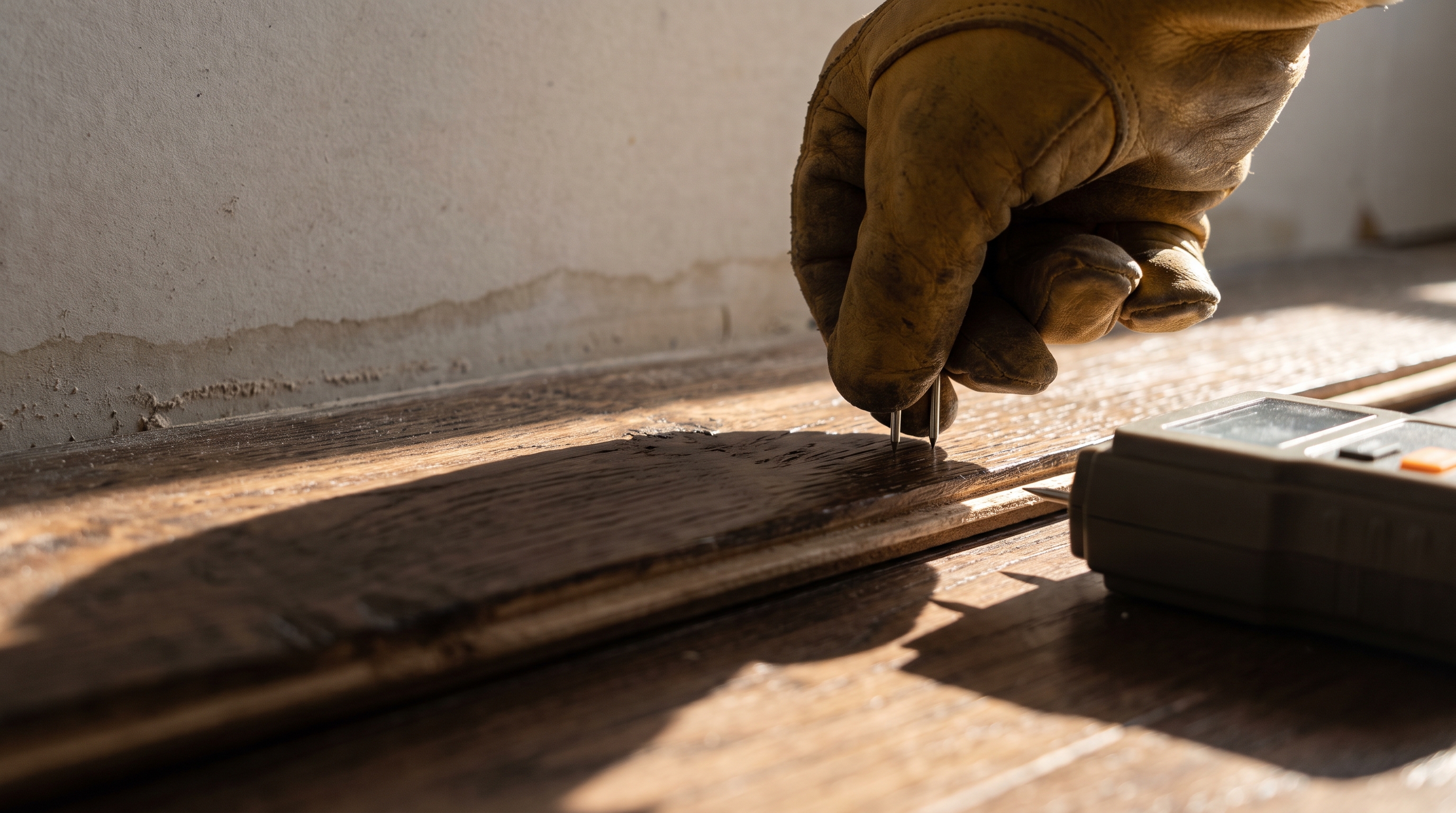
Sometimes. Solid hardwood wet by a roof leak or rain intrusion can often be dried in place if drying starts within 24 to 48 hours and boards are not badly buckled or cracked. Hardwood saturated by storm surge or floodwater generally cannot be saved, because that water carries bacteria and pathogens drying cannot fully remove.
Hurricane Isaias came ashore near Destin, Florida, on Friday night, Oct. 9, as a Category 2 storm with 105 mph winds, according to Fox Weather and Wikipedia. Wikipedia's summary lists a 5.51-foot storm surge at Panama City, and rain totals reached 12.97 inches in Bellwood, Alabama, and 8.06 inches in Niceville, Florida. CBS News reported widespread flooding in Destin and Pensacola, with numerous homes taking water from surge and heavy rain.
If your floors are wet, the next 48 hours matter more than anything else you'll do on this project. Here's how to sort out what to dry, what to pull, what it should cost, and whom to call.
Step one: figure out where the water came from
Before you decide anything about a specific floor, answer one question: did this water come from outside and rise up, or did it come down from above?
The restoration industry's standards body, the IICRC, addressed this directly in a March 2026 position statement on weather-related water damage. Under its S500 standard, Category 3 water is grossly contaminated, and that category covers sources like seawater and rising water from rivers or streams. Wind-driven rain, on the other hand, is not automatically Category 3. The category is supposed to be based on what a pro actually observes at your house.
In plain terms:
-
Storm surge or floodwater that came in under the doors: treat it as contaminated. Porous flooring is generally coming out.
-
A roof leak, a blown-in window or rain intrusion: it may be cleaner water, which gives you more options to dry and save floors. A mitigation tech should confirm the category on site.
That single call decides most of what follows.
The 24-to-48-hour window
The EPA puts it simply in its guide to mold and moisture: "It is important to dry water-damaged areas and items within 24-48 hours to prevent mold growth." It adds that if wet materials are dried in that window, "in most cases mold will not grow." The CDC gives the same window for cleaning up and drying out a home after a flood.
The catch on the Gulf Coast is humidity. LSU AgCenter housing specialist Claudette Reichel told KSLA: "Drying wood floors may take weeks in our humid climate, less if you can dehumidify the space." So the 48-hour goal is about starting serious drying fast: water out, wet materials out, air conditioning and dehumidifiers running. Full drying can take much longer.
One safety note: if you're running fans or dehumidifiers off a generator, keep the generator outside. One of the Isaias deaths in Escambia County came from carbon monoxide from a generator used indoors, according to Fox Weather and CBS News.
Carpet and pad: mostly a rip-out
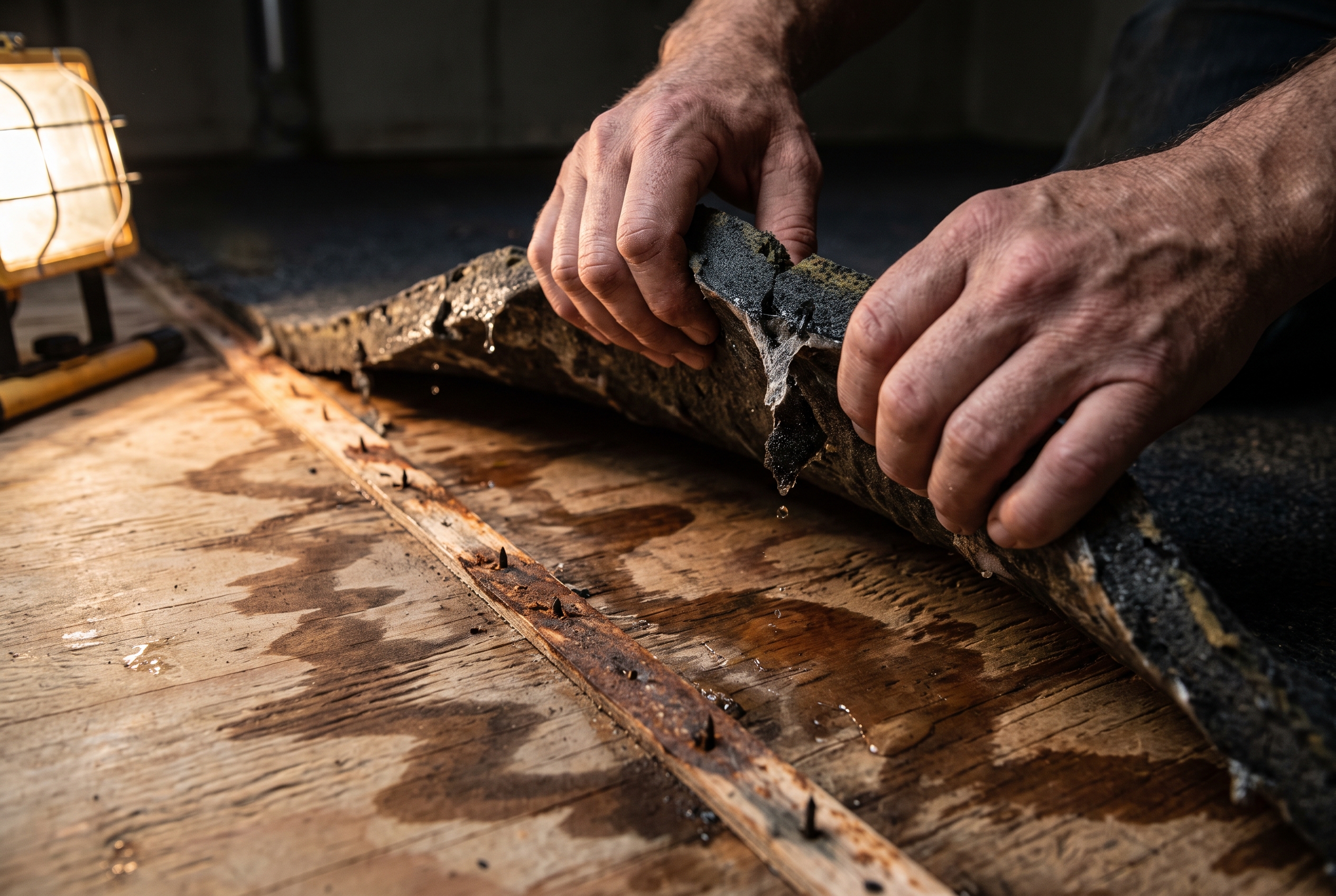
This is the easiest call on the list. Reichel's guidance: "Remove wet carpets, carpet pads and rugs within 24 hours." She also said "you should always replace carpet pads."
-
Carpet soaked by surge or floodwater: it goes. The CDC says to remove carpets that have been soaked and can't be dried right away, and the EPA notes porous materials like carpet may have to be thrown away if they become moldy. EPA also recommends calling a professional experienced with contaminated water when the damage came from sewage or other contaminated water.
-
Pad: replace it, no matter the water source.
-
A valuable rug wet by a clean-water leak: Reichel said valuable carpets may be salvageable through professional cleaning. Get it to a cleaner quickly.
Solid hardwood: the floor most worth fighting for
Solid hardwood is where the answer really depends on the details. According to restoration firm WrightWay Emergency Services, professional drying of hardwood is "usually successful" when exposure was within 24 to 48 hours. Pros use specialty floor-drying mats that pull moisture up through the boards, along with dehumidifiers.
Signs it can likely be dried:
-
The water was a cleaner source, like a roof leak or rain intrusion
-
Drying started within a day or two
-
Boards are cupped or slightly raised but not cracked or split
Signs it needs replacing:
-
Storm surge or floodwater. WrightWay is blunt: "Sewage backups, storm surge, and floodwater saturate hardwood with bacteria and pathogens that cannot be fully removed."
-
Badly lifted, damaged boards. Per WrightWay, boards lifted more than half an inch and cracked or split "cannot be reversed by drying."
-
Long saturation. WrightWay says saturation of five or more days causes "irreversible swelling in solid hardwood."
Tips while drying:
-
Reichel recommends carefully removing a board every few feet to reduce buckling, and running air conditioning plus a dehumidifier to speed drying (WAFB).
-
Be patient with a buckled subfloor. In Reichel's words: "A buckled subfloor may flatten out on drying. Be patient."
-
Don't let anyone sand and refinish too soon. WrightWay gives a hardwood target moisture in Florida of "6 to 9 percent." Ask your contractor to show you moisture readings before sanding starts.
Engineered wood: same rules, less margin
Engineered hardwood follows roughly the same logic as solid wood, but with less room for error. WrightWay says prolonged saturation (five or more days) causes "delamination in engineered hardwood," meaning the layers separate. Even when engineered planks survive drying, the real-wood top layer is thinner than solid hardwood, so there's less material to sand away if the surface needs refinishing. If your engineered floor sat in surge water or stayed wet for days, plan on replacement.
Laminate and LVP: pull them so the subfloor can breathe
Here's the trap with "waterproof" and water-resistant floors: they hold water against whatever is underneath. Reichel's advice: "Also remove vinyl, laminate and other impermeable flooring over wood floors immediately after the flood has receded." The point is to let the wood subfloor dry.
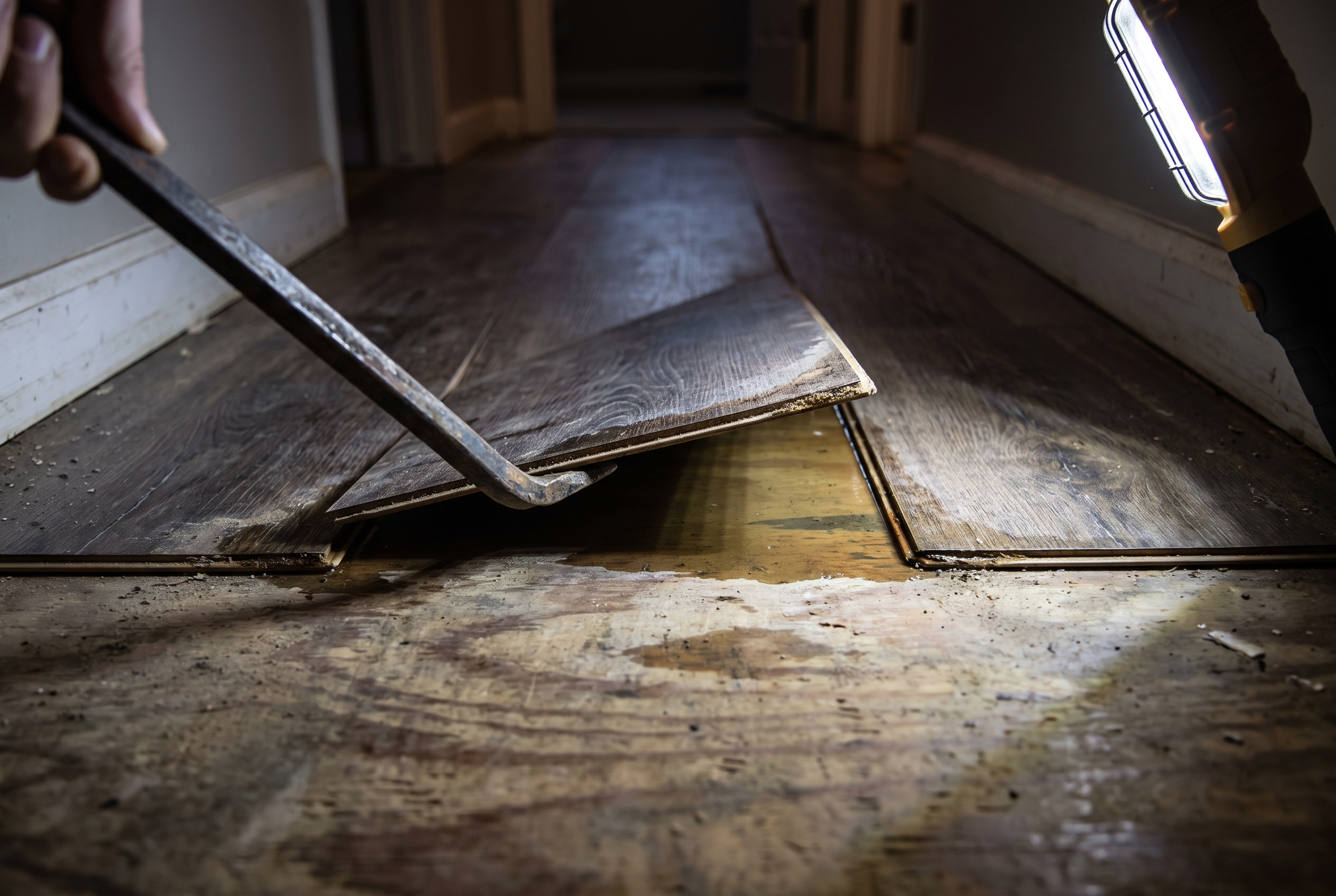
The Alabama Cooperative Extension System goes further: "If a plywood or hardwood subfloor is wet, you should remove the linoleum or vinyl and replace the subfloor material." It also warns that with resilient flooring, "Thorough drying may take as long as 6 weeks or more."
Don't count on a warranty, either. Luxury vinyl plank warranties commonly exclude this exact situation. Ferma Flooring's LVP warranty, as one example, says flooding and standing water are "not covered by this warranty" and "Any mold or mildew claims are excluded." A waterproof plank doesn't mean your subfloor, or your claim, is protected.
Don't rush the new floor
Probably the most expensive mistake after a flood is installing new flooring over a subfloor that's still wet. Alabama Extension's guidance: "Allow subflooring to dry for several months before installing another floor over it." That feels slow when you're living on bare plywood, but trapping moisture under new flooring can put you right back where you started.
When you do replace, think about what holds up next time. The Association of State Floodplain Managers lists "solid vinyl flooring with chemical-set adhesives" among highly flood-resistant residential materials. Worth raising with your installer if you live in a surge zone.
What it costs: mitigation, removal and new floors
Most good cost data is national. Here's what the numbers say, step by step.
1. Water mitigation (extraction and drying)
PuroClean's 2026 guide prices mitigation by water category:
-
Category 1 (clean water): $3-$4 per square foot
-
Category 2 (gray water): $4-$7 per square foot
-
Category 3 (black water, which includes surge): $7-$15 per square foot
PuroClean's 2026 national average is $3,860, with most homeowners paying $1,383 to $6,370. That covers mitigation only, not rebuilding or flooring.
2. Removing the old floor
HomeAdvisor puts old floor removal at $1-$6 per square foot, with vinyl and carpet at the low end. Fixr lists hardwood removal at $1-$3 per square foot.
3. New flooring, installed (national)
| Material | Installed cost per sq ft | Source |
|---|---|---|
| Carpet | $3-$22 | HomeAdvisor |
| Vinyl | $2-$14 | HomeAdvisor |
| Laminate | $1.70-$17 | HomeAdvisor |
| Hardwood (all types) | $4-$29 | HomeAdvisor |
| Engineered hardwood | $8-$14 | Fixr |
| Solid hardwood | $9-$23 | Fixr |
HomeAdvisor says labor makes up roughly 60% of a typical flooring job, and its national average project runs $3,153 (range $1,528 to $4,850).
What Pensacola quotes look like
The only Gulf Coast-specific numbers we found come from Homeyou's Pensacola flooring cost page, based on 221 local flooring installations quoted on its platform this year. These are quote data from a lead-generation site, not a survey, so treat them as a rough local reference point:
-
Laminate: $5.50 to $6 per square foot
-
Vinyl or linoleum: $2.50 to $4 per square foot
-
Wood: about $8,000 for a 1,000-square-foot home (roughly $8 per square foot)
-
Typical Pensacola flooring job: $668 to $5,019
We couldn't find reliable data comparing Gulf Coast prices to national averages, so get at least two or three local quotes to see where your market sits right now.
A sample room, start to finish
Using the ranges above, here's rough math for a 300-square-foot living room hit by surge water and refloored with engineered hardwood:
-
Category 3 mitigation: 300 x $7-$15 = $2,100-$4,500
-
Floor removal: 300 x $1-$6 = $300-$1,800
-
Engineered hardwood installed: 300 x $8-$14 = $2,400-$4,200
That's roughly $4,800 to $10,500 before any subfloor replacement, wall repair, tax or permits. This is an illustration built from national ranges, not a quote.
Mitigation and rebuild are separate bills
Expect two separate invoices, often from two separate companies. The mitigation crew handles extraction, tear-out and drying. Rebuilding comes after. Homewyse puts national water damage repair (cutting out damaged materials, disposal, framing repair and basic surface patching) at $20.58-$37.63 per square foot as of May 2026, and that figure doesn't include finished flooring, hazardous-material testing, a 13% to 22% general contractor markup, tax or permits.
When you compare bids, make sure each one says clearly which phase it covers. A cheap "water damage" quote that leaves out drying, or a flooring quote that assumes a dry subfloor that isn't, isn't a real comparison.
Whom to call, and how to avoid getting burned
The order matters:
-
A water mitigation company first. They extract water, pull wet carpet and pad, set up drying equipment and take moisture readings. Ask them to tell you the water category in writing.
-
A flooring installer second, once moisture readings show the subfloor is dry enough. Ask the installer what readings they need before they'll lay new flooring.
Be careful who you hand money to this week. Florida Attorney General James Uthmeier warned of price gouging and repair scams after Isaias, telling News4JAX, "This happens to be the time when some scammers come into play." Officials said unlicensed contractors and adjusters were collecting deposits, and they urged residents not to sign contracts before verifying identities.
Red flags to watch for:
-
Door-to-door crews who want a deposit on the spot
-
Pressure to sign today before you've seen a written, line-item estimate
-
No proof of license or insurance, or reluctance to show it
-
Quotes that don't separate mitigation from flooring replacement
-
An installer ready to lay new floors without checking subfloor moisture
Price gouging penalties in Florida are $1,000 per violation, up to $25,000 per day. To report it, call the AG's hotline at 1-866-9NO-SCAM (1-866-966-7226) or file at myfloridalegal.com.
The bottom line: what to do today
-
Pull it today: wet carpet pad (always), carpet soaked by surge or floodwater, and vinyl, laminate or LVP over a wood subfloor.
-
Try to dry it: solid hardwood wet by a cleaner source, caught early, without cracked or badly lifted boards. Engineered wood only if it wasn't saturated for days.
-
Replace it: any hardwood saturated by surge or floodwater, and a wet plywood subfloor under vinyl.
-
A fair quote looks like: roughly $3-$4 per square foot for clean-water mitigation, $7-$15 for black water, $1-$6 for removal, and an installed flooring price inside the national ranges above, with each phase listed separately.
Related reading
-
How to Run an Alabama Contractor License Lookup Before Isaias Repairs
-
What Should an Emergency Roof Tarp Cost After Hurricane Isaias?
Sources
-
Fox Weather: Post-tropical Isaias leaves at least 4 dead in Southeast
-
CBS News: At least 4 dead as weakened Isaias brings threat of floods across the Southeast
-
News4JAX: Florida officials warn of price gouging, repair scams after Hurricane Isaias
-
IICRC: Category of Water Damage and Weather-related Events (March 2026)
-
Alabama Cooperative Extension System: Floor Cleanup and Renovation
-
WrightWay Emergency Services: How to Dry Hardwood Floors After Water Damage
-
Association of State Floodplain Managers: Installation of flood damage-resistant materials
Note: This article contains AI-assisted content and has been reviewed by our editorial team.
ABOUT THIS SERVICE: CallTheLocal.com is a directory and lead generation service, not a contractor or service provider. Submitting this form does not obligate you to hire anyone or purchase any service. Your information will be shared with licensed, insured home service professionals in your area who may provide quotes for your project. CallTheLocal.com does not guarantee the quality, timeliness, or outcome of any work performed by service providers you connect with through this service. Always verify licensing, insurance, and references before hiring. Get everything in writing before work begins.