Note: This article contains AI-assisted content and has been reviewed by our editorial team.
The 2026 Atlantic hurricane season officially opened June 1, and if you started calling generator dealers that morning, you already heard the bad news. Most Southeast installers are quoting 14 to 20 week lead times, which puts a realistic in-service date somewhere in October. That is past the statistical peak of the season, which lands in August and early September.
Here is the part that surprises homeowners: the units are mostly in stock. The bottleneck is the install crews, the gas plumbers, and the electrical inspectors. After heavy demand following the 2024 and 2025 seasons, every authorized dealer in Florida, Georgia, the Carolinas, and the Gulf Coast is booked deep. Generac alone controls roughly 70 percent of the residential standby market, and even their certified installers cannot conjure additional Saturdays.
This guide is for the homeowner who is finally serious about backup power. We will walk through what NOAA is actually forecasting, what a standby system does (and does not) cover, real installed price ranges, the propane versus natural gas decision, a defensible portable Plan B, and the red flags that separate a licensed installer from a storm-season opportunist.
What NOAA Is Forecasting for 2026
The Atlantic hurricane season runs June 1 through November 30, with the busiest stretch typically from mid-August through early October. The NOAA Climate Prediction Center issues its updated outlook in late May, and the call this year again leans above-normal for total named storms, hurricanes, and major hurricanes.
For Call The Local readers on the Southeast and Gulf coasts, the relevant takeaway is not the precise storm count. It is that the climatological window where a major hurricane is most likely to make landfall opens in roughly 60 days, and your install crew probably cannot be at your house in 60 days. FEMA's preparedness guidance has always been the same: decide before the first named storm, not after it.
How a Whole-Home Standby System Actually Works
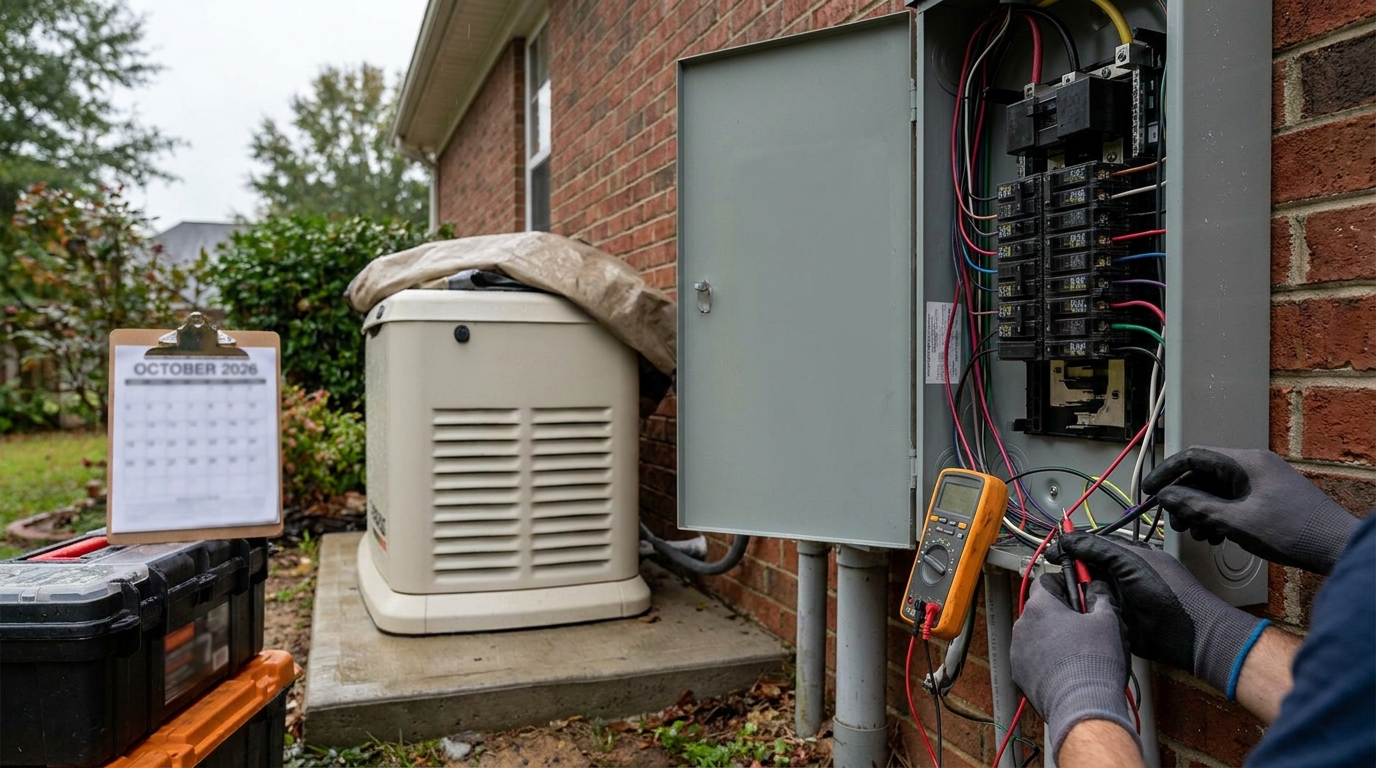
A standby generator is permanently installed outside the house, like a central AC condenser, and it runs on natural gas from your utility or liquid propane from an onsite tank. The brain of the system is an automatic transfer switch (ATS), which sits next to your main electrical panel. When utility power drops, the ATS isolates your home from the grid, signals the generator to start, and re-energizes selected circuits, usually within about 10 seconds.
Sizing falls into two families:
-
Air-cooled, 10 to 14 kW class. Think Generac Guardian, Kohler 14RCA, and Briggs PowerProtect. These cover essentials: refrigerator, well pump, internet, lights, a window or mini-split AC, and selected outlets. With a load-shedding module, they can rotate larger loads like a central AC compressor.
-
Liquid-cooled, 22 to 26 kW and up. This is the tier that genuinely powers a typical 2,500 to 4,000 square foot Southeast home, including central air conditioning, the electric range, and the well or septic pump, all at once. This is what most homeowners actually mean when they say "whole-home."
An interlock kit on a portable generator is not the same thing. It is a useful Plan B, covered below, but it is not a standby system and a dealer who blurs that line is a dealer to walk away from.
Installed Price Ladder (Not Sticker Price)
The number on the manufacturer's website is the unit only. The number that matters is installed, with the ATS, the pad, the gas hookup, and the permit. Working from current Southeast dealer quotes and corroborated by trade-press benchmarks and the Consumer Reports Generator Buying Guide:
-
14 kW air-cooled, installed with ATS and basic gas hookup: roughly $5,500 to $7,500.
-
22 kW liquid-cooled, installed: roughly $12,000 to $22,000. The spread comes from how far your gas run is, panel work, pad and clearance requirements, and whether load-shedding modules are needed.
-
Underground 500-gallon LP tank, if you are going propane: add $2,500 to $4,500.
Financing is widely available through manufacturer-affiliated programs (Generac Financial Solutions, Synchrony). A fully installed 22 kW project typically runs $99 to $200 per month on 10-year terms. Run the math against your homeowners insurance deductible after a major storm; for many coastal homeowners the payment is smaller than the spoiled-food and hotel tab after a single multi-day outage.
AI workflows for revenue teams
Placeholder house ad for Conservus.ai. Swap with final creative when brand assets are ready.
Partner with Conservus.aiNatural Gas vs. Propane: The Decision That Actually Matters
Both fuels work. The right one depends on what is available at your address and your tolerance for risk during a storm.
-
Natural gas. If your street has a gas main, this is usually the cheaper and simpler install. Runtime is effectively unlimited as long as utility pressure holds. The risk: in a major hurricane, utility gas pressure can be interrupted, and you have no reserve.
-
Liquid propane. A 250-gallon tank is the entry point, 500 gallons is the common Southeast spec, and 1,000 gallons is for larger liquid-cooled units or longer runtime targets. Propane is immune to gas-main outages, which is the entire argument in a hurricane zone. The tradeoff is finite runtime: a 22 kW unit at roughly 50 percent load will burn through a 500-gallon tank in several days, not weeks.
Current residential propane pricing is tracked weekly by the U.S. Energy Information Administration; check it before you sign so the runtime cost math in your quote matches reality.
Plan B: Portable Inverter Generators Done Right
If you cannot get a standby installed before the season peaks, a portable inverter generator paired with a proper interlock kit or manual transfer switch is a legitimate stopgap. "Inverter" matters: these units produce clean sine-wave power that will not fry modern electronics, and they run far quieter and more fuel-efficiently than a traditional open-frame portable.
Realistic options and price points:
-
Honda EU2200i, around $1,200 to $1,400. The reliability benchmark for the category.
-
Yamaha EF2000iSv2, similar price tier, similar reputation.
-
Predator 3500 inverter, around $1,000 to $1,200 if you want more headroom for a window AC.
Budget realistically: a refrigerator, a 6,000 to 8,000 BTU window AC, modem and router, a few LED lights, and phone chargers will fully load a 2,200 watt unit. For a central AC compressor, you are in standby-generator territory, not portable.
Two non-negotiables on the safety side. First, the U.S. Consumer Product Safety Commission attributes roughly 85 deaths per year to portable-generator carbon monoxide poisoning. New units sold today are expected to meet the PGMA G300 or ANSI/UL 2201 CO shut-off standards, which automatically kill the engine when CO builds up. Verify this label before you buy, especially on used or marketplace units. Second, never run a portable inside a garage, even with the door open, and never backfeed an outlet with a homemade cord. Use an interlock kit installed by a licensed electrician.
Contractor Red Flags
Hurricane season brings out specialists, and it also brings out opportunists. A legitimate standby install in the Southeast follows NEC Article 702 for optional standby systems and requires real paperwork. Any of the following should end the conversation:
-
No load calculation. If the dealer hands you a quote without measuring your actual electrical demand, they are guessing at sizing.
-
No permit. Most Southeast jurisdictions require both an electrical permit and a gas permit. Skipping the permit means skipping the inspection.
-
No automatic transfer switch. An interlock kit on your main panel, sold to you as a "whole-home" solution with a standby generator, is a mismatch. Standby units pair with an ATS.
-
No manufacturer authorization. Ask for the dealer's authorized installer credential for the brand they are selling. Warranty service depends on it.
-
Cash only, no written contract, or pressure to sign before a site survey. Standard storm-chaser tells.
AI workflows for revenue teams
Placeholder house ad for Conservus.ai. Swap with final creative when brand assets are ready.
Partner with Conservus.aiTiming Reality for 2026
Even if you sign a contract this week, plan on a September or October in-service date in most Southeast markets. That is not a reason to skip the call. It is a reason to get on the schedule now so you are installed before the 2026 season closes November 30, and absolutely before the 2027 season opens. In the meantime:
-
Order a properly rated portable inverter generator and a CO detector for every sleeping area.
-
Have a licensed electrician install an interlock kit or manual transfer switch so you are not running extension cords through a window.
-
If you are going propane, get the tank scheduled and topped off; tank installs are also booking out.
What Ownership Actually Costs
Budget for annual dealer service at roughly $200 to $400, which covers an oil and filter change, spark plugs as needed, valve and air-filter check, and a battery test. Plan on a starting battery replacement around the five-year mark. Your unit will also run a brief weekly or monthly exercise cycle on its own, which is normal and is what keeps it ready.
Local Action Checklist
-
Get on two or three authorized dealer schedules this month. Lead times are real; do not wait for a single quote to come back.
-
Decide your fuel before the site survey: confirm natural gas availability with your utility, or get a propane company out to spec a tank location.
-
Insist on a written load calculation, a permit, and an ATS in the proposal.
-
For the gap before install, buy a CO-shutoff-equipped portable inverter generator and have an electrician install an interlock kit.
-
Verify each contractor's state license, liability insurance, and manufacturer authorization before signing.
Use the form on this page to be matched with licensed, insured generator installers serving your area. Get multiple written quotes, compare what is actually included (not just the headline number), and confirm permit and inspection are part of the price.
AI workflows for revenue teams
Placeholder house ad for Conservus.ai. Swap with final creative when brand assets are ready.
Partner with Conservus.aiRelated reading
Sources
-
NOAA Climate Prediction Center, Atlantic Hurricane Season Outlook
-
U.S. Energy Information Administration, Residential Propane Prices
ABOUT THIS SERVICE: CallTheLocal.com is a directory and lead generation service, not a contractor or service provider. Submitting this form does not obligate you to hire anyone or purchase any service. Your information will be shared with licensed, insured home service professionals in your area who may provide quotes for your project. CallTheLocal.com does not guarantee the quality, timeliness, or outcome of any work performed by service providers you connect with through this service. Always verify licensing, insurance, and references before hiring. Get everything in writing before work begins.