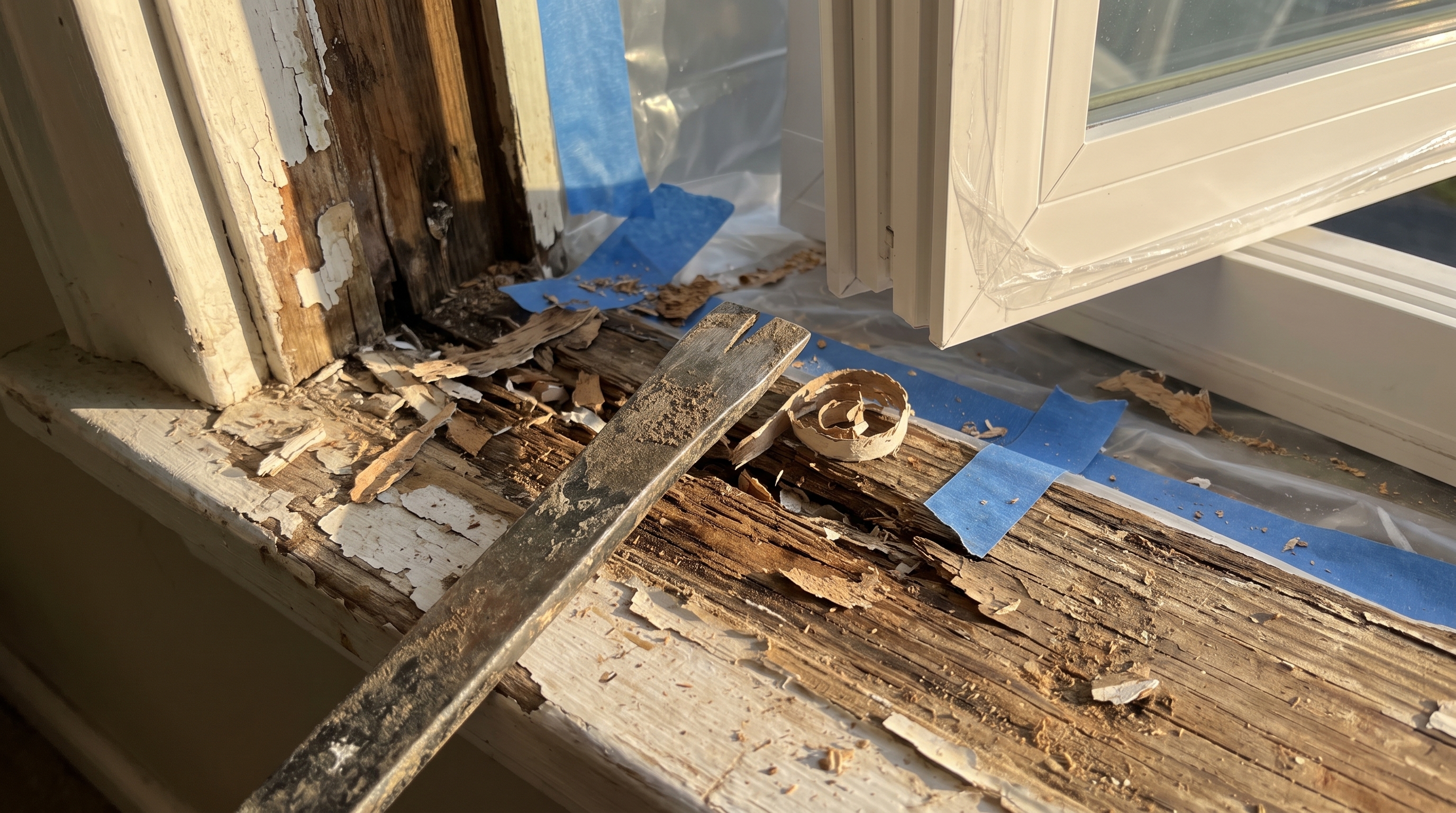
A window quote can look complete and still leave out the things that decide both the price and how the job turns out. This checklist covers the window replacement red flags worth catching before you sign. Each one comes with a description of what a fair quote looks like, so you can put two or three bids side by side and see which contractor is being straight with you.
Work through every bid with the list below. A quote that passes all six is worth serious consideration. A quote that only holds up if you sign tonight is not.
What should a window replacement quote include?
Short answer: it should name the window brand and model, the number of windows, the size and type of each one, any add-ons, and how they'll be installed, with labor and materials priced separately. That's the standard set by Consumer Reports' replacement window buying guide.
Red flag 1: A vague product line
Watch for line items like "vinyl double-hung, energy efficient, 12 windows." That tells you almost nothing. You can't compare it with another bid, and nothing stops a contractor from installing a cheaper unit than the one you pictured.
What a fair quote looks like:
-
Brand and model for every window, not "or equivalent"
-
Count, size and type (double-hung, casement, slider, and so on) for each opening
-
Add-ons listed one by one, such as grilles, special glass or hardware finishes
-
Installation details
-
Labor and materials broken out separately
The quote should also say the windows will carry the right energy labels. ENERGY STAR advises homeowners to ask for models that meet ENERGY STAR criteria for their location, with an ENERGY STAR label and an NFRC label on each window. On install day, before any old window comes out, check that the delivered units are the ones you ordered and that both labels are on them.
The NFRC label lists five ratings: U-factor, solar heat gain coefficient (SHGC), visible transmittance, air leakage and condensation index. NFRC certification means a third party verified those numbers independently. The two that matter most for comparing bids are explained by the U.S. Department of Energy: the lower the U-factor, the less heat moves through the window, and the lower the SHGC, the less solar heat gets in. If one bid lists these numbers and another doesn't, you've learned something about both contractors.
What is the difference between insert and full-frame window replacement?
Short answer: an insert (or "pocket") window fits a new unit inside your existing frame. A full-frame replacement tears out the old frame and puts in a completely new one, including the head, side jambs and sill. That's how This Old House defines the two methods.
Red flag 2: No install method on the quote
The install method changes the cost, the scope of work and how much glass you end up with. A bid that doesn't say which method it uses leaves you unable to compare it with anything else.
According to Consumer Reports, pocket windows keep installation costs down because they sit inside the existing frame. New-construction windows require removing the whole old window, including the frame, sill and trim, and they usually cost more to install.
Each method makes sense in different situations, according to This Old House:
-
Full-frame fits when the existing frame shows rot, warping or structural damage, when you want to change the window's size or style, or when settling has pushed the opening out of square.
-
Insert fits when the frame is in good shape and the size and style aren't changing. The trade-off is that inserts reduce the total glass area.
For a sense of the price gap, This Old House puts insert windows at roughly $100 to $400 per window and full-frame windows at roughly $180 to $1,500 per window.
What a fair quote looks like: it names the method for each opening and explains the choice. If a contractor quotes inserts across the board, ask whether they checked each frame for rot or out-of-square openings. If they quote full-frame everywhere, ask why the cheaper insert method won't work.
Are "today only" window prices a scam?
Short answer: pressure to decide on the spot is a warning sign. The FTC says plainly that "scammers pressure you for an immediate decision." A fair price should still be good after you've had time to get other bids.
Red flag 3: Disappearing discounts and inflated "retail" prices
Window sales have a track record here. In 2009 and 2010 the Washington Attorney General investigated window sellers over what the office later called "high-pressure sales pitches, inflated pricing and nonexistent discounts" along with unsupported energy-savings claims. In July 2010, Tacoma-based Energy Exteriors settled allegations that it inflated starting prices so customers would think they were getting a discount and made unsupported claims such as "This won't cost you a cent." The settlement included a $25,000 suspended civil penalty and about $23,600 in fees and costs, and the company denied wrongdoing. West Coast Vinyl, Harley Exteriors, Penguin Windows and Evans Glass had reached similar settlements in the months before.
Energy-savings promises are a related trap. In February 2012 the FTC settled with five replacement-window marketers (Gorell Enterprises, Long Fence & Home, Serious Energy, THV Holdings and Winchester Industries) over unsupported claims like a "40% Energy Savings Pledge" and "50% Energy Savings Guaranteed." The orders bar those companies from making savings claims unless competent and reliable scientific evidence backs them up.
What a fair quote looks like:
-
The price stays good long enough for you to collect and compare other bids
-
No "regular price" anchor that gets slashed if you sign tonight
-
No percentage savings guarantees; the efficiency case rests on the NFRC ratings
-
A written statement of your right to cancel within three business days, which the FTC lists as a standard contract element
Can I cancel a window contract I signed at home?
Often, yes. Under the FTC Cooling-Off Rule, you can usually cancel a sale of $25 or more made at your home (or $130 or more at a temporary location) until midnight of the third business day after the sale. Saturdays count as business days; Sundays and federal holidays don't. The seller has to give you two copies of a cancellation form along with a dated contract or receipt. If a salesperson in your living room doesn't hand those over, treat it as another red flag.
How much should a deposit be for window replacement?
Short answer: it depends on your state, and some states set a legal maximum. Whatever your state, the FTC's advice is: "Don't pay the full amount for the project up front."

Red flag 4: An oversized deposit or a cash-only request
The FTC notes that some states limit down payments, and it also flags contractors who "only accept cash." Two state rules show how much the limits can vary:
-
California: According to the Contractors State License Board, the down payment on a home improvement job can't be more than $1,000 or 10 percent of the contract price, whichever is less, and "there are no exceptions for special-order materials." Payments also can't run ahead of the work completed, and the contract needs a detailed written payment schedule.
-
Massachusetts: Under M.G.L. c.142A §2, contracts over $1,000 must be in writing, and a deposit paid before work starts can't be more than the greater of one-third of the total contract price or the actual cost of any special-order or custom-made materials.
That difference matters for windows in particular, because replacement windows are often built to order. A Massachusetts contractor may legally collect enough to cover custom units up front. A California contractor can't, even for special-order windows. If a California bid asks for 50 percent down to "order the windows," it breaks the state rule.
What a fair quote looks like: a deposit within your state's limit, a written payment schedule tied to work actually completed, payment by check or card rather than cash only, and the final payment held until the job is done and you've inspected it.
Do you need a permit to replace windows?
Short answer: often, yes, but the rules are set locally, so ask your city's building department. Don't assume a same-size swap is exempt.
Red flag 5: No permit line, or "you pull the permit"
The FTC lists a contractor asking you to get the building permits yourself as a warning sign. The permit holder is generally the one responsible for meeting code, so you want that to be the contractor.
Los Angeles shows that even a simple replacement can need paperwork. The city's building department, LADBS, issues an electronic building permit for replacing windows with the same size, opening type and location as the existing ones. LADBS also restates the egress rules for bedroom windows: at least 5.7 square feet of net clear openable area, a clear opening at least 24 inches high and 20 inches wide, and a sill no more than 44 inches above the floor. That's one reason to be careful with inserts in bedrooms, since an insert shrinks the opening a bit.
What a fair quote looks like: it says who pulls the permit (the contractor), whether the permit fee is included in the price, and that the windows will meet local code, including egress for bedrooms.
Bonus red flag for pre-1978 homes: No mention of lead-safe work
If your home was built before 1978, the original window frames and trim may have lead paint. EPA's Renovation, Repair and Painting (RRP) rule applies to anyone paid to do work that disturbs painted surfaces in homes, child care facilities and preschools built before 1978. Those workers must be certified or trained in lead-safe work practices. EPA's consumer page specifically lists "replacing windows" among the activities that can create hazardous lead dust, and it tells homeowners to look for the Lead-Safe Certified Firm logo.

What a fair quote looks like: the firm is EPA (or state) Lead-Safe Certified, and the bid describes how it will contain dust and clean up. You can look firms up in EPA's locator, which Consumer Reports also points to. While you're checking credentials, Consumer Reports suggests looking for installer certification from the American Window and Door Institute (AWDI) or InstallationMasters.
How much does window replacement cost?
Use these numbers to sanity-check a bid, not as a target price. Consumer Reports, citing Fixr, puts the national average to have a pro replace one window at about $800, with a range of roughly $300 to $3,000. Also via Consumer Reports, Angi estimates installation alone typically runs $100 to $300 per window. This Old House's insert and full-frame ranges listed above give you another check.
Window type, size, frame material, install method and the condition of your existing frames all move the price, and so do local labor rates. If one bid comes in far above or below the others, the line items should explain why. If they don't, ask.
Your bid comparison checklist
| Check | Red flag | Fair quote |
|---|---|---|
| Product | "Vinyl, energy efficient" | Brand, model, count, sizes, types, add-ons; ENERGY STAR and NFRC labels required |
| Install method | Not stated | Insert or full-frame named per opening, with the reason |
| Pricing | "Today only," big "retail" discount, savings guarantees | Price holds while you compare; written three-day cancellation notice |
| Deposit | Large up-front payment or cash only | Within state limit; payment schedule tied to work done |
| Permit | Missing, or you're told to pull it | Contractor pulls it; fee included or listed |
| Lead (pre-1978) | Not mentioned | Lead-Safe Certified firm; containment and cleanup described |
| Contract basics | Missing contact or license info | Name, address, phone, license number, start and completion dates, written scope and costs (per the FTC) |
The bottom line: how to pick a window contractor
Get at least two or three itemized bids. Lay them side by side and go through this checklist line by line. Look up each contractor's license, confirm lead-safe certification if your home was built before 1978, and get everything in writing. Sign only the quote that passes every check, and walk away from any bid that only works if you sign today. A good contractor's price will still be there tomorrow.
Related reading
Sources
-
Consumer Reports: Choosing Replacement Windows (buying guide)
-
Washington AG: Attorney General orders window seller to be transparent in its marketing
-
Washington AG blog: Investigations into window sellers catch the eye of federal regulators
-
U.S. DOE FEMP: Purchasing Energy-Efficient Residential Windows, Doors, and Skylights
Note: This article contains AI-assisted content and has been reviewed by our editorial team.
ABOUT THIS SERVICE: CallTheLocal.com is a directory and lead generation service, not a contractor or service provider. Submitting this form does not obligate you to hire anyone or purchase any service. Your information will be shared with licensed, insured home service professionals in your area who may provide quotes for your project. CallTheLocal.com does not guarantee the quality, timeliness, or outcome of any work performed by service providers you connect with through this service. Always verify licensing, insurance, and references before hiring. Get everything in writing before work begins.