The Denver lawn watering ban took effect Oct. 1, 2026, and it has no end date. Denver Water's Board of Water Commissioners voted on Aug. 26 to stop all lawn watering and all spray irrigation. The rule stays in place "until further action by the Denver Board of Water Commissioners," according to Denver Water's rules page. The Colorado Sun reports the cutoff will last at least through spring 2027 and that rules for summer 2027 depend on this winter's snowpack.
Breaking the rule costs money. Single-family homes pay $500 for a first violation and $1,000 for a second. Every violation after that costs $1,000, and Denver Water shuts off the water service, per its Sept. 28 notice.
Your trees don't have to go without water, though. Here's what's legal, how much water each tree and shrub needs, and when it's worth paying someone to convert a sprinkler zone to drip.
What you can still water, and how
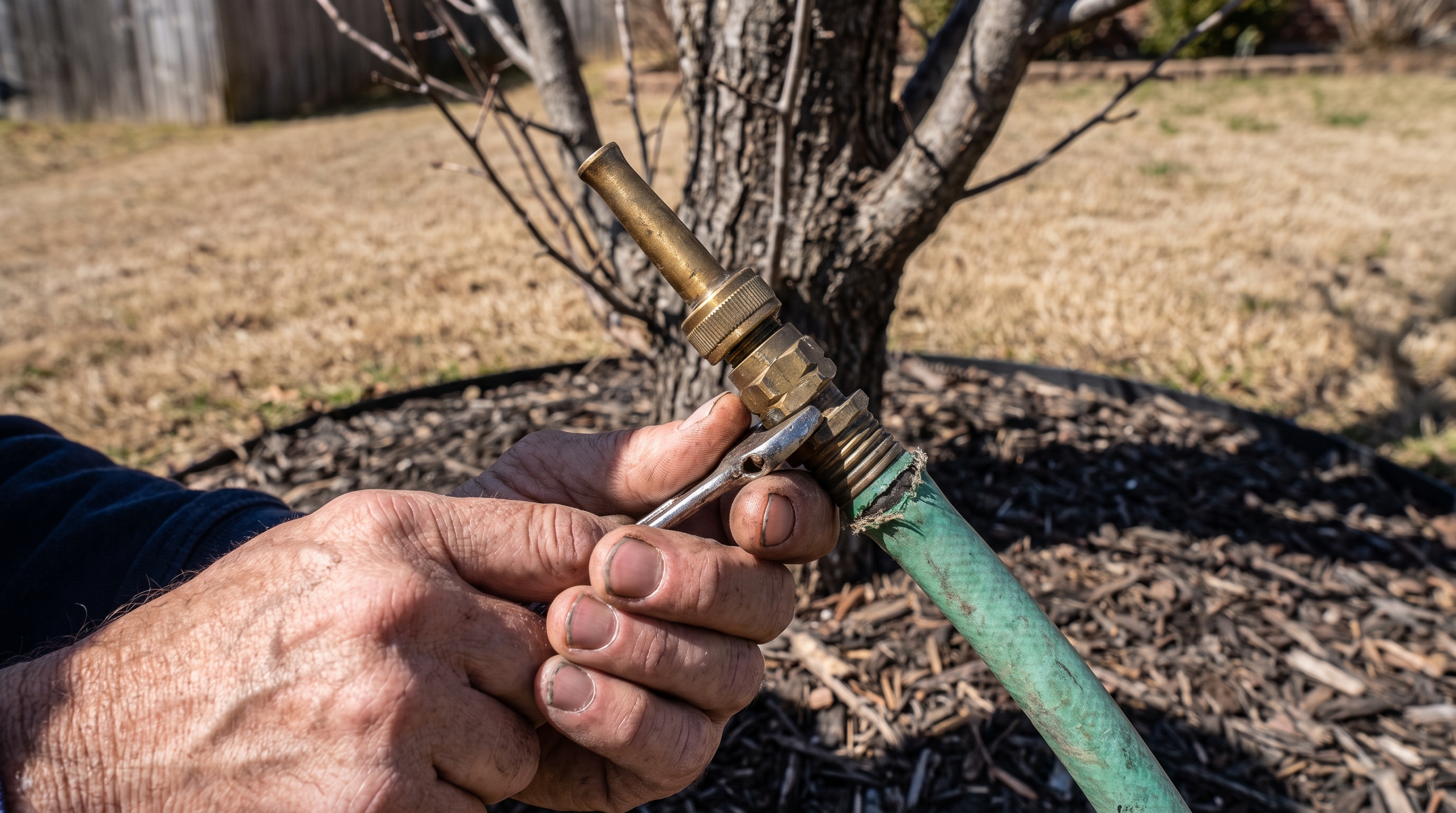
Denver Water's rules name the exceptions directly: "Trees, shrubs and perennials may be watered any day with a hand-held hose with a shutoff nozzle or low-volume, non-spray irrigation (such as a drip system). They may not be watered by spray irrigation." The rules page says the hose needs an automatic shut-off nozzle.
-
Allowed any day: trees, shrubs and perennials, watered with a hand-held hose that has an automatic shut-off nozzle, or with drip or another low-volume, non-spray system.
-
Allowed until first frost: annuals and vegetables, using the same methods.
-
Not allowed: lawns, by any method. Grass is not on the list of exceptions. The Southwest Metropolitan Water and Sanitation District, which posted matching Oct. 1 restrictions, tells residents to "let lawns go dormant."
-
Allowed only with someone present: running a sprinkler system for upkeep. Denver Water says a system "may be operated for installation, repair or reasonable maintenance, so long as the system is attended throughout the period of operation and water waste does not occur." That covers drip conversions and fall blowouts.
If a different district supplies your water, look up its rules too. The Southwest Metro district, for example, allows occasional hand-watering of trees and shrubs on dry winter days when it's above 40°F.
Why the rules are this strict
Denver Water's reservoirs were at 67% of capacity in late September. They're usually 91% full at that point. The utility expects storage to drop to 60% by next spring's runoff, compared with 85% in a typical year. Denver7 reports that natural streamflow from April through July was 95,000 acre-feet. That's 22% of normal and the lowest since Denver Water started keeping records 110 years ago. The Colorado Sun reports that 2026 is so far the hottest year on record for the metro area.
Earlier restrictions didn't save enough. The Sun reports savings began at 2% and rose to about 7%, well short of the goal of 20% below the five-year average. "Formally ending lawn watering Oct. 1 will help stretch our supplies, as we will be entering next spring with storage levels far below normal," Board President Tyrone Gant said in Denver Water's announcement.
Triage: which plants to water first
Hand-watering takes time, so put the most vulnerable plants at the top of the list:
-
Newly planted trees. Denver Water's tree-care tips make these the priority.
-
Shallow-rooted species. CSU Extension says these need extra water during dry fall and winter spells: European white and paper birch; Norway, silver, red, Rocky Mountain and hybrid maples; lindens, alders, hornbeams, dogwoods, willows and mountain ashes.
-
Young trees and evergreens. Water twice a month from October through March, per CSU PlantTalk.
-
Established trees. Water once or twice a month over the same months.
How to water a tree in fall and winter
These rules come from CSU Extension fact sheet 7.211:
-
How much: 10 gallons of water for each inch of trunk diameter.
-
Where: inside the drip line, the circle under the outer edge of the branches. Denver Water also warns against watering established trees too close to the trunk.
-
How deep: soak the soil to a depth of 12 inches.
-
When: only when the air is above 40°F, and at midday, so the water soaks in before it can freeze overnight.
-
How often: about once or twice a month during long dry stretches with no snow on the ground.
Worked example: a tree with a 4-inch trunk needs about 40 gallons per watering. A soaker hose puts out about 10 gallons every 20 minutes, according to Denver Water, so that tree needs about 80 minutes. Denver Water's own example is a 2-inch tree, which needs about 40 minutes.
Mulch helps the water last. CSU recommends spreading mulch 4 inches deep inside the drip line and keeping it 6 inches back from the trunk.
Soaker hose, drip or hand-held hose?
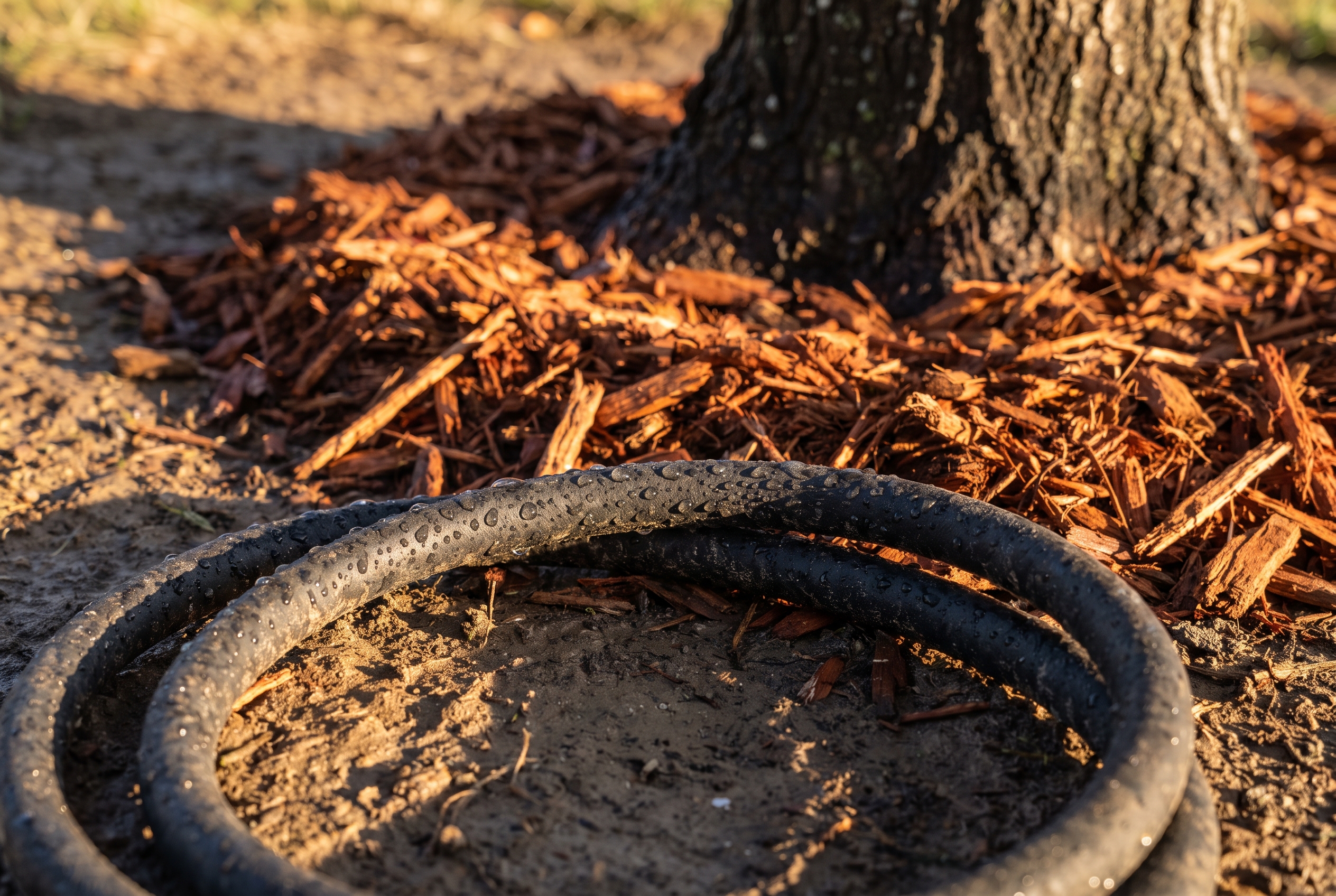
Soaker hose: This is the cheapest way to get a lot of water to a tree slowly, and Denver Water recommends it. Its ban announcement says: "Placing a soaker hose around the tree along the drip line is an effective way to water trees without wasting water." Lay the hose in a ring, set a timer, and move it to the next tree when time is up.
Hand-held hose with an automatic shut-off nozzle: This works well for shrubs and perennials. It gets slow for mature trees that need 40 gallons or more each.
Drip system: This is the most hands-off choice, especially if your trees and beds are already on spray zones you can convert.
CSU's shrub amounts:
-
Newly planted shrub: 5 gallons twice a month
-
Small established shrub (under 3 feet): 5 gallons a month
-
Large established shrub (over 6 feet): 18 gallons a month
Converting spray zones to drip: DIY vs. hire
If your beds and trees sit on spray zones you can't run anymore, converting those zones to drip makes them legal again. Here's what the published prices look like:
| Source | Region | Published range |
|---|---|---|
| HomeAdvisor (updated June 2026) | National | $300-$1,200 per zone to convert sprinklers to drip |
| LawnStarter (updated Dec. 2025) | National | $300-$1,200 per system, plus $300-$1,100 for each added zone |
| Denver Pro Landscape | Denver metro | $1,500-$4,000 to convert a water-wise bed (the company's 2026 planning estimate) |
Denver-area quotes for a whole bed can come in well above the national per-zone numbers. The bigger the bed and the more plants it has, the higher the price.
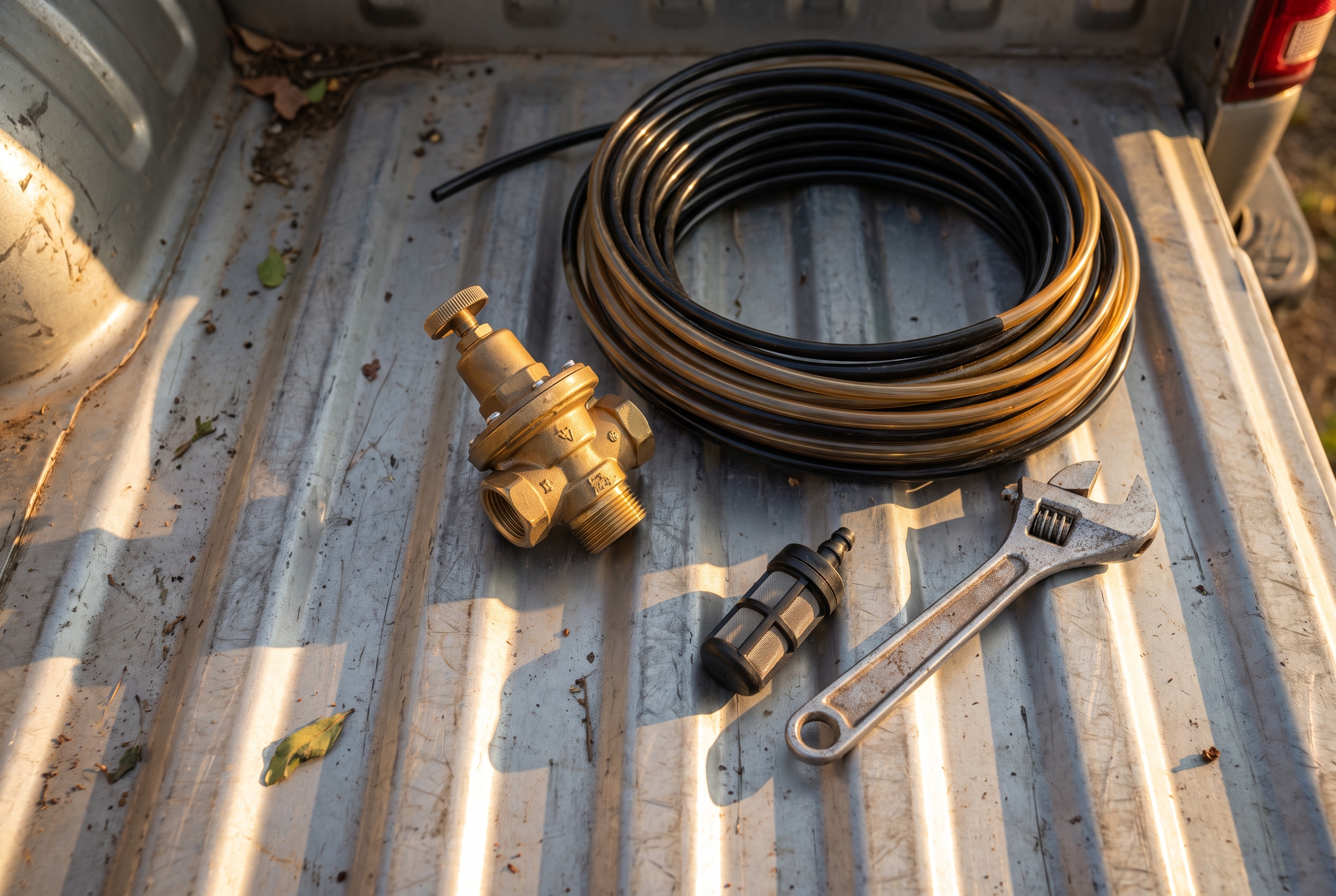
DIY: Conversion kits screw onto your existing sprinkler risers. LawnStarter lists premade drip kits at $25-$225, each covering 150-750 square feet. HomeAdvisor says a drip system lasts 10-15 years. If you test the system after installing it, stay with it the whole time it runs so you stay inside the maintenance exception.
Hire: Calling a pro makes sense if you have several zones, mature trees spread across the yard, or HOA rules to deal with. Denver7 reports that landscaper Dena Townsend, owner of Gardens in Bloom, is seeing more demand for water-wise work. "People's yards are burnt up, and they're ready to take it out," she said. Her crews are "putting in drip lines." She also noted that some HOAs require homeowners to keep some sod, so read your covenants before you rip out grass.
What to ask a landscaper before you sign
-
Is the price per zone or for the whole system? National guides quote it both ways.
-
Are a pressure regulator and filter included, or are they extra?
-
Will the old spray heads be capped so they can't run by accident?
-
Will someone stay on site whenever the system is running for testing, so the work fits Denver Water's maintenance exception?
-
Is the fall blowout included? Denver Pro Landscape lists blowouts at $75-$150 and sprinkler repair or tune-ups at $150-$500.
-
Can I see proof of license and insurance, and get the scope, price and deposit in writing?
Fall yard jobs to put off this year
-
Overseeding and new sod. Denver Water says "watering establishment permits will not be available after Sept. 30 until further notice," so you can't legally water in new grass. Resource Central notes that overseeding "requires consistent watering, often two to three times per day for about a month."
-
Core aeration on brown lawns. CSU advises against aerating lawns that are fully brown or dormant because of watering limits.
-
Fertilizing dormant lawns. CSU says it will give "little or no benefit this fall." Resource Central suggests skipping chemical fertilizer during drought and mowing at about 3 to 3.5 inches.
-
Counting on a turf rebate. Denver Water's turf-removal discount, worth up to $750 and run with Resource Central, has been fully allocated for 2026.
Fines and enforcement
| Violation | Single-family | Multifamily and nonresidential |
|---|---|---|
| First | $500 | $1,000 |
| Second | $1,000 | $2,000 |
| Each after that | $1,000 plus water shutoff | $2,000 plus water shutoff |
Greg Fisher, Denver Water's manager of demand planning and efficiency, told Denver7 that neighbors can photograph violations and report them on Denver Water's website, and that field staff also drive around looking for them. "We wouldn't assess any fines without pictures backing up that, or if we had one of our employees seeing that waste happen at that time," he said. Denver7 reports that customers can dispute fines.
The bottom line: DIY or call a pro?
Doing it yourself is enough if you have a few trees and a couple of shrub beds. A soaker hose, a timer, a measuring tape for trunk diameter and a bag of mulch will cover you through the winter. Water at midday on dry days above 40°F, once or twice a month.
Call a landscaper if mature trees and beds are spread across several spray zones, you can't drag hoses for an hour per tree, or your HOA has landscaping rules. A fair quote spells out per-zone or per-system pricing, says how many emitters go in and where, and lists the regulator, filter, head capping and any blowout as separate line items. Nationally that's roughly $300-$1,200 per zone. Expect more for full bed conversions in the Denver metro.
The ban runs until the board votes to lift it, and probably at least into spring 2027. Plan on watering trees all winter.
Related reading
-
How to Prepare for House Painters Before Interior Painting Day
-
Your Lawn Can Go From Green to Brown in One Night: Fall Armyworms Are Feeding Right Now
Sources
-
Denver Water warns customers of heavy fines for lawn watering after Sept. 30, Denver Water Tap
-
Board declares formal end to lawn watering season Oct. 1, Denver Water Tap
-
Denver Water approves Oct. 1 ban on lawn watering, Colorado Sun
-
Denver Water orders lawn sprinklers off starting Oct. 1, Denver7
-
How will Denver Water enforce the ban on lawn watering?, Denver7
-
Sprinkler ban prompts some homeowners to ditch their grass, Denver7
-
Fall and Winter Watering of Plants and Trees, CSU Extension fact sheet 7.211
-
Dry times can mean trees need a little TLC, Denver Water Tap
-
Denver Landscaping Cost: 2026 Pricing Guide, Denver Pro Landscape
Note: This article contains AI-assisted content and has been reviewed by our editorial team.
ABOUT THIS SERVICE: CallTheLocal.com is a directory and lead generation service, not a contractor or service provider. Submitting this form does not obligate you to hire anyone or purchase any service. Your information will be shared with licensed, insured home service professionals in your area who may provide quotes for your project. CallTheLocal.com does not guarantee the quality, timeliness, or outcome of any work performed by service providers you connect with through this service. Always verify licensing, insurance, and references before hiring. Get everything in writing before work begins.