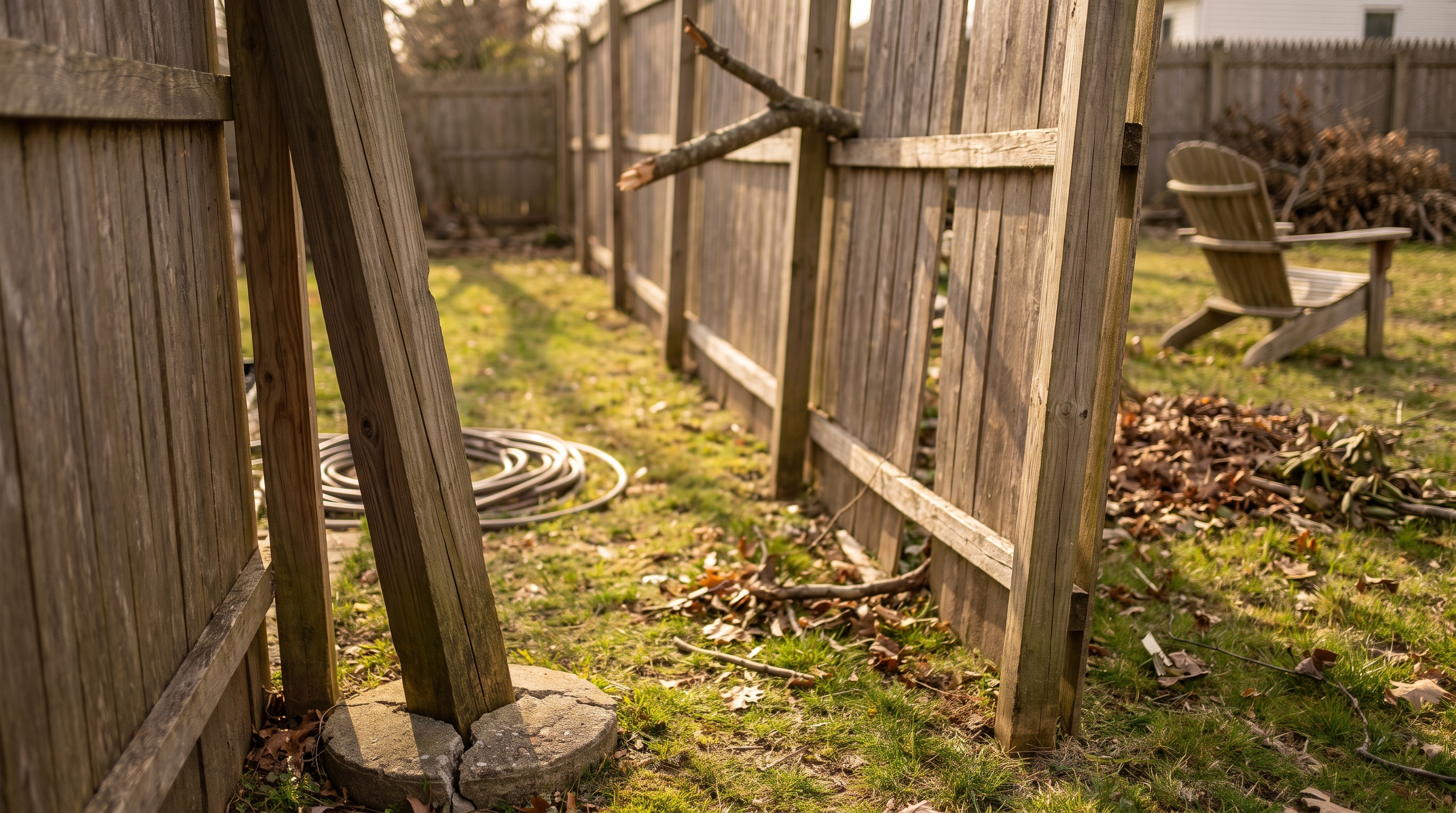
Fence repair cost after storm damage averages about $618 nationally in 2026, with a typical range of $304 to $948, according to HomeAdvisor. Expect roughly $270 per replaced post, $150 to $300 per missing panel and $200 to $400 to straighten a leaning run. Contractor labor averages about $50 an hour.
If you're walking your property line this week looking at a fence that's leaning, snapped or flat under a tree limb, you're not alone. The rest of this guide covers what happened, what to do before anyone picks up a saw, how to read a quote and when your insurance actually comes into play.
What the nor'easter did
The September 2026 nor'easter ran from September 23 to 29, and NBC New York forecast Friday evening through Saturday as the peak wind window, calling Saturday "the apex of the storm." The gusts were stronger than many early forecasts suggested:
-
Jersey Shore: ABC News reported a 74 mph gust late Friday night at a weather station in Surf City, NJ, with other Jersey Shore stations reporting gusts of 60 mph or more.
-
Long Island: Gov. Kathy Hochul said gusts "exceeding 50, even 60 miles an hour" had been recorded on Long Island, per ABC News. The Wikipedia storm summary lists a peak gust of 81 mph at Montauk.
-
Rhode Island: NBC 10, citing Rhode Island Energy, reported gusts of up to 55 mph that brought down trees and power lines, knocking out power to more than 50,000 customers. Scituate, South Kingstown, Cumberland and Coventry were among the hardest-hit communities. Crews handled more than 270 outages involving trees or limbs.
Gov. Hochul declared states of emergency for New York City, Long Island and Westchester, and Gov. Mikie Sherrill did the same for eight New Jersey counties. Falling trees were the big hazard: ABC News reported that a 56-year-old man in Brooklyn died after being struck by a falling tree, and New York City logged calls for 391 downed trees as of 9 p.m. Saturday. If a tree or large limb is hung up over your fence, keep kids and pets away and don't try to pull it free yourself.
Your first 48 hours: document before you clean up
Whether or not you end up filing a claim, good records help you get fair quotes and protect your options.
-
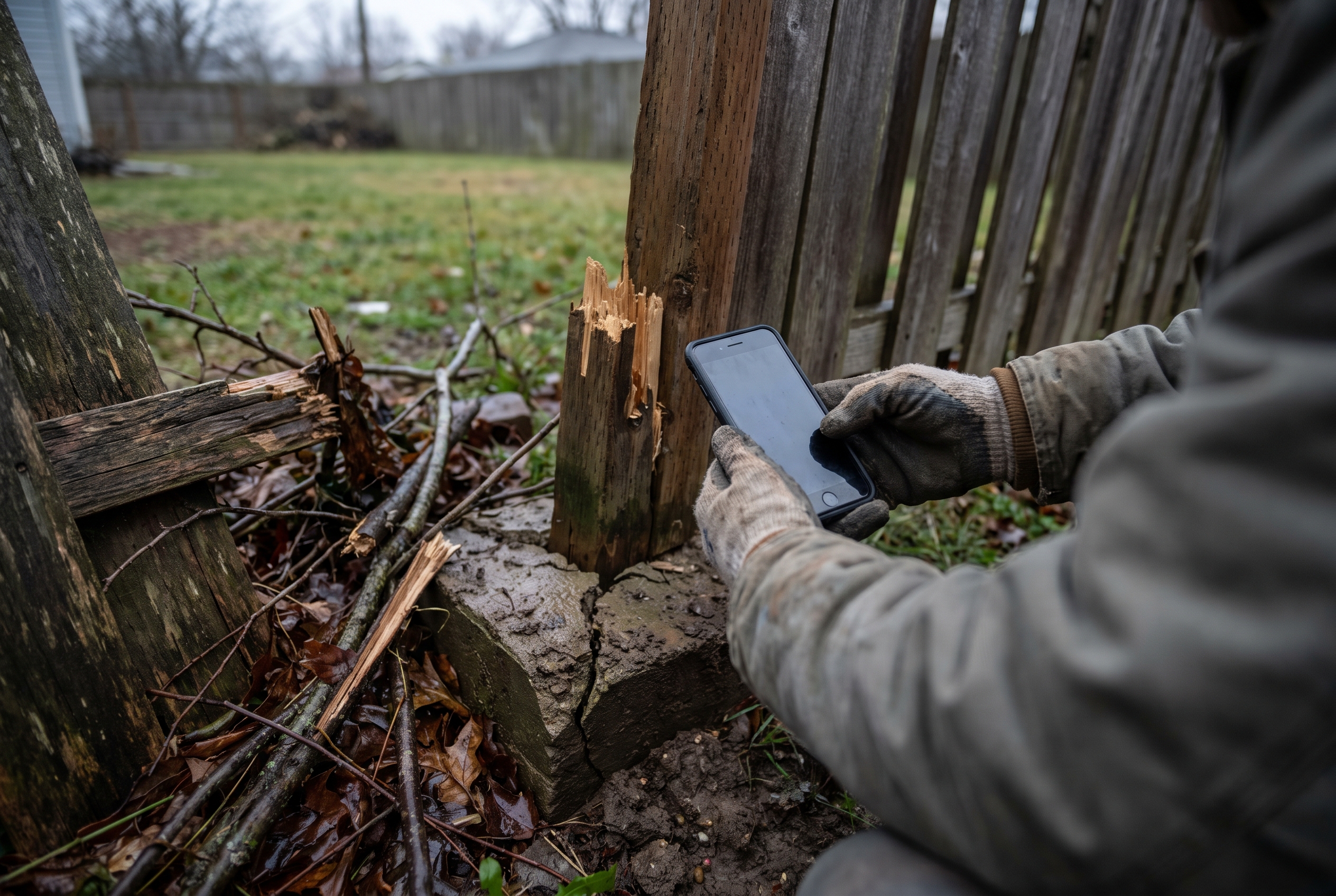
Photograph everything. Every leaning post, every broken or missing panel, the gate and any tree or limb on the fence. Get wide shots that show the whole run and close-ups of snapped posts and footings.
-
Note where the tree came from. Was it in your yard or your neighbor's? Photograph the base and the break. If it looks dead, hollow or rotted, that matters (more on why below).
-
Keep the damaged pieces if you can. Stack broken panels and posts somewhere out of the way until an adjuster or contractor has seen them.
-
Note pre-existing wear. Insurers generally won't pay for rot or rust, so it helps to know which damage is new.
Is it an insurance claim?
Here's how fence coverage typically works, according to Travelers:
-
Fences are "other structures" and are insured for up to 10% of your home's dwelling coverage limit.
-
Most insurers apply depreciation to fence payouts, and your deductible applies.
-
Damage from wear and tear or lack of upkeep, like wood rot or rust, is likely not covered.
If your neighbor's tree fell on your fence: Travelers says that if a neighbor's tree or branches fall and damage your fence because of a storm or high winds, your fence would likely be covered by your own homeowners policy. Insurance.com puts it plainly: "If a healthy tree went down in a storm, you can't be blamed." The exception is negligence. If the tree was dead, diseased or damaged and your neighbor knew about it, Insurance.com says you can file a liability claim against their policy. That's why your photos of the trunk matter.
Tree removal is capped. Progressive says homeowners policies generally cover removal up to about $500 to $1,000, depending on the insurer and policy, and Insurance.com describes it as usually capped at $500 to $1,000 per tree. Progressive also notes that insurance doesn't help with removing a rotting or decaying tree.
Do the simple math first. If your contractor quotes $600 to reset two posts and replace a panel, and your deductible is $1,000, a claim won't pay you anything after the deductible. Claims make more sense when a tree flattened a long run, or when tree removal and fence repair together clearly exceed your deductible.
Which deductible applies?
This matters a lot along the coast. The NAIC explains that a hurricane deductible applies to damage from a hurricane as categorized by the National Weather Service or the National Hurricane Center. Those deductibles range from 1% to as high as 15% of insured value, and New Jersey, New York and Rhode Island are all on the NAIC's list of hurricane-deductible states. In New York, the Department of Financial Services says a hurricane deductible is triggered only when the hurricane made landfall in the state.
This storm was a nor'easter, so a hurricane deductible shouldn't be the one in play. But some policies carry a separate windstorm or wind/hail deductible, and that kind can apply to any wind loss. Pull out your declarations page and look for the deductible lines before you call your agent, so you know what number you're working with.
What fence repair costs: the national baseline
HomeAdvisor's fence repair guide (updated June 20, 2026) is the most current national baseline:
| Repair | Typical cost |
|---|---|
| Average fence repair | $618 (typical $304 to $948) |
| Post replacement | $270 per post |
| Straightening a leaning fence | $200 to $400 |
| Missing sections | $150 to $300 per panel |
| Rotten sections | $150 to $500 |
| Gate repair | $100 to $400 |
| Contractor labor | About $50 per hour |
HomeAdvisor's full range runs from $50 for a tiny fix up to $5,450 for major damage. For a second opinion, Bob Vila (updated July 2023, so a bit older) puts post replacement at $140 to $400, averaging about $270; support braces at $60 to $150; entire panels at $150 to $400 each; and fallen-tree fence repair at $135 to $400, plus $400 to $900 for tree removal. Bob Vila's concrete stabilization range is wide, $125 to $2,300, which tells you how much footing work can swing a quote.
Regional prices: Jersey Shore, Long Island and Rhode Island
Honest disclaimer: good local price data for fence repair is thin. Here's what we could find for each area hit hardest, and how much weight to give it.
Jersey Shore (Ocean and Monmouth counties)
Ocean County Handyman, serving the Bayville, Toms River and Lacey area, publishes its rates (the page isn't dated):
-
Post replacement: usually $165 to $325 per post installed
-
Panel or rail repairs: $95 to $275 each, depending on material and profile availability
-
Gate rehanging plus hardware: typically $120 to $260
-
Chain-link fabric: $8 to $15 per foot
The company also offers "insurance-friendly documentation" for storm claims, which is worth asking any contractor about if you plan to file.
In Monmouth County, Any Time Any Job Handyman of Long Branch lists $120 to $350 per single post, $150 to $400 per panel and an average repair of about $617. Keep in mind the page attributes those figures to Angi's 2026 national cost guides, so treat them as national numbers rather than a Monmouth survey. HomeAdvisor's Long Branch page shows the same $200 to $400 for straightening a leaning fence.
Long Island (Nassau and Suffolk)
We couldn't find a reliable local survey of fence repair prices for Long Island. HomeAdvisor's Hempstead page shows the same $200 to $400 for straightening a leaning fence that it lists elsewhere, so use the national baseline above as your yardstick and expect local quotes to vary. The best protection here is getting two or three written, itemized bids.
In Nassau, check the license. The county's Office of Consumer Affairs requires a home improvement license for repair or replacement work at private residences of up to three families, and it specifically lists "fences and railings" as covered work. In Suffolk, ask for license and insurance details up front and verify them before you sign.
Rhode Island
CostToRenovate (updated April 2026) estimates Providence-area fence repair at $328 to $1,312, about 9% above its national average of $650, with post replacement at $150 to $600 per post. One caveat: the site builds metro prices by scaling labor costs to local wage data, not by surveying actual Rhode Island jobs. Use it as a rough sense of direction, not a price list. HomeAdvisor's Pawtucket page lists $200 to $400 for straightening a leaning fence.
Reading the quote: reset vs. replace
Most storm quotes come down to three kinds of line items. Knowing what each one means is the best way to tell a fair bid from a padded one.
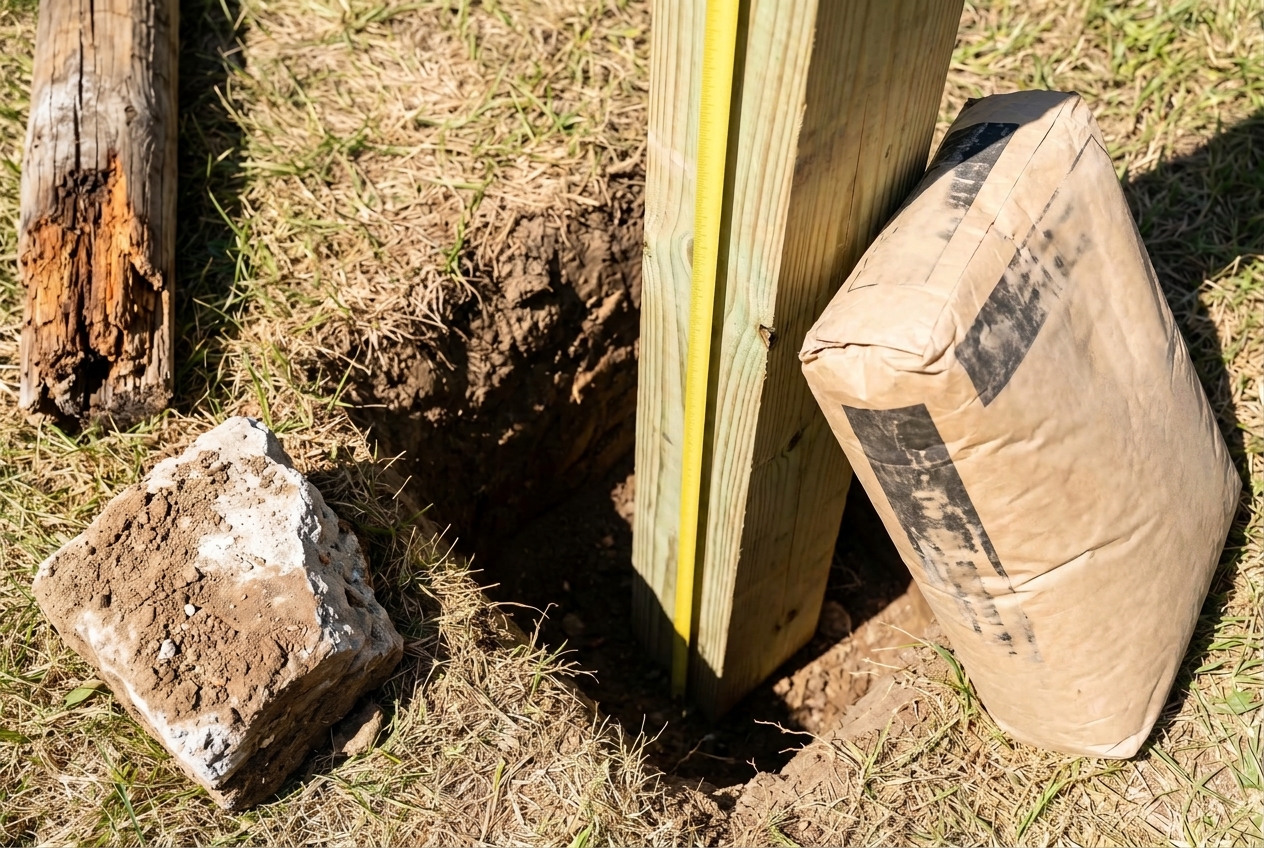
"Straighten," "reset" or "realign" ($200 to $400 per HomeAdvisor). The post isn't broken, it's just pushed out of plumb. HomeAdvisor's Pawtucket page describes this work as the pro assessing the damage, resetting or replacing the posts and realigning the panels. According to Family Handyman, a post set in dirt or gravel can often be stabilized by driving a fence repair spike beside it and screwing the post to the spike. A post set in concrete gets reset in new concrete.
"Post replacement" (about $270 each). This is the bigger job. Family Handyman lays out the steps: brace the panels on both sides, cut the rail nails with a reciprocating saw, pull the post, break up the old concrete, then set the new post plumb, brace it and backfill with new concrete. Rails are reattached with screws after the concrete hardens. If your quote says "post replacement," ask whether breaking out the old footing and new concrete are included.
"Panel" or "section" ($150 to $300 per panel). This covers the infill between posts only. If your posts are fine and a limb punched through one panel, this is the line you should see.
Red flags on a storm quote:
-
No line items at all, just one lump sum.
-
Whole sections replaced when only posts snapped and the panels are intact.
-
Posts listed as "replace" when they're only leaning and the footing looks solid.
-
Pressure to sign the same day, or a contractor who won't put the quote in writing.
Repair or replace the whole run?
Bob Vila puts full fence replacement at $1,740 to $4,430 (2023 figures). If the storm damaged a few posts on an otherwise sound fence, repair almost always wins. But if your contractor finds rot at the base of most posts, or rust through chain-link, think harder. Insurance won't cover wear and tear, so you'd be paying for those fixes yourself anyway, and patching an aging fence post by post can add up quickly.
Who to call, and what to ask
-
Tree on the fence? Call a tree service first. Nobody can price the fence until the weight is off it, and removal is a separate cost with its own insurance cap.
-
Several snapped or leaning posts, or a long run down? Call a licensed fence contractor.
-
One panel, a sagging gate or a single leaning post? A licensed handyman who does fence work is often a good fit.
Whoever you call, ask for:
-
An itemized written quote that separates posts, panels and gate work.
-
Whether new concrete footings are included for replaced or reset posts.
-
Whether haul-away of the damaged material is included.
-
Photo documentation you can hand to your insurer, if you're filing.
-
Proof of license (where required) and insurance before work begins.
Then compare the total to your deductible. If the repair lands under it, pay directly and skip the claim. If a fallen tree turned your fence into a big job, call your insurer with your photos and your itemized quote in hand.
Related reading
-
How to Prepare for House Painters Before Interior Painting Day
-
Flat Roof Leak After Heavy Rain? What to Check in Phoenix and Albuquerque as Polo Moves Through
Sources
-
Nor'easter brings strong winds, coastal flooding and high waves to East Coast, ABC News
-
Powerful nor'easter to wreak havoc on coastal Long Island, New Jersey, NBC New York
-
Rhode Island Energy says power restored to all customers affected by nor'easter, NBC 10
-
Fence Repair in Bayville, NJ and All of Ocean County, Ocean County Handyman
-
Fence Repair in Monmouth County, NJ, Any Time Any Job Handyman
-
Whose homeowners insurance covers damage from a fallen tree? Insurance.com
-
Homeowners Insurance: Basic Coverage and Adding Coverage, NY DFS
Note: This article contains AI-assisted content and has been reviewed by our editorial team.
ABOUT THIS SERVICE: CallTheLocal.com is a directory and lead generation service, not a contractor or service provider. Submitting this form does not obligate you to hire anyone or purchase any service. Your information will be shared with licensed, insured home service professionals in your area who may provide quotes for your project. CallTheLocal.com does not guarantee the quality, timeliness, or outcome of any work performed by service providers you connect with through this service. Always verify licensing, insurance, and references before hiring. Get everything in writing before work begins.