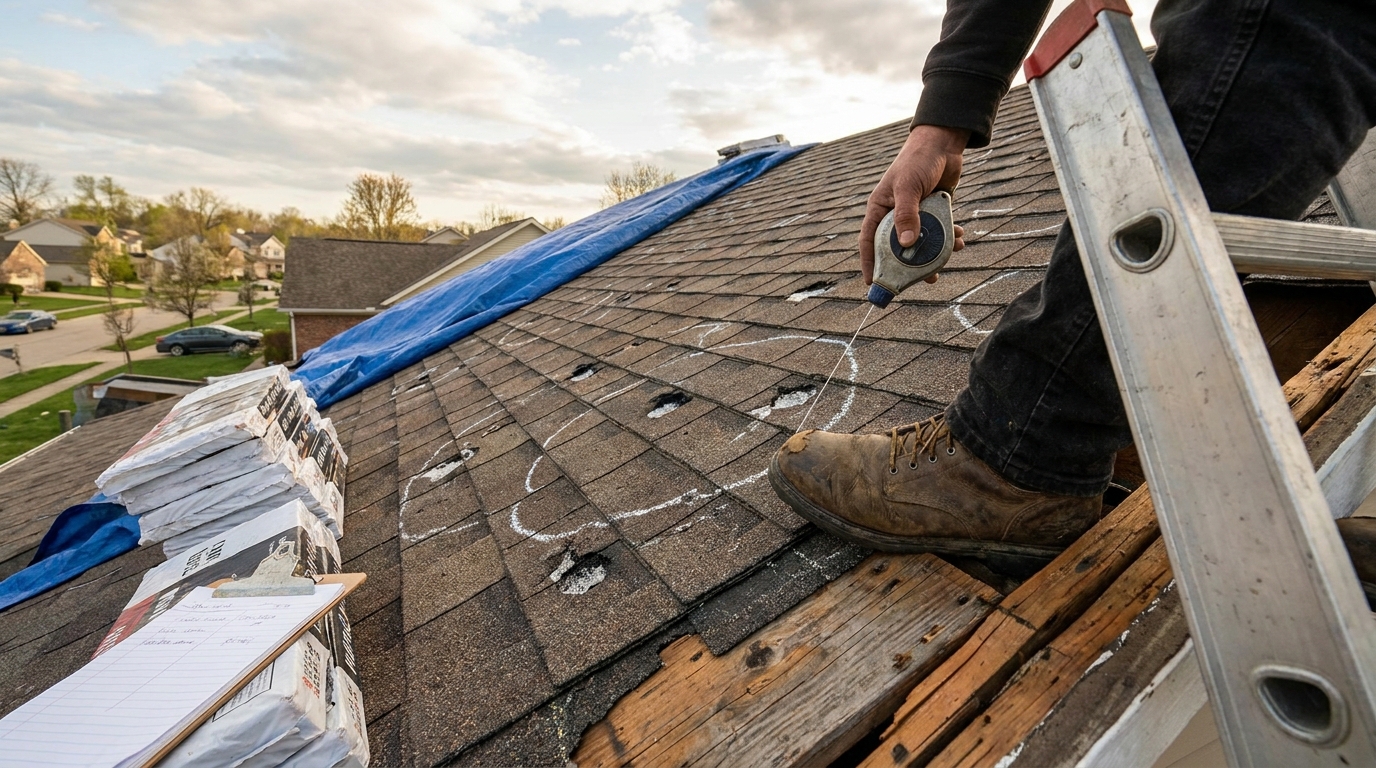
If you are standing in your driveway looking at a tarp where shingles used to be, you already know spring 2026 was bad. The numbers say it was historically bad. The National Weather Service office in Fort Worth logged 287 severe weather reports across six straight days from April 24 through April 29, 2026, including 226 hail reports with stones up to softball size, 37 wind damage reports, and tornadoes that killed two people and injured at least 11 more across North and Central Texas (NWS Fort Worth). Add Denver's traditional late-May-through-June hail window on top of that, and roofing crews from the Metroplex to Oklahoma City to the Front Range are quoting full replacements at five-figure prices with installation pushed into the fall.
Here is the part nobody tells you when they hand you a business card from the truck idling at your curb: the size of your check is not decided by the roofer's estimate. It is decided in a 30-minute meeting on your driveway with an insurance adjuster. Three numbers from that meeting (your deductible, your depreciation, and whether your policy pays Replacement Cost Value or Actual Cash Value) will determine whether a $25,000 replacement gets funded or whether you net a fraction of it. This guide is about walking into that meeting prepared.
Why spring 2026 is different
Hail Alley always produces a season. This one stacked storms back to back across the corridor running through Texas, Oklahoma, Kansas, Nebraska, and Colorado, with the most severe activity tracked by the NOAA Storm Prediction Center. The DFW outbreak alone produced more hail reports in less than a week than some entire prior seasons. Denver's primary hail season runs late April through August, with the most severe storms typically clustered from late May through late June, and Colorado homeowners insurance premiums have risen roughly 65% over the last five years with hail cited as a primary driver (Cenco Roofing).
What that means at the checkbook level: typical 2026 Colorado residential roof replacements run $9,500 to $24,000 for 1,500 to 3,000 square foot homes. DFW and OKC replacements on larger or steeper homes are getting quoted into the $18,000 to $35,000 band. Reputable local crews are openly telling homeowners they cannot start until October or November.
Phase 1: Before you call anyone
Do three things before you let a single contractor or adjuster set foot on your property.
Photograph the roof from the ground. Walk the perimeter, shoot every slope, every gutter run, every vent, and every window screen. Hail-bent screens and dented gutters are the easiest tells that hail of a damaging size actually fell on your house. Date and time-stamp your photos.
Save the weather record. Pull the NWS event page or storm report for the date hail hit your address and save it as a PDF. If your claim ever becomes contested, the carrier will want proof a qualifying storm occurred at your location, not just somewhere in your county.
Pull your declarations page. This is the cover sheet of your homeowners policy. You are looking for three things: whether your roof is covered at Replacement Cost Value (RCV) or Actual Cash Value (ACV), what your wind/hail deductible is (often a separate percentage of dwelling coverage, not a flat dollar amount), and whether your policy has an ACV-only endorsement for roofs over a certain age. Carriers in hail-prone states have been quietly adding those endorsements for years.
Phase 2: Who inspects first matters
You have two real options, and they are not the same product.
A paid independent inspection in Texas runs roughly $120 to $400, with $150 to $250 buying a basic walk, $250 to $350 buying a written report with photos, and $300 to $500-plus buying drone or thermal imaging (M&M Roofing). The inspector has no financial stake in finding damage. Their report is what an adjuster cannot easily dismiss.
A free roofer inspection is a sales call. That does not make it useless, but it does mean the report is written by someone whose business model depends on finding work. Use a roofer inspection to get a repair scope and a price, not to settle the question of whether you actually have a claim worth filing.
If your deductible is $4,000 and the roofer says you have $6,000 of damage, a $250 independent inspection that says you have $2,500 of damage just saved you a claim that would have raised your premium for nothing. If the independent inspector confirms full replacement, you walk into the adjuster meeting with a document the carrier has to address line by line.
AI workflows for revenue teams
Placeholder house ad for Conservus.ai. Swap with final creative when brand assets are ready.
Partner with Conservus.aiPhase 3: The adjuster meeting
This is where the money is decided. The adjuster will produce a scope of loss, which is the carrier's itemized estimate of what they think it costs to put your roof back. A complete scope should include slope-by-slope test squares (the standard test is a 10-foot by 10-foot square per slope, with hits counted), all flashings, all vents, decking where damaged, and any code-required upgrades your jurisdiction has adopted since your roof was last installed.
Common line items insurers underpay or omit: ice and water shield, drip edge, starter strip, code upgrades, R&R (remove and replace) for solar panels and satellite dishes, and dump fees. Your roofer's estimate will almost always carry these. Compare the two documents side by side and flag every difference.
The math the adjuster will run on the driveway:
- Replacement cost (RCV) of the work.
- Minus depreciation based on the age and condition of the roof.
- Equals Actual Cash Value (ACV).
- Minus your deductible.
- Equals your first check.
ACV vs RCV: the worked example
Assume a $25,000 asphalt roof replacement. Asphalt roofs are typically depreciated on a 20 to 25 year curve (Bankrate). A 12-year-old roof on a 20-year curve is roughly 60% depreciated.
Pure ACV policy: Replacement cost $25,000, minus $15,000 depreciation, equals $10,000 ACV, minus a $2,500 wind/hail deductible (assume 1% of $250,000 dwelling), equals a $7,500 check. That is all you get. The $15,000 in depreciation is gone.
RCV policy: The first check is still cut at ACV minus deductible, so you still receive $7,500 up front. The remaining $15,000 is called recoverable depreciation. You only get it after the work is completed and your contractor submits a final invoice with proof of completion to the carrier (Midwest Guard). If the final invoice comes in under the RCV estimate, the carrier only releases what you actually spent. This is why a contractor who pushes you to sign before the adjuster sets a number is a problem: the carrier's number becomes the ceiling.
The matching argument
If only one or two slopes have damage, the carrier may try to pay for only those slopes. The shingles they install will not match the rest of the roof. Whether you can force a full replacement depends on your state.
The strongest national hook is the NAIC Unfair Claims Settlement Practices Model Regulation (MDL-902), Section 9.A(2), which requires insurers to "replace all items in the area so as to conform to a reasonably uniform appearance." Quote this language directly to the adjuster.
By state:
- Texas: No specific matching statute. Outcome hinges on policy language and adjuster discretion (Insurance Claim Recovery Support).
- Oklahoma: No codified matching statute (PropertyCasualty360).
- Colorado: No statute, but at least one Larimer County District Court ruling has required "reasonably uniform appearance" restoration, giving Colorado homeowners a stronger argument than their Texas or Oklahoma neighbors.
The matching problem is one of the most litigated questions in property insurance and is rarely decided on a coin flip. The position you take, in writing, at the adjuster meeting matters (IRMI).
AI workflows for revenue teams
Placeholder house ad for Conservus.ai. Swap with final creative when brand assets are ready.
Partner with Conservus.aiStorm-chaser red flags
The Texas Department of Insurance specifically warns homeowners about contractors who show up after a storm with out-of-state plates and brand-new magnetic door signs (TDI Storm Fraud Resources). Other warning signs TDI and the post-storm consumer guidance flag:
- Door-to-door pitches offering a "free inspection" the day after a storm.
- Requests to sign anything (especially an Assignment of Benefits) before the adjuster has visited.
- Demands for an upfront payment or a blank contract.
- Any offer to "waive" or "work in" your deductible. Under Texas law this is illegal, and an honest contractor will tell you that.
- No Texas contractor registration and no proof of insurance.
TDI's post-storm consumer guidance is short and worth reading before you sign anything (TDI: Help after a storm). Get every bid in writing. Verify license and insurance. Confirm a physical local address that existed before the storm.
When to bring in a public adjuster
A public adjuster works for you, not the carrier. In Texas the market rate is a 10% to 15% contingency on the settlement, paid only if and when they get you a check. Texas does not statutorily cap public-adjuster fees, but TDI requires the fee to be disclosed in writing up front (PublicAdjustHQ).
The break-even is straightforward. If the carrier's first offer is $8,000 and a public adjuster believes they can get you $20,000, a 12% contingency on the $12,000 delta is $1,440 (Hail King Pros). On small claims a public adjuster rarely pencils out. On contested or underpaid five-figure claims, they often do. If the dispute is about coverage rather than scope (the carrier is denying that a covered loss occurred at all), an attorney is usually the better call.
The Class 4 question
While crews are booked through November anyway, this is the right window to ask about Class 4 impact-resistant shingles. Most carriers in hail states offer a premium discount for Class 4 shingles, and the Colorado Roofing Association notes the upgrade can materially extend roof life in hail-exposed markets (Colorado Roofing Association). The out-of-pocket spread above what insurance pays is often recovered in five to seven years of premium discount, and you skip the next claim cycle entirely.
Lock the contract with a local roofer who does not require a deposit. A reputable contractor in a backlog market does not need your cash to hold a slot.
AI workflows for revenue teams
Placeholder house ad for Conservus.ai. Swap with final creative when brand assets are ready.
Partner with Conservus.aiYour adjuster meeting checklist
Bring: declarations page, paid independent inspection report, dated ground photos, NWS storm record PDF, your contractor's written estimate, and a notebook.
Ask: Are you measuring test squares on every slope? What depreciation rate are you applying and on what curve? Is matching included? Are code upgrades included? What is your scope's line item for ice and water shield, drip edge, starter strip, R&R of solar or satellite, and dump fees?
The three numbers that decide your check: your deductible, your depreciation, and whether your policy is RCV or ACV. Walk in knowing all three. Do not sign the adjuster's worksheet on the driveway. Take a copy, compare it to your contractor's estimate line by line, and respond in writing.
Related reading
Sources
- April 24-29, 2026 Severe Storms & Tornadoes — NWS Fort Worth
- NOAA Storm Prediction Center — Warning Coordination Meteorologist
- Help after a storm — Texas Department of Insurance
- Storm Fraud Resources — Texas Department of Insurance
- Roof Insurance: ACV vs. Replacement Cost — Bankrate
- What is Recoverable Depreciation? — Midwest Guard
- Matching Statutes by State — PropertyCasualty360
- Texas Matching Statutes — Insurance Claim Recovery Support
- NAIC Matching Standards (MDL-902 §9.A(2)) — Merlin Law Group
- Matching Problem in Property Insurance Claims — IRMI
- How Long Should Your Roof Last in Colorado's Climate? — Colorado Roofing Association
- How Much Does a Roof Inspection Cost in Texas? — M&M Roofing
- How Much Does a Public Adjuster Cost? — PublicAdjustHQ
- Hiring a Public Adjuster for a Roof Claim — Hail King Pros
- 2026 Denver Roofing Market Changes — Cenco Roofing
Note: This article contains AI-assisted content and has been reviewed by our editorial team.
ABOUT THIS SERVICE: CallTheLocal.com is a directory and lead generation service, not a contractor or service provider. Submitting this form does not obligate you to hire anyone or purchase any service. Your information will be shared with licensed, insured home service professionals in your area who may provide quotes for your project. CallTheLocal.com does not guarantee the quality, timeliness, or outcome of any work performed by service providers you connect with through this service. Always verify licensing, insurance, and references before hiring. Get everything in writing before work begins.