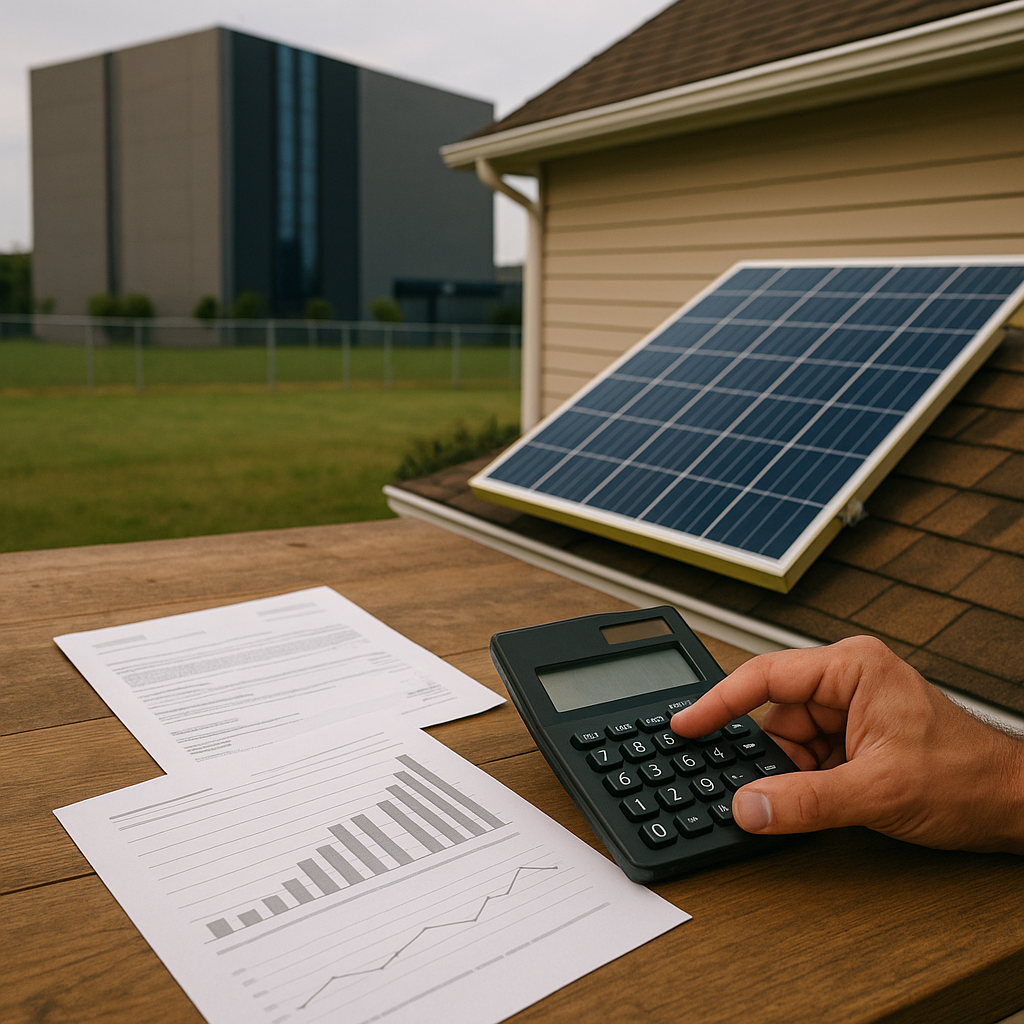
If you have read that AI data centers are pushing home electric bills up 8% to 22% across the country in 2026, the actual approved numbers are more modest, and they are uneven from state to state. The bigger surprise for homeowners shopping solar is on the federal side: the 30% residential solar tax credit did not step down this year, it ended entirely for systems you buy outright (EnergySage explains the change under the One Big Beautiful Bill Act). Here is the practical version of both stories, and what they mean if you live near a tech hub and are weighing rooftop solar this year.
What 2026 residential rate increases actually look like
Background: regulators across the country broadly expect upward pressure on residential bills in 2026 from generation, transmission, and capacity costs, with data-center load a recurring theme in filings (Utility Dive overview; EESI background). But the headline percentages get fuzzy fast. The cleanest way to think about it is utility by utility.
Virginia: Dominion Energy
The Virginia State Corporation Commission approved a Dominion Energy rate increase that adds about $11.24 per month for a typical residential customer in 2026, with another $2.36 per month in 2027 (Cardinal News coverage of the SCC order). Coverage of the same order frames it as part of a broader shift to assign more grid costs to hyperscalers rather than households (Inside Climate News).
Ohio: AEP Ohio
The Public Utilities Commission of Ohio approved a rider that took effect April 1, 2026, raising the average AEP Ohio residential bill by about $7.90 per month (WOSU reporting on the approved rider).
Texas: Oncor
The Public Utility Commission of Texas approved an Oncor delivery rate change effective May 1, 2026 that works out to roughly $7 per month, or about 4.7%, on a 1,000 kWh residential bill (Utilities For My Home summary of the approved change).
Arizona: Arizona Public Service
APS has filed for a 13.99% net residential revenue increase that would add about $20 per month to a 1,000 kWh bill in the second half of 2026 (KTAR on the filing). This one is a proposal, not an approval, and it is being opposed at the Arizona Corporation Commission.
Georgia: Georgia Power
This is the exception people often miss. Under a July 2025 Public Service Commission order, Georgia Power base rates are frozen through 2028 (Georgia PSC data-center fact sheet). So if you are a Georgia Power residential customer, you should not be planning around a 2026 base-rate hike, even though the state has approved a large generation buildout aimed at data centers (Georgia Recorder on the 9,885 MW approval).
Put it together and the approved residential increases in big data-center states are running roughly 4% to about 14% on the high end of the proposals, with one state actively frozen. That is meaningful, but it is not the 8% to 22% headline.
How regulators are trying to shield households from data-center costs
Several states have moved to put more of the cost of new AI load on the data centers themselves rather than on residential ratepayers.
-
Virginia: The SCC approved a new GS-5 rate class for customers at or above 25 MW with a 75% load factor, taking effect January 1, 2027, designed to isolate hyperscaler costs (Loudoun Now on the GS-5 class).
-
Ohio: PUCO approved an AEP Ohio data-center tariff in July 2025 that requires new data centers to pay for at least 85% of their contracted demand even if they do not use it (Data Center Frontier analysis; AEP Ohio tariff page).
-
Arizona: APS has proposed raising data-center rates by roughly 30% and creating a new large-load customer class (KTAR on the data-center side of the filing).
-
Georgia: The PSC's stipulation tied to the December 2025 data-center generation approval targets at least $8.50 per month of downward pressure on typical residential bills in 2029 through 2031 from large-load revenue (Georgia Recorder). Whether those protections are sufficient is contested (SELC critique).
The federal solar credit story changed in 2026
Here is the part most homeowners are still surprised to hear. The 30% federal residential solar Investment Tax Credit did not phase down to a smaller percentage this year. For customer-owned systems (cash or loan), it fully expired on January 1, 2026 under the One Big Beautiful Bill Act signed in July 2025 (EnergySage explainer). Third-party owned systems (lease or power purchase agreement) can still qualify under the commercial ITC if construction begins before mid-2026 or the system is placed in service by 2028 (Enphase summary of the OBBBA changes).
That single change is large. On an 8 kW system priced around $26,000, the lost credit is roughly $7,800. By itself, that extends a typical payback by about 1.5 to 3 years compared with a 2025 purchase.
AI workflows for revenue teams
Placeholder house ad for Conservus.ai. Swap with final creative when brand assets are ready.
Partner with Conservus.aiA worked example with realistic 2026 inputs
Imagine a household using 1,000 kWh per month in a data-center-adjacent service territory where retail rates move from about 14 cents per kWh to 16 cents per kWh over the next couple of years (consistent with the AEP Ohio and Oncor changes above). An 8 kW owned system at $26,000, with no federal credit, offsetting most of that usage, generally pencils to a payback in the rough range of 7 to 10 years on electricity savings alone in those higher-rate, faster-rising territories. In lower-rate states without data-center pressure, the same system more often lands in the 9 to 12 year range. Your installer's numbers should be specific to your utility's filed rates and your roof's production estimate, not a national average.
How to spot data-center cost recovery on your bill
If you want to see the cost shift in your own statement, look at the line items below the basic energy charge. In PJM states like Virginia and Ohio, transmission, capacity, and fuel riders are where higher wholesale costs show up; PJM's most recent capacity auction cleared 833% higher year over year for the 2025-2026 delivery year, with data-center demand cited as a major driver (EESI background on the macro driver). In Texas, Oncor's residential bill changes flow through delivery charges set by the PUCT (Utilities For My Home).
Questions worth asking a solar installer in 2026
-
What rates are you assuming for my utility, and over what years? A quote built on 2024 rates will overstate payback time; one built on your utility's filed escalation may better match reality.
-
Are you assuming the 30% federal credit, and on what basis? If you are buying the system outright, that credit no longer applies (EnergySage). If you are looking at a lease or PPA, ask the installer to show in writing how the system qualifies under the commercial ITC and the OBBBA construction-start or placed-in-service deadlines (Enphase).
-
Is my utility filing or considering rate-class changes that would affect net metering? Virginia, Ohio, Arizona, and Texas have all moved on large-load classes in the last year, and broader rate-design changes often follow.
-
What is the payback if rates stay flat? A sober quote should pencil under conservative assumptions too, not only the most optimistic ones.
AI workflows for revenue teams
Placeholder house ad for Conservus.ai. Swap with final creative when brand assets are ready.
Partner with Conservus.aiThe lease and PPA path
For homeowners who cannot use a 30% upfront discount anyway (for tax reasons or by preference), a third-party owned lease or PPA is the surviving federal-credit path in 2026, because the installer/financier claims the commercial credit and passes savings through (Enphase). The tradeoffs are real: you do not own the asset, contract terms vary widely, and net metering rules in your state still drive the underlying economics. Ask for the full 20- or 25-year cash flow, not just the first-year savings.
Bottom line
Near major data-center clusters, retail rates are rising fast enough that solar still pencils for many homeowners, even without the 30% federal credit. But two corrections to the conventional wisdom matter. First, the approved 2026 residential increases in the biggest data-center states are running roughly 4% to about 14%, not 8% to 22%, and Georgia Power customers are under a base-rate freeze through 2028 (Georgia PSC fact sheet). Second, the 30% federal solar credit for owned systems is gone, not reduced (EnergySage). Build your decision on your utility's filed numbers, your roof, and the financing path you actually qualify for.
Related reading
AI workflows for revenue teams
Placeholder house ad for Conservus.ai. Swap with final creative when brand assets are ready.
Partner with Conservus.aiSources
-
Regulators approve Dominion Energy rate increase (Cardinal News)
-
SCC Approves New Data Center Rate Class for Dominion (Loudoun Now)
-
State utilities commission approves AEP Ohio rate changes (WOSU)
-
Ohio Sets New Precedent: AEP's Power Rules Shift Data Center Cost Burden (Data Center Frontier)
-
What the New Oncor Rate Increase Means for Your Texas Home (Utilities For My Home)
-
APS rate hike: Utility seeks to raise costs by 14% in 2026 (KTAR)
-
Georgia regulators approve massive power grid expansion to serve data centers (Georgia Recorder)
-
Customers should not expect electric bill relief in 2026 (Utility Dive)
-
Data Center Power Demands Are Contributing to Higher Energy Bills (EESI)
Note: This article contains AI-assisted content and has been reviewed by our editorial team.
ABOUT THIS SERVICE: CallTheLocal.com is a directory and lead generation service, not a contractor or service provider. Submitting this form does not obligate you to hire anyone or purchase any service. Your information will be shared with licensed, insured home service professionals in your area who may provide quotes for your project. CallTheLocal.com does not guarantee the quality, timeliness, or outcome of any work performed by service providers you connect with through this service. Always verify licensing, insurance, and references before hiring. Get everything in writing before work begins.