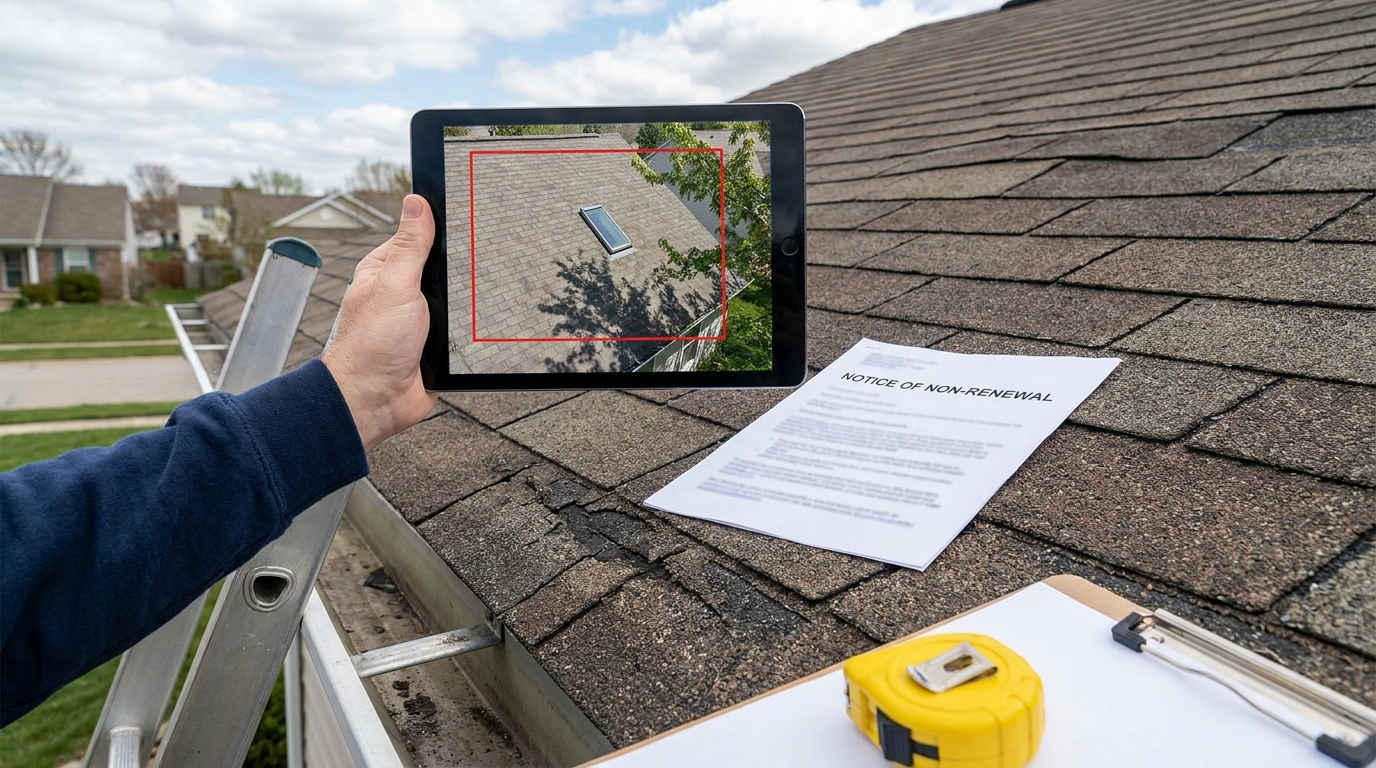
Here is a scenario that is becoming routine in 2026: you never saw an inspector pull into your driveway, you never got a ladder set against your gutters, and yet a letter arrives saying your homeowners policy will not be renewed because of the condition of your roof. What actually happened is that a piece of software studied an aerial or satellite photo of your house and flagged it. The trigger might have been real damage. But it might just as easily have been a tree shadow, a skylight, a solar panel, some normal staining, or nothing at all except your roof's age.
The good news your insurer is not eager to mention: these decisions can be challenged, and homeowners are winning. This guide walks through how we got here, why the algorithms get it wrong, the rights you already have, and the exact file you need to build to fight back, plus the inspections and state grants that can both rescue your coverage and lower your bill.
How we got here: inspectors out, algorithms in
Property insurers have largely retired the human roof inspector. In their place is artificial intelligence trained to analyze aerial, satellite, and drone imagery, often capturing your home without you knowing a photo was ever taken. The scale is staggering. As the California Department of Insurance noted in a March 2025 release, the Wall Street Journal reported that insurers are now imaging "nearly every building in the country".
Why the rush? Speed, cost, and the incentive to shed risk before storm season. A camera in the sky can screen millions of roofs faster and cheaper than any field crew, and it lets carriers quietly drop higher-risk homes ahead of the next big weather event. The effect on homeowners is measurable. In Texas, the rate at which insurers chose not to renew homeowner policies nearly doubled between 2020 and 2023 as satellite and drone screening expanded, according to NPR.
Why the algorithm gets it wrong
Aerial imagery is often grainy, and software reading it makes mistakes that no person on a ladder would. Consumer advocates and reporters have documented cases where algorithms misread skylights as damaged roofing and flagged solar panels as structural problems. Tree overhang, debris, and ordinary staining can all read as deterioration to a model that has never set foot on your property. United Policyholders, a consumer-advocacy nonprofit, has tracked a sharp rise in homeowners being dropped on flawed imagery alone.
Then there is the simplest trigger of all: age. Many carriers will not renew an asphalt-shingle roof past roughly 15 to 20 years, even with no active leaks and no visible damage. Roof-age cutoffs are a standard underwriting practice, but here is the key point for your appeal: a non-renewal based only on age, with no evidence of actual material deterioration, can be challenged. As one industry breakdown of roof-age underwriting explains, the type and documented condition of the roof matter, not just the number of birthdays it has had.
Know your rights
You are not powerless when that letter arrives. You generally have the right to ask why you are being non-renewed and to submit documentation that rebuts the finding. Massachusetts' Division of Insurance spells this out plainly in its consumer guidance on how insurers use aerial imaging: if a carrier cites "wear and tear" pulled from an aerial photo, you can respond with proof, such as a receipt showing the roof was replaced two years ago.
Lawmakers are catching up to the technology. In California, AB 75 (introduced by Assemblymember Lisa Calderon in 2025) would require 30-day advance notice before an aerial inspection and give homeowners the right to obtain copies of any aerial images used in a coverage decision. Massachusetts has a parallel proposal for image access and a formal appeals process. Even in states without these laws yet, the practical playbook is the same: in writing, demand the specific reason for the non-renewal and a copy of the actual imagery the insurer relied on. Once you can see what the algorithm "saw," you can rebut it.
AI workflows for revenue teams
Placeholder house ad for Conservus.ai. Swap with final creative when brand assets are ready.
Partner with Conservus.aiBuild your appeal file
An appeal is only as strong as the evidence behind it. If you get a non-renewal tied to roof condition, assemble a file that directly counters a bad aerial read:
-
Timestamped roof photos. Dated, close-up images showing the actual surface, valleys, and any feature (a skylight, a vent, solar panels) the algorithm may have misclassified.
-
The replacement invoice or permit. Proof of when the roof was installed cuts directly against an age-based or wear-and-tear finding.
-
Manufacturer warranty. Documentation of the shingle or material warranty supports the roof's expected service life.
-
A licensed contractor's written certification. A statement from a licensed roofer confirming the roof is structurally sound and detailing its remaining useful life is one of the strongest pieces you can submit. An independent inspection finding the roof sound is solid grounds for appeal.
Put simply: request the imagery and the written reason, then counter with photos, paperwork, and a professional's signature. This kit is cited across roofing and consumer sources, including explainers on imagery-based non-renewals, as the standard way to respond.
The wind mitigation play
If you live in a wind-prone state, there is a single inspection that can both document your roof's soundness and lower your premium: the wind mitigation inspection. In Florida it uses form OIR-B1-1802. It checks features that determine how well your home stands up to wind, such as roof covering, roof deck attachment, roof-to-wall connections (think hurricane clips or straps), and the roof shape.
The economics are friendly. A standalone wind mitigation inspection typically runs about $75 to $150, and in Florida the report is valid for five years. Carriers credit documented features against the windstorm portion of your premium, and the savings can run roughly 20 to 45 percent depending on what the inspection finds.
Read that discount honestly, though. As carrier guidance on wind mitigation credits makes clear, the savings apply to the windstorm portion of your premium, not the entire bill. In coastal Florida that wind portion can be anywhere from 30 to 70 percent of the total premium, so a 20 to 45 percent cut on that slice is real money, but it is a cut on a slice, not on the whole pie. Anyone promising a percentage off your "whole bill" is misreading how the credit works.
Hardening that pays
If your roof needs work anyway, building it to a recognized resilience standard turns a repair into a long-term discount. The standard to know is IBHS FORTIFIED, a roofing and home-hardening designation that insurers across several states reward with mandated or voluntary discounts.
How much depends heavily on the state. According to IBHS's roundup of FORTIFIED financial incentives, Alabama offers discounts of roughly 35 to 60 percent on the hurricane portion and 20 to 35 percent on other wind portions, while some South Carolina and Oklahoma insurers offer 40 percent or more on the wind/hail portion. As with wind mitigation, these are discounts on the wind-related portions of the premium, but in storm country those portions are large enough that a FORTIFIED designation can meaningfully change your annual cost.
AI workflows for revenue teams
Placeholder house ad for Conservus.ai. Swap with final creative when brand assets are ready.
Partner with Conservus.aiMoney on the table: state resilience grants
Several states will help pay for the inspection and the hardening work itself. Two of the biggest:
My Safe Florida Home. The program reopened in August 2025 with $352 million in funding. It offers free wind-mitigation inspections and grants of up to $10,000 toward hardening. Low-income homeowners can receive up to $10,000 with no match required, while moderate-income homeowners get a 2:1 match, meaning the state covers about two-thirds of the cost. There is one rule that disqualifies people every cycle: do not start any work before your grant is approved. Begin early and you lose the grant.
Strengthen Alabama Homes. Alabama grants up to $10,000 to re-roof to the FORTIFIED standard with no income limit. The home must be your primary residence, and you must keep wind coverage after the work is done.
These are not the only programs. Other Gulf and Southeast states run comparable grants, and Smart Home America maintains a state-by-state list of roofing and home-hardening grants worth checking before you pay out of pocket. The pattern to remember everywhere: confirm eligibility, understand the per-home cap and any income matching, and never begin work before approval.
If the appeal fails
Sometimes the appeal does not land, and the priority becomes simply staying insured. A few avenues to keep you from a coverage gap:
-
The surplus or E&S market. Excess and surplus-lines carriers write policies the standard market declines. Coverage can cost more and come with more conditions, but it keeps you protected while you sort out the roof.
-
Your state FAIR plan. FAIR plans are state-backed insurers of last resort designed for homeowners who cannot get coverage in the regular market.
-
Mind the timeline. Start shopping the moment a non-renewal notice arrives so you are never left with a lapse. A gap in coverage can create problems with your mortgage and make future coverage harder to get.
Your 30/60/90-day action plan after a non-renewal notice
First 30 days:
-
Read the notice and note every deadline.
-
In writing, request the specific reason for the non-renewal and a copy of any aerial or drone imagery used.
-
Take dated, close-up photos of your roof yourself.
-
Start gathering your replacement invoice, permit, and manufacturer warranty.
By day 60:
-
Hire a licensed roofer for a written certification of condition and remaining useful life.
-
If you are in a wind-prone state, book a wind mitigation inspection (and check whether a state program will do it for free).
-
Submit your appeal file: the imagery rebuttal, photos, paperwork, and the contractor's certification.
-
Begin quoting replacement coverage in parallel so you have a backup.
By day 90:
-
Follow up on the appeal in writing and keep records of every contact.
-
If the roof needs work, apply for any available state grant and wait for approval before starting.
-
If the appeal fails, secure coverage through the surplus market or your state FAIR plan so you are never uninsured.
AI workflows for revenue teams
Placeholder house ad for Conservus.ai. Swap with final creative when brand assets are ready.
Partner with Conservus.aiThe quick checklist
-
Demand the reason and the actual images, in writing.
-
Counter an age-only or wear-and-tear finding with dated photos, the replacement invoice/permit, and a licensed roofer's certification.
-
Get a wind mitigation inspection ($75 to $150, valid 5 years in Florida) for documentation and windstorm-portion savings of roughly 20 to 45 percent.
-
Consider building to the FORTIFIED standard for state-specific wind-portion discounts.
-
Check state grants (up to $10,000 in Florida and Alabama), and never start work before approval.
-
Line up backup coverage immediately so you never have a gap.
An algorithm flagging your roof from space is not the final word. It is the opening of a conversation you are allowed to win, with photos, paperwork, and a professional on your side.
Related reading
-
Your AC Now Runs on R-454B, and That's Why a 2026 Replacement Costs 10 to 20% More Than Last Year's
-
[Canadian Lumber Duties Just Roughly Doubled: Why Your 2026 Deck, Fence, and Framing Quotes Are Climbing Again](/article/canadian-lumber-duties-2026-deck-fence-framing-costs)
Sources
-
California Department of Insurance: Commissioner Lara supports AB 75 on aerial imagery transparency
-
Massachusetts Division of Insurance: The Truth About Your Roof
-
NPR: Insurance companies using aerial imagery to determine renewals
-
The Zebra: Can Your Insurance Company Drop You From a Drone Photo?
-
Smart Home America: Available Roofing and Home Hardening Grants by State
Note: This article contains AI-assisted content and has been reviewed by our editorial team.
ABOUT THIS SERVICE: CallTheLocal.com is a directory and lead generation service, not a contractor or service provider. Submitting this form does not obligate you to hire anyone or purchase any service. Your information will be shared with licensed, insured home service professionals in your area who may provide quotes for your project. CallTheLocal.com does not guarantee the quality, timeliness, or outcome of any work performed by service providers you connect with through this service. Always verify licensing, insurance, and references before hiring. Get everything in writing before work begins.
AI workflows for revenue teams
Placeholder house ad for Conservus.ai. Swap with final creative when brand assets are ready.
Partner with Conservus.ai