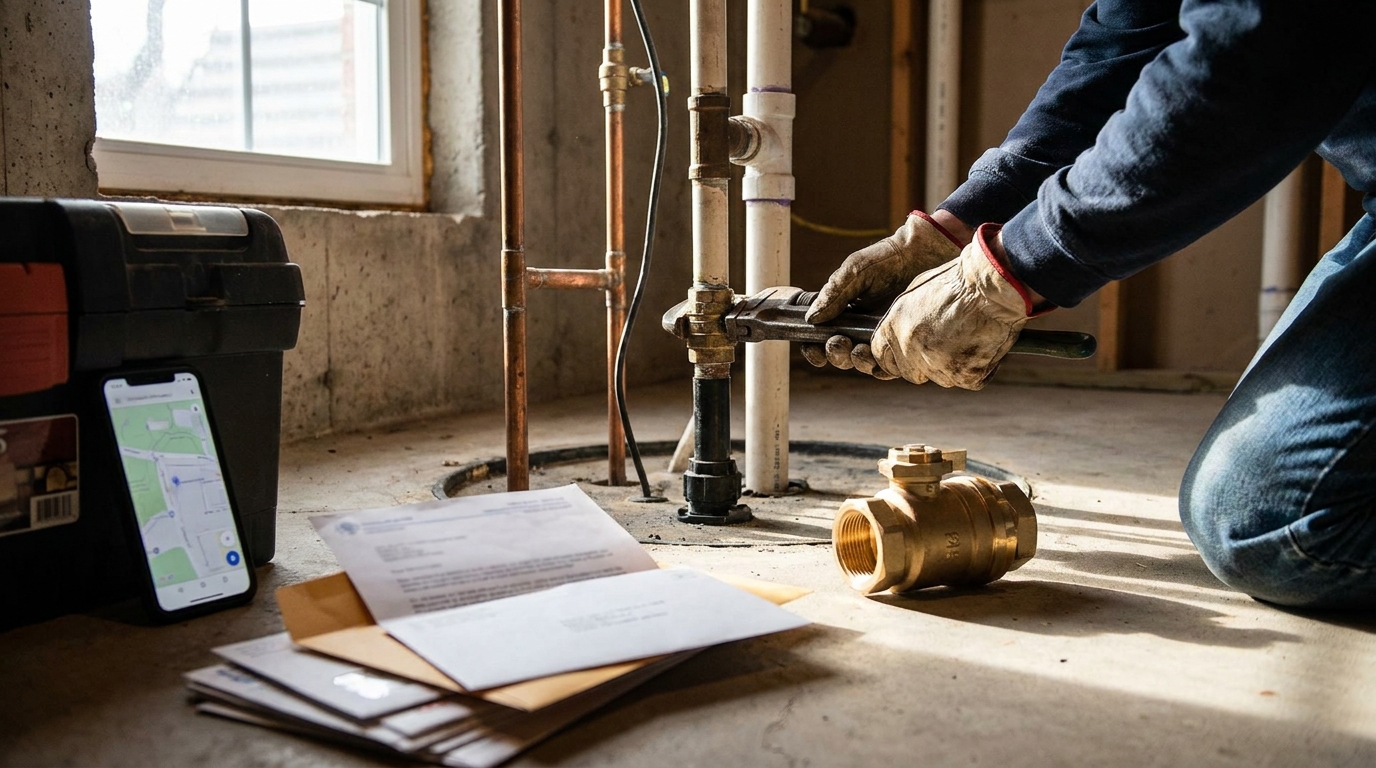
The letter arrived between a cable bill and a coupon flyer. A regional bank reminded a homeowner outside Houston that, effective later this year, federally backed mortgages on the property would require flood insurance. There was no hurricane. There was no flood. There was a quiet update to a FEMA Flood Insurance Rate Map.
If you live in one of the 100-plus communities getting new flood maps in 2026, that envelope is on its way to you too. And the smaller, more local question buried inside it is this: what does your new flood zone mean for the pipes under your basement?
What is actually happening in 2026
FEMA is rolling out one of the busiest map cycles in years. According to FEMA's Notice to Congress on flood mapping, the mid-June 2026 release covers more than 100 communities across 12 states, the largest single-day Flood Insurance Rate Map (FIRM) release in five years. States with 2026 Letters of Final Determination include Texas, Illinois, Minnesota, New York, South Carolina, Georgia, Indiana, Virginia, West Virginia, and North Carolina, with effective dates running through the year.
The marquee example is Harris County, Texas. According to a 2026 Neptune Flood analysis, the county's draft maps expand the 100-year floodplain by roughly 50,000 acres, pulling about 170,000 properties and an estimated $50 billion in real estate into the Special Flood Hazard Area. That is just one county. Multiply that pattern across the other states with finalized 2026 determinations and you have one of the most significant reshuffles of who pays for flood insurance, and who has to upgrade their plumbing, in years.
Two things make this rollout sting more than past ones. First, FEMA's Risk Rating 2.0 prices each structure individually, so two homes on the same block in the same AE zone can pay very different premiums based on elevation, foundation type, and rebuild cost. Second, more than 40% of National Flood Insurance Program claims now come from properties in Zone X, the so-called moderate or low-risk category. Inland suburbs are no longer the safe assumption they used to be.
How to check your new flood zone
You do not have to wait for a letter from your lender. Three free FEMA tools will tell you where you stand right now.
-
FEMA Flood Map Service Center. Plug your address into the Map Service Center to pull your current effective FIRM panel.
-
National Flood Hazard Layer Viewer. The NFHL Viewer is an interactive map that overlays current zones on satellite imagery.
-
Flood Map Changes Viewer. The Flood Map Changes Viewer overlays the new preliminary maps against current effective maps. If your lot color changes, that is the news. Preliminary data is also posted at the FEMA Mapping Information Platform.
Quick translation: Zone AE means a 1% annual chance of flooding and mandatory insurance on federally backed mortgages. Shaded Zone X means a 0.2% annual chance, no federal mandate, but rapidly rising premiums and underwriter interest. Unshaded Zone X is the lowest tier. The 'effective date' printed on your Letter of Final Determination is the day all of this becomes legally binding for insurance and code purposes. Public-media coverage of the FEMA map revision process walks through the timeline if you want a deeper background read.
Why the plumbing code suddenly matters
FEMA maps do not rewrite plumbing code. What they do is change who is doing substantial improvements, rebuilds, and new construction inside a flood zone. Those projects pull permits, and permits trigger code compliance.
The provision to know is IRC Section P3008 (mirrored as IPC 715.1 in the commercial code). In plain English: if the flood-level rim of any plumbing fixture in your home sits below the elevation of the next upstream public sewer manhole cover, you need a backwater valve. UpCodes has a plain-language version of the same rule. The valve has to comply with ASME A112.14.1, CSA B181.1, or CSA B181.2, and it has to remain accessible for service.
That P3008 trigger is older than the 2026 maps. What is new is how many homes are about to come under permit scrutiny at the same time. Substantial improvement work in a newly mapped AE zone, defined as renovation work whose cost equals or exceeds 50% of the structure's market value, can force code-current plumbing on the whole drain system, not just the area you are renovating.
AI workflows for revenue teams
Placeholder house ad for Conservus.ai. Swap with final creative when brand assets are ready.
Partner with Conservus.aiMandatory versus recommended upgrades
Not every upgrade is legally required. The honest breakdown:
-
Backwater valve. Often legally required when the P3008 elevation trigger applies, and increasingly required by municipal stormwater ordinances, especially for new builds and substantial improvements. State and city rules vary widely, so confirm with your local building department before scheduling work.
-
Battery-backup sump pump. Rarely a state code mandate, but increasingly required by municipal stormwater ordinances and by insurance underwriters writing policies in newly mapped AE areas. If your home already has a sump pit, a backup is a smart hedge regardless of what the code says.
-
Strongly recommended. A sewer cleanout with surface access, sealed floor drains with trap primers, and elevating your furnace, water heater, and electrical panel above the projected base flood elevation. None of these are universally mandated. All of them save money in a real flood claim.
Real cost ranges, scheduled versus emergency
Plumbing cost data for 2026 is fairly consistent across the major industry trackers. Here is what to budget.
-
Backwater valve, new construction. Around $500 when the building drain is open and accessible.
-
Backwater valve, retrofit on an existing home. $2,000 to $5,000, because the plumber has to break out a section of basement slab to reach the building drain, install the valve body, and patch the floor. The lower end of that range applies to shallow drains and easy slab access. Both Square One Insurance and Western Rooter and Plumbing confirm these retrofit numbers.
-
Battery-backup sump pump, installed. $600 to $1,200 for a typical pro install with a standard battery, per Angi's 2026 data and HomeGuide's 2026 cost report. National average is around $900. Premium deep-cycle systems with rerouted discharge piping can push $1,500 to $1,800.
-
Emergency plumber hourly rate. $100 to $500 per hour for standard after-hours work, with high-cost markets and specialty shops over $600 per hour. Most shops charge a service-call fee of $150 to $250 just to roll a truck. After-hours work runs 1.5x weekday rates, with weekends and holidays at 2x to 3x, per Angi's 2026 plumbing cost data.
-
Same-night backwater valve retrofit during an active sewer backup. $3,500 to $6,000 is realistic once you add the emergency premium, the service-call fee, and any extraction work. Basement flood cleanup costs stack on top of that.
The takeaway is simple. A scheduled retrofit on a dry Tuesday morning is roughly half what the same job costs on a Saturday night with two inches of standing water in the laundry room.
The grandfathering window
Here is the most useful piece of timing in this entire article. If FEMA is moving your property into a higher-risk zone, you can lock in the current lower-zone NFIP rate by purchasing a policy before the new map's effective date. The rate sticks even after the new map kicks in, as long as the policy stays continuously in force.
Check your Letter of Final Determination for the effective date and call an NFIP agent well ahead of it. Industry analysis confirms lenders are already using these effective dates to start requiring coverage on federally backed mortgages. Once the date passes, the new rate applies, and Risk Rating 2.0 will price your specific structure rather than your zone.
This matters in Florida even if your zone has not changed. Citizens Property Insurance began requiring flood insurance on January 1, 2026 for homes with Coverage A of $400,000 or more, regardless of flood zone. Zone X is no longer a free pass with that carrier.
AI workflows for revenue teams
Placeholder house ad for Conservus.ai. Swap with final creative when brand assets are ready.
Partner with Conservus.aiRebates and offsets you should ask about
Before you write a check for a backwater valve, check two places for money back.
-
Municipal stormwater rebate programs. Cities in Illinois, Ohio, Missouri, Minnesota, and New Jersey are among those running cost-share programs that reimburse part of a backwater valve install. Toronto's program, often cited as a benchmark, pays up to CA$3,400. Ask your city's water or stormwater utility directly.
-
NFIP Increased Cost of Compliance (ICC) coverage. If you have an NFIP policy and your home is declared substantially damaged after a flood, ICC can pay up to $30,000 toward code-required mitigation, including elevation, dry floodproofing, and relocation. This applies after a claim, not before, but it changes the math on rebuilding.
What to ask a local plumber before hiring
A backwater valve retrofit is one of those jobs where a careless install creates a worse problem than the one it was supposed to fix. Before signing a quote, ask:
-
Does the valve comply with ASME A112.14.1, CSA B181.1, or CSA B181.2? P3008 requires one of these.
-
Are you pulling a permit with the city, and is an inspection included in the price?
-
Normally-open or normally-closed valve, and why? Normally-open is more common for whole-house use because it lets sewer gases vent and reduces clog risk.
-
Where will the access cover sit, and is it labeled for future service?
-
What is the warranty on the slab patch and on the seal between the valve and the pipe?
-
Will you camera-scope the line after install to confirm flow and seating?
For a battery-backup sump pump, ask whether the installer is sizing the battery for your typical power-outage duration, whether the discharge line is independent of the primary pump, and whether the system has an alarm and a way to test it without flooding the pit.
Bottom line
If your address is in one of the communities getting a new FIRM this year, the cheapest version of every decision in this article is the one you make before the new effective date and before the first heavy rain of the season. A scheduled backwater valve retrofit at $2,000 to $5,000 is uncomfortable. A same-night emergency call during an active sewer backup, plus water damage cleanup, is the kind of number that ends up on a home equity line. Check your zone today on the FEMA Flood Map Service Center, price the work now, and get the policy in force before the date on your Letter of Final Determination.
AI workflows for revenue teams
Placeholder house ad for Conservus.ai. Swap with final creative when brand assets are ready.
Partner with Conservus.aiRelated reading
Sources
-
FEMA Notice to Congress: Monthly Updates on Flood Mapping, 2026
-
Flood Insurance Guru: Citizens Flood Insurance Requirement 2026
-
Wholesale Industrial Supply: Backwater Valve Code Requirements
-
Western Rooter and Plumbing: Backwater Valve Homeowner's Guide
Note: This article contains AI-assisted content and has been reviewed by our editorial team.
ABOUT THIS SERVICE: CallTheLocal.com is a directory and lead generation service, not a contractor or service provider. Submitting this form does not obligate you to hire anyone or purchase any service. Your information will be shared with licensed, insured home service professionals in your area who may provide quotes for your project. CallTheLocal.com does not guarantee the quality, timeliness, or outcome of any work performed by service providers you connect with through this service. Always verify licensing, insurance, and references before hiring. Get everything in writing before work begins.