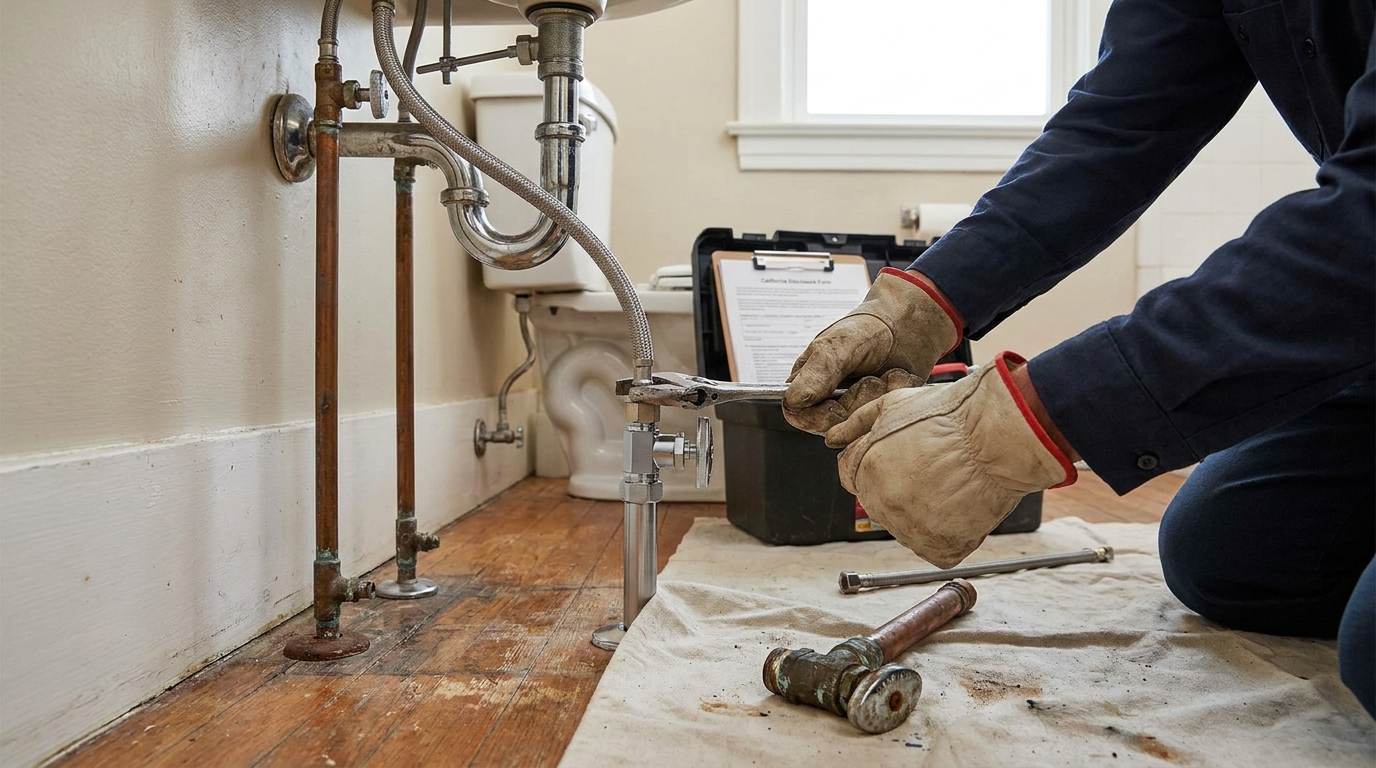
If a social media post told you that California will block the sale of your home in 2026 until you replace your toilets and faucets, take a breath. That framing is wrong, and it's worth correcting before it costs you money or a panicked weekend of plumbing work.
The law behind the rumor is real. It's called SB 407, signed back in 2009. But it is a disclosure requirement paired with a retrofit duty whose deadlines already passed years ago. It is not a rule that stops a sale. There is no new 2026 statutory deadline. What is genuinely happening in 2026 is more scrutiny from inspectors and buyers, tighter product standards on new fixtures, and stricter enforcement of an obligation that has been on the books for over a decade.
Let's walk through what the law says, which fixtures actually fail, what a fix costs, and how to fill out the paperwork honestly so you can sell (or buy) without drama.
What SB 407 actually requires
SB 407 (Civil Code sections 1101.1 through 1101.9, plus the disclosure section 1102.155) says that single-family homes built before 1994 must have their noncompliant plumbing fixtures replaced with water-conserving models. It also requires sellers to state, in writing, whether the home still contains any noncompliant fixtures when the property changes hands. (Official bill text, California Legislature.)
Here's the part the viral posts leave out. The retrofit deadlines are already in the past:
-
Single-family homes: compliance due by January 1, 2017 (Civil Code section 1101.4).
-
Multifamily and commercial buildings: compliance due by January 1, 2019 (section 1101.5).
So the obligation to swap noncompliant fixtures has technically applied to most California homes for years. The seller disclosure requirement (section 1102.155) became operative on January 1, 2017. Importantly, the original version of SB 407 tied replacement to the point of sale, but lawmakers replaced that with a date-certain approach. That means the current law is a disclosure at sale, not a mandatory-replacement-before-you-can-close rule. (See the City of San Diego's plumbing retrofit explainer for a plain-language summary of the scope.)
Bottom line: a noncompliant toilet does not veto your sale. It creates a disclosure you must make, and a repair you were already supposed to have done.
Which fixtures actually fail the test
SB 407 (Civil Code section 1101.3) defines a "noncompliant plumbing fixture" using these thresholds:
-
A toilet that uses more than 1.6 gallons per flush (gpf)
-
A urinal over 1.0 gpf
-
A showerhead over 2.5 gallons per minute (gpm)
-
An interior faucet over 2.2 gpm
These are the legal triggers for replacement. The classic offender is the old toilet. The 1.6 gpf ceiling is actually the federal standard from the Energy Policy Act, which took effect in 1994. That's why pre-1994 toilets, which often used anywhere from 3.5 to 7 gallons per flush, are the fixture inspectors flag most often. (US EPA WaterSense, Residential Toilets.)
A quick way to check your own toilet: lift the tank lid and look for a stamped date or a gpf rating on the inside of the tank or near the seat hinge. If it's from the 1980s and there's no efficiency label, assume it's a candidate for replacement.
The stricter standard buyers and remodels now expect
Here's where 2026 buyers get confused, and where the story does have a forward-looking angle. The SB 407 thresholds above are the legal minimum. But the fixtures you can actually buy new in California must meet a tougher standard set by Title 20 (enforced by the California Energy Commission and aligned with CalGreen):
-
Toilets: 1.28 gpf
-
Showerheads: 1.8 gpm
-
Kitchen faucets: 1.8 gpm (a temporary boost to 2.2 gpm is allowed)
-
Bathroom (lavatory) faucets: 1.2 gpm at 60 psi
Fixtures sold in the state must be listed in the Energy Commission's MAEDbS database. (California Title 20 Water-Efficiency Standards FAQ.)
The practical takeaway: if you go to a store or hire a plumber today, the new fixtures you install will already beat the SB 407 requirement by a comfortable margin. You don't need to hunt for a special "compliant" product. Standard modern fixtures sold in California already clear the bar.
The timeline that actually matters
Instead of a mythical 2026 deadline, here are the dates that genuinely drive enforcement:
-
January 1, 2014: Any building alteration or improvement to a single-family home triggers replacement of noncompliant fixtures as a condition of final permit or occupancy approval. This is the most common real-world enforcement point. If you pull a permit for a remodel, expect the inspector to require compliant fixtures before sign-off.
-
January 1, 2017: Single-family retrofit deadline, plus the seller disclosure requirement takes effect.
-
January 1, 2019: Multifamily and commercial retrofit deadline.
Notice the pattern. Enforcement runs through permits, inspections, and written disclosure, not through a power to stop your sale. If you remodel, you'll be required to comply as part of the permit. If you sell, you'll be required to disclose. Those are the pressure points.
The paperwork: what the disclosure says
When you sell a pre-1994 single-family home, the disclosure under Civil Code section 1102.155 requires you to state in writing that section 1101.4 requires water-conserving fixtures, and to disclose whether your property still contains any noncompliant fixtures. This language sits within the broader Transfer Disclosure Statement package that California sellers already complete.
Some cities added their own point-of-sale certificate rules on top of the state law. Those local layers are being rolled back, not tightened. San Diego, for example, eliminated its Water Conservation Certificate resale filing as of February 28, 2022. (City of San Diego; see also PSAR on the point-of-sale elimination.) That trend is more evidence that the direction of travel is toward disclosure, not sale-blocking certificates.
One honest note: check your own city. Local rules vary and change. A five-minute call to your city's building or water conservation department before you list is cheap insurance.
What a retrofit actually costs
This is usually the real question. The good news is that fixing noncompliant fixtures is one of the more affordable home projects, and it often pays for itself.
Toilets. A WaterSense-labeled 1.28 gpf toilet commonly runs about $150 to $600 for the unit alone. Installed, popular models tend to land around $280 to $400 each. (Cost-to-replace guide, 2025. Confirm current local pricing before budgeting.)
Showerheads and faucets. These are the budget-friendly swaps. A compliant showerhead or faucet aerator is often a modest hardware-store purchase, and many are true do-it-yourself jobs with a wrench and some plumber's tape. Faucet replacements that require new valves cost more and may be worth a plumber's time.
Whole-house scaling. Your total scales with fixture count. Add up your toilets, showerheads, and faucets, then multiply. A small two-bath home might see a few hundred dollars in parts for the simple swaps plus toilet costs; a larger home with several bathrooms will run higher.
DIY vs. plumber. Showerheads and faucet aerators are approachable for most homeowners. Toilet replacement is doable for a confident DIYer but involves shutting off water, lifting a heavy fixture, and setting a new wax ring correctly. If a leak at the base would ruin your flooring, a plumber's labor is money well spent.
Rebates. Utility rebates can offset a real chunk of the cost. Los Angeles Department of Water and Power, for instance, has offered rebates for high-efficiency toilet replacement. Check your water provider's conservation page before you buy, because rebates change and sometimes require you to apply before purchase.
The payback: why this often makes sense anyway
Setting the law aside, upgrading an old toilet is one of the better small investments in a home. According to the EPA, a 1.28 gpf WaterSense toilet uses about 20 percent less water than the 1.6 gpf federal standard. That saves a typical household nearly 13,000 gallons and $170 or more per year, which adds up to roughly $3,400 over the life of the toilet. (US EPA WaterSense.) An old 3.5 to 7 gpf toilet wastes far more, so your savings could be even larger.
Buyer and seller playbook
If you're selling:
-
Inventory your fixtures. Note the gpf on each toilet and the age of showerheads and faucets.
-
Fill out the disclosure honestly. Saying "yes, one noncompliant toilet remains" is legal and normal. Hiding it is the actual risk.
-
Decide whether to fix or disclose. A cheap showerhead swap before listing removes a talking point. A full toilet replacement is a judgment call you can weigh against buyer expectations.
-
Expect it in negotiations. Buyers may ask for a credit or a swap. It's a small line item, not a deal-killer.
If you're buying:
-
Read the disclosure. If noncompliant fixtures are listed, price the fix using the ranges above and factor it into your offer.
-
Don't panic over it. A flagged toilet is a couple hundred dollars, not a reason to walk.
-
Have your inspector note fixture flow rates so you know exactly what you're inheriting.
Outside California? Read this as a preview
If you don't live in California, this is still worth watching. California's fixture rules and disclosure model tend to foreshadow where water-efficiency requirements head nationally. You can pre-empt the trend cheaply. Swapping to WaterSense-labeled toilets, showerheads, and faucets lowers your water bill now and keeps you ahead of any disclosure or standard your state may adopt later. Given the payback numbers above, it's often a smart move regardless of what the law requires.
The honest summary
No one is going to stop you from selling your California home in 2026 because of an old toilet. SB 407 is a decade-old law with deadlines that have already passed, enforced mainly through remodel permits and a written seller disclosure. The smart play is simple: know your fixtures, disclose honestly, budget a few hundred dollars if you choose to upgrade, and grab a utility rebate if one's available. Do that, and the "2026 toilet law" is a footnote, not a crisis.
Related reading
Sources
-
Point-of-sale water retrofit requirement eliminated in San Diego (PSAR)
-
California Title 20 Water-Efficiency Standards FAQ (citing the CEC)
-
How Much Is a Toilet? Cost to Buy, Replace, and Install in 2025
Note: This article contains AI-assisted content and has been reviewed by our editorial team.
ABOUT THIS SERVICE: CallTheLocal.com is a directory and lead generation service, not a contractor or service provider. Submitting this form does not obligate you to hire anyone or purchase any service. Your information will be shared with licensed, insured home service professionals in your area who may provide quotes for your project. CallTheLocal.com does not guarantee the quality, timeliness, or outcome of any work performed by service providers you connect with through this service. Always verify licensing, insurance, and references before hiring. Get everything in writing before work begins.
Related reading
- Millions of Homeowners Are Getting a 'Your Water Line May Be Lead' Letter in 2026: What the Notice Means and Who Actually Pays the Bill
- Your Local Plumber Just Got Bought by Wall Street: How the $50 Billion Home-Services Buying Spree Is Quietly Reaching Your Service Call
- The Viral '2026 Water Heater Rule Will Double Your Bill' Warning Is Mostly Wrong: What the DOE Standard Actually Changes at Home
- The Bay Area's Gas Water Heater Ban Was Set for January 2027. Regulators May Push It to 2028, and Quotes Are Already Using the Old Date.