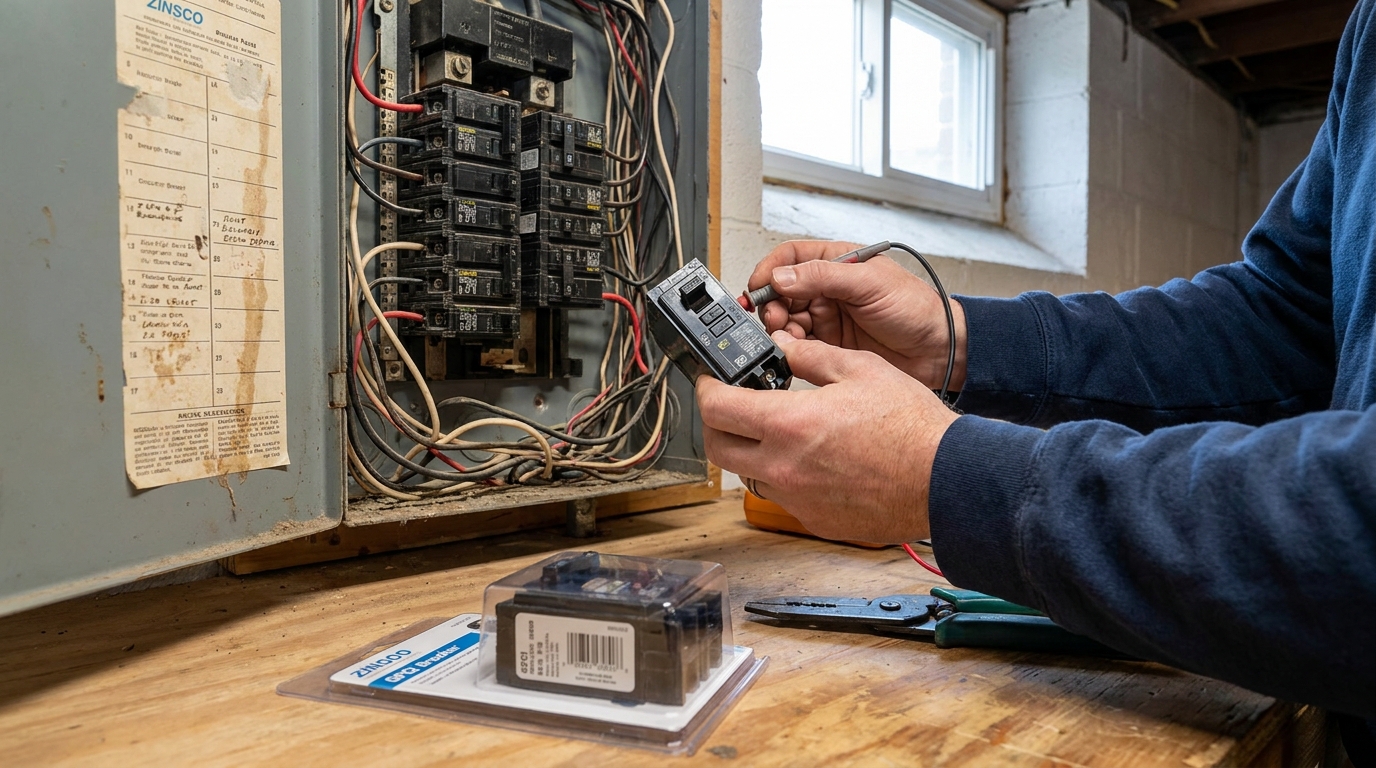
You pull a permit this spring to finish a basement bedroom or add a Level 2 EV charger, and the inspector mentions GFCI protection on the affected circuit. You drive to the home center expecting a $40 breaker. Two days later you are on the phone with an electrician who is using the words panel replacement and service upgrade, and the number on the estimate has four digits.
This is the gap between what the code says and what your panel will actually accept. Here is what the 2026 National Electrical Code (NEC) actually changed, what it did not change, and why a small ground-fault protection requirement can become a $1,200 to $3,000 project on an older home.
What the 2026 NEC Actually Changed (and What It Didn't)
The internet headline that basements and garages just became GFCI-required in 2026 is mostly wrong, and the truth matters because it determines whether your house is already non-compliant or whether the new rule is the one catching you.
-
Garages: GFCI protection for dwelling-unit garage receptacles has been required for decades. Nothing new in 2026.
-
Basements: The 2020 NEC, in section 210.8(A)(5), already required GFCI for all dwelling-unit basement receptacles, finished or unfinished. The 2023 cycle kept it. So if your jurisdiction is on 2020 NEC or later, basement GFCI is not a 2026 change. (JADE Learning)
-
2023 expansion: The 2023 NEC pushed GFCI to all 125V to 250V receptacles on single-phase circuits at 150V or less to ground in the listed locations, grew the dwelling list from 11 to 12 locations, and removed the old kitchen countertop limiter so more kitchen receptacles are covered. (ExpertCE)
-
The real 2026 headline: GFCI protection within 6 feet of every indoor sink, not just kitchen and bath. That sweeps in laundry sinks, basement utility sinks, and garage slop sinks. The 2026 cycle also tightens GFCI handling around EV charging circuits and energy storage systems. (Building Code Forum, Buildermuse)
So the practical truth for most homeowners in 2026 is this: the GFCI rule that surprises you is usually one already on the books in 2020 or 2023, finally getting triggered because you pulled a permit. The 6-foot-from-any-sink rule is the genuinely new one to watch.
Does Your State Even Use the 2026 NEC Yet?
NEC adoption is state-by-state, and it usually lags the NFPA release by 12 to 36 months. As of mid-2026, only about eight states have formally adopted the 2026 edition: Colorado, Idaho, Massachusetts, New Hampshire, Oregon, Utah, Vermont, and Washington. Washington's enforcement target is December 31, 2026, and federal facilities default to September 1, 2026. (Low Voltage Nation)
Most of the largest states, including California, Florida, New York, Texas, Illinois, Pennsylvania, Ohio, North Carolina, Georgia, New Jersey, and Virginia, are still operating under 2020 or 2023 NEC with state amendments. (NSSL adoption snapshot) That means in most of the country, the GFCI rule your inspector enforces is the 2020 or 2023 version, not the 2026 one you read about online.
Before you spend a dollar, verify your edition with two sources that keep this current:
If you live in a state like Washington, the actual amendment text matters too, because states routinely edit the NEC before adopting it. WAC 296-46B-210 is a model for how to read your state's amendments rather than relying on the raw NEC.
What 'Triggers' the GFCI Upgrade in the First Place
Code does not generally chase you down for outlets that were legal when installed. What pulls existing wiring into the current GFCI rules is usually one of these:
-
Pulling a permit to alter, extend, or replace a branch circuit (adding outlets in a finished basement rough-in, for example).
-
Installing an EV charger or an energy storage system.
-
Replacing the panel itself, which can pull AFCI and GFCI requirements forward on circuits the panel feeds. (Panel Upgrade Authority)
A true like-for-like receptacle swap (same circuit, same location, no extension) generally does not trigger a panel-wide upgrade, though it can trigger a GFCI requirement at that outlet. State labor departments publish plain-English FAQs on this; Minnesota DLI's 2023 NEC FAQ is a useful primary-source example. (Northwest Electric Pros covers the rollout from the installer side.)
AI workflows for revenue teams
Placeholder house ad for Conservus.ai. Swap with final creative when brand assets are ready.
Partner with Conservus.aiGFCI Receptacle vs GFCI Breaker: Why It Matters for the Bill
There are two ways to deliver GFCI protection, and the choice changes your cost dramatically.
-
GFCI receptacle ($20 to $30 part, roughly $150 to $300 installed): Protects from that outlet downstream. Works on any panel, regardless of vintage. The catch: code generally requires protection on the entire circuit when the first outlet is not readily accessible, and a receptacle obviously cannot protect a hard-wired load.
-
GFCI or dual-function CAFCI/GFCI breaker ($35 to $65 for standard GFCI, $50 to $110 for dual-function): Protects the whole circuit from the panel. Installed cost typically runs $185 to $500 per breaker depending on panel access and compatibility. (CountBricks)
If the load is hard-wired, you have no choice. Dishwashers, dryers, and EV charging equipment (EVSE) all force the breaker route. That is where a long-standing dwelling can hit a wall. (EC&M overview of GFCI history)
The Real Reason a $40 Breaker Becomes a $1,200 Project: Panel Compatibility
Every breaker has to be UL listed for the panel it goes into. It fits is not the same as it is listed, and inspectors fail this on sight.
The panels most likely to leave you without a listed GFCI option include:
-
Federal Pacific Stab-Lok: No modern listed GFCI/dual-function lineup. These panels also have a documented history of failure-to-trip issues and many electricians refuse to add load to them.
-
Zinsco / Sylvania: Same problem. Limited or no UL-listed GFCI options, and the bus itself is often the failure point.
-
Older GE THQL (pre-1990) and certain Square D QO/HOM vintages: May have only single-pole GFCI stock available, or none for the dual-function trim you need. (Garage Journal thread, DoItYourself.com thread)
When there is no listed breaker for your panel, the math changes. You are now choosing between a sub-panel add-on or a full service replacement.
The Four Financial Paths, With 2026 Numbers
-
Path A. GFCI receptacle where code allows: Roughly $150 to $300 installed per device.
-
Path B. GFCI or dual-function breaker (listed for your panel): Roughly $185 to $500 installed per breaker.
-
Path C. Sub-panel add-on (when the main panel cannot accept listed GFCI/DF breakers): Roughly $800 to $1,500 for a small sub-panel feeding the new or altered circuits.
-
Path D. 200A panel replacement, like-for-like: Roughly $1,300 to $3,000 nationally in 2026. (Vons Electric, HomeGuide)
-
Path E. Full service upgrade with new meter, mast, and grounding: Roughly $5,000 to $7,500, higher in permit-heavy metros. UniColorado data from Denver puts a typical 2026 number at $5,050 to $7,350 when meter and grounding are bundled.
The path you land on depends almost entirely on whether your panel has UL-listed GFCI breakers available. That is one phone call and a flashlight away, not a guessing game.
AI workflows for revenue teams
Placeholder house ad for Conservus.ai. Swap with final creative when brand assets are ready.
Partner with Conservus.aiHow to Ask for a Panel Compatibility Check Before You Commit
Before you sign anything for a basement finish, an EV charger, or any project that will touch your panel, pay for a focused panel compatibility check. Expect to spend roughly $150 to $250, and many electricians credit it toward the work if you hire them.
Get these answers in writing:
-
Panel manufacturer, model, and approximate vintage.
-
Whether UL-listed GFCI and dual-function breaker SKUs exist for your panel in the trim sizes you need.
-
Condition of the bus and any signs of aluminum corrosion or burn marks.
-
Number of available spaces, and whether tandem breakers are allowed in those slots.
-
Service capacity headroom: does your existing 100A or 150A service support the new load, or does the project push you toward a 200A upgrade?
That document is your defense against a contractor later telling you the panel needs to go when a sub-panel or single listed breaker would have done the job.
Permits, Inspections, and the 6-Foot-From-Sink Rule
In jurisdictions on the 2026 NEC, some inspectors are reading the 6-foot-from-any-indoor-sink rule aggressively on basement remodels, sweeping in the utility sink near the washer or the slop sink by the garage door. That can pull additional circuits into GFCI scope that you did not budget for.
If you are on 2020 or 2023 NEC, the basement GFCI requirement is already there for any new or altered receptacles in the basement. The permit, not the calendar, is what activates it.
Red Flags in a Bid
-
The electrician says a breaker is fine because it fits even though it is not listed for your panel. That is a failed inspection waiting to happen and a safety problem.
-
Refusal to put the panel make, model, and listed-breaker availability in writing.
-
No permit pulled for a project that clearly requires one (panel swap, EV charger, new circuits in a finished basement).
-
Jumping straight to a full service upgrade without first confirming that listed GFCI breakers do not exist for your existing panel.
-
Quoting from photos only, without opening the panel cover.
AI workflows for revenue teams
Placeholder house ad for Conservus.ai. Swap with final creative when brand assets are ready.
Partner with Conservus.aiA Homeowner Checklist Before Your First Walkthrough
-
Look up your state's current NEC edition at IAEI and cross-check with Mike Holt.
-
Check whether your state has amendments (Washington's WAC 296-46B-210 is the model for what to look for).
-
Photograph your panel's label, the inside of the dead-front if you can do it safely, and any breaker that looks original.
-
Make a list of every project on the horizon (basement finish, EV charger, hot tub, dryer move) so the panel question is answered once for all of it.
-
Pay for the compatibility check up front. The $150 to $250 you spend protects against a $5,000 surprise.
Bottom Line
The 2026 NEC is real, but for most homeowners in 2026 it is not the rule catching them. The 2020 and 2023 cycles already covered basements, garages, and most 125V to 250V dwelling circuits. The 2026 sink rule is the genuine new wrinkle in the few states that have adopted it. What turns any of these rules into a four-figure bill is panel compatibility, and that is a question you can answer before you sign anything.
Related reading
AI workflows for revenue teams
Placeholder house ad for Conservus.ai. Swap with final creative when brand assets are ready.
Partner with Conservus.aiSources
-
[NEC 2026 Adoption by State Tracker (Low Voltage Nation)](https://www.lowvoltagenation.com/posts/nec-2026-adoption-by-state-tracker)
-
GFCI Requirements in the 2026 NEC: What Changed (Building Code Forum)
-
AFCI and GFCI Breakers During Panel Upgrades (Panel Upgrade Authority)
-
[200-Amp Panel Upgrade Cost 2026 (Vons Electric)](https://vonselectric.com/articles/200-amp-panel-upgrade-cost/)
-
[Electrical Panel Upgrade Cost Denver 2026 (UniColorado)](https://unicolorado.com/pricing/electrical-panel-upgrade-cost/)
Note: This article contains AI-assisted content and has been reviewed by our editorial team.
ABOUT THIS SERVICE: CallTheLocal.com is a directory and lead generation service, not a contractor or service provider. Submitting this form does not obligate you to hire anyone or purchase any service. Your information will be shared with licensed, insured home service professionals in your area who may provide quotes for your project. CallTheLocal.com does not guarantee the quality, timeliness, or outcome of any work performed by service providers you connect with through this service. Always verify licensing, insurance, and references before hiring. Get everything in writing before work begins.