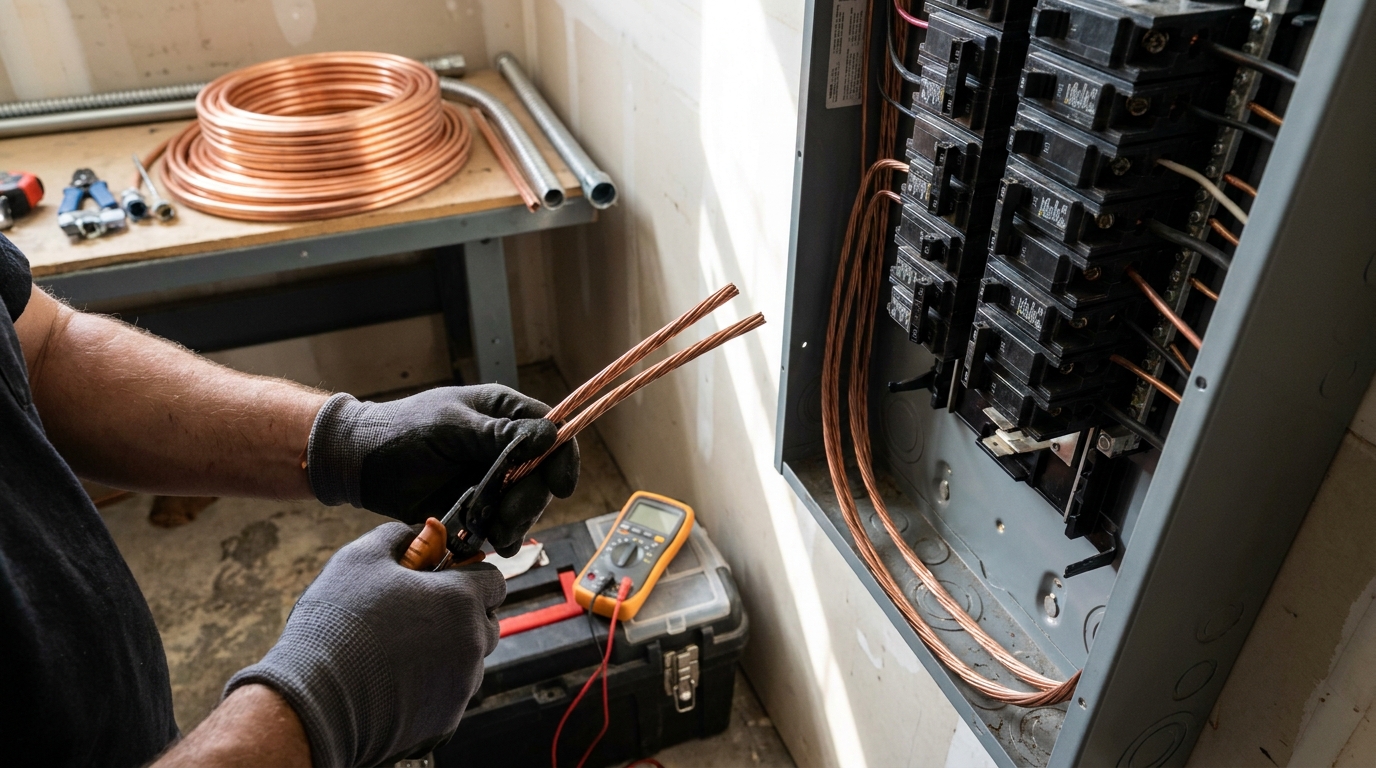
If you have asked an electrician or plumber for a quote lately and felt some sticker shock, you are not imagining it. The price of copper, the metal inside nearly every wire and water line in your house, pushed past $6 a pound for the first time ever in early 2026. That single number, set on a commodities exchange far from your kitchen, is quietly reshaping what it costs to rewire a house or repipe a bathroom.
Here is the honest version of what is happening, what the work actually costs in 2026, and how to keep a volatile metal market from blowing up your project budget.
Copper's record run, explained
Copper crossed the $6 per pound mark on the COMEX exchange for the first time in early 2026, then set a record intraday high of $6.716 on May 13, 2026. By June 2026 it had settled back into the $6.30 to $6.36 range, still far above where it sat a year earlier (Barchart, Investing News Network).
Two forces are pushing it up at the same time:
-
Electrification demand. Data centers, EV charging networks, and grid modernization all run on copper, and they are all expanding at once. That is a long-term pull on supply (Barchart).
-
Tariffs. A 50% Section 232 tariff on semi-finished copper products, which includes wire, rod, pipe, tube, and sheet, took effect August 1, 2025. As of April 6, 2026, that tariff applies to the full value of those semi-finished products, with a 25% rate on copper-intensive derivative goods (White & Case, Thompson Coburn).
Translation for homeowners: the exact materials your contractor buys got more expensive both because the raw metal is pricier and because the finished wire and pipe carry a tariff on top.
From spot price to your invoice: a reality check on that 25 to 35% number
Let's be straight about the headline figure. The most authoritative construction cost benchmark, the RSMeans copper electric wire index tracked by Gordian, came in at $416.11 per MLF (thousand linear feet) in Q2 2026. That was up 5.30% from the prior quarter and 18.42% year over year compared to Q2 2025 (Gordian / RSMeans).
So the measured, official rise in copper wire pricing is roughly 18% over a full year, not 25 to 35% in a single quarter. Where do the bigger jumps some homeowners are seeing come from? They tend to be anecdotal, drawn from individual contractor quotes rather than a tracked index. A few things stack on top of the raw metal move to produce a steeper bid:
-
Tariffs added after the metal was priced.
-
Contractors building in a cushion because the metal price can move day to day.
-
Higher scrap and theft losses that get folded into overhead (more on that below).
The takeaway: an 18% year-over-year increase in wire cost is well documented. If a single quote came in 25 to 35% higher than a comparable job a few months ago, that is plausible given everything above, but ask your contractor to itemize the material line so you can see how much is metal, how much is tariff, and how much is labor.
What the work actually costs in 2026
Here are verified 2026 ranges for the most common copper-heavy home projects.
Whole-home rewire
Expect roughly $6,000 to $30,000, generally landing around $2 to $4 per square foot. A typical 1,500 square foot home falls in the $10,000 to $18,000 range. The single biggest swing factor is access: if walls have to be opened up and patched, the cost can roughly double. Electrician labor runs about $50 to $100 per hour (Angi).
200-amp service or panel upgrade
Plan on roughly $1,300 to $3,000. This is one of the more common upgrades right now as homes add EV chargers and higher electrical loads (Angi).
Copper repipe vs. PEX
A full copper repipe runs about $8,000 to $15,000, while a PEX repipe runs about $4,000 to $8,000. Copper typically costs 40 to 60% more than PEX. Part of that gap is the metal, and part is labor: copper takes about 3 to 5 days because joints are soldered, while PEX usually wraps in 1 to 2 days ([Whole-Home Repipe Cost Guide 2026](https://www.geekpoweredstudios.com/post/whole-home-repipe-cost-guide-2026)).
The theft wave nobody warns you about
When metal gets this valuable, it gets stolen. Copper theft surged 77% in 2025 according to CargoNet, and the trend carried into 2026. Thieves target construction jobsites, secluded laydown yards where materials are staged, and vacant homes, stripping them for what the trade calls "bare-bright" copper, meaning clean, uninsulated wire that commands the top scrap price (Construction Dive, For Construction Pros).
For context on why it is worth the risk to thieves, building wire scrap (the Romex pulled off jobs) was projected around $3.80 to $4.40 per pound in 2026, materially more than a year earlier (Stripmeister).
Why this matters to you as a homeowner: if you have a project underway, delivered copper sitting on site is a target. So is an unfinished remodel or a vacant property. Theft losses also push contractor overhead up, which eventually shows up in bids.
The alternatives your electrician may suggest
Faced with copper prices, electricians are increasingly floating aluminum-based options. There are two worth understanding.
-
AA-8000 series aluminum. This is the only solid or stranded aluminum permitted for the job, and it has long been used for larger feeders and service entrances.
-
14 AWG copper-clad aluminum (CCA). The 2026 NEC newly approved 14 AWG CCA for 10-amp branch circuits. This is specifically for LED lighting loads, not for receptacle outlets. Where aluminum or CCA is used at a 15 or 20 amp receptacle, the receptacle must be rated CO/ALR for those terminations (Copperweld / PR Newswire).
If a contractor proposes aluminum or CCA to save on copper, that can be legitimate and code-compliant. Just confirm it is being used where the code allows it, and that any receptacle terminations use CO/ALR-rated devices.
Red flags and how to protect yourself
-
A quote that "won't hold past a week" is not a sales gimmick. With copper moving day to day, short quote-validity windows reflect real metal volatility. Treat a short window as a signal to decide promptly, not as pressure to skip your homework.
-
Ask to lock material costs. If you can pin down the metal portion of the bid, you protect yourself from a mid-project price jump.
-
Itemize the bid. Have the contractor separate metal, tariff impact, and labor so you understand what is driving the number.
-
Secure delivered copper. If materials are dropped at your home before the crew arrives, keep them out of sight and ideally locked up. Watch for bare-bright wire being stripped from any unfinished work.
-
Verify aluminum terminations. If CCA or aluminum is used, confirm CO/ALR-rated receptacles where required.
What to expect for the rest of 2026
The pressure on copper comes from two directions that are unlikely to reverse quickly. Electrification demand from data centers, EV charging, and grid work is a multi-year story, and the tariff structure expanded rather than eased in April 2026. Copper has cooled slightly from its May record but remained above $6.30 a pound in June. For homeowners, the practical move is the same whether prices climb a little more or hold steady: get itemized quotes, lock your material costs where you can, and do not let a short quote-validity window rush you past basic vetting.
Related reading
-
[Your Roof Quote Jumped Again June 1: Why GAF, Owens Corning, and CertainTeed Just Raised Shingle Prices 6 to 9% for the Second Time This Year](/guides/roof-quote-jumped-june-1-2026-shingle-price-increase)
-
[Your EV Charger Quote Doubled Because of the Panel: When an $800 Install Becomes a $4,000 Project (and When 70% of Homes Can Skip It)](/guides/ev-charger-panel-upgrade-cost-2026)
Sources
-
President Trump Orders 50 Percent Section 232 Tariff on Copper Imports — White & Case LLP
-
Proclamation Imposing 50% Section 232 Tariffs on Copper — Thompson Coburn LLP
-
What the Data Says: Copper Price Updates — Gordian (RSMeans)
-
Can Copper Still Rally After Reaching a Long-Term Target? — Barchart
-
What Was the Highest Price for Copper? — Investing News Network
-
Copper Thefts Spike as Construction Site Crimes Become Big Business — Construction Dive
-
Copper Tariffs and Construction Site Theft — For Construction Pros
-
Copperweld Explains the NEC's New 14 AWG CCA Inclusion — PR Newswire
-
How 2026 Copper Tariffs Are Changing the Math for Electrical Contractors — Stripmeister
Note: This article contains AI-assisted content and has been reviewed by our editorial team.
ABOUT THIS SERVICE: CallTheLocal.com is a directory and lead generation service, not a contractor or service provider. Submitting this form does not obligate you to hire anyone or purchase any service. Your information will be shared with licensed, insured home service professionals in your area who may provide quotes for your project. CallTheLocal.com does not guarantee the quality, timeliness, or outcome of any work performed by service providers you connect with through this service. Always verify licensing, insurance, and references before hiring. Get everything in writing before work begins.