
Hail fell across parts of three states on Nov. 11 and 12, and a lot of homeowners in western Indiana, New Jersey and northern Delaware are now looking at dented gutters and wondering about the roof above them. Before you call anyone, sort the hail damage roof signs you can check safely from the ground from the ones only a trained inspector can judge up close. A dented gutter tells you hail hit your house hard. It doesn't tell you, by itself, that your shingles will leak.
What the storm reports show
All of the figures below come from preliminary reports. The Storm Prediction Center (SPC) labels its storm report pages as preliminary, so treat them as reports, not final confirmations.
Indiana, Nov. 11. NWS local storm report data, published through the Iowa Environmental Mesonet, lists measured 1.75-inch hail (golf ball size) at Riley in Vigo County at 5:29 p.m. Eastern, reported by an amateur radio operator. A separate 1-inch report came in from 4 miles south of Indiana State University a few minutes earlier. In southwest Indiana, the SPC's Nov. 11 reports list several quarter-size (1-inch) hail reports in Gibson, Posey and Warrick counties. One near Newburgh described "Lots of dime to quarter size hail covering the ground and damaging their vehicle."
New Jersey, Nov. 12. The SPC's Nov. 12 reports list 1.75-inch hail at 1 NE Burlington Township in Burlington County at 3:41 p.m., and 1.75-inch hail at two spots near Lakehurst in Ocean County later that afternoon. The remark on one Lakehurst report reads: "Video sent in of golf ball size hail occurring west of Toms River." SPC also lists 1.50-inch hail at Oldmans Township (Salem County), Columbus and Bordentown (both Burlington County), plus many 1-inch reports across Gloucester, Camden, Burlington, Ocean and Monmouth counties. At Wrightstown, quarter-size hail was described as "accumulating on the ground." The weather outlet Ryan Hall Y'all put Ocean County's top size at 1.75 inches and Burlington County's at 1.50 inches in its Nov. 13 recap, so the two sources differ on Burlington County.
Delaware, Nov. 12. The largest Delaware hail on the SPC list was 1.50 inches (ping pong ball size), reported in Newark at 1:02 p.m. from a social media photo and in Claymont from a trained spotter. Brookside reported 1.25 inches, and Newark and Wilmington both had 1-inch reports. All of these are in New Castle County.
How big was the hail at your house?
Size matters more than anything else you'll see from the ground. The National Weather Service uses everyday objects to describe it (NWS hail size chart):
| Diameter | Compared to |
|---|---|
| 1 inch | Quarter (the size at which a storm counts as severe) |
| 1 1/4 inches | Half dollar |
| 1 1/2 inches | Ping pong ball |
| 1 3/4 inches | Golf ball |
The bigger the stones near your address, the stronger the case for a professional roof inspection. If you live near Riley, Burlington Township or Lakehurst, where golf-ball hail was reported, that case is strong. Hail is a big deal for houses in general: the Insurance Institute for Business & Home Safety (IBHS) says hail is often the leading loss-driver, accounting for 50 to 80 percent of severe-storm damage in the U.S. each year.
Do dented gutters mean the roof is damaged?
Not on their own. Soft metal like aluminum gutters, downspouts and AC fins dents easily, and it keeps every dent. Scott J. Morrison, a principal engineer at Haag Engineering, wrote in Professional Roofing that "metals are permanent records of all the hailstorms the metals have endured." That cuts both ways. Fresh dents show this week's hail hit hard enough to leave a mark, but some of what you see may be from a storm years ago.
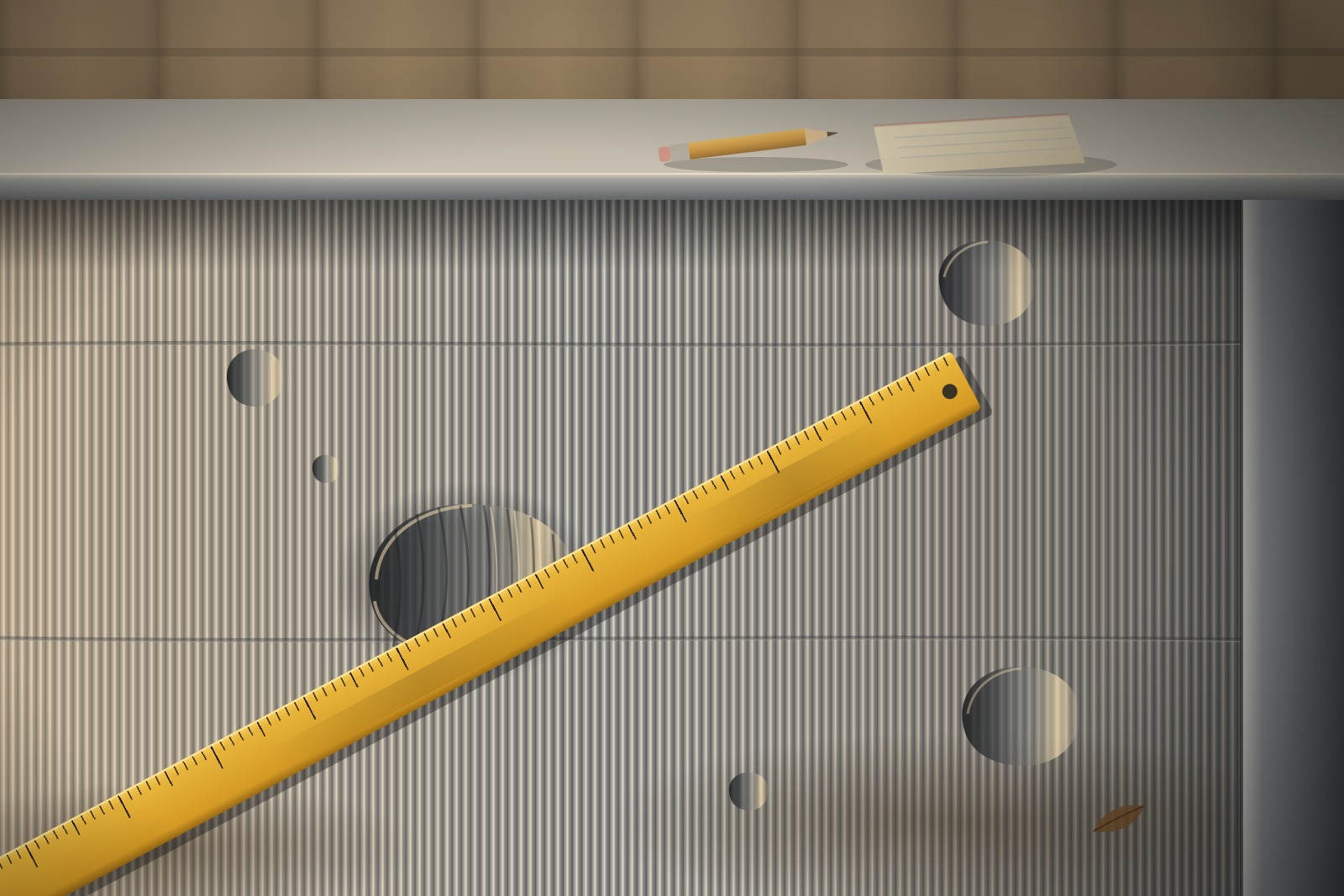
Those same dents are useful, though. Morrison's firm found the best gauge of hailstone size is "the dents left by hail in aluminum fins of air-conditioning and HVAC units," and that "a dent's width typically is 80 percent of the hailstone diameter." So a dent about 1.4 inches wide on your condenser fins points to a stone around 1.75 inches across.
A ground-level walkaround (stay off the roof)
A wet or hail-scarred roof is no place for a homeowner. Do this from the yard and driveway, and take dated photos of everything as you go:
-
Gutters and downspouts. Look for round dents and note which sides of the house have them.
-
AC condenser fins. Measure the widest dents with a ruler for a rough hail-size estimate.
-
Metal roof vents and flashing. Check what you can see from the ground. Binoculars help.
-
Window screens and metal window wraps. Tears or dents here are easy to photograph.
-
Siding. Look for cracks, chips or splatter marks, especially on the side that faced the storm.
-
Your car. Dents on a car parked outside back up your hail-size estimate.
-
Downspout outlets. Piles of shingle granules at the bottom are worth photographing.
If you have older photos of the house, pull them up. Since metal holds onto old dents, a before picture helps an inspector or adjuster separate this week's damage from past storms.
Functional damage vs. cosmetic damage, and why it affects your claim
This is where homeowners and insurers often end up disagreeing, and the experts disagree too.
The longstanding engineering standard comes from Haag. Morrison wrote that asphalt shingles "must be punctured or fractured by hail before they are considered functionally damaged," that functional damage means "the roof's watershedding capabilities are diminished," and that "granule loss is not considered functional damage." Under that view, a roof that lost granules but has no cracks or punctures is cosmetically marked, not broken.
IBHS research published in September 2025 pushes back. In a peer-reviewed study in Frontiers in Materials, IBHS researchers found that "exposure to high concentrations of small hailstones can significantly reduce the roof cover's resistance" to later large hail. Shingles exposed to natural weathering and smaller impacts were "approximately ten times more susceptible to future damage from subsequent severe hail events," measured by granule loss per impact (192.2 vs. 20.0 square millimeters). It was a lab test of six products, and the authors say more testing is needed.
What this means for you: granule loss you can see at the downspouts may not be enough for a claim under the Haag standard, but it isn't nothing either. It's one more reason to get a professional to look at the roof after golf-ball hail, even if the gutters are the only damage you can see.
Was it hail or wind?
Don't assume every damaged roof after a hailstorm was hit by hail. Near Riley, the roof damage that was reported came in as a wind report, not a hail report. A trained spotter 2 miles south of Riley described "3 to 4 homes with roof damage" and a grain bin "partially damaged and thrown into nearby trees." An NWS storm survey also logged an EF-0 tornado starting 2 miles southwest of Riley, with maximum winds of 85 mph, that hit a barn and an RV.
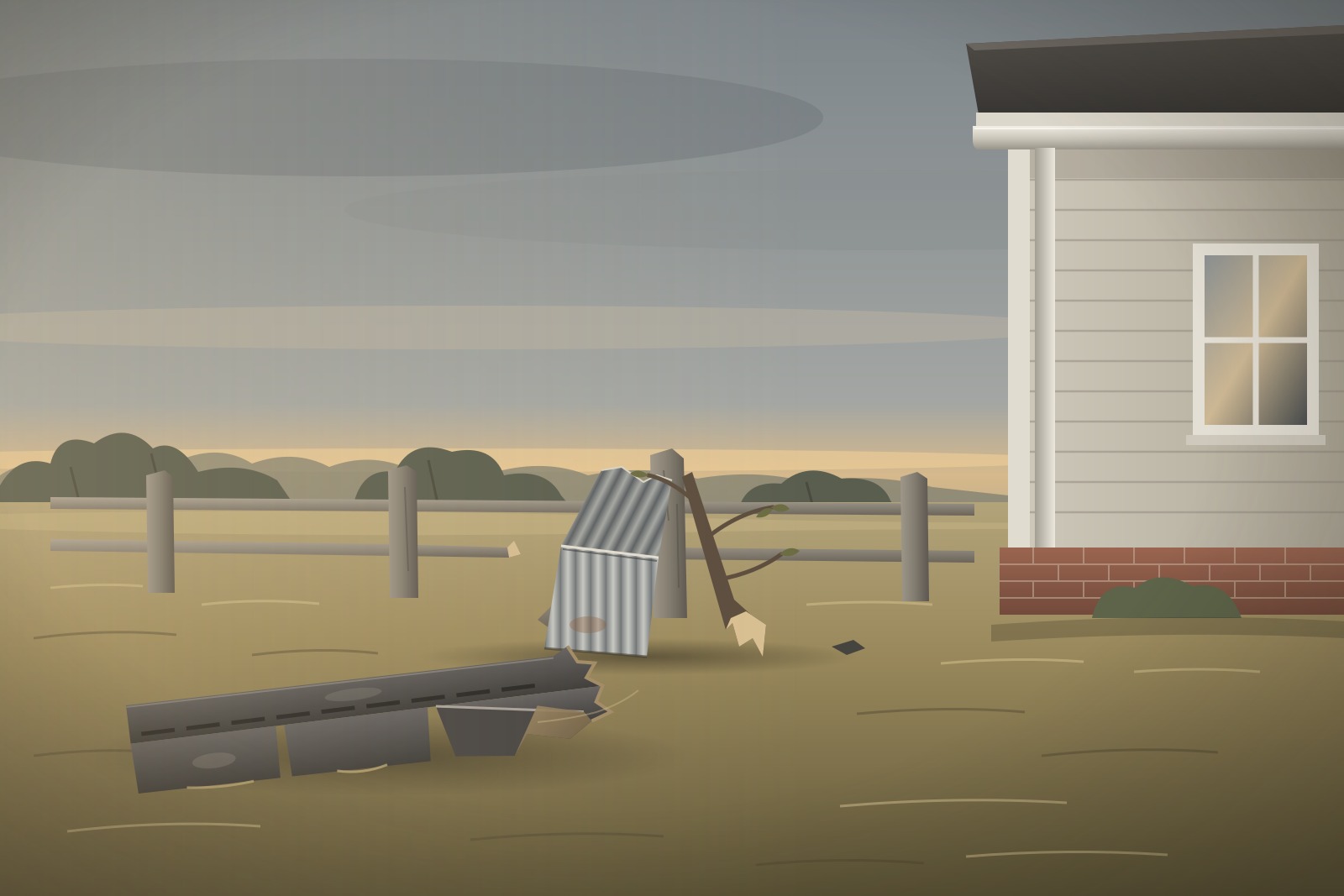
Inspectors and adjusters handle wind and hail damage differently, so tell your inspector what you saw and heard. In the Nov. 12 storms, Ryan Hall Y'all also reported a tornado near Christiana Hospital in Delaware and a radar-confirmed tornado over Crosswicks, New Jersey, and said damage survey results weren't available when it published. If you're near either spot and have lifted or missing shingles, mention wind as a possible cause.
When should you call for a roof inspection?
Book a free inspection if any of these apply:
-
Golf-ball (1.75-inch) hail was reported at or near your address.
-
Your AC fins or other soft metal are dented on several sides of the house.
-
You're finding shingle granules at the downspout outlets.
-
You have any leak inside, however small.
If all you see is a few minor gutter dings after quarter-size hail, use your judgment. Photograph them anyway, since that record may matter if a leak shows up months from now.
What a useful inspection report should include
There's no single required format, but in our view a report you can hand to an insurer should have:
-
Date-stamped photos of every roof slope, not just the worst one
-
Hit counts from test squares on each slope
-
Photos of damage to soft metal and other items like screens, siding and the AC unit
-
An estimated hail size and the storm date, citing the NWS or SPC storm report for your area
-
The inspector's opinion on whether the damage is functional or cosmetic, and why
-
A line-item scope of the repair or replacement they recommend
How to vet a roofer who knocks on your door
Expect trucks in the neighborhood within days. Some will be fine. Check them the same way you'd check anyone else, using your own state's rules.
Indiana. Under Indiana Code 24-5-11-10.5, a contractor "shall not advertise, offer, or promise to pay or rebate any part of an insurance deductible" to win your job. The law also bars cash allowances, gifts, bonuses, referral fees and payments for putting up a yard sign, and says a contractor "shall not act as a public adjuster." A roofer who offers to cover your deductible or deal with your insurer for you is waving a red flag. Indiana Attorney General Todd Rokita's storm-scam tips (as reported by The Reporter) include asking for IDs, licenses and proof the contractor is bonded and insured; getting more than one estimate; not believing promises that aren't in writing; never paying by wire transfer, gift card, cryptocurrency or cash; and not paying the full amount up front. Complaints go to indianaconsumer.com or 1-800-382-5516.
New Jersey. Home improvement contractors must register with the state Division of Consumer Affairs and renew each year unless exempt, according to Monmouth County Consumer Affairs. Contracts for projects of $500 or more must be in writing and must include the contractor's legal name, business address, start and completion dates, a description of the work, the total price and the registration number. You must be told you have three business days to cancel for any reason. Monmouth County residents can call county Consumer Affairs at 732-431-7900.
Delaware. Search the roofer's business name or ZIP code in the state's Registered Construction Contractors registry, which lists businesses certified as construction contractors in Delaware. Individual professional licenses are handled separately by the Division of Professional Regulation.
All three states. The FTC Cooling-Off Rule covers sales of $25 or more made at your home. You have until midnight of the third business day after the sale to cancel for a full refund. Saturdays count as business days. Sundays and federal holidays don't. The seller has to tell you about this right at the time of sale and give you two copies of a cancellation form plus a dated contract or receipt. If a door-knocker skips that paperwork, don't sign.
Whom to call
Call a local roofer you've checked against your state's rules, not the first truck parked on your street. Ask for a written inspection report with the items listed above and a line-item bid, and get a second bid so you can compare them line by line. Keep your walkaround photos together with the NWS storm report for your area, because that's the evidence your insurer will want to see.
For the next storm season, IBHS suggests keeping gutters and downspouts secure and clear and fitting your HVAC unit with a protective screen to cut down on hail damage.
Related reading
-
How to Thaw Frozen Pipes Before This Weekend's Hard Freeze in Middle Tennessee
-
Rain Returned to Texas, but Slab Foundations Are Still Moving
-
Should You Pull a Roof Permit Before Florida's Code Changes on New Year's Eve?
-
Bent Shingles and Vanished Deposits: October's Roofing Scams
-
How to Get Your Roof Ready Before El Niño Storms Hit California
Sources
-
Iowa Environmental Mesonet: NWS Indianapolis Local Storm Reports, Nov. 11, 2026
-
Ryan Hall Y'all: Delaware Tornado, NJ Hail and Flash Floods Recap
-
Professional Roofing: Hail damage (Scott J. Morrison, P.E., May 2009)
-
The Reporter: Attorney General Todd Rokita warns Hoosiers of storm scams (March 16, 2024)
-
Monmouth County Consumer Affairs: Home Improvement Contractors
Note: This article contains AI-assisted content and has been reviewed by our editorial team.
ABOUT THIS SERVICE: CallTheLocal.com is a directory and lead generation service, not a contractor or service provider. Submitting this form does not obligate you to hire anyone or purchase any service. Your information will be shared with licensed, insured home service professionals in your area who may provide quotes for your project. CallTheLocal.com does not guarantee the quality, timeliness, or outcome of any work performed by service providers you connect with through this service. Always verify licensing, insurance, and references before hiring. Get everything in writing before work begins.