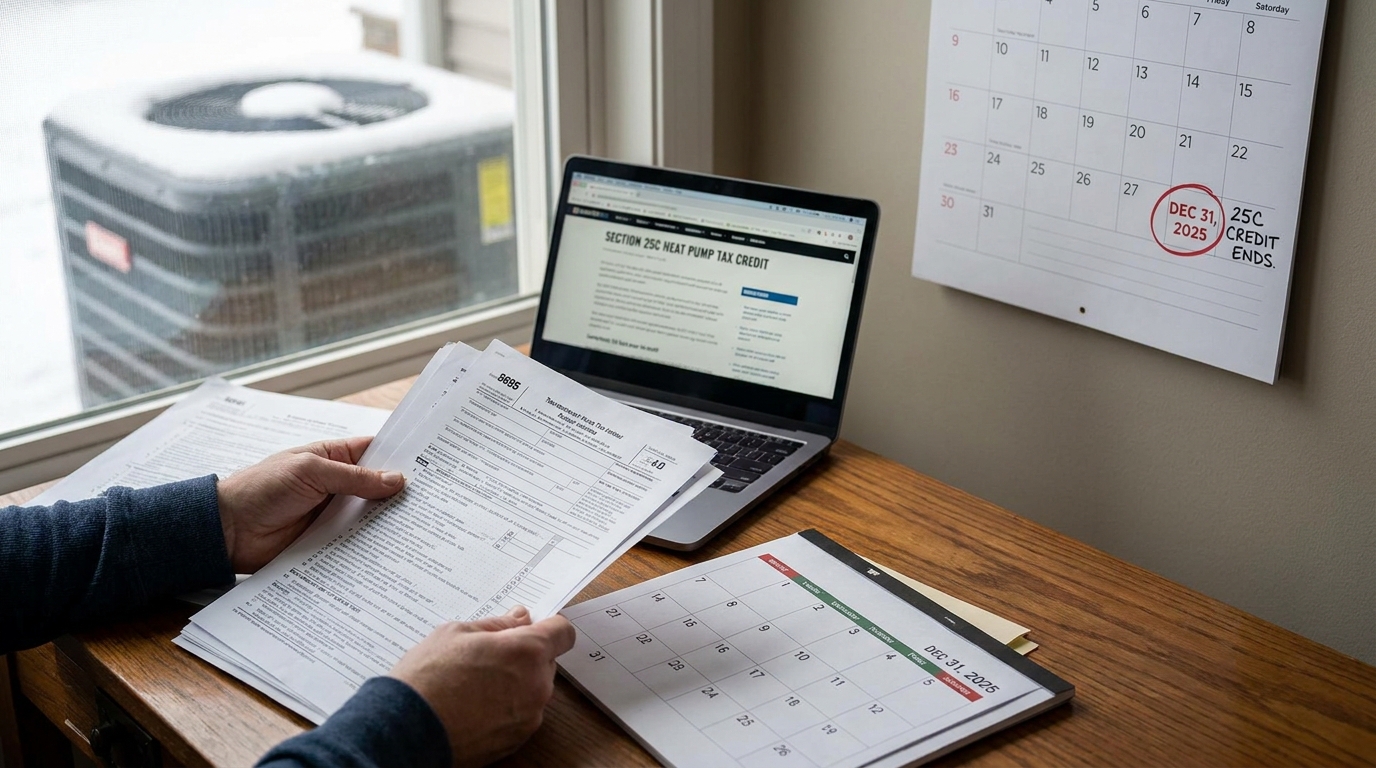
If you've seen ads in early 2026 promising a "last chance" $2,000 federal tax credit on a new heat pump, here is the part nobody is putting in the headline: that credit is already closed for any new install. The Section 25C Energy Efficient Home Improvement Credit was terminated for any property placed in service after December 31, 2025, under Public Law 119-21 (the One Big Beautiful Bill, or OBBB), which was signed July 4, 2025.
So the "race to lock it in" was real, but it ended on New Year's Eve. What homeowners are actually doing right now is filing for it on their 2025 tax returns. And a lot of folks are finding out the install they thought qualified, doesn't.
This is a practical guide to where you stand in 2026: who can still claim 25C, what "placed in service" really means to the IRS, what is still available going forward, and how to spot a contractor who is using a credit that no longer exists as a closing pitch.
The Quick Timeline
-
January 2023 to December 2025: Section 25C offers 30% of project cost, with a $2,000 annual cap specifically for qualifying heat pumps, heat pump water heaters, and biomass stoves (separate from the $1,200 cap on other improvements like insulation and windows).
-
July 4, 2025: OBBB signed. The law terminates 25C for any property placed in service after December 31, 2025.
-
December 31, 2025: Final eligibility cutoff. Equipment must be installed, operational, and ready for use by this date.
-
2026 tax season: Eligible 2025 installs are claimed on [Form 5695](https://www.irs.gov/credits-deductions/energy-efficient-home-improvement-credit) filed with your 2025 Form 1040, due April 15, 2026 (or October 15, 2026 with an extension).
-
2026 and beyond: No 25C credit for any new heat pump install. Period.
What "Placed in Service" Actually Means
This is the part that is tripping up homeowners who signed contracts in late 2025. "Placed in service" is IRS language, and it has a strict definition: the equipment has to be installed, operational, and ready for use at your home. None of the following count as placing it in service:
-
A signed contract dated December 2025
-
A paid deposit, even a 100% prepayment
-
Equipment delivered to your driveway but not installed
-
A partial install where the system is not yet running
-
Final inspection pending in January 2026
If the system fired up for the first time on January 2, 2026, you do not have a 25C-eligible install. The IRS guidance on OBBB is unusually plain on this point, and there is no grace period.
If You Did Install by 12/31/2025, Here's How to Actually Claim It
For qualifying installs placed in service in 2025, the credit is 30% of your total project cost (equipment plus labor for heat pumps) up to a $2,000 annual cap. Three documents do the work on your return:
-
Form 5695, Residential Energy Credits. This gets filed with your 2025 Form 1040 in 2026.
-
The Qualified Manufacturer (QM) PIN. For any property placed in service after December 31, 2024, the IRS requires you to list the manufacturer's PIN for the specific equipment on Form 5695. No PIN, no credit. Your installer or the manufacturer can provide this.
-
AHRI Certificate and Manufacturer's Certification Statement. You don't mail these in, but you keep them with your tax records for roughly seven years. The AHRI Certificate confirms your indoor and outdoor units are a matched, tested combination, which is what the AHRI CEE Directory verifies.
Before you file, run your model number through the DOE Tax Credit Product Lookup Tool. Match by model number and the year you installed it. This is the official check, and it is the single best defense against a contractor who told you something qualified when it didn't.
AI workflows for revenue teams
Placeholder house ad for Conservus.ai. Swap with final creative when brand assets are ready.
Partner with Conservus.aiThe Efficiency Math: What "Tier 1" Actually Required in 2025
You may have seen marketing claims like "18+ SEER2 required for the credit." That number was incorrect in 2025. The law ties 25C eligibility to the CEE highest tier in effect on January 1 of the install year, excluding any "Advanced" tier. For 2025 installs, the floor was:
-
Ducted split air-source heat pumps: SEER2 of at least 15.2, EER2 of at least 11.7, HSPF2 of at least 7.8.
-
Ductless mini-splits: SEER2 of at least 16.0, EER2 of at least 12.0, HSPF2 of at least 9.0.
Plenty of mid-tier mainstream heat pumps cleared those numbers. If a contractor told you that you needed an 18 SEER2 premium package to qualify, that was a sales angle, not the rule. The ENERGY STAR program page spells out the same thresholds.
Cost Reality: What $2,000 Actually Trimmed Off the Bill
Heat pumps are not cheap, and the 25C credit was never going to pay for one outright. Here is the typical 2025 cost picture from EnergySage and Rewiring America:
-
National average for a ducted air-source heat pump install: around $14,500 turnkey.
-
Common range: $8,000 to $20,000 depending on home size, climate, and equipment.
-
Reusing existing ductwork: often lands in the $7,500 to $15,000 range.
-
Panel upgrade or duct repairs: add $1,500 to $5,000.
So a $13,000 install with the full $2,000 25C credit netted out around $11,000 in real cost. Helpful, not transformative. If your contractor sold you the credit as if it were a $5,000 rebate, the math was off.
What's Still Available in 2026
This is the part worth bookmarking. OBBB closed 25C, but it did not flatten every federal energy incentive.
Section 25D: Geothermal Heat Pumps Still Qualify
The Section 25D Residential Clean Energy Credit for geothermal (ground-source) heat pumps remains 30% with no dollar cap, available for installs placed in service through 2032, then it steps down. Geothermal is a much larger upfront investment than an air-source system, but if you were already weighing it, the federal credit is still on the table.
State and Utility Programs
Many of the most generous heat pump incentives never came from 25C in the first place. Depending on where you live, look at:
-
State clean heat programs (for example, NY Clean Heat or Massachusetts Mass Save)
-
IRA-funded HOMES and HEAR rebates where your state has launched its program
-
Local utility heat pump rebates, often $500 to $3,000 per system
The Alliance to Save Energy and industry trade press have flagged that state and utility programs are now carrying more of the weight on heat pump adoption than they did when 25C was active.
AI workflows for revenue teams
Placeholder house ad for Conservus.ai. Swap with final creative when brand assets are ready.
Partner with Conservus.aiContractor Red Flags in 2026
Now that the credit is gone, the smartest move is to know what a clean pitch looks like and what a sketchy one sounds like. Watch for these:
-
Any promise of 25C eligibility for a 2026 install. This is the big one. There is no version of the federal credit that applies to a heat pump placed in service in 2026 or later. If you hear "we'll still get you the $2,000," walk.
-
Refusing to provide the Manufacturer's Certification Statement for a 2025 install you are filing on this year. You need it for your records.
-
Skipping the AHRI match. The credit applied to the matched indoor and outdoor combination, not just the outdoor unit. Get the AHRI Certificate Reference Number and verify it in the AHRI CEE Directory.
-
Oversizing the system. A unit that hits the SEER2 numbers on the spec sheet but is two tons too big for your house will short-cycle, run inefficiently, and cost you on utility bills. A Manual J load calculation, not a rule of thumb, is what you want.
-
Vague answers about the QM PIN. For 2025 installs, the PIN is mandatory on Form 5695. "We'll get that to you later" is not a complete answer.
A Practical Checklist for Where You Stand
Quick gut check based on your situation:
-
You had a heat pump installed and running by 12/31/2025: Pull the AHRI Certificate, get the QM PIN, check the model in the DOE Lookup Tool, and file Form 5695 with your 2025 return. Up to $2,000 back.
-
You signed a contract in late 2025 but the system was finished in January 2026: Tough news, but no 25C credit. Look at state and utility rebates instead.
-
You're shopping for a heat pump now in 2026: Skip the federal credit conversation entirely for air-source units. Ask about state clean heat programs and utility rebates. If you have the budget and the site for geothermal, the 25D credit is still 30% with no cap.
-
A contractor is quoting you with the $2,000 federal credit baked into the 2026 install price: Get a second quote from someone who is being honest about the current rules.
The biggest mistake right now is not missing the credit, it is overpaying for the wrong equipment because someone built a sales pitch around a benefit that no longer exists. Verify the install date, verify the model, and ask about every state and utility program in your zip code. That stack is where the real money lives in 2026.
Related reading
AI workflows for revenue teams
Placeholder house ad for Conservus.ai. Swap with final creative when brand assets are ready.
Partner with Conservus.aiSources
-
IRS FAQs on Sections 25C, 25D, and related credits under Public Law 119-21 (OBBB)
-
2025 CEE Performance Requirements for HVAC and Water Heaters
-
[EnergySage: How Much Does a Heat Pump Cost in 2025](https://www.energysage.com/heat-pumps/costs-and-benefits-air-source-heat-pumps/)
-
Current Federal Tax Developments: Key Modifications Under OBBB
Note: This article contains AI-assisted content and has been reviewed by our editorial team. Nothing here is tax advice. For your specific return, talk to a CPA or enrolled agent.
ABOUT THIS SERVICE: CallTheLocal.com is a directory and lead generation service, not a contractor or service provider. Submitting this form does not obligate you to hire anyone or purchase any service. Your information will be shared with licensed, insured home service professionals in your area who may provide quotes for your project. CallTheLocal.com does not guarantee the quality, timeliness, or outcome of any work performed by service providers you connect with through this service. Always verify licensing, insurance, and references before hiring. Get everything in writing before work begins.