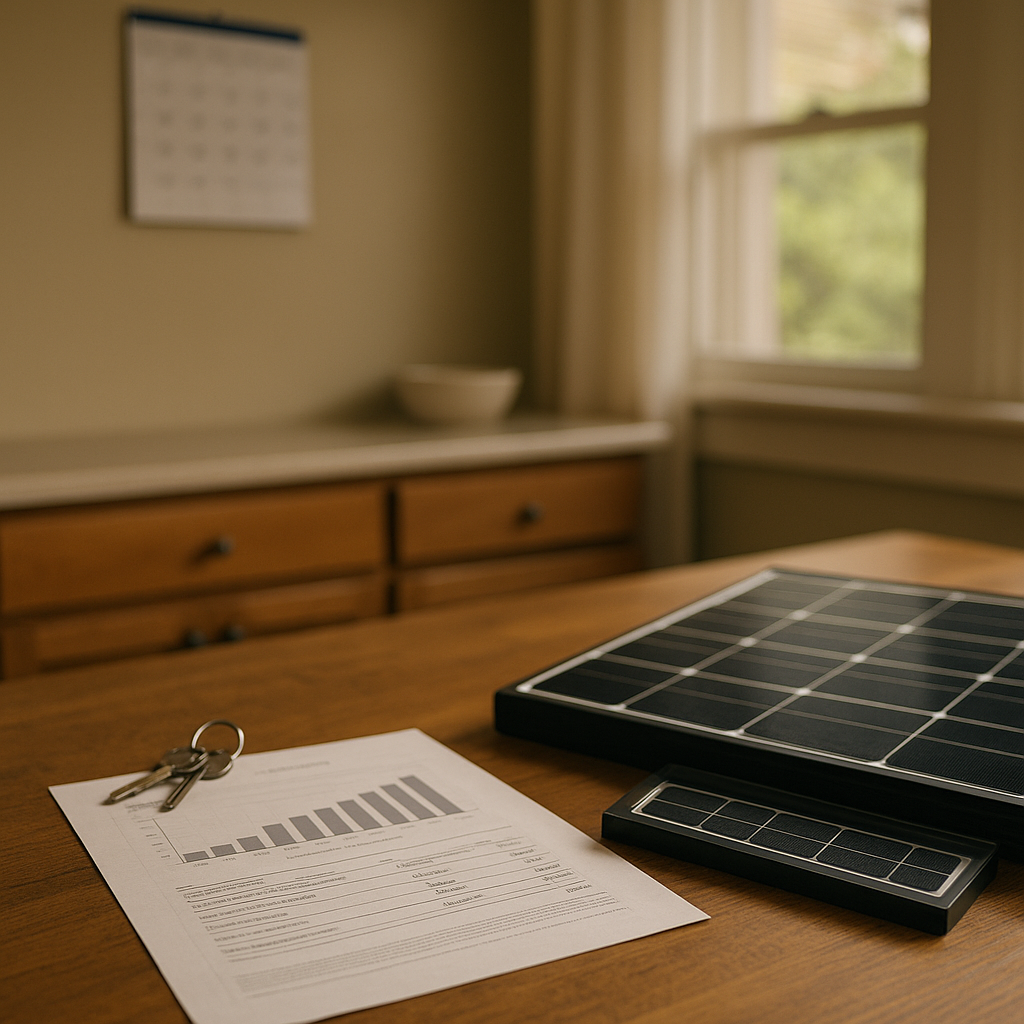
If you have a Hawaii rooftop solar quote sitting on your kitchen table, the math on it may have changed this week. On May 8, 2026, the state House voted 45-6 to pass SB 3125, a bill that caps the state's 50-year-old Renewable Energy Technologies Income Tax Credit (RETITC) starting in 2027 and ends it entirely after 2030. The bill now sits with Gov. Josh Green.
For homeowners shopping for solar today, the headline number is the residential cap: up to $5,000 per qualifying system under the existing rules. If your install is structured to claim multiple 5kW caps, the savings on the line can reach $10,000 or more. Lose the credit, and that money comes out of your pocket instead of the state's.
What the existing credit actually pays
There's a common misunderstanding about the "35% off" framing you'll see in solar ads. Under HRS §235-12.5, the residential credit is 35% of system cost, but it's capped at $5,000 per system, with the cap structured per 5kW of system size. The same statute caps multi-family units at $350 per unit and commercial systems at $500,000. The Hawaii Department of Taxation publishes the official RETITC program details and Form N-342 for filers.
That cap matters because of how a typical rooftop system gets sized. An 8kW residential install priced in the $24,000 to $32,000 range usually claims one $5,000 cap, not 35% of the full system price. Larger systems sized to clear two 5kW thresholds can claim two caps and reach $10,000 in total state credit.
Real-world math on a typical install
Take a $30,000 system. With the Hawaii RETITC at the $5,000 cap intact, the homeowner's net out-of-pocket lands around $25,000 on the state side alone. If the system is large enough to qualify for two $5,000 caps, net cost drops closer to $20,000 before any other incentives.
Strip out the state credit under SB 3125, and that same $30,000 quote nets out at the full sticker price on the state side. For a system structured to claim two caps, the swing is the full $10,000.
One important context point on stacking: the Hawaii Solar Energy Association attributes a roughly 30% industry revenue decline in 2026 to the loss of the federal residential clean energy credit, which historically covered 30% of project cost on top of the state credit. Treat any quote that still bakes in a 30% federal line as a question to ask your installer, not a guarantee.
What changes under SB 3125, and when
The bill institutes a hard $40 million annual cap on the credit from 2027 through 2030, then ends the program entirely. Current annual program cost is roughly $100 million, so the cap effectively cuts available credit dollars by more than half before the full sunset.
Three changes hit immediately, not in 2027:
-
Income limits. Taxpayers with adjusted gross income above $175,000 single or $350,000 joint become ineligible. The income restriction applies retroactively to January 2026.
-
Commissioning deadline. Projects not commissioned by March 1, 2026 face prorated credits based on available funding.
-
Certification wait. Households must wait until May 31 following purchase to learn final credit eligibility under the new certification rule.
That last one is the trap door. You can sign a contract, take delivery, get inspected, and still not know your real credit number until the following May.
AI workflows for revenue teams
Placeholder house ad for Conservus.ai. Swap with final creative when brand assets are ready.
Partner with Conservus.aiWhy this hits Hawaii harder than other states
Hawaii residential electricity rates ran roughly 43 cents per kWh in early 2026, more than double the U.S. average near 17.65 cents per kWh, according to U.S. Energy Information Administration data. That's why solar payback periods in Hawaii have historically been shorter than in lower-cost states, and why homeowners run the math more aggressively than mainland buyers.
On top of that, Hawaiian Electric has flagged potential rate increases of up to 30% in the current billing cycle, separate from anything in SB 3125. Higher rates plus a smaller credit means homeowners pay more for grid power and get less help going off it.
What homeowners with active quotes should do this week
If you're holding a written quote, three things deserve a phone call to your installer before you sign:
-
Get the commissioning date in writing. "Permit pulled" is not the same as "commissioned." Ask for a calendar date and confirm the contract has remedies if the installer misses it.
-
Confirm system sizing and the cap multiplier. If the installer is pitching a larger system to capture two $5,000 caps, ask them to show the math against your actual usage. Oversizing only pays back if you can use or export the power.
-
Separate the federal and state credit lines on the quote. They have different rules and different risks now. A quote that bundles them into a single "tax savings" number hides which one is exposed.
Red flags on "pre-deadline" sales pitches
Expect the next few weeks to bring urgency-driven sales calls. A few patterns to watch:
-
Deposits with no defined commissioning date. Money in, no calendar commitment, is how installers protect cash flow at the homeowner's expense.
-
Vague "locked in" credit language. Under the May 31 certification wait, the credit is finalized when the system is commissioned and certified, not when you sign. Even commissioned systems may face proration.
-
System upsizing with no usage justification. If the only reason for the bigger system is to multiply the $5,000 cap, the installer is selling tax math, not energy. Ask what happens if the cap rules change again before commissioning.
AI workflows for revenue teams
Placeholder house ad for Conservus.ai. Swap with final creative when brand assets are ready.
Partner with Conservus.aiWhat the industry is saying
About 100 solar workers rallied at the State Capitol on May 8, the day of the final House vote. Rocky Mould, executive director of the Hawaii Solar Energy Association, told Solar Power World: "This is not a phaseout, it is a shutdown. We see it as an existential threat to the industry."
Brian Gold, CEO of Inter-Island Solar Supply, told the Honolulu Star-Advertiser the bill will "make living in Hawaii more expensive." Industry groups are urging Gov. Green to veto.
The state's case for the change
SB 3125 doesn't just touch solar. The bill repeals seven commercial tax credit programs and is projected to save the state nearly $1.2 billion over six years, funding broader income-tax cuts for about 90% of households through 2031.
Rep. Nicole Lowen, who chairs the House Energy and Environmental Protection committee, voted yes but criticized the credit cuts, suggesting alternative paths to the same savings target existed.
What's still uncertain
As of publication, three things are not yet settled:
-
Whether Gov. Green signs, vetoes, or lets the bill pass without signature.
-
Final administrative rules from the Hawaii Department of Taxation governing certification and proration.
-
Whether 2026 projects already commissioned before the March 1 cutoff will be fully grandfathered without proration.
If you can't get a clear answer from your installer on any of those points, that isn't necessarily the installer's fault. It's a sign the rules are still moving. Treat any quote that promises a guaranteed credit number with caution.
AI workflows for revenue teams
Placeholder house ad for Conservus.ai. Swap with final creative when brand assets are ready.
Partner with Conservus.aiA last-minute checklist before you sign
-
Commissioning date in writing, with contract remedies if the installer misses it.
-
State and federal credits broken out on separate lines, not bundled into a single "tax savings" figure.
-
System size in kW shown against the $5,000-per-5kW cap structure, with cap multipliers spelled out.
-
Financing terms that survive a reduced or denied state credit. Ask: what does my monthly payment look like if the credit comes back smaller than quoted, or not at all?
-
AGI eligibility check. If you're near the $175K single or $350K joint line, your credit is at risk regardless of installer timeline.
Bottom line for Hawaii homeowners
The 35% framing was always shorthand. The real number for most residential buyers has been a $5,000 cap, sometimes doubled to $10,000 with careful sizing. SB 3125 puts that number on a glide path to zero, with retroactive triggers that affect 2026 projects already in motion. If you're getting quotes, slow down enough to read the credit lines carefully, ask for written commissioning dates, and don't let "act now or lose the credit" pressure push you into a contract with terms that hide the new risks.
Related reading
AI workflows for revenue teams
Placeholder house ad for Conservus.ai. Swap with final creative when brand assets are ready.
Partner with Conservus.aiSources
-
Hawaii legislators voting on bill threatening state's solar market (Solar Power World)
-
Hawaiʻi Is About To Pull The Plug On Its Own Energy Future (Honolulu Civil Beat)
-
Solar industry rallies to save Hawaii tax break (Honolulu Star-Advertiser)
-
Legislative session adjourns with passage of tax relief (Hawaii Tribune-Herald)
-
Renewable Energy Technologies Income Tax Credit (RETITC) (Hawaii Department of Taxation)
-
Electricity Rates by State 2026, EIA February 2026 data (JouleIO)
Note: This article contains AI-assisted content and has been reviewed by our editorial team.
ABOUT THIS SERVICE: CallTheLocal.com is a directory and lead generation service, not a contractor or service provider. Submitting this form does not obligate you to hire anyone or purchase any service. Your information will be shared with licensed, insured home service professionals in your area who may provide quotes for your project. CallTheLocal.com does not guarantee the quality, timeliness, or outcome of any work performed by service providers you connect with through this service. Always verify licensing, insurance, and references before hiring. Get everything in writing before work begins.