If you have been pricing a home backup battery this spring, you have probably seen the headline: the U.S. installed a record 9.7 GWh of energy storage in the first quarter of 2026, a 32% jump from the same quarter last year, according to the Wood Mackenzie and American Clean Power U.S. Energy Storage Monitor released March 24. That is the strongest first quarter on record, riding on a full-year 2025 total of 57.6 GWh.
Good news for the grid. But before you assume that record means falling sticker prices at your doorstep, it helps to read the fine print. And there is real news for homeowners this month too, just not the news the GWh number suggests.
The 9.7 GWh number, translated for a homeowner
Most of that record was not residential. According to pv magazine USA's coverage of the report, the Q1 2026 breakdown looked like this:
-
Utility-scale: 7.8 GWh (the big batteries plugged into the grid)
-
Commercial and industrial: 648 MWh
-
Residential: 515 MWh
So roughly 5% of that record quarter was home batteries. The headline is real, but it is mostly a story about utilities. Residential pricing has not collapsed, and you should not walk into a quote expecting it to.
What a home backup battery actually costs in 2026
Marketplace data from EnergySage still puts typical installed pricing in the $700 to $1,300 per kWh range, with an overall average around $1,128 per kWh. That works out to:
-
10 kWh system: roughly $8,000 to $13,000 installed
-
13.5 kWh Tesla Powerwall 3: averaging around $15,228 before any incentives
-
20 kWh whole-home setup: commonly $18,000 to $22,000 or more
Brand matters. Tesla Powerwall installs tend to land at the lower end, near $700 to $780 per kWh. Enphase IQ systems often come in higher, around $1,510 per kWh, because they use lots of smaller microinverter-style battery units. Whether that premium is worth it depends on how your home is wired and whether you want the modular expandability.
The tax-credit cliff nobody told you about
This is the single biggest change in 2026 ROI math, and it is easy to miss in the excitement about record installs. The federal Residential Clean Energy Credit (Section 25D), the 30% homeowner credit that anchored the math on residential batteries last year, ended for property placed in service after December 31, 2025 under the One Big Beautiful Bill Act.
If you buy a battery in 2026, the 30% federal credit you may have read about in older articles is no longer available to you as a homeowner. Standalone storage credits under Section 48E still exist, but those apply to commercial and third-party-owned systems, not a battery you buy and own.
State and utility programs are still in play and worth chasing:
-
California: SGIP rebates for storage
-
Massachusetts, Connecticut, Rhode Island, New Hampshire: ConnectedSolutions performance payments
-
New York: NY-Sun storage incentives
Ask any installer to lay out what is available in your ZIP code in writing. Pre-incentive sticker price is what matters when you compare quotes.
AI workflows for revenue teams
Placeholder house ad for Conservus.ai. Swap with final creative when brand assets are ready.
Partner with Conservus.aiThe actual news for homeowners this month
On May 20, 2026, ConnectDER announced that its IslandDER meter socket adapter is now compatible with EcoFlow's OCEAN Pro whole-home battery. That sounds like installer-only inside baseball, but it has real dollars attached to it for homeowners.
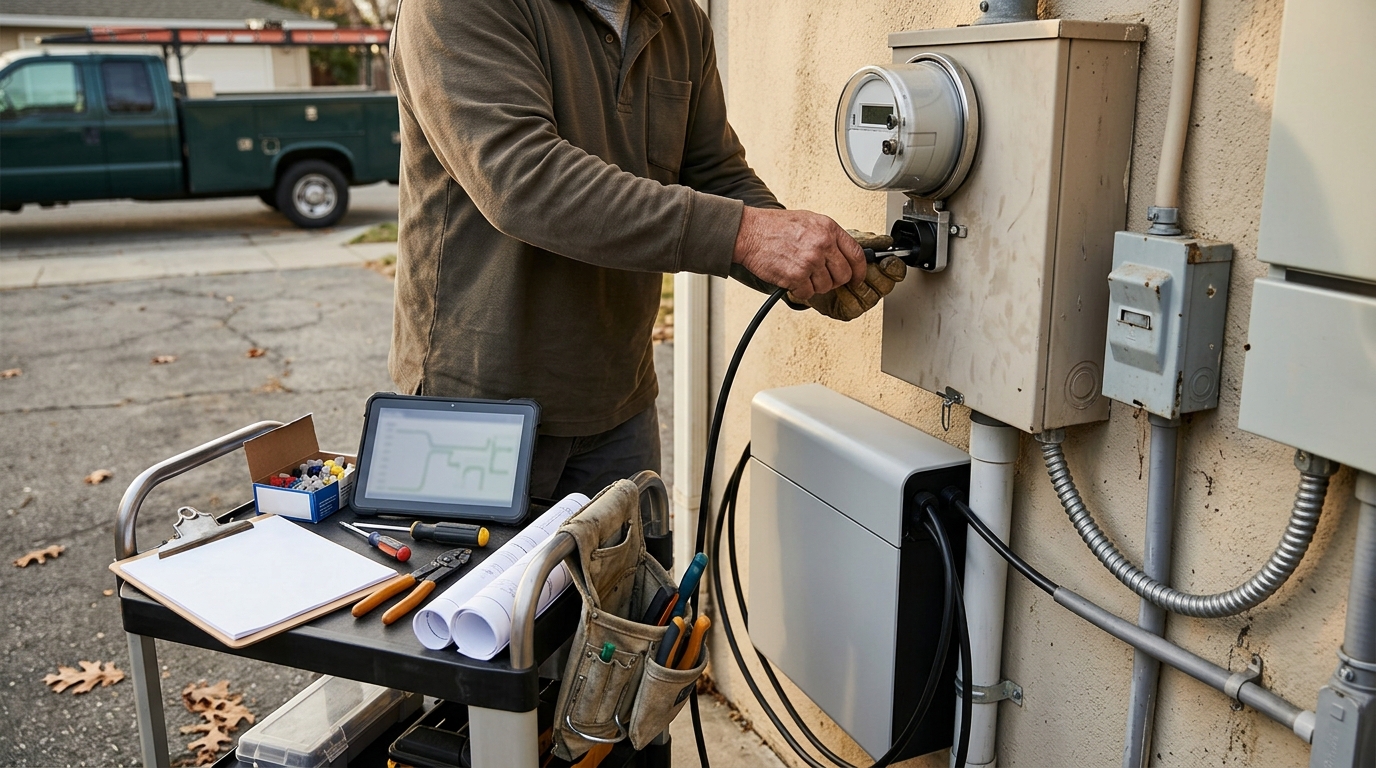
Here is why. A meter-collar adapter sits between your existing electric meter and the meter socket on the side of your house. It lets a battery connect to your home behind the utility meter, without an installer touching your main service panel. According to ConnectDER, that eliminates the need for:
-
A main service panel upgrade
-
Rewiring
-
Relocating circuits
-
An add-on system controller
What does that save you? A main service panel upgrade alone typically runs $2,000 to $5,000 or more, and it can add weeks to a project. Skipping it is a real line item, not a marketing claim.
The OCEAN Pro itself has heavy-duty specs: 24 kW continuous output, 205 A locked-rotor surge for big motor loads like central AC, 10 kWh base capacity expandable to 80 kWh, eight solar MPPT inputs accepting up to 40 kW of panels, and a 15-year warranty. It is rated IP67 and certified from minus-4 to 140 degrees Fahrenheit. Whether that horsepower is overkill for your home is a separate question (more on that below).
EcoFlow joins existing IslandDER-compatible partners including FranklinWH, SolarEdge, and Lunar Energy, with Fox ESS rolling out later in 2026. Initial deployment territories for the EcoFlow integration are California, Arizona, Illinois, Florida, and Texas, with a standalone meter socket version planned for the rest of the country.
Battery vs. a $12,000 standby generator
This is the comparison most homeowners actually want. A typical 22 to 24 kW whole-home standby generator from Generac or Kohler runs about $10,000 to $18,000 installed, which is now right on top of where a 15 to 20 kWh battery system lands. Neither one is obviously better. They solve different problems.
| Factor | Battery (15-20 kWh) | Standby generator (22-24 kW) |
|---|---|---|
| Runtime in an outage | Hours to a couple of days, depending on loads and solar | Days to weeks if fuel keeps coming |
| Fuel | None | Natural gas or propane |
| Noise | Silent | Loud, runs continuously |
| Maintenance | Minimal | Annual service plus exercise cycles |
| Daily payback potential | Yes, via solar self-consumption or time-of-use arbitrage | None, it only runs in outages |
| Install timeline | 3 to 6 months end-to-end including utility approval | Typically faster, fewer interconnection hurdles |
If you live somewhere with multi-day outages (think ice storms or hurricanes), a generator still has the edge on raw endurance. If your outages are short and frequent, or you have solar and time-of-use rates, a battery does double duty and pays a little something back every day.
Regional pricing and what to watch for
Texas: Cheaper labor and faster permitting (Texas is one of the SolarAPP+ automated permitting states), so installed pricing tends to land at the lower end. Watch for hot-climate derating on battery output and lifespan if the unit is mounted in a sunbaked garage or on a south-facing wall.
California: SGIP storage rebates are still active, and under NEM 3.0 net metering rules, a battery is essentially required to make new rooftop solar pencil out. Expect 5 to 6 month end-to-end project timelines including utility interconnection, even with automated permitting.
Northeast (MA, CT, RI, NH, NY, NJ): Cold-climate derate on output capacity in winter, more complex permitting in older municipalities, and a lot of homes still on oil heat where a battery does not back up your heating system. New Jersey signed automated permitting legislation in December 2025 with an 18-month rollout, so timelines should improve there over 2026.
AI workflows for revenue teams
Placeholder house ad for Conservus.ai. Swap with final creative when brand assets are ready.
Partner with Conservus.aiLead times in 2026
Equipment lead times have shortened to roughly 4 to 6 weeks in peak season, but the project around the box has not. Realistic end-to-end timelines look like:
-
Texas: 3 to 4 months
-
California: 5 to 6 months
-
Most other states: somewhere in between
The bottleneck is usually utility interconnection paperwork, not parts. SolarAPP+, the automated permitting platform now mandated in California, Maryland, Texas, and Florida, has reduced permit review from up to 20 business days to zero, with projects installing about 12 days faster on average. Helpful, but not magic.
One more 2026 wrinkle worth knowing: the 2026 edition of NFPA 855, released in September 2025, now requires a Hazard Mitigation Analysis for virtually all residential battery installs over 1 kWh. Your installer should be handling this. If they have not heard of it, that is a flag.
Red flags when you read a quote
-
Oversized capacity. A typical home uses 25 to 35 kWh per day. If you do not have an EV, two electric AC units, or an all-electric house, a 30 to 40 kWh battery proposal is almost certainly oversized. The installer is selling capacity you will not use.
-
Solar you did not ask for. Bundled solar can make sense, but if you only wanted backup and the quote includes 8 kW of panels, ask why and get the battery quoted separately.
-
No load-shed plan. A good quote tells you which circuits get backed up, in what order, and what happens to your AC compressor when the grid goes down. If it is just a battery and a wave of the hand, push back.
-
No sub-panel or critical-loads breakdown. Whole-home backup costs more than essentials-only. If the quote does not specify which approach it is, you cannot compare it to anything else.
-
Missing 15-year warranty paperwork. Most major brands offer 10 to 15 year warranties. Get them in writing, including throughput (total kWh cycled) limits, not just years.
-
No NFPA 855 documentation. Setback drawings, ventilation, and Hazard Mitigation Analysis should be part of the permit packet under the 2026 code.
Questions to ask before you sign
-
What is the cycle warranty in kWh of throughput, not just years?
-
Who files the utility interconnection paperwork, and what is the realistic timeline for permission to operate?
-
What happens to my warranty if your company closes? Is it manufacturer-backed or installer-backed?
-
Will this install use a meter-collar adapter (like ConnectDER's IslandDER) or a main service panel upgrade? If it is a panel upgrade, why?
-
Can I see itemized labor on the quote, not just a lump sum?
-
What state, utility, or local rebates are you applying, and what happens to my price if they are denied?
-
Which specific circuits will be backed up, and for how long under a full-house outage scenario?
AI workflows for revenue teams
Placeholder house ad for Conservus.ai. Swap with final creative when brand assets are ready.
Partner with Conservus.aiBottom line
The hardware is getting better and easier to install. Meter-collar adapters like the IslandDER paired with batteries like the EcoFlow OCEAN Pro, FranklinWH, or Lunar Energy can shave thousands of dollars and several weeks off an install in supported markets. The 9.7 GWh Q1 record is real, but it is mostly a utility-scale story.
What has not changed: sticker price for a homeowner-owned battery is still $700 to $1,300 per kWh installed, putting most useful systems in the $8,000 to $22,000 range. What has changed for the worse: the 30% federal Residential Clean Energy Credit ended December 31, 2025, so 2026 buyers are doing the math without it. State rebates and bill savings from time-of-use shifting are doing more of the heavy lifting now, and outage avoidance is back to being the real reason most homeowners pull the trigger.
If you are in a market with frequent outages, on NEM 3.0 solar in California, or about to do a panel upgrade anyway, a battery probably makes sense in 2026. If you are mostly worried about a once-a-year storm, get a generator quote too before you decide.
Related reading
Sources
-
pv magazine USA: U.S. energy storage installations reach record 18.9 GW in 2025 (Q1 2026 segment breakdown)
-
Wood Mackenzie: US Energy Storage Monitor Q1 2026
-
ConnectDER IslandDER + EcoFlow OCEAN Pro announcement, May 20, 2026
Note: This article contains AI-assisted content and has been reviewed by our editorial team.
ABOUT THIS SERVICE: CallTheLocal.com is a directory and lead generation service, not a contractor or service provider. Submitting this form does not obligate you to hire anyone or purchase any service. Your information will be shared with licensed, insured home service professionals in your area who may provide quotes for your project. CallTheLocal.com does not guarantee the quality, timeliness, or outcome of any work performed by service providers you connect with through this service. Always verify licensing, insurance, and references before hiring. Get everything in writing before work begins.