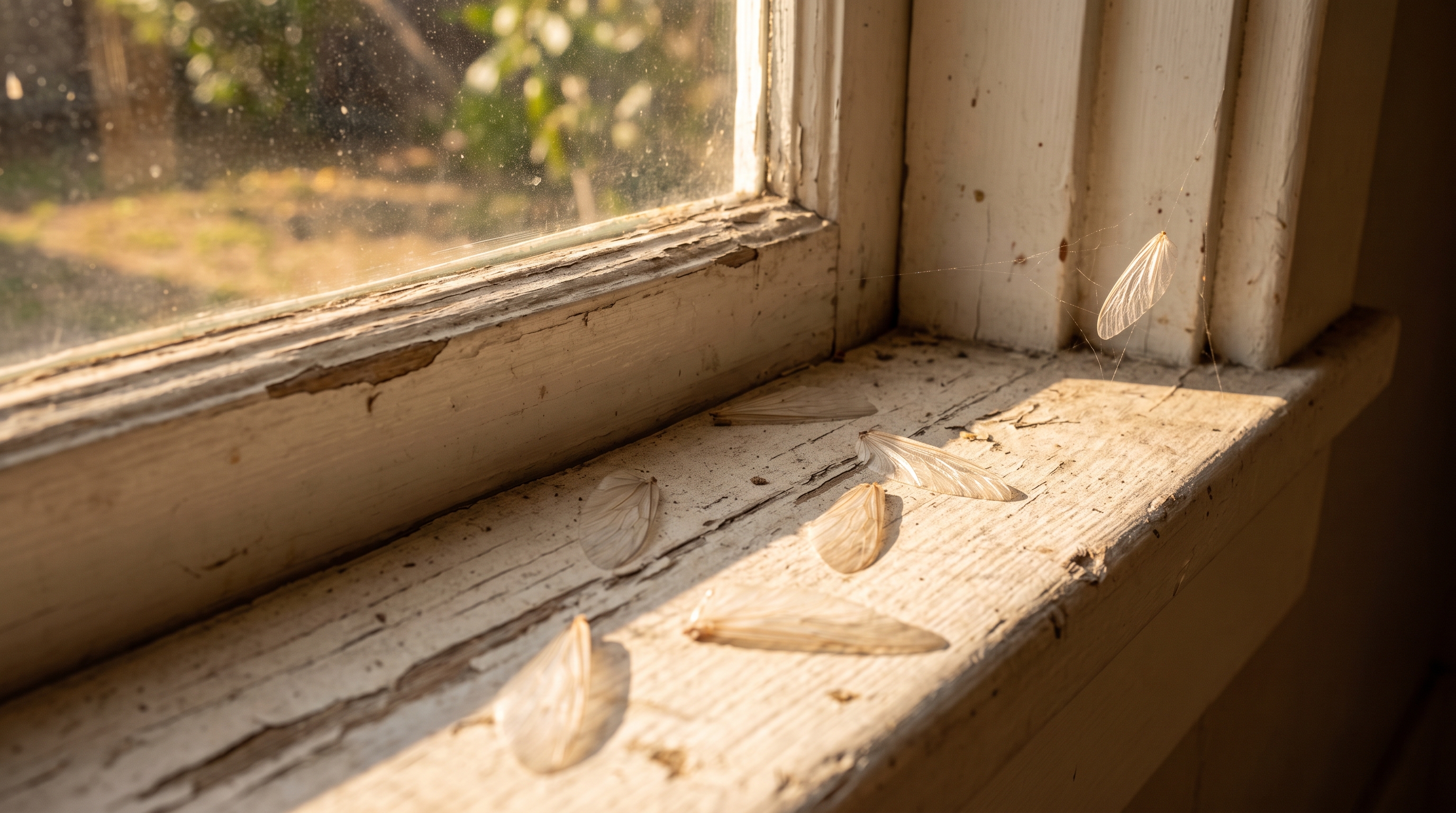
For flying ants vs termites, University of Maryland Extension uses three checks. Termites have straight antennae, a thick body with no pinched waist, and two pairs of pale, see-through wings of about equal length. Flying ants have elbowed antennae, a pinched "wasp" waist, and brown-tinted front wings that are longer than the hind wings.
If you found winged insects on a windowsill this week, you're not imagining a second season. Most people think of termite swarms as a spring thing. In California and parts of the South, a smaller fall swarm is under way right now. Here's how to figure out what you're looking at, what to do in the first hour, whom to call, and what it tends to cost.
Why termites swarm in the fall
Swarmers are the winged adults that leave a mature colony to start new ones. Different species fly at different times of year, so fall swarms depend on where you live.
-
California: The UC Statewide IPM Program says the most common sighting of drywood termites is swarmers flying "during daytime hours during summer and fall" (UC IPM Drywood Termites Pest Note). Western subterranean termites (Reticulitermes) swarm "during the afternoon in either spring or fall on clear days after a soaking rain," and the desert subterranean termite flies in the late afternoon or early evening in July, August and September (UC IPM Subterranean and Other Termites Pest Note).
-
Florida: Nozzle Nolen, a Florida pest control company, writes that western drywood termite flights have been recorded in every month except December, and that half of them happened in September, October or November. The company also says the Florida dampwood termite has peak swarming events in late fall and early winter (Nozzle Nolen).
-
The eastern U.S.: University of Georgia Extension reports that the light southeastern subterranean termite (R. hageni) swarms July through September. The eastern subterranean termite swarms February through April, and the dark southeastern species April through June (UGA Extension).
A note for Gulf Coast readers: the Formosan termite, the big name in that region, swarms "from dusk until about midnight from April through July," according to UGA. Native subterranean species swarm during the day. So a daytime swarm in late September probably isn't Formosan. That doesn't mean it's harmless, but it's useful information to give an inspector.
Flying ants vs termites: three checks
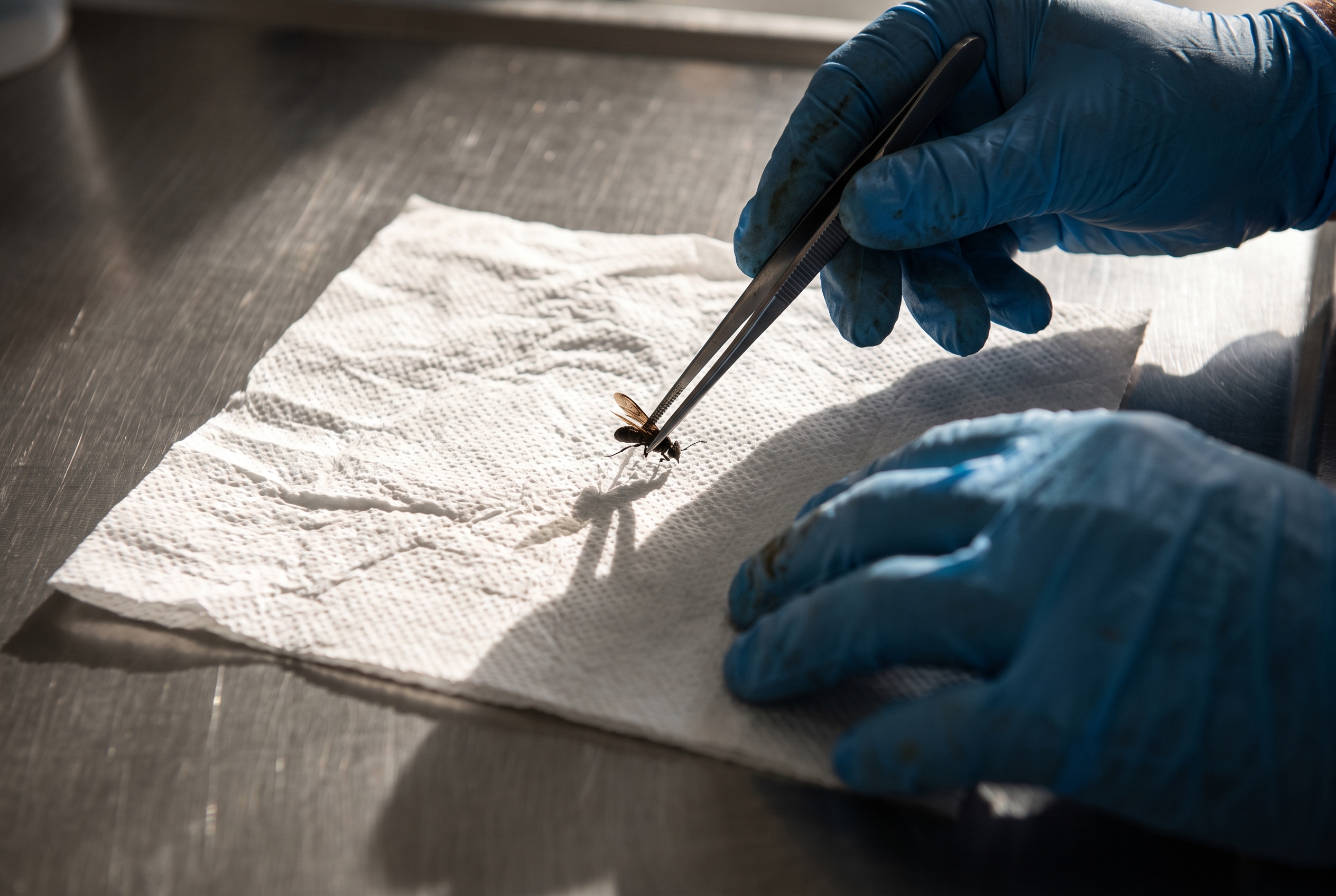
You don't need a microscope. Get one of the insects onto a white paper towel and look at it with your phone camera zoomed in. These descriptions come from University of Maryland Extension.
-
Wings. Termites have front and hind wings that are similar in shape and about equal in length, and they're pale and translucent. On ants, the front wings are longer than the hind wings and tinted brown.
-
Waist. A termite's body "extends straight back from head" with no pinched waist, so it looks thick from end to end. An ant has a narrow, pinched "wasp-waist" between its sections.
-
Antennae. Termite antennae are straight, sometimes like a string of tiny beads. Ant antennae are elbowed, with a clear bend partway along.
If all three point the same way, you have your answer. If they're mixed or you can't tell, treat it as a possible termite and have a professional look.
Clues besides the bug
Swarmers often drop their wings soon after landing, so the insect itself may be gone by the time you look. Check for these:
-
Shed wings piled on windowsills, in spider webs, or near light fixtures. Inspectors look for these specifically, per UC IPM.
-
Drywood pellets. UC IPM says drywood termite fecal pellets "have six hexagonal sides and are diagnostic for drywood termites." They often gather in small piles under a piece of wood trim or furniture.
-
Kickout holes. These are tiny openings, under 2 mm across, that drywood termites use to push pellets out of the wood (UC IPM).
-
Mud tubes on foundation walls, crawlspace piers or along slab edges, which point to subterranean species.
What to do in the first hour
-
Save a sample. Put a few swarmers in a zip-top bag or small jar. Nozzle Nolen suggests collecting specimens before an inspection. A physical sample helps an inspector identify the species.
-
Note where they came from. A specific window, a wall, the garage, a bathroom? Write it down. It helps show where the colony may be.
-
Take photos of the swarmers, any shed wings and any pellets, next to a coin for scale.
-
Don't spray. A can of bug spray kills the swarmers you can see, but it doesn't reach the colony, and it destroys the evidence an inspector would use.
-
Book an inspection. Keep this in perspective. UC IPM says "seeing swarms of flying termites does not always mean your home or building is infested." At the same time, UGA Extension says that swarming indoors "is often one of the first signs of a structural infestation." Both sources point to the same next step: have a professional take a look.
Whom to call
Call a licensed pest control company, not a handyman. For drywood termites there's also no DIY option. UC IPM says residents should get help from pest control professionals "since products needed for controlling these insects are not available for the general public."
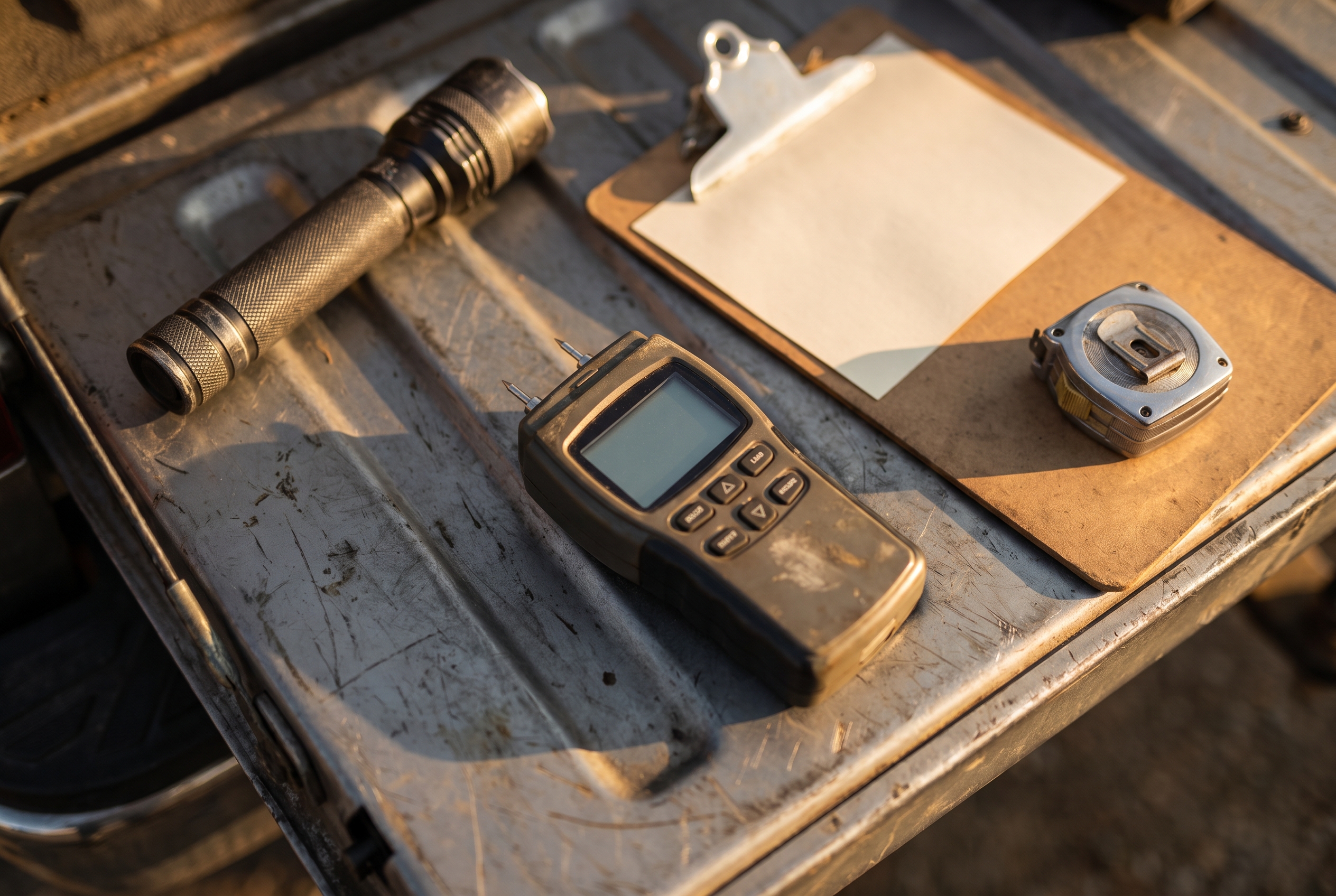
Before anyone comes over, check the license. It takes five minutes:
-
California: The Structural Pest Control Board has a "Verify a Company or Licensee" lookup and a complaint process. It also offers WDO (wood-destroying organism) Property Searches, so you can see whether your home has past termite inspection reports on file. Ask for the written WDO inspection report after your visit too.
-
Florida: FDACS runs a Pest Control Database Search. Termite work requires certification in "Termite and Other Wood-Destroying Organisms Control," so make sure the company holds that category, not only general household pest.
-
Texas: The Texas Department of Agriculture's Structural Pest Control Service publishes downloadable reports of active license holders.
What termite treatment costs in three regions
Every figure below comes from a pest company or a cost-guide site, not a government survey, so read them as ballpark numbers. Your quote depends on your house.
California
A 2026 California termite guide from MyWild lists:
-
Inspection: $75-$150
-
Whole-house drywood fumigation (tenting): $2,000-$8,000 or more, priced by cubic footage
-
Localized drywood treatment: $500-$2,500
-
Subterranean liquid barrier: $1,500-$4,000
UC IPM notes that whole-structure fumigation uses sulfuryl fluoride, and that localized treatments exist but their effectiveness varies. If a company recommends spot treatment for a drywood infestation, ask how it will confirm the whole infestation was reached.
Florida
Hoffer Pest, a Florida company, says tenting typically runs $1,000-$3,000, or about $1.00-$2.00 per square foot. Its example for a 2,450-square-foot two-story home is $2,500-$3,500. Location matters too:
-
Urban: $2,500-$4,000
-
Suburban: $1,800-$3,000
-
Rural: $1,200-$2,500
Gulf Coast (Texas, Oklahoma, Louisiana, Mississippi)
Romex Pest, a regional company, lists these 2026 ranges:
-
Liquid barrier treatment: $1,000-$3,000
-
Bait system (Sentricon): $1,200-$3,500 upfront, plus annual monitoring
-
Annual monitoring: usually $200-$400 a year
-
Spot treatment: $300-$800
-
Tent fumigation: $2,500-$7,500 or more
-
Average damage repair: $3,000-$8,000
National check
This Old House puts fumigation at $2,000-$8,000 for most homes, or $1-$4 per square foot, with an average around $5,000 for a 2,000-square-foot home. Inspections run $100-$200, and some companies do them free. Don't forget the extras. The same source puts post-fumigation cleaning at $500-$1,000 and hotel stays at about $159 a night on average, because you'll be out of the house during tenting.
What moves the quote
-
Species. Drywood colonies live in the wood and often need tenting or localized treatment. Subterranean colonies live in the soil and are usually handled with liquid barriers or bait.
-
Method. Spot treatment is the cheapest line on every list, whole-house fumigation the most expensive.
-
Size. Tenting is priced by square or cubic footage.
-
Roof and access. Tile roofs and hard-to-reach crawlspaces can add labor.
-
Prep and displacement. Budget for bagging food, the hotel nights and cleanup.
Why this usually comes out of your pocket
Don't count on your insurance. Nationwide says the cost to remove termites and repair their damage "is generally not covered by your homeowners insurance," because homeowners insurance is designed for damage that is "accidental and sudden." Termite damage builds up slowly. That's why an annual monitoring plan (about $200-$400 a year, per Romex Pest) can be worth pricing out, especially if you've already had one infestation.
The decision: what to do next
-
Elbowed antennae, pinched waist, brown front wings longer than the hind wings: those are ants. A general pest company or a store-bought ant bait is a reasonable next step, especially if you only saw a few.
-
Straight antennae, no waist, equal-length pale wings, or six-sided pellets indoors: book a licensed termite inspection this week. Check the license first.
-
If treatment is recommended: get at least two bids and compare them line by line. Look at the treatment method (tent, local, liquid or bait), what the warranty covers and for how long, whether retreatment is free if swarmers come back, and what annual renewal costs after year one.
A swarm is a good reason to make the call, but not a reason to panic. With a sample in a jar and two written bids, you'll be in a good position to choose.
Related reading
-
Flat Roof Leak After Heavy Rain? What to Check in Phoenix and Albuquerque as Polo Moves Through
-
Which Foundation Cracks Mean You Should Call a Structural Engineer?
Sources
-
Ants and Termites: How to Tell the Difference, University of Maryland Extension
-
Subterranean and Other Termites Pest Note, UC Statewide IPM Program
-
Biology of Subterranean Termites in the Eastern United States, UGA CAES Field Report
-
Termite Treatment Cost in 2026: Texas, Oklahoma, Louisiana & Mississippi, Romex Pest
-
Structural Pest Control Reports: Current Licenses, Texas Department of Agriculture
Note: This article contains AI-assisted content and has been reviewed by our editorial team.
ABOUT THIS SERVICE: CallTheLocal.com is a directory and lead generation service, not a contractor or service provider. Submitting this form does not obligate you to hire anyone or purchase any service. Your information will be shared with licensed, insured home service professionals in your area who may provide quotes for your project. CallTheLocal.com does not guarantee the quality, timeliness, or outcome of any work performed by service providers you connect with through this service. Always verify licensing, insurance, and references before hiring. Get everything in writing before work begins.