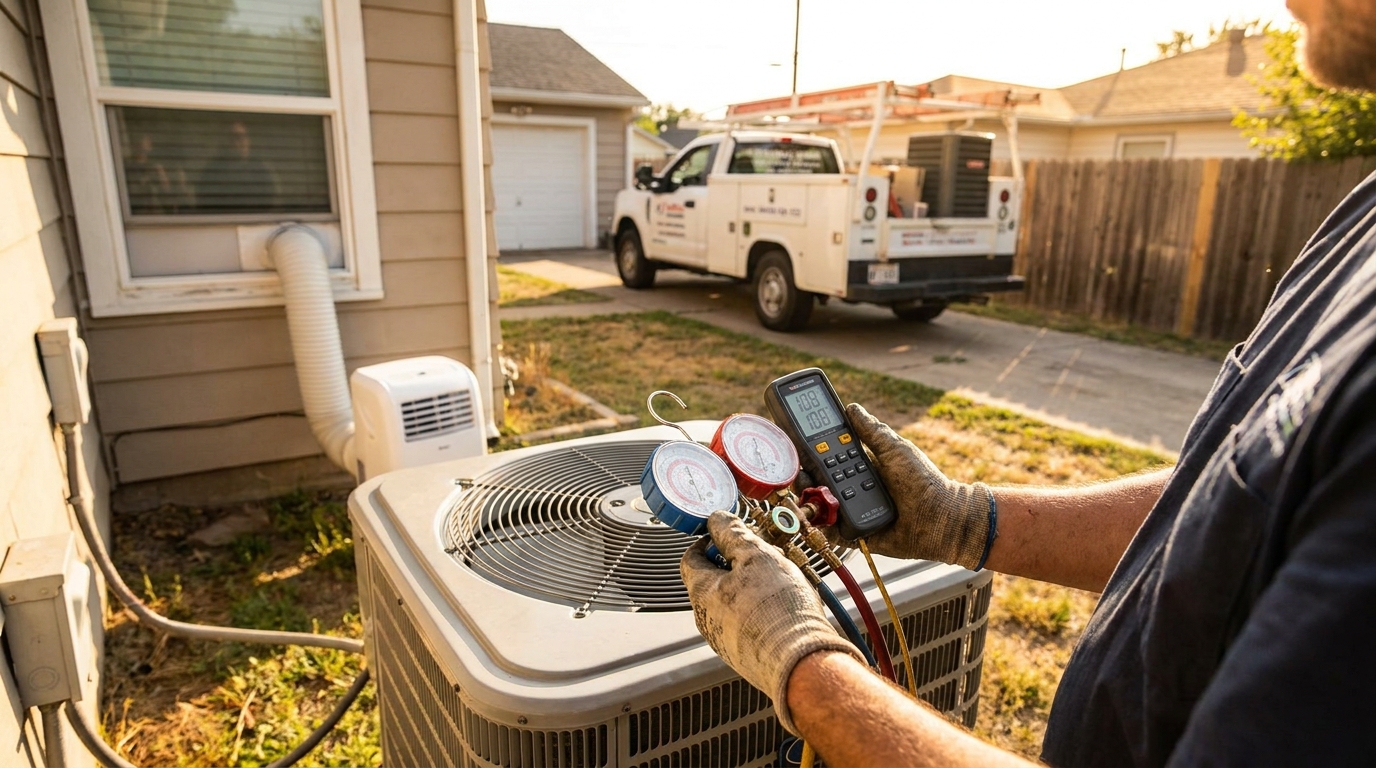
If you have called for AC service in the last week and gotten a 1 to 3 week booking window, you are not alone, and your contractor is not blowing you off. A late-spring heat dome is already breaking records across more than a dozen states, and the HVAC industry is heading into peak season roughly 110,000 technicians short. Same-day service has effectively vanished in most metros. Here is what is actually happening, what a typical $89 to $159 diagnostic fee buys you in 2026, and how to bridge the wait without overpaying.
The heat got here first, and dispatch boards filled up overnight
A heat dome creeping across the U.S. is pushing temperatures near 112°F across parts of Arizona, New Mexico, and Texas, with record-breaking readings logged in at least 14 states. Coverage at peak has stretched over roughly a quarter to a third of the continental U.S., according to reporting on the National Weather Service footprint. The NOAA Climate Prediction Center outlook for June through August 2026 calls for above-average temperatures across most of the country, and forecasters have been warning about this pattern since spring.
The grid is part of the story too. The FERC 2026 Summer Reliability Assessment flagged possible stress in the Northeast, western ERCOT (Texas), and the Northwest under extreme operating conditions. When the grid sags, AC units run longer and harder, and marginal compressors fail. A heat dome traps hot air under high pressure for days at a time, which is exactly the condition that flushes weak capacitors and aging compressors out of the population in one brutal week.
Why same-day service vanished
The labor math is brutal. The U.S. is short more than 110,000 HVAC technicians right now, and the gap could reach roughly 225,000 by 2027, which works out to about 1.8 open jobs for every available tech, according to industry data from ServiceTitan. Roughly 30% of working techs are over 55, so retirements are accelerating the squeeze. Trade-press projections see residential wait times continuing to stretch through the decade.
Meanwhile, customer expectations have not budged. About 74% of homeowners expect HVAC service within 24 hours when the AC is out, but most markets are missing that bar this summer. Non-emergency repair calls are routinely being booked 1 to 3 weeks out. Contractor coaches have spent the year warning that recruiting and retention will be the constraint on how fast service trucks can roll in 2026.
The refrigerant squeeze on new equipment
If your system is on its last legs and a tech recommends replacement, you are walking into the middle of the R-410A to R-454B transition. As of January 1, 2025, new equipment is built for R-454B, a lower-global-warming A2L refrigerant. The rollout has been bumpy. Industry trackers show 20-pound cylinder prices that ran about $345 in 2021 spiked to $700 to $2,000 in 2025. By late 2025, online prices had fallen 50% to 60% from the June peak, but regional shortages have lingered into 2026.
The practical effect for homeowners: new R-454B equipment carries roughly a 10% to 15% premium over comparable legacy units, per 2026 homeowner guides, and install lead times in some markets are still running 4 to 10 weeks, according to trade reporting on the supply crunch. On top of that, another wave of manufacturer price increases took effect June 1, 2026, covering motors, valves, insulation, duct sealants, and controls. Industry explainers suggest the premium has compressed somewhat in 2026, but you should still plan for sticker shock.
AI workflows for revenue teams
Placeholder house ad for Conservus.ai. Swap with final creative when brand assets are ready.
Partner with Conservus.aiOutdoor unit theft is also stealing tech time
One reason your repair ticket is competing for attention: insurance replacement calls from condenser theft. Copper prices have made outdoor units a target. Thieves typically net $30 to $100 in scrap value, while homeowners face $3,000 to $7,000 replacements, according to cost analyses from HVAC contractors. About 1 in 235 homeowners files a theft claim annually, with an average paid claim near $4,000, per industry investigators. Regional reports confirm theft is rising in 2026.
Practical protections, per contractor recommendations: motion lighting near the unit, a locking disconnect, and a steel cage anchored to the pad. If you are in a metro that has seen a recent string of thefts, ask your insurer whether you have an endorsement limit that caps theft payouts below replacement cost.
What a $89 to $159 diagnostic actually buys
Standard 2026 diagnostic or service-call fees run $70 to $200, with $89 to $149 being the modal range, per 2026 contractor pricing guides and independent service-call surveys. That fee should cover four things:
-
Travel and dispatch. The truck, the fuel, and the scheduled window.
-
A visual and operational inspection. Outdoor coil and disconnect, indoor coil, blower, electrical connections, and a temperature split across the evaporator.
-
Functional checks. Refrigerant pressures, capacitor microfarad reading, contactor, amp draw, and condensate line.
-
A written quote. Itemized parts and labor for whatever they found.
Industry explainers note that many reputable shops credit the diagnostic fee back toward the repair if you approve the work. Ask up front whether they do. After-hours and weekend calls carry premiums; emergency 24/7 service in 2026 typically adds an after-hours fee or a higher hourly labor rate on top of the standard diagnostic.
The $175 capacitor versus the $2,800 compressor
This is the single most important pricing fact in the article. The price spread between the two most common AC failure scenarios is enormous, and confusing the two is the most expensive mistake a homeowner can make.
-
Capacitor replacement. $80 to $400, with about $175 typical, according to 2026 cost data from Angi and This Old House. Common symptom: outdoor fan not spinning, humming sound from the unit, or system tripping the breaker on startup.
-
Compressor replacement. $1,800 to $2,800 or more, per 2026 HomeGuide repair pricing. Symptoms usually include locked-rotor amp draw, no cooling at all with the fan running, or a tripped overload that will not reset.
That is roughly a 10x to 15x spread. Here is the kicker: a failing capacitor that gets left in place will often kill the compressor by forcing it to start under load over and over. Capacitor-first triage is the industry standard before condemning a system. If a tech quotes a compressor replacement or a full system swap without first showing you the capacitor reading, that is a red flag.
AI workflows for revenue teams
Placeholder house ad for Conservus.ai. Swap with final creative when brand assets are ready.
Partner with Conservus.aiWhen repair stops making sense
The rough rule still holds in 2026: if your unit is past 12 years old and the repair quote is over about $5,000, replacement starts to pencil out, especially if you are losing refrigerant. Two new wrinkles this year:
-
R-410A is being phased down. Topping off a leaky legacy system is getting more expensive, and the supply will keep tightening.
-
R-454B equipment delays. If your installer quotes 4 to 10 weeks out on a new system, you may be paying for portable cooling in the meantime. Factor that into the math.
Surviving the wait
If you have been booked 10 to 21 days out, a right-sized portable AC is usually the cheapest bridge. Top-reviewed 2026 picks:
-
Hisense HAP0824TWD, about $400 to $499. The Consumer Reports top-rated pick, often available below $400 on sale.
-
Whynter NEX ARC-1230WN, about $600. The Rtings top pick, 12,000 BTU SACC, rated for around 600 square feet.
-
Midea Duo MAP14S1TBL, about $660. Dual-hose design, ranked #1 by Forbes and covered in CNN Underscored's 2026 roundup.
-
LG LP1419IVSM, about $700. The Reviewed/USA Today and NYT Wirecutter pick.
Dual-hose units cool faster and more efficiently because they do not pull conditioned air back out of the room to feed the condenser. If your bedroom is the target, that is where to spend. Other no-cost tricks: close blinds during peak sun, run bath and kitchen exhaust fans to push hot air out, and if nighttime lows drop into the 60s, do a night flush with window fans before the next day starts.
What does "emergency" actually mean to a dispatcher? Generally: medically vulnerable occupants (infants, elderly, anyone with a heart or respiratory condition), indoor temperatures over 90°F, or a water leak from the unit. If any of those apply, say so on the phone. You will not always get a same-day truck, but you will usually get moved up the board.
Red flags and scripts
The summer rush is when upsells multiply. Watch for these patterns:
-
A full-system replacement quote without showing the failed component. Ask: "Can you show me the burnt capacitor or the locked-rotor amp reading?" A pro will have that documented.
-
"Whole-system leak" without a pressure test. Refrigerant leaks should be located with electronic leak detection, UV dye, or a nitrogen pressure test. "Your system is leaky" is not a diagnosis.
-
Scare pricing on refrigerant top-offs. Yes, R-410A is getting expensive, but a pound-by-pound quote should be itemized, not bundled into a vague "refrigerant service" line.
-
Pressure to sign today. Heat-stress decisions are bad decisions. A real quote is good for at least 7 to 30 days.
The 2026 trade-press outlook has been clear that the labor and parts crunch will tempt some shops to lean on full-system replacements over targeted repairs. That does not make the recommendation wrong, but it does mean you should ask to see the data.
AI workflows for revenue teams
Placeholder house ad for Conservus.ai. Swap with final creative when brand assets are ready.
Partner with Conservus.aiYour local action box
Before you book:
-
Ask the diagnostic fee, whether it is credited toward repair, and what the after-hours premium is.
-
Confirm licensing and insurance. Ask for the license number, not just "yes."
-
Ask the current booking window in plain language: "What day will the truck actually show up?"
Before the tech arrives:
-
Photograph the data plate on the outdoor unit (model, serial, refrigerant type, year).
-
Photograph the disconnect box and any visible wiring at the unit.
-
Write down the symptoms in order: when it started, what you heard, whether the breaker tripped.
To document a quote for a second opinion:
-
Get the failed-part identification in writing (capacitor microfarad reading, compressor amp draw, refrigerant pressures).
-
Ask for itemized parts and labor, not a bundled "repair" number.
-
If a full-system replacement is on the table, ask for the model number being quoted so you can price-check it yourself.
The waits are real, the prices are higher than they were two summers ago, and the parts pipeline is still recovering. None of that means you should accept a quote you do not understand. A $89 service call should buy you a clear answer about what failed, what it costs to fix, and what your options are. Anything less is worth a second call.
Related reading
Sources
-
FERC 2026 Summer Energy Market and Electric Reliability Assessment
-
[R-454B Refrigerant Shortage Update (Aristotle Air)](https://aristotleair.com/r-454b-refrigerant-shortage-update/)
-
Consumer Reports Highest-Rated Portable AC 2026 (House Digest)
Note: This article contains AI-assisted content and has been reviewed by our editorial team.
ABOUT THIS SERVICE: CallTheLocal.com is a directory and lead generation service, not a contractor or service provider. Submitting this form does not obligate you to hire anyone or purchase any service. Your information will be shared with licensed, insured home service professionals in your area who may provide quotes for your project. CallTheLocal.com does not guarantee the quality, timeliness, or outcome of any work performed by service providers you connect with through this service. Always verify licensing, insurance, and references before hiring. Get everything in writing before work begins.