If a letter from your water utility lands this fall saying your service line may contain lead, you are not being singled out, and in most cases you are not being told your water is unsafe. You are being told your utility does not know what your pipe is made of.
Baltimore County made that unusually plain in late August. On August 27, 2026, the county's Department of Public Works and Transportation announced it would notify water customers whose service lines are either confirmed to need replacement or are simply unverified in county records. More than 99% of those notices, officials said, are going to addresses classified as unknown. Actual lead lines appear to be uncommon in the county. The county also said it will replace, at no cost to water customers, every line the EPA requires to be replaced.
That 99% figure is the whole story of these letters nationally. And unknown is not a clean bill of health, but it is also not an alarm. It is an unresolved blank in a spreadsheet, and you can often fill it in yourself with a refrigerator magnet and a house key.
Why the letter arrives, and why it keeps arriving
This is a federal requirement, not a local marketing campaign. Under the Lead and Copper Rule Revisions and the newer Lead and Copper Rule Improvements (LCRI), community water systems had to build an inventory of every service line they serve and then notify every customer whose line is lead, galvanized requiring replacement, or unknown. The notice has to go out within 30 days of the inventory being completed, and it has to repeat every year until that line is confirmed to be none of those three things. Delivery must be by mail or hand delivery, which is why this shows up as paper and not an email.
A common misreading: the rule does not name November. The first wave of notices was due by November 15, 2024, so most systems now run their annual cycle on that anniversary and homeowners see the envelope each November. State timing varies. Massachusetts, for example, sets a December 31 distribution deadline. If your letter shows up in a different month, nothing is wrong.
The practical takeaway is that this letter is a subscription, not a one-time event. It arrives again next year, and the year after, until somebody establishes what your pipe is. That somebody can be you.
The three words that decide everything
Your letter will classify your line one of three ways, and the required content of the notice changes depending on which one you got.
-
Lead. The line is known to be lead. Your notice should include replacement information and financing information.
-
Galvanized requiring replacement (GRR). This is galvanized steel pipe that currently sits, or used to sit, downstream of a lead pipe. Galvanized steel is porous enough to absorb lead over the years and then release it later, so even after the lead upstream is gone, the galvanized section is treated as a lead problem. Your notice should include replacement information.
-
Unknown. The utility has no record establishing the material. Your notice is required to tell you how to verify it.
There is a wrinkle worth knowing if your letter and your neighbor's letter say different things. A service line has two halves: the utility side, running from the water main to the curb stop, and the customer side, running from the curb stop into your house. Some utilities break unknown down by side. WSSC Water, which serves suburban Maryland, distinguishes unknown-customer-side-only, unknown-utility-side-only, and unknown-on-both-sides. That distinction tells you who has the homework to do. If only your side is unknown, the utility is waiting on you.
The fifteen-minute self-check
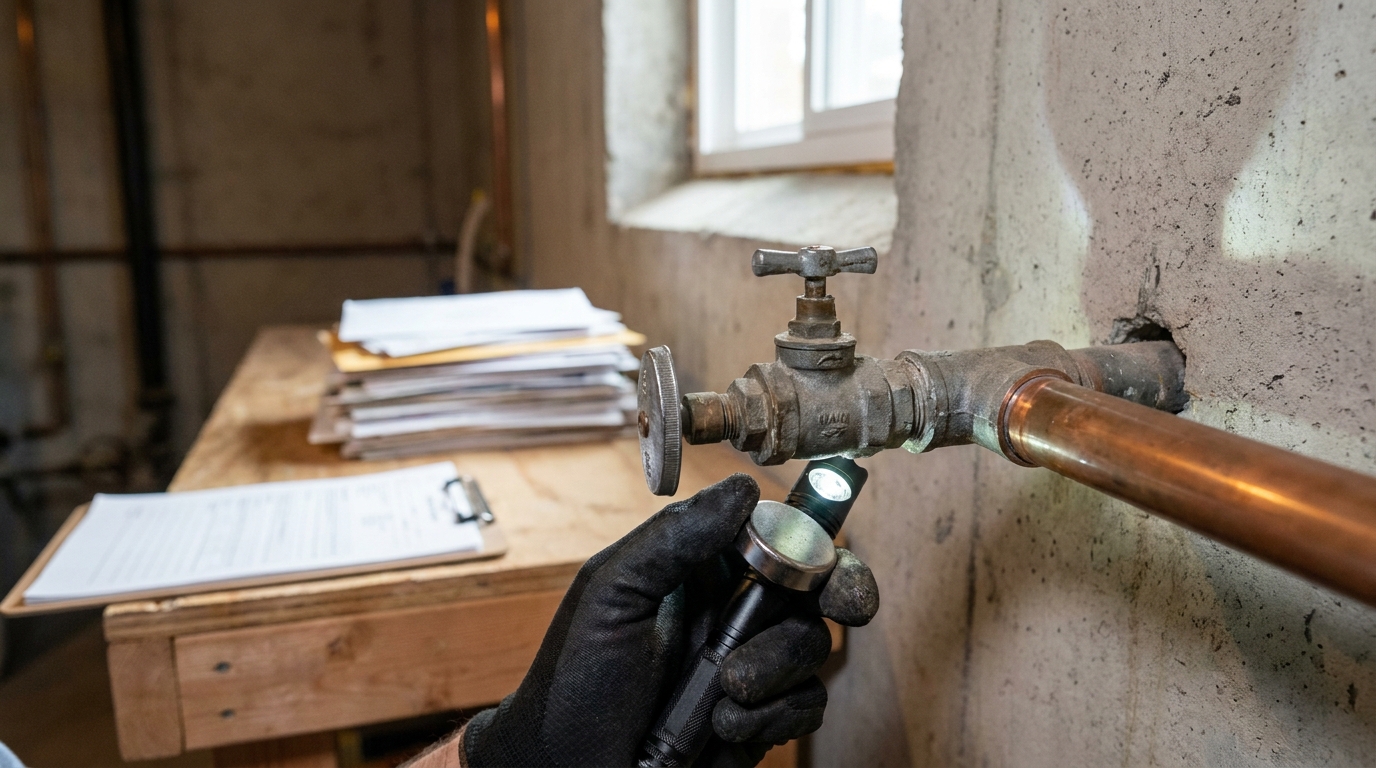
Go to your basement or crawlspace and find where the water line comes through the foundation wall. You want the stretch of pipe between the wall and the main shutoff valve. That is the service line. Anything past the valve is house plumbing and tells you nothing about what is buried in your yard.
-
Magnet first. Hold a refrigerator magnet against the pipe. If it sticks, the pipe is galvanized steel. A magnet will not stick to lead, copper, or brass. This one step rules out a lot.
-
Then scratch. Service lines wear a layer of surface corrosion that hides the true color. Scrape through it with a key, a coin, or a flathead screwdriver. Lead is soft, scrapes easily, and reveals a dull shiny silver underneath, and remember it is not magnetic. Copper scratches to the color of a new penny. Plastic is obvious on sight.
-
Look for the bulge. A short swollen section near the valve, often described as looking like a snake that swallowed an egg, is a lead gooseneck, a flexible lead connector. That is lead even if the rest of the run is not.
Most utilities will take it from there with a photo. Baltimore County runs a self-report survey and, for anyone who would rather not guess, will send an inspector to the house for free. The county lists 410-887-1368 and waterserviceline@baltimorecountymd.gov for scheduling. Check your own letter for the equivalent, because nearly every system that mailed these notices has some version of it.
Why bothering to resolve 'unknown' actually pays
Free and no-cost replacement programs are generally keyed to confirmed material. As long as your line sits in the unknown pile, you are in the annual-letter loop and outside the program that would have paid for the work. Resolving the classification is the step that moves you into a queue, or off the list entirely.
It works in both directions, and usually in the homeowner's favor. WSSC Water has reclassified roughly 6,000 previously-unknown lines as non-lead through records research and in-home verification. Those households are done. On the other side, Newark, New Jersey replaced nearly all of its roughly 18,500 lead service lines at no cost to residents, which is the clearest proof that a full-line, homeowner-pays-nothing program is a real thing and not a theoretical one.
One caution specific to Baltimore County: an earlier free customer-side replacement offer carried a March 31, 2026 survey deadline, and that date has passed. Do not assume that program is still open, and do not assume it is closed either. The August 2026 announcement is a separate and broader commitment tied to EPA-required replacements. Call and ask what you qualify for today rather than working from a news article from last winter.
What replacement costs, and who is on the hook
The number you will see quoted everywhere is EPA's: an average of about $4,700 per line, with a range of $1,200 to $12,300. Worth knowing where that came from. As Brookings documents, it traces to EPA's October 2019 report on strategies to achieve full lead service line replacement. That is a seven-year-old figure, and it has not aged well against real quotes.
Reporting out of Chicago has cited homeowner quotes in the $15,000 to $18,000 range plus roughly $3,500 in city permit costs, and as high as $30,000 for a single line. Dense urban blocks, long runs from the main, permit-heavy jurisdictions, and restoring a torn-up sidewalk or driveway all push the number. A short run through soft yard in a low-permit suburb is a different job at a different price. Treat EPA's range as the official baseline for policy math, not as what you should expect a plumber to write on an estimate.
The historical split works like this: the water system covers the main-to-curb-stop portion, and the property owner covers the curb-to-house segment. That default is exactly what the current wave of programs and federal money is designed to override. Baltimore County's no-cost commitment and Newark's completed citywide replacement are both examples of a utility taking the whole line. Never assume the old split applies to you before you ask.
On funding: the Infrastructure Investment and Jobs Act provides $3.0 billion per year for fiscal years 2022 through 2026, $15.0 billion in total, through the Drinking Water State Revolving Fund specifically for lead service line replacement, with 49% delivered as grants or principal forgiveness and no state match required. Another $11.7 billion in general DWSRF money is also eligible. Real money. Also competitive money, and contested: Food & Water Watch reported in January 2026 that a federal spending package would eliminate $125 million in previously approved infrastructure-law lead replacement funds. EPA maintains a directory of funding sources if you learn your line is lead and your utility does not cover the customer side.
The partial replacement problem, and why timing matters here
This is the part most homeowners have never heard of, and it is the one to understand before anyone puts a shovel in your yard.
A partial replacement is when only one side of the line gets swapped, usually the utility side, leaving lead in the ground on the customer side. It sounds like progress. Research has documented that it often is not, at least not for months afterward. Two mechanisms are at work. First, physically disturbing an old lead pipe knocks loose the mineral scale that has built up inside it, and that scale carries lead. Second, where new copper meets remaining lead, galvanic corrosion can accelerate lead release at the joint. Peer-reviewed work in Environmental Health Perspectives documented lead elevation following partial replacement along with the galvanic mechanism, and a direct full-versus-partial comparison found that full replacement reliably lowers lead in a way partial replacement does not.
EPA does not hedge on this. Its replacement planning guidance discourages partial replacement, citing its own Science Advisory Board.
Now the timing qualifier, because this matters for how worried to be. LCRI generally prohibits partial replacements as of the compliance date, and a partial does not count toward a system's minimum replacement rate, which removes the incentive to do them. The exceptions are narrow: emergency repairs, such as a leak or break on a utility-side lead pipe, and planned capital work like a main replacement. There is also a customer-refusal path. If a customer declines full replacement, the utility has to make four documented attempts within 45 days to offer customer-side replacement before proceeding with a partial, and the line still gets counted as a lead service line afterward.
So the practical risk is concentrated in work happening right now and in those exception cases, not stretching indefinitely into the future. If your street is getting a main replaced this year, that is the moment to pay attention.
Ask these questions before anyone digs
-
Is this a full replacement or a partial?
-
If it is partial, why, and which exception applies (emergency repair, coordinated main work, or something else)?
-
Are you replacing the customer side at no cost to me? If not, what will it cost, and is there a program or funding source I qualify for?
-
Am I getting the filter and the replacement cartridges the rule requires?
-
What are the flushing instructions after the work?
-
Will this line still be counted as a lead service line in your inventory afterward?
That filter question is the one to press on. LCRI requires the water system to provide a filter certified by an ANSI-accredited certifier to reduce lead, plus six months of replacement cartridges, following full and partial replacement of lead and GRR lines, and after other disturbances to lead, GRR, and unknown lines. Flushing instructions are required too. This is an entitlement, not a courtesy, and it is the single most actionable thing most readers do not know to ask for. You should not have to ask twice.
What could still change between now and the letters
Three moving pieces are worth knowing about, because anyone who tells you the next decade is settled is overstating it.
The rule is in court. The American Water Works Association petitioned for review of LCRI on December 13, 2024, arguing the replacement timeline is not feasible under the Safe Drinking Water Act. Briefing is complete, and the D.C. Circuit set oral argument for September 30, 2026 on the ten-year timeline and private-side replacement obligations. EPA announced in August 2025 that it would defend the rule. LCRI remains fully in effect in the meantime, and the argument lands only weeks before this fall's letters go out.
The national numbers moved. EPA's 2025 update to its drinking water infrastructure survey revised the national lead service line estimate down to roughly 4 million, while more than 24 million service lines remain classified unknown, with EPA projecting about 1 million of those unknowns will turn out to be lead or GRR. The NRDC has publicly urged skepticism about that downward revision. Either way, the shape of the problem is the same: unknown is by far the most common answer in America, which is exactly why your letter says what it says.
Enforcement will vary by state. States must submit final LCRI primacy revision applications by October 30, 2026, and may request extensions of up to two additional years. Expect meaningfully different postures from state to state for years.
The calendar that actually matters
LCRI was published in the Federal Register on October 30, 2024 and took effect December 29, 2024. The main compliance date is November 1, 2027. That is when the baseline inventory, the replacement plan, the schools and childcare list, and the updated sampling plan all come due. It is also when the lead action level drops from 15 ppb to 10 ppb at the 90th percentile, with a 24-hour public notice requirement on exceedance. The 10 ppb level is not in force today.
One correction to a thing you will hear repeated: the ten-year replacement clock does not start with your letter. From November 1, 2027, systems face a minimum average annual replacement rate of 10% of lead and GRR lines and must keep working through the unknowns. That puts the finish line at 2037, not ten years from the notice in your mailbox.
Which leaves you with the same modest to-do either way. Take a magnet and a key to the basement. Find where the line enters. Spend fifteen minutes. Then send your utility a photo or book the free inspection. That is what moves your address from the unknown column into a column where somebody, quite possibly not you, pays for the pipe.
Related reading
-
[Your Lawn Can Go From Green to Brown in One Night: Fall Armyworms Are Feeding Right Now](/guides/fall-armyworms-lawn-damage-what-to-do-2026)
-
More Than Half the Lower 48 Is in Drought Right Now, and the Clay Under Your Slab Is Shrinking
Sources
-
Lead and Copper Rule Improvements, US EPA
-
Notification of Known or Potential Service Line Containing Lead, US EPA Region 8
-
National Primary Drinking Water Regulations for Lead and Copper: Improvements (LCRI), Federal Register, October 30, 2024
-
Planning and Conducting Lead Service Line Replacement, US EPA
-
SAB Evaluation of the Effectiveness of Partial Lead Service Line Replacements, EPA Science Advisory Board
-
Reaction to the Solution: Lead Exposure Following Partial Service Line Replacement, Environmental Health Perspectives
-
Evaluating the Effects of Full and Partial Lead Service Line Replacement on Lead Levels in Drinking Water, PubMed
-
Baltimore County to notify water customers whose service lines may require replacement, August 27, 2026
-
Annual Notifications of Service Line Material, WSSC Water
-
What would it cost to replace all the nation's lead water pipes?, Brookings
-
2025 7th DWINSA Update Fact Sheet, US EPA
-
The EPA Now Says There Aren't 9 Million Lead Pipes, There Are 4 Million. Be Skeptical., NRDC
-
LSL Policy Lowdown: July 6-12, 2026, Environmental Policy Innovation Center
-
American Water Works Association et al. v. EPA, NRDC Court Battles (NRDC is an intervenor, not a neutral party)
-
Lead Service Lines (LSLs) Replacement: Funding Developments (R47717), Congressional Research Service
-
Identifying Funding Sources for Lead Service Line Replacement, US EPA
-
Federal Spending Package Would Cut Lead Pipe Replacement Funding, Food & Water Watch (advocacy organization)
-
How to Find Out If Your Home Has Lead Service Lines, NRDC
-
Baltimore County offers free lead water line replacements through 2026, Fox Baltimore
-
Frequently asked questions about the Lead and Copper Rule improvements, CDM Smith
-
Lead and Copper Rule Improvements, Bricker Graydon
-
Lead in Water: EPA's New Service Line Dashboard, 4 Million LSLs Estimate, Unleaded Kids
Note: This article contains AI-assisted content and has been reviewed by our editorial team.
ABOUT THIS SERVICE: CallTheLocal.com is a directory and lead generation service, not a contractor or service provider. Submitting this form does not obligate you to hire anyone or purchase any service. Your information will be shared with licensed, insured home service professionals in your area who may provide quotes for your project. CallTheLocal.com does not guarantee the quality, timeliness, or outcome of any work performed by service providers you connect with through this service. Always verify licensing, insurance, and references before hiring. Get everything in writing before work begins.