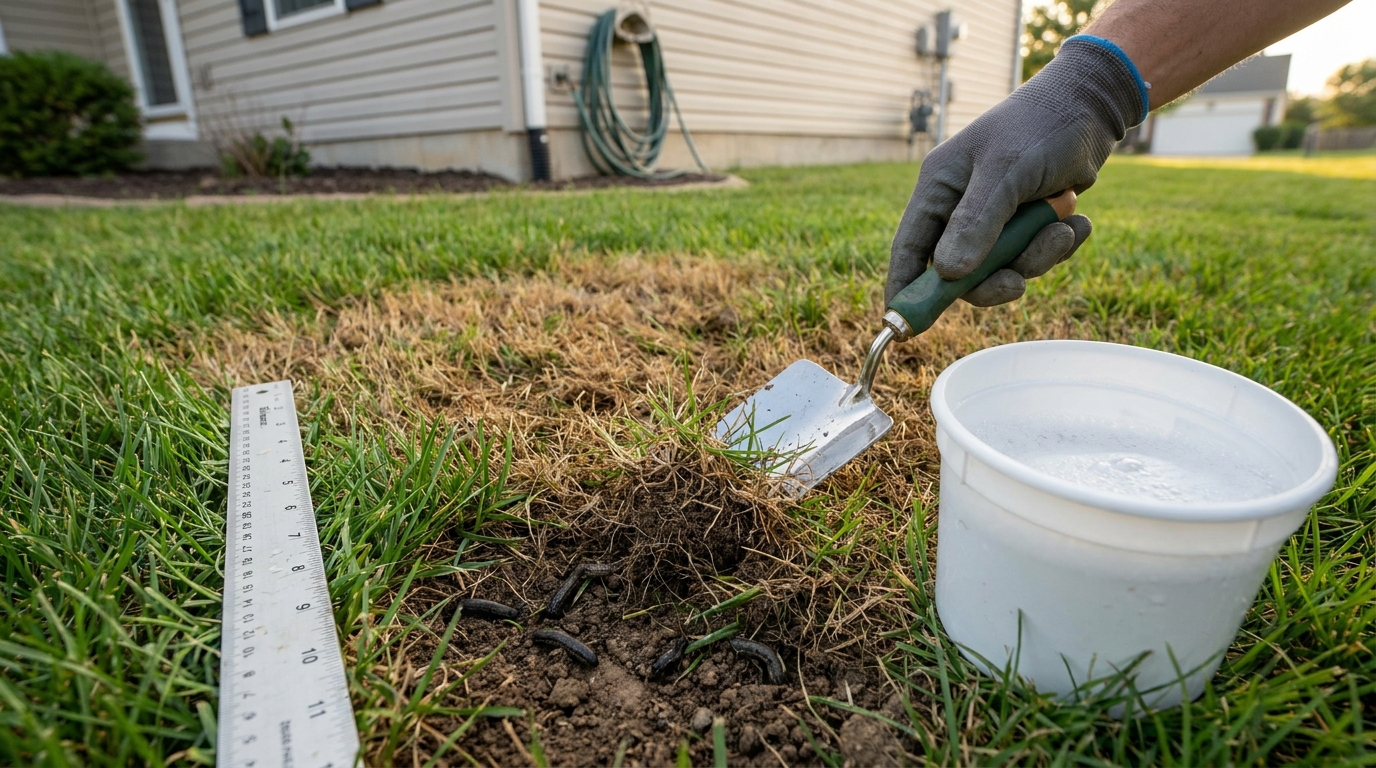
You mowed Saturday. The lawn looked fine. By Wednesday there are brown patches with a ragged edge that seems to be moving across the yard, and no amount of watering is bringing them back.
That is not drought. That is very likely fall armyworm, and the reason it feels like it happened overnight is baked into how the insect grows. According to Clemson Cooperative Extension, more than 93 percent of the feeding damage happens after the fourth larval instar. Translation: the caterpillars are in your grass for days doing almost nothing you can see, then they get big and eat the lawn down to the thatch in a hurry.
A quick note on the framing you may have seen elsewhere this season. There is no verified extension source saying armyworms arrived early in 2026. K-State entomologist Anthony Zukoff makes the opposite point in the 2026 trap network announcement, writing that this migratory pest has no fixed arrival date and that each year will be different. The accurate story is not that they came early. It is that they came in force, and the damage window is open now.
What is actually happening this season
K-State Extension Entomology posted Fall Armyworm is Now Active in Kansas on June 24, 2026, reporting that moths began arriving in the state in mid-June. Pheromone trap counts as of June 22, 2026 tell you how uneven this is county to county: Franklin County caught 121 moths, Kingman 19, Stanton 6, Finney 1, while Ellsworth and Jackson caught none.
The widely shared "August 1 warning" was a KWCH-TV report published July 31, 2026, not a formal advisory. In it, Matthew McKernan of K-State Research and Extension said, "Right now, traps around Kansas are showing some of the presence of adult moths, which means the adult moths will be laying eggs and starting to see fall armyworms appear in the lawn and agronomic crops in the coming weeks."
Put the biology next to those dates and you get your timeline. Per K-State publication MF3595, eggs hatch in two to four days at 70 to 80 degrees, a single female lays 50 to 200 eggs per mass and up to 2,000 eggs in a week, and the full life cycle runs about four weeks. Larvae feed for roughly two to three weeks before they pupate. That larval stretch is the gap between a moth flight and a homeowner noticing anything, and it is the only stretch where treatment does anything at all.
Why you will misread it as heat stress
The first three instars are small, about 2 millimeters at hatch and light green. They cluster on the undersides of leaf blades and inside leaf folds, scraping tissue and leaving a tattered, thin, faded look. That reads as drought or heat stress to almost everyone. The last three instars feed all the way down to the crown, and that is the damage that actually kills turfgrass (K-State MF3595).
Two tells separate armyworm from a dry spot:
-
Green frass at the soil surface. Look for small piles of green fecal pellets where the leaf tissue has been eaten. K-State lists this as a diagnostic sign, and it is the one most homeowners walk right past.
-
The edge moves. Drought damage sits in the same hot spots: the strip by the driveway, the slope, the area the sprinkler misses. Armyworm damage has an advancing front that marches across the yard, which is where the name comes from.
KWCH also notes jagged, missing leaf-blade feeding as a visible sign. If you water a suspicious patch for three days and it keeps expanding outward, stop watering and start looking for caterpillars.
The ten-minute confirmation test
The soap flush is the single most useful thing in this article. It costs you a squirt of dish soap and about ten minutes, and it turns a guess into a fact.
There are two published protocols. Alabama Cooperative Extension uses 2 tablespoons of liquid dish soap in 1 gallon of water poured over a 1 to 2 square foot area. Clemson uses 1 to 2 tablespoons of lemon dish soap in 1 to 2 gallons of water over one square yard, and says armyworms emerge within 10 minutes of pouring.
The version a Kansas lawn operator described to KWCH is the easiest to remember. Dylan Weber of The Greener Side Lawn and Landscape mixes a gallon of water with Dawn, pours half on good grass and half on the affected area, and waits. "They will rise to the surface."
That comparison pour matters. You want to sample the edge of the damage and the healthy turf right next to it, because the caterpillars are usually at the advancing front, not in the middle of the part they already ate.
Confirm what surfaced. The flush also brings up sod webworms and mole crickets, which need different handling. Fall armyworm has a light-colored inverted "Y" on the front of its dark head and four black tubercles arranged on the back of each abdominal segment. Mature larvae are tan to olive-green with stripes running down both sides and reach 1.25 to 1.5 inches, up to about 2 inches according to UGA Extension Circular 1335. The inverted Y is what separates fall armyworm from true armyworm.
How many is too many, and the honest answer on thresholds
You will find a "3 to 4 per square foot" number all over the internet. Here is the real situation. UGA states plainly that no threshold exists that correlates with damage in turf. Alabama Extension declines to give one too, saying the decision depends on the kind of turf, its condition, and how it is used. K-State's 2026 alert does give 3 to 5 caterpillars per square foot, but that figure is for pasture and brome, not home lawns.
So treat 3 or more per square foot as a working rule of thumb, not an extension standard. The practical homeowner version: if you flush live larvae and you have a visibly advancing damage edge, treat. Lower your trigger further if you have tall fescue, a lawn seeded within the past year, or sod that went down this season, because those are the cases where the damage gets expensive.
Why the nicest lawn on the block is the target
This part frustrates people who have done everything right. K-State MF3595 lists well-managed turfgrass alongside cool weather, abundant rainfall, and few natural enemies as the conditions that lead to extensive infestations. Clemson specifically notes a preference for well-fertilized, well-maintained bermudagrass. Irrigated, fertilized, lush grass is exactly what a female moth is looking for when she picks a place to lay 2,000 eggs.
Do not read that as an argument for neglect. UGA's counterpoint is that healthy turf also tolerates and recovers from feeding damage better than stressed turf. The well-kept lawn attracts more moths and bounces back faster. Keep managing it well, just scout it more often in late summer.
One mowing note while you are out there. Mow before you treat, but resist the reflex to mow and bag a damaged area before you have flushed it. You want to see what is in the grass first.
DIY or call someone: what actually differs
The difference is not effort. It is chemistry.
What is on the homeowner shelf. Alabama Extension and Clemson list these active ingredients as labeled for homeowner lawns, in granular or spray form: bifenthrin, permethrin, cyfluthrin, cypermethrin, lambda- and gamma-cyhalothrin, deltamethrin, spinosad, trichlorfon, imidacloprid plus cyfluthrin, and Bacillus thuringiensis subsp. kurstaki (Btk).
What the pros carry. The diamides, chlorantraniliprole and tetraniliprole. UGA recommends Btk or pyrethroids for early infestations and moves to chlorantraniliprole or tetraniliprole for larger caterpillars. Iowa State Extension reports that pyrethroid resistance has been documented and recommends switching insecticide class, including to products containing chlorantraniliprole, when the first attempt fails. That resistance note is the strongest honest case for escalating instead of buying a second bag of the same thing.
Application mechanics that decide whether DIY works at all. From Alabama Extension, Clemson, and K-State MF3595:
-
Mow before applying.
-
Irrigate lightly a few hours before treating.
-
Do not irrigate for 24 hours after.
-
Treat in early morning or late afternoon and evening, when larvae feed most.
-
Check the turf at least twice a week afterward.
-
Expect that a repeat application may be needed.
Skip the pre-irrigation or water it in right after and you have largely wasted the product.
One disagreement worth knowing about. K-State MF3595 states flatly that there are no preventative insecticide treatments for fall armyworm, and that insecticides must be applied when young caterpillars are present. Clemson recommends Acelepryn G (chlorantraniliprole) applied in April or May for season-long control on high-value turf. Two respected extension services, two different answers. If a company pitches you a spring preventive, that is the context: it is a real recommendation from one state's turf program, not universal guidance, and it is not something to buy in August.
The size rule that decides everything
If you remember one line from this article, make it K-State's from the 2026 Kansas alert: "It is critical to scout early and treat, if needed, when the caterpillars are less than a half-inch long."
Everything else follows from that. Virginia Cooperative Extension puts the flip side bluntly: control of large larvae is sometimes difficult with any insecticide. UGA notes pyrethroids may not provide adequate control when caterpillars are in their late stages. A treatment that lands on half-inch larvae can succeed where the very same product applied to inch-plus larvae often does not.
This is why the soap flush matters so much. It does not just tell you whether you have armyworms, it tells you how big they are, which tells you whether the cheap product on the shelf has any chance.
Recovery: the cheap problem and the expensive one
What this costs you depends almost entirely on what kind of grass you have.
Warm-season turf is the cheap problem. Bermudagrass and zoysia regrow from stolons, rhizomes, and intact crowns. UGA reports that after mild to moderate infestations, the affected turfgrass usually grows back within three to four weeks with proper fertilization and irrigation. Severe damage may require resodding, but that is the exception.
Cool-season turf is the expensive one. Iowa State reports damage is worst in new seedings and plantings less than a year old, and in turf-type tall fescue more than Kentucky bluegrass. Virginia Tech notes severe cool-season damage may require fall renovation and reseeding, and that newly installed sod faces serious establishment risk from defoliation.
On dollars, we are going to be straight with you rather than repeat numbers we cannot source. No extension service publishes a reliable national figure for what armyworm cleanup costs, and prices for both granular insecticide and lawn renovation vary a lot by region and lawn size. The comparison that holds regardless: a bag of granular product plus an afternoon of your time is in a completely different category from a full fall renovation of a fescue lawn, which means seed, soil prep, labor, and weeks of watering. Get local quotes for the renovation side rather than trusting a number you read online.
One silver lining if you are in cool-season country. Iowa State points out that fall is the best time to reestablish cool-season turf anyway. If you are going to lose a fescue lawn to something, losing it in late August is better timing than losing it in June.
What to do this week
-
Do not buy anything yet. Walk the lawn, look at the edge of any brown area, and look for green frass at the soil line.
-
Run the soap flush. Two tablespoons of dish soap in a gallon of water. Half on damaged turf, half on healthy turf right beside it. Give it ten minutes.
-
Check the head. Inverted Y on a dark head, four black tubercles per abdominal segment. Measure a few. Under half an inch is your best-case scenario.
-
Then decide. Live larvae plus an advancing edge means treat, especially on fescue or new sod. Mow first, water lightly a few hours ahead, apply early morning or evening, and keep the sprinklers off for 24 hours.
-
Re-scout twice this week. One application is often not the end of it.
Regional tracking you can actually use. Kansas and Plains readers can follow K-State's weekly pheromone trap counts, published through the Great Lakes and Maritime Pest Monitoring Network. Carolinas and Southeast readers should bookmark NC State's interactive Fall Armyworm Map, relaunched for 2026 and updated as recently as August 26, 2026, which crowdsources sightings from golf courses, athletic fields, lawns, and sod farms. Everyone else, check your state extension service's late-summer pest alerts.
Here is the fact that makes all of this trackable. Fall armyworm does not overwinter where temperatures freeze. It survives the winter in southern Florida and south Texas and rides weather fronts north, which is why outbreaks hit at irregular intervals rather than every year (K-State MF3595). Every northern infestation is an arrival, and arrivals get caught in traps weeks before they show up in your yard. Which means the homeowners who lose the least are simply the ones who looked at their grass in the window between the trap count and the brown patch.
Related reading
Sources
-
Fall Armyworm is Now Active in Kansas — K-State Extension Entomology, Anthony Zukoff, June 24, 2026
-
Weekly fall armyworm counts available online for the 2026 season — K-State Extension Entomology, May 27, 2026
-
Kansas lawn owners warned to watch for fall armyworm damage this season — KWCH, July 31, 2026
-
Fall Armyworm: Insect Pest of Turfgrass (MF3595) — Raymond A. Cloyd, Kansas State University
-
Armyworms: Identification, Damage, and Control in Turfgrass — Clemson Cooperative Extension HGIC
-
Controlling Fall Armyworms on Lawns and Turf — Alabama Cooperative Extension System
-
Fall Armyworm in Georgia: Biology and Management in Turfgrass (Circular 1335) — William G. Hudson and Shimat V. Joseph, UGA Extension
-
Fall Armyworm Control in Home Lawns — Iowa State University Extension Yard and Garden
-
Managing Fall Armyworms on Lawns (SPES-357) — Virginia Cooperative Extension
-
Interactive Fall Armyworm Map is Back for 2026 — NC State Extension TurfFiles, August 21, 2026
Note: This article contains AI-assisted content and has been reviewed by our editorial team.
ABOUT THIS SERVICE: CallTheLocal.com is a directory and lead generation service, not a contractor or service provider. Submitting this form does not obligate you to hire anyone or purchase any service. Your information will be shared with licensed, insured home service professionals in your area who may provide quotes for your project. CallTheLocal.com does not guarantee the quality, timeliness, or outcome of any work performed by service providers you connect with through this service. Always verify licensing, insurance, and references before hiring. Get everything in writing before work begins.
Related reading
- Nevada Will Now Pay You Up to $7 a Square Foot to Rip Out Your Lawn, and the Turf Deadline Lands January 1
- California's 'Zone 0' Is Here: Why the First 5 Feet Around Your House Now Has to Be Bare
- Lawn Watering Bans Just Hit 14 States This Summer: How Landscapers Are Pivoting Customers to $4,000 to $18,000 Xeriscape Conversions