Editor's note: this piece was assigned under the headline "A Termite That Should Not Exist Is Swarming in Two Seasons at Once." We could not verify the two claims that headline rests on. University of Florida research found hybrid termite colonies grow and eat wood at rates similar to both parent species, not faster, and hybrids have only been confirmed in Broward County, roughly 350 miles from Jacksonville. We rebuilt the article around what the science does support. The cost guidance below is unchanged and, frankly, is the part that will save you money.
Here is a scene that plays out every spring in Northeast Florida. A homeowner in Mandarin or Orange Park sees a cloud of winged insects at dusk, finds a pile of shed wings on a windowsill the next morning, calls a pest control company, and gets told the house may have "hybrid termites," a new and unstoppable pest.
The University of Florida's termite lab has a blunt response to that: it is highly unlikely to be true, and nobody can tell by looking.
The real story is less dramatic and more expensive. Two invasive termite species are marching across Florida faster than researchers predicted, they are already in Duval County, and standard homeowners insurance will not pay for a dollar of the damage they cause.
What is actually confirmed about hybrid termites
The hybrid is real. Thomas Chouvenc and colleagues at the UF/IFAS Fort Lauderdale Research and Education Center published their findings in Proceedings of the Royal Society B in May 2025, documenting that the Formosan subterranean termite and the Asian subterranean termite are interbreeding in South Florida.
The timeline is specific. Hybrid winged termites, called alates, were first collected in April 2021 in Fort Lauderdale, 87 females in a single haul. They have turned up in every swarm season since. In October 2024, researchers found the first confirmed hybrid colony in the field, living in a tree in a Fort Lauderdale city park and producing hybrid soldiers, which means it had likely been established for about five years before anyone noticed.
Now the part that rarely makes the headlines. Of 138,182 alates collected during monitoring from 2022 through 2024, 0.13 percent were hybrids. UF/IFAS puts it at roughly one in a thousand alates in parts of Broward County. That is the entire confirmed footprint.
The "super termite" claim, and how to push back on it
UF/IFAS published an extension document specifically to correct the record: Hybrid Coptotermes Termites: Separating Fact from Fiction. Three points in it are worth memorizing before you take a sales call.
-
Hybrids are not hungrier. The publication states hybrid colonies "grow and consume wood at a rate similar to the rates of both Formosan and Asian subterranean termites." The underlying 2023 study in the Journal of Economic Entomology is titled, plainly, "Equivalent Colony Growth of Hybrids of Two Invasive Coptotermes Species."
-
Hybrids cannot be identified by eye. Not by you, not by an inspector, not by anyone without molecular diagnostics in a lab.
-
UF/IFAS warns homeowners directly that any claim your house is infested with hybrid termites is highly unlikely to be accurate without rigorous confirmation.
If a company tells you it found hybrid termites, you have free recourse. Bag a sample and email the UF Termite ID Service at TermiteIDServices@ifas.ufl.edu. Identification costs nothing. As Chouvenc has put it, "I always say that 99.9% of all infestations in houses will be either Asian termites or Formosan termites."
The threat that is real: spread, not hybrid vigor
In January 2026, Chouvenc published 35 years of monitoring data in the Journal of Economic Entomology, covering 1990 to 2025. The findings are the actual news:
-
Roughly half the South Florida metro area is projected to be at infestation risk by about 2040.
-
Spread shows "no signs of slowing," with all of Florida potentially at risk by mid-century.
-
The Formosan subterranean termite is already established in most Florida coastal counties and major urban centers, including Duval County.
-
The Asian subterranean termite has pushed north to Tampa, first confirmed in 2023, and now reaches Orlando and Melbourne.
That last point is why the hybrid premise falls apart for Jacksonville. The Asian parent species, Chouvenc notes, is "adapted to truly warm temperatures, cannot survive cold temperatures." Its documented northern edge is around Melbourne. UF/IFAS Extension Duval County lists what is actually here: native subterranean termites and Formosan termites. No Asian parent means no local hybrid.
About that "35 percent surge" number
You may have seen a figure circulating that termite calls in Jacksonville jumped 35 percent in 2026. It is worth knowing where it came from. It originates in a May 31, 2026 press release from TAYLOR'D Pest Services, a St. Augustine company, distributed through a paid newswire. It is that company's own call volume, not agency data or industry statistics.
Owner Kevin Taylor named Mandarin, Riverside, Springfield, Southside, Clay County, Palm Coast, and Orange Park as active areas, and attributed the increase to a mild winter and a wet spring. The release does not mention hybrids at all. Treat it as one company's experience, which is useful context and not proof of a regional trend.
The swarm calendar, correctly explained
Florida does have a long swarm window, but it comes from having two species, not from one hybrid.
-
Asian subterranean termite: flights recorded February through April, at dusk or into the night.
-
Formosan subterranean termite: flights in the evenings from April to July, peaking April to May, strongly attracted to lights.
Statewide that stacks up to a swarm season running from roughly mid-February into July, which is exactly the 15 February to 15 June window UF researchers monitor each year. The brief overlap between the two flight seasons is what makes hybridization possible in the first place. There is no published evidence that hybrid colonies swarm across a longer window than their parents do.
For Jacksonville specifically: your watch period is April through July, at dusk, around porch lights and exterior fixtures. Not a February problem.
Termite swarmer or flying ant? The three-point test
Most homeowners guess wrong on this, and it is the difference between a $1,500 problem and no problem at all. University of Maryland Extension breaks it down to three checks:
-
Antennae. Termite antennae are straight. Ant antennae are elbowed, with a visible bend.
-
Waist. A termite's body runs straight back with no narrowing. An ant has a pinched, wasp-like waist.
-
Wings. A termite's four wings are similar in shape and equal in length, pale and translucent. An ant's front wings are noticeably longer than the hind pair and tinted brown.
In practice you are more likely to find the evidence than the insect. Look for discarded wings collected on windowsills, in door tracks, and stuck in spiderwebs near the foundation. Swarmers shed their wings within minutes of landing.
Four places to check right now, in the off season
August and September are quiet months for swarming, which makes them the right time to inspect without a salesperson standing next to you.
-
Mud tubes. Pencil-width to thumb-width dirt tunnels running up foundation walls, block piers, and the inside of crawl space perimeter walls. Break a section open. If it gets rebuilt within a few days, it is active.
-
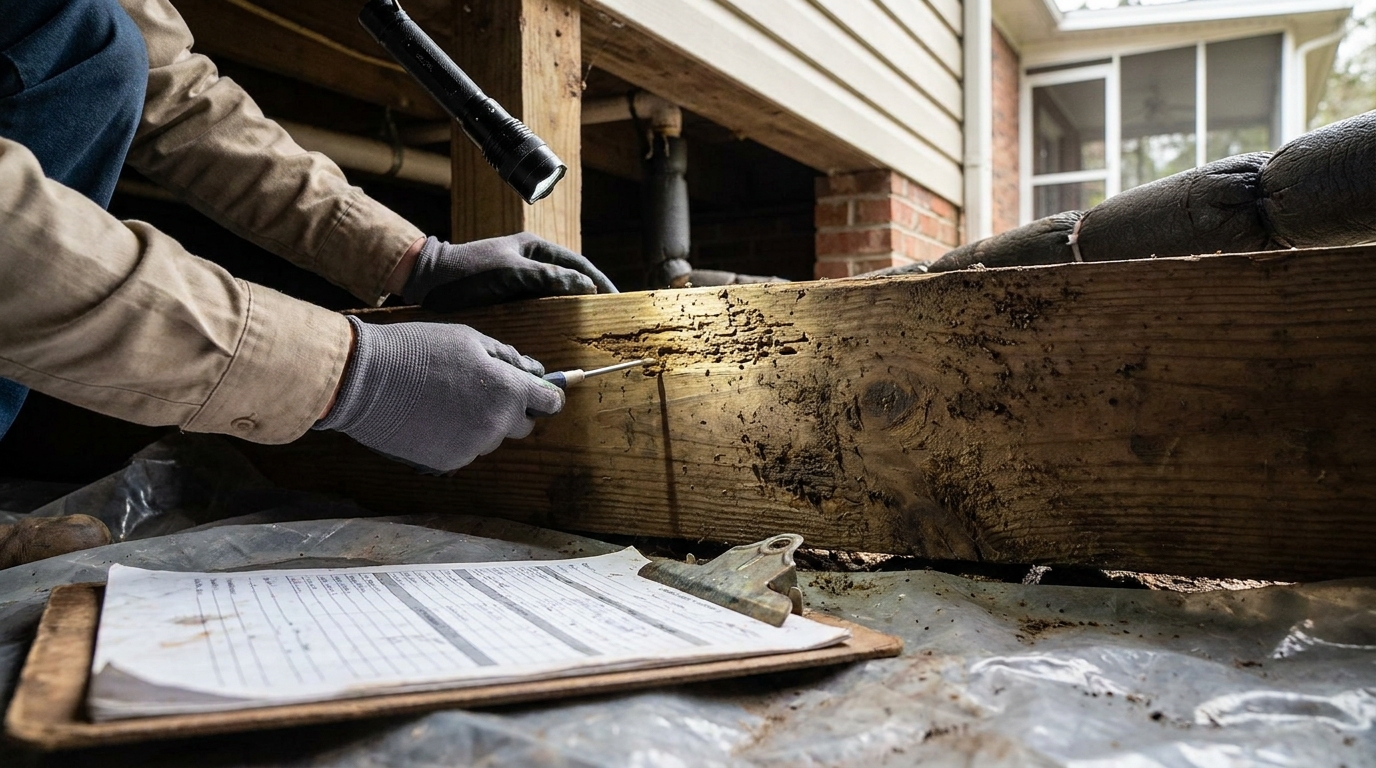
Sill plates and door frames. Tap along the bottom framing with a screwdriver handle. Listen for hollow spots, and probe anywhere the wood gives. Check the bottom eight inches of exterior door jambs and garage door frames.
-
Moisture against the structure. Mulch piled against the slab, sprinkler heads spraying the foundation, downspouts dumping at the wall, and AC condensate lines draining next to the footing. These are the conditions that invite colonies in.
-
Trees near the house. Both invasive species attack living and ornamental trees, not just structures. A dying oak or palm within 50 feet of the house is worth a look, since a tree colony is often the source of what later shows up indoors.
What an inspection costs, and what "free" is buying them
Nationally, Angi's 2026 data puts termite inspections at roughly $0 to $277, averaging near $130. In Florida, a wood-destroying organisms (WDO) inspection, performed by an inspector licensed through the Florida Department of Agriculture and Consumer Services, typically runs about $75 to $150. A WDO report is required for VA loans.
Plenty of national and regional companies, Terminix and Orkin among them, inspect for free. That is not charity, it is a sales channel. The free inspection buys the company a technician in your crawl space and a warm lead. That can be perfectly fine, and it is still worth doing, but go in with two rules:
-
Get a written report either way, with photos and specific locations, not just a verbal "you've got termites" and a quote.
-
Pay for an independent inspection before a big-ticket diagnosis. Spending $125 for an opinion from someone who is not selling the treatment is cheap insurance against a $2,500 recommendation you did not need.
Treatment economics: liquid barrier vs. bait system
For a typical 1,800 to 2,200 square foot home, here are the figures in circulation for 2026. These come from commercial cost aggregators rather than government or academic sources, so treat them as industry estimates and get local quotes.
-
Liquid soil barrier (products such as Termidor SC): roughly $700 to $2,500. Creates a treated zone around and under the structure immediately, and kills termites on contact as they cross it.
-
Bait station system (systems such as Sentricon): roughly $1,800 to $3,500 installed, plus about $200 to $500 per year for monitoring. Works by eliminating the colony over a period of months. There is no immediate barrier while that happens.
The honest trade-off: liquid gives you protection today but does not necessarily wipe out the colony. Bait eliminates the colony but asks you to wait. FDACS lists both soil chemical barriers and bait systems as legitimate control approaches. Homes with complex foundations, additions, or hard-to-drill slabs often push toward bait for practical reasons. Ask which one the company is recommending and, more importantly, why.
Read the termite bond before you sign it
This is the single most consequential paragraph in this article. A termite bond is an ongoing agreement with the pest control company, and there are two very different kinds.
-
Retreat-only bond: roughly $150 to $250 per year. If termites come back, the company treats again at no charge. Repairs to your house are yours to pay for.
-
Retreat-and-repair bond: roughly $200 to $350 per year. Covers retreatment and some amount of damage repair, subject to a stated dollar cap.
The gap between those two is often under $100 a year. The gap in what they cover can be tens of thousands of dollars. Before signing, get answers in writing to four questions:
-
Does this bond include repair, and what is the dollar cap?
-
What exactly triggers a claim, live termites found, visible damage, or a formal inspection finding?
-
What are my obligations, and does missing the annual inspection void coverage?
-
Are pre-existing or previously noted damage areas excluded?
A bond is worth taking seriously because it is realistically your only financial backstop. Here is why.
The insurance wall
Standard HO-3 and HO-5 homeowners policies exclude damage from insects and vermin. Insurers classify termite damage as preventable maintenance rather than a sudden accidental loss, and carriers describe the reasoning the same way. There is no rider you can buy to add termite coverage. It is not a deductible question or a negotiation. It is simply not covered.
One narrow exception: a covered peril that results from termite damage may still be paid. If termites chew through wiring insulation and that causes a fire, the fire damage is generally a covered loss. The chewed wood that started it is not.
For scale on what you would be paying out of pocket, the repair figures circulating for 2026 run roughly $3,000 to $8,000 for typical structural repair, around $500 for cosmetic baseboard work, and $25,000 to $35,000 or more when load-bearing framing is involved. Again, these are aggregator estimates rather than official data, but they explain why FDACS describes Formosan damage in terms of tens of thousands of dollars.
Regional notes
Northeast Florida (Jacksonville, Duval, Clay, St. Johns): Formosan and native subterranean territory. Not Asian subterranean territory, and not hybrid territory. Watch April through July at dusk. If someone tells you your Jacksonville house has hybrid termites, ask for the molecular confirmation.
South Florida and the Gulf Coast: both invasive species are present, with the confirmed hybrid zone in Broward County. This is where the long February-to-July swarm window applies in full, and where the 2040 risk projection lands hardest.
Central Florida (Tampa, Orlando, Melbourne): the current front line of Asian subterranean termite expansion. Tampa's first confirmation came in 2023.
Outside Florida: FDACS lists Formosan termites in 13 states, including Alabama, Georgia, Louisiana, Mississippi, the Carolinas, Tennessee, Virginia, Texas, Arizona, California, and Hawaii. The spread is human-mediated, moving in wood packing material, mulch, railroad ties, and used mobile homes hauled up from Gulf Coast states. A nationwide Formosan survey launched in 2025, with 32 trap kits distributed in Tennessee at marinas and railroad-tie storage sites, and a Norfolk, Virginia sample was confirmed in June. As Chouvenc told UF/IFAS, "This may be a Florida story now, but it likely won't stay just in Florida. Give it time."
What to do this week
-
Walk the four inspection spots: foundation mud tubes, sill plates and door frames, moisture against the slab, and declining trees near the house.
-
Pull mulch back six inches from the foundation and redirect any sprinkler head hitting the wall. It is free and it removes the conditions colonies want.
-
If you find swarmers or shed wings, bag a sample in a small container with rubbing alcohol and email the free UF Termite ID Service. Do not accept a "hybrid" diagnosis without it.
-
If you get a treatment recommendation over $1,000, pay for one independent inspection first.
-
Before signing any bond, find the repair clause and the dollar cap. Read that paragraph twice.
The termites are not new and they are not supernatural. They are spreading, they are already here, and the only real protection is a homeowner who knows what a mud tube looks like and what page 3 of the contract says.
Related reading
-
[The Crew That Didn't Show Up: 349,000 Missing Workers and Why Your Start Date Keeps Sliding](/guides/construction-labor-shortage-contractor-delays-what-homeowners-should-know)
Sources
-
Chouvenc et al., "Ongoing human-mediated spread and hybridization of two major invasive termite species," Proceedings of the Royal Society B 292(2047):20250413, May 2025
-
UF/IFAS Extension, ENY-2137: "Hybrid Coptotermes Termites: Separating Fact from Fiction"
-
Chouvenc, "Ongoing monitoring of the spread of 2 invasive subterranean termite species (Coptotermes Wasmann) in Florida (1990 to 2025)," Journal of Economic Entomology 119(2):1268-1275, January 24, 2026
-
UF/IFAS News, "UF/IFAS scientists confirm hybrid termites established in Florida," May 21, 2025
-
UF/IFAS News, "New study shows invasive termites threatening homes in Florida are spreading farther than predicted," February 4, 2026
-
News4JAX, "Here's when these invasive termites may put all of Florida at risk, experts warn," May 4, 2026
-
News4JAX, "All of Florida is at risk thanks to 2 invasive termite species that have now formed a hybrid," February 9, 2026
-
UF/IFAS Featured Creatures, EENY-128: "Asian Subterranean Termite, Coptotermes gestroi"
-
Florida Department of Agriculture and Consumer Services, Formosan Termite Program
-
UF/IFAS Extension Duval County, Termites in Florida
-
University of Maryland Extension, "Ants and Termites: How to Tell the Difference"
-
TAYLOR'D Pest Services via EIN Presswire, "Jacksonville Pest Control Company Reports 35% Surge in Termite Calls in 2026," May 31, 2026 (company press release, self-reported data)
-
Angi, "How Much Does a Termite Inspection Cost? [2026 Data]" (commercial marketplace estimate)
-
NerdWallet, "Does Homeowners Insurance Cover Termite Damage?"
-
Progressive, "Does Homeowners Insurance Cover Termite Damage?"
-
TermiteTreatmentPrice.com, ["Subterranean Termite Treatment Cost 2026"](https://termitetreatmentprice.com/subterranean-termite-treatment-cost) (commercial cost aggregator, industry estimate)
-
Pest Management Professional, "Formosan termites expand northward into Virginia"
-
University of Tennessee Extension, "The Nationwide Formosan Subterranean Termite Survey Has Begun," 2025
-
UF/IFAS News, "UF/IFAS termite scientists confirm first spread of Asian Subterranean termites in Tampa," March 23, 2023
All cost figures drawn from commercial sources are industry estimates, not official data. Get local quotes before budgeting.
Note: This article contains AI-assisted content and has been reviewed by our editorial team.
ABOUT THIS SERVICE: CallTheLocal.com is a directory and lead generation service, not a contractor or service provider. Submitting this form does not obligate you to hire anyone or purchase any service. Your information will be shared with licensed, insured home service professionals in your area who may provide quotes for your project. CallTheLocal.com does not guarantee the quality, timeliness, or outcome of any work performed by service providers you connect with through this service. Always verify licensing, insurance, and references before hiring. Get everything in writing before work begins.