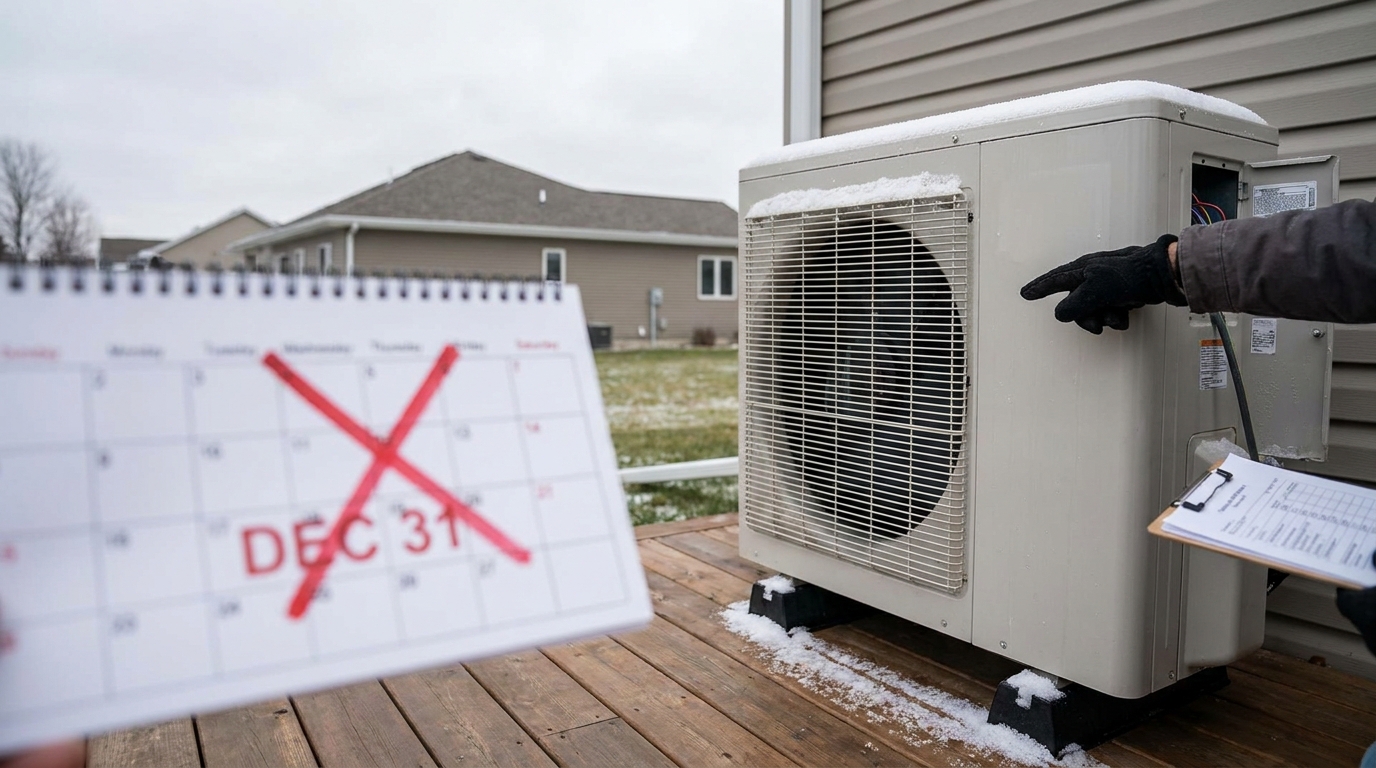
If you have been planning to replace your heating and cooling system this year and mentally banked on that $2,000 federal heat pump credit, here is the hard news up front: for a 2026 install, it is gone. And the timing rule is stricter than most homeowners realize. Putting a deposit down in 2025 does not lock in the credit. What matters is the date your system is installed, running, and ready to use, not the day you signed a contract or wrote a check.
Let us walk through exactly what changed, who can still claim money, and where the real savings live now that Washington has stepped back.
What ended, and the exact date it ended
The One Big Beautiful Bill Act (Public Law 119-21), signed July 4, 2025, moved up the expiration of the residential energy tax credits. The Section 25C Energy Efficient Home Improvement Credit ends for any property placed in service after December 31, 2025. The Inflation Reduction Act had originally kept this credit alive through 2032. That runway got cut short by six years.
Here is what homeowners are losing. For qualifying installs in 2023 through 2025, Section 25C covered 30 percent of the cost with these annual caps:
-
Up to $2,000 per year for a heat pump, heat pump water heater, or biomass stove or boiler.
-
A separate $1,200 per year for other improvements like insulation, windows, doors, and home energy audits.
-
A combined maximum of $3,200 per year.
Heat pumps also had to meet or exceed the Consortium for Energy Efficiency (CEE) highest efficiency tier for the year they were installed. For 2026 installs, none of that applies anymore. There is effectively no federal HVAC efficiency credit waiting for you.
The most important word in the whole rule: "placed in service"
This is where people get tripped up, so read this part twice. According to the IRS, "placed in service" means the date the equipment is installed, operational, and ready to use. It is not the purchase date. It is not the deposit date. It is not the contract date.
What that means in plain terms: if you put money down in late 2025 but the crew does not finish and fire up your new heat pump until January 2026, you get zero federal 25C credit. A 2025 deposit on a 2026 install earns you nothing from this program. The calendar, not your checkbook, decides eligibility.
The geothermal trap: clearing up the "30 percent through 2032" confusion
You may have seen claims floating around that geothermal still gets a 30 percent credit through 2032. If you are a homeowner, that number is not for you, and acting on it could cost you real money.
The residential geothermal credit lived under Section 25D. OBBBA terminated it too, for expenditures made after December 31, 2025. In the IRS's own words, "The credit will not be allowed for any expenditures made after December 31, 2025." For Section 25D, an expenditure is treated as made when the original installation is completed. So a home geothermal system finished after that date gets no 25D credit, same story as a heat pump.
So where does "30 percent through 2032" come from? It applies to the commercial Section 48 Investment Tax Credit, which covers business-owned and commercial geothermal projects, not a homeowner installing a residential system. That commercial credit reaches 30 percent when prevailing-wage and apprenticeship requirements are met (or for projects under 1 megawatt), then phases down to 5.2 percent in 2033, 4.4 percent in 2034, and zero after December 31, 2034. OBBBA also removed the 5-year accelerated depreciation that commercial geothermal systems used to get. None of this reaches a typical household's install. If a salesperson quotes you 30 percent on a residential geothermal system for 2026, that is a red flag worth questioning in writing.
Who can still claim it: the 2025 install exception
If your qualifying heat pump or geothermal system was placed in service on or before December 31, 2025, you are still in luck. You can claim it on your 2025 tax return, filed in spring 2026, using IRS Form 5695.
-
The heat pump credit (25C) goes in Part II of Form 5695.
-
Residential geothermal (25D) goes in Part I.
-
Keep your documentation: invoices showing the install date, equipment model and efficiency ratings, and proof the system was operational in 2025.
One helpful wrinkle: if your 25D geothermal credit from a 2025 install is larger than your tax bill, the unused amount can be carried forward to future years. The 25C heat pump credit does not carry forward the same way, so plan around your 2025 liability if that is the credit you are claiming.
The real 2026 savings: state programs, utility rebates, and DOE rebates
Here is the good news. The federal automatic credit is gone, but there is still money on the table. It just comes from state energy offices, your utility, and DOE-funded Home Energy Rebates rather than the IRS. These can stack, and the range is wide, roughly $500 on the low end to well over $10,000 for the right household in the right state.
The headline program is DOE's Home Energy Rebates, which includes HEEHRA (the electrification rebates) and HOMES (the whole-home efficiency track). For income-qualified households:
-
Households under 80 percent of area median income (AMI) can get up to $8,000 for a heat pump, and up to $14,000 for a whole electrification package.
-
Households between 80 and 150 percent AMI can get 50 percent of costs covered up to program limits.
The big caveat: these programs are state-administered and are not available everywhere, and some are running out of money. California's HEEHRA single-family retrofit funds, for example, were fully reserved and waitlisted as of February 24, 2026. That is exactly why you need to check your own state's program status before you buy, not after. A rebate that existed last quarter may be paused or exhausted today.
Two 2026 rules that can make or break a rebate
Even where rebate money is still flowing, the equipment and installer have to qualify. For HEEHRA-eligible projects in 2026:
-
The equipment must be ENERGY STAR certified.
-
Beginning January 1, 2026, it must use refrigerants with a global warming potential (GWP) of 700 or less, per EPA's Technology Transition Rule.
-
Rebates often require a certified or trained contractor. Hiring the wrong installer can disqualify an otherwise eligible project.
Confirm all three before you sign. Ask the contractor to put the model number, refrigerant type, and their program certification in writing.
Your practical playbook for spring and summer replacement season
Replacement season is when most of these systems get installed, so here is how to protect yourself:
-
Check your state and utility program status first. Before you commit to equipment, find out whether your local rebate is open, waitlisted, or exhausted. Budgets run dry mid-year.
-
Do not count on a federal credit for a 2026 install. The 25C and residential 25D credits are gone for anything placed in service after December 31, 2025.
-
If you are claiming a 2025 install, gather your paperwork now and file with Form 5695 in spring 2026.
-
Verify ENERGY STAR certification and the GWP 700-or-less refrigerant requirement on any equipment tied to a rebate.
-
Use a program-certified contractor if your rebate requires one, and get every promise in writing.
-
Be skeptical of a residential 30 percent geothermal pitch. That figure belongs to commercial projects, not homeowners, for 2026.
The bottom line
There is no more automatic federal HVAC credit for 2026 installs. The $2,000 heat pump credit and the 30 percent residential geothermal credit both ended December 31, 2025, and a 2025 deposit does not rescue a 2026 installation. Your savings now depend on where you live and how fast you move, because state and utility rebate budgets are limited and some are already waitlisted. If a heat pump replacement is in your near future, treat the rebate check the same way you would treat a good contractor's schedule: the sooner you confirm it, the better your odds.
Related reading
Sources
-
IRS: FAQs for modification of sections 25C, 25D and others under Public Law 119-21
-
IRS: Instructions for Form 5695 (2025), Residential Energy Credits
-
U.S. Department of Energy: Tax Credits and Incentives for Geothermal Heat Pumps
-
California Energy Commission: IRA Residential Energy Rebate Programs (HEEHRA)
-
Geothermal Insider: The Federal Geothermal Tax Credit, What Changed in 2026
This article contains AI-assisted content and has been reviewed by our editorial team.
ABOUT THIS SERVICE: CallTheLocal.com is a directory and lead generation service, not a contractor or service provider. Submitting this form does not obligate you to hire anyone or purchase any service. Your information will be shared with licensed, insured home service professionals in your area who may provide quotes for your project. CallTheLocal.com does not guarantee the quality, timeliness, or outcome of any work performed by service providers you connect with through this service. Always verify licensing, insurance, and references before hiring. Get everything in writing before work begins.
Related reading
- A Second Wave of HVAC Price Hikes Just Landed July 1: Six Suppliers Added 6 to 10% to Your 2026 AC Job
- Your AC Now Runs on R-454B, and That's Why a 2026 Replacement Costs 10 to 20% More Than Last Year's
- Seven HVAC Brands Are Being Sued for Allegedly Fixing Prices Since 2020: What the Class Action Means for Your 2026 AC Quote
- The GFCI Grace Period on Your Outdoor AC Ends September 1, 2026: Why New Installs Need a Special Breaker and What It Adds to the Bill