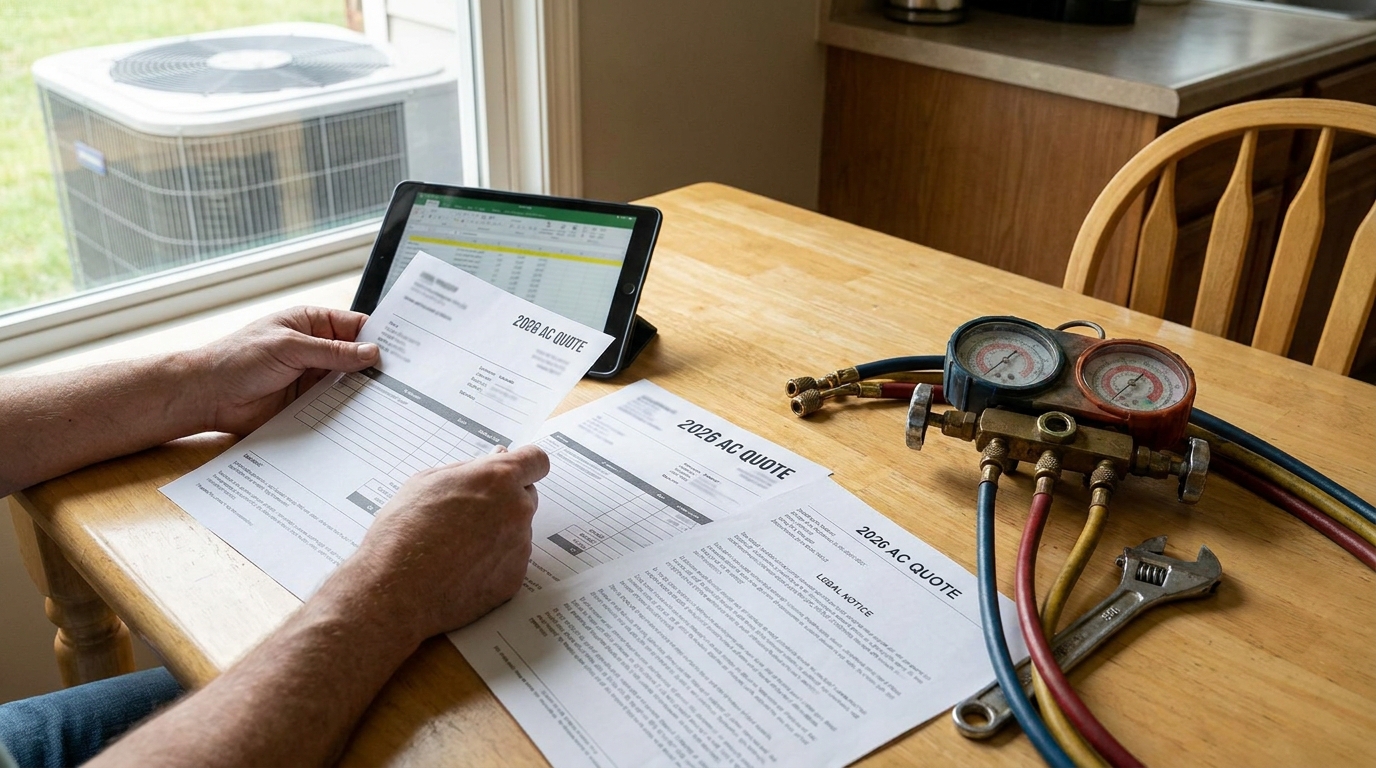
If your 2026 air conditioning quote came in higher than you expected, you are not imagining it. A group of homeowners has taken seven of the biggest names in heating and cooling to federal court, and the case helps explain why replacement prices have climbed so fast over the last few years.
Here is the plain-English version of what is happening, what the lawsuit actually claims, and how to use all of it as leverage the next time a contractor hands you a bid. None of this is legal advice. Think of it as kitchen-table guidance from a neighbor who has been reading the fine print.
Seven brands, one Michigan courtroom
The lead case, Berg v. Robert Bosch, LLC, was filed on March 20, 2026 in the U.S. District Court for the Eastern District of Michigan. By a status conference on May 14, 2026 in front of Judge Susan DeClercq, the count had grown to at least six related suits, organized into roughly three groups of plaintiffs (homeowners on one track, and contractors and distributors on others).
The defendants are a who's-who of the industry: Bosch, Carrier (which includes Bryant, Payne, Heil, Tempstar, and Comfortmaker), Trane (American Standard, Mitsubishi Electric Trane, and Ameristar), Lennox (Allied Air, Armstrong Air, AirEase, and Ducane), Daikin (Goodman and Amana), Rheem (Ruud), and AAON. According to the complaints, those companies together control more than 90% of the U.S. HVAC equipment market. You can see the full brand and sub-brand breakdown in this rundown from Total Repair Pros.
The plaintiffs allege the companies coordinated residential and commercial equipment price increases from January 2020 to the present. That is the heart of the case, summarized on the plaintiff firm's Hagens Berman case page and in this consumer summary from Top Class Actions.
What "price coordination" actually means
This is the part people get wrong, so it is worth slowing down. In a market with only a handful of big players, prices often move in the same direction at the same time. That alone is called parallel pricing, and it is legal. Companies are allowed to watch competitors and respond.
What turns parallel pricing into an antitrust claim is an agreement to do it. The plaintiffs say they have evidence of that agreement, and they point to two mechanisms.
First, they allege the manufacturers shared competitive and pricing data through their trade association, the Air-Conditioning, Heating, and Refrigeration Institute (AHRI), including at in-person events. Second, they claim the companies used the trade publication ACHR News "extensively and nearly exclusively" to announce specific price-increase percentages, the products affected, and the effective dates weeks ahead of time, so rivals could line up and match them. The trade-press reporting from Facilities Dive walks through this alleged signaling in more detail.
The complaints go a step further and claim that when demand softened, the companies coordinated to restrict supply so that lower volumes would not force prices down. Facilities Dive has also confirmed that more than one suit has been filed, and the lead case is tracked by the firm Lockridge Grindal Nauen.
The numbers behind the claim
The plaintiffs put hard figures on the alleged harm. They say HVAC equipment prices rose about 53.5% over the class period, compared with roughly 29.7% for general consumer prices and about 30.8% for major appliances over the same stretch. In other words, the claim is that cooling and heating gear got expensive at nearly double the pace of inflation.
Pair that with the 90%-plus market concentration and you can see why the case has drawn attention. When a small number of companies sell almost everything, even a modest coordinated bump lands on a huge share of homeowners.
To be clear, these are allegations. A court has not ruled on whether any of it is true.
Why your 2026 quote is already higher
Separate from the lawsuit, two price increases for 2026 were announced publicly and are already baked into current bids. Trane Technologies raised prices up to 5% on many residential products effective January 1, 2026, and Lennox raised prices up to 10% effective February 16, 2026. Those hikes are corroborated by Paschal Air, Plumbing & Electric and appear on the ACHR News price-increase list for January 2026, the same channel the lawsuit points to as central to the alleged signaling.
That overlap is worth noting, but it does not prove anything by itself. A company announcing a price increase in a trade publication is ordinary business. The lawsuit's claim is about the pattern and the alleged agreement behind it, not any single announcement.
The legitimate cost driver to separate out: R-454B
Before you assume every dollar of increase is suspect, there is a real, non-controversial reason 2026 equipment costs more. The industry began phasing out the old R-410A refrigerant in 2025 in favor of a lower-GWP refrigerant called R-454B.
The new refrigerant runs roughly $17 to $20 per pound, compared with about $5 to $7 per pound for R-410A. Beyond the refrigerant itself, equipment had to be redesigned to handle it. Together, that transition is estimated to add about 8% to 12% to equipment and installation prices, on top of ordinary inflation in labor, copper, and steel. This homeowner guide from AC Direct explains the switch and why it raises costs.
This matters for your bid because the R-454B redesign is the part of a higher price you should expect to pay. The leverage move is separating that legitimate increase from anything extra.
What a 2026 replacement really costs
For a full-system replacement in 2026, plan on roughly $7,000 to $15,000 installed, with the broader range running anywhere from $5,000 to $30,000 depending on home size, system type, and how much ductwork is involved. The 2026 replacement-cost breakdown from HVAC Load Calculate supports that installed range.
For perspective: a 3-ton, 16-SEER2 job that ran about $7,500 in 2023 commonly bids between $8,800 and $9,400 in 2026. Some of that jump is the refrigerant transition. Some is general inflation. The lawsuit asks whether some of it is something else.
Your kitchen-table leverage checklist
You cannot control a federal antitrust case, but you have real power at the quoting stage. Here is how to use it:
-
Get three quotes. With this much price movement, a single bid tells you almost nothing. Three lets you spot an outlier.
-
Ask for itemized equipment versus labor. A good contractor will break out the cost of the unit, the refrigerant, and the labor. Vague all-in numbers are harder to compare.
-
Ask directly whether the price reflects the R-454B redesign or a markup. This single question signals you have done your homework, and it forces a clear answer.
-
Never sign same-day. Take the bids home and compare line items side by side. A reputable pro expects this.
-
Compare across brands. Because the named companies own most of the market through many sub-brands, two "different" quotes may trace back to the same parent. Knowing the brand families helps you compare apples to apples.
Status and caveats
This is important: there is no verdict. The allegations are unproven, and the manufacturers dispute them. Trane and Rheem have publicly denied wrongdoing. Daikin said it would review the claims. Carrier says it operates lawfully. Bosch declined to comment. A separate case filed in Florida additionally names the distributor Watsco.
If a class is eventually certified, homeowners who bought equipment during the period may be able to participate. You do not need to take any action now. The practical guidance from the coverage is simply to hold onto your paperwork: installation invoices, model and serial records, warranty registrations, and any financing documents that show the brand, model, date, and amount you paid. The Total Repair Pros explainer lays out the same record-keeping advice.
The bottom line
Treat this case as buyer leverage, not as a legal strategy. Whatever the courts decide, the smart play for a 2026 install is the same one that has always worked: get multiple itemized quotes, understand which part of the increase is the real refrigerant transition, ask hard questions about the rest, and keep every receipt. That is how you make an informed decision no matter how the lawsuit turns out.
Related reading
-
[Florida's Roof-Age Insurance Rules in 2026: What's Actually Law (and Why HB 815 Won't Take Effect July 1)](/guides/florida-roof-age-insurance-law-2026-hb-815-explained)
-
The HVAC Tariff Got Cut From 25% to 15% in June, So Why Did Your AC Quote Still Go Up?
Sources
-
Consumer sues manufacturers for conspiring to inflate HVAC prices — Facilities Dive
-
HVAC manufacturers face second suit over price-fixing allegation — Facilities Dive
-
HVAC Equipment Antitrust Litigation | Berg v. Bosch et al. — Lockridge Grindal Nauen
-
7 AC Brands Involved in Federal Lawsuit for Allegedly Price Fixing — Total Repair Pros
-
2026 HVAC Price Increases by Brand — Paschal Air, Plumbing & Electric
-
R-454B Is Here: What Every Homeowner Buying HVAC Equipment in 2026 Needs to Know — AC Direct
-
[HVAC Replacement Cost 2026: How Much Does a New System Cost? — HVAC Load Calculate](https://hvacloadcalculate.com/hvac-replacement-cost-by-brand/)
This article contains AI-assisted content and has been reviewed by our editorial team.
ABOUT THIS SERVICE: CallTheLocal.com is a directory and lead generation service, not a contractor or service provider. Submitting this form does not obligate you to hire anyone or purchase any service. Your information will be shared with licensed, insured home service professionals in your area who may provide quotes for your project. CallTheLocal.com does not guarantee the quality, timeliness, or outcome of any work performed by service providers you connect with through this service. Always verify licensing, insurance, and references before hiring. Get everything in writing before work begins.
Related reading
- The HVAC Tariff Got Cut From 25% to 15% in June, So Why Did Your AC Quote Still Go Up?
- Section 25C Heat Pump Tax Credit Already Closed for 2026 Installs: What Homeowners Filing in 2026 Need to Know
- The June 2026 Heat Dome Is Pushing AC Repair Waits Past Two Weeks: What a $89 Service Call Actually Buys You Right Now