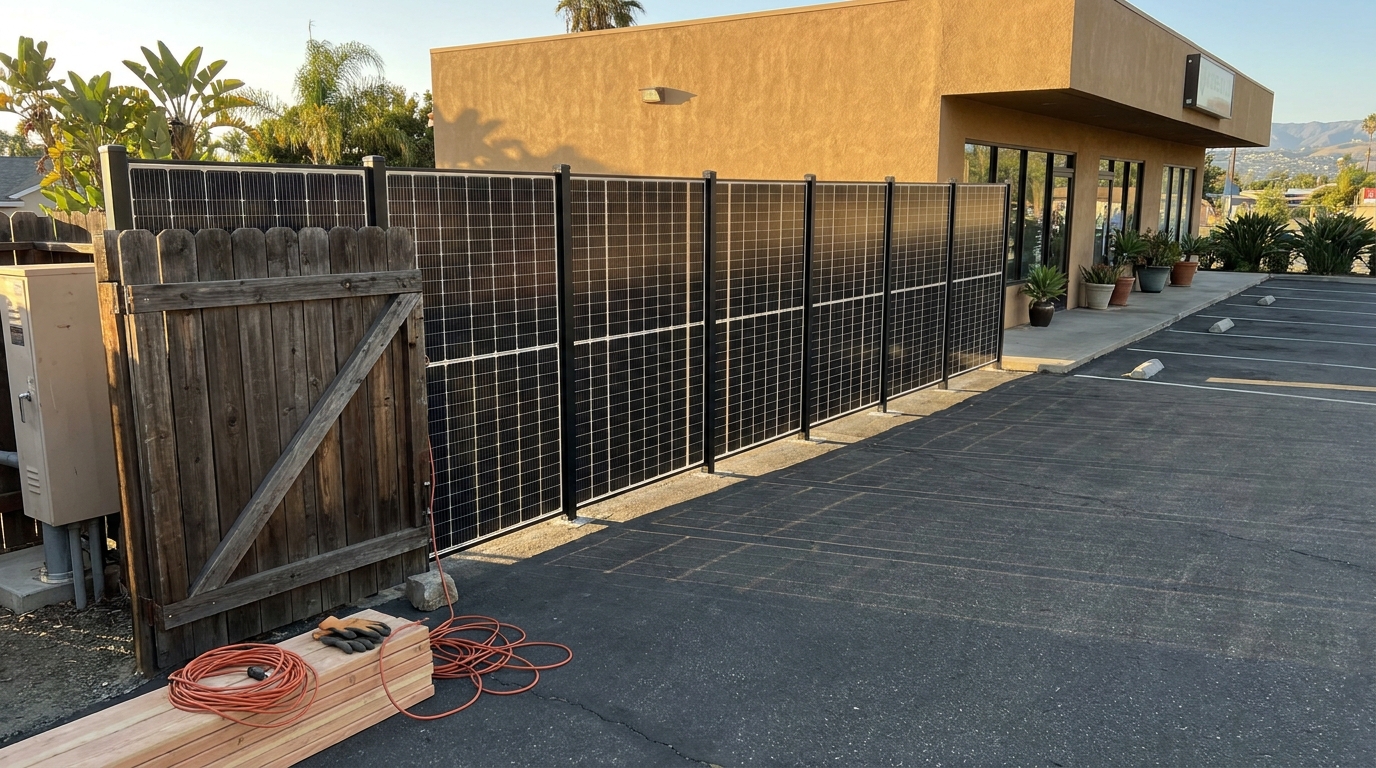
On May 21, 2026, a hot yoga studio in San Rafael, California became the first urban commercial site in the US to wrap itself in a fence made of solar panels. Sunzaun's installation at Bodhi Hot Yoga & Fitness uses 16 bifacial panels standing 8 to 9 feet tall along the back parking lot, projected to save the studio $5,000 to $10,000 a year on electric bills that had climbed past $2,000 a month.
That single project matters because it is the first concrete US data point for a category that has lived mostly in European pilot installations and trade-show booths. For homeowners with shaded roofs, structurally tired roofs, or HOAs that will not let them touch the front-facing roofline, vertical solar fences are quietly becoming a real option in 2026, typically landing somewhere between $6,000 and $15,000 for a residential run.
Here is what the homeowner conversation actually looks like now that the kit is shipping.
What a solar fence actually is
A solar fence is a row of bifacial panels (panels that generate from both sides) mounted vertically on posts, configured as a perimeter structure rather than a roof or a tilted ground-mount array. Sunzaun's fence configuration stands the panels upright, typically 8 to 9 feet tall, oriented east-west so the two faces catch the morning and evening sun. Each panel can generate up to about 430 W under ideal conditions.
This is different from traditional ground-mount solar (panels tilted on racks in a yard) and different from rooftop solar (panels flat on the roof plane). It does two jobs at once: physical perimeter and electricity generation.
One important caveat. The vertical bifacial systems shipping today, including Sunzaun's, were designed primarily for commercial and agricultural sites. Sunzaun's horizontal residential-oriented product is still in R&D, with availability targeted for fall 2026. A homeowner buying today is buying a commercial-grade product configured for residential use, and Sunzaun's trade-press launch coverage confirms the system originally entered the US market aimed at agrivoltaic and commercial buyers.
What you will actually pay
For residential runs of 4 to 16 panels, expect $6,000 to $15,000 installed, with the spread driven by panel count, inverter sizing, trenching distance, and local permitting. Small starter kits from European entrants like Sunbooster begin around 372 W per set and scale to about 1.87 kWp for a four-unit configuration.
For comparison, a conventional 6 kW rooftop system in California runs $16,500 to $19,500 before incentives in 2026, or roughly $2.75 to $3.25 per watt. EnergySage's 2026 California pricing dataset confirms a similar range. In the dense Northeast, that same 6 kW system commonly pushes $25,000 or more.
The pricing trap here is that ground-mounted systems (and a solar fence is a form of ground mount) generally cost about 51% more than equivalent rooftop systems, or roughly $0.10 to $0.50 per watt extra. That premium covers foundations ($1,000 to $2,000), heavier racking ($500 to $1,500), and trenching back to the main panel ($500 to $2,500). If a fence quote shows a rooftop-style per-watt number, ask where those line items live.
The output reality check
You may have heard the line that vertical solar produces only 60 to 75 percent of what a roof would. Newer peer-reviewed and field data tells a more nuanced story. Vertical bifacial systems deliver roughly 1,000 to 1,400 kWh per kWp per year, compared with about 1,300 kWh per kWp per year for an east-west flat-roof system. In other words, comparable in many cases, not always discounted.
The Oxford International Journal of Low-Carbon Technologies analysis of real-world residential vertical bifacial performance and Sandbox Solar's engineering review both find that output depends heavily on three things: albedo (how reflective the ground or snow nearby is), azimuth (which direction the fence faces), and shading. A bright, unshaded east-west fence on a snowy lot can outperform expectations. A shaded north-south fence will not.
One real bonus in cold climates: snow on the ground actually boosts winter output from the back face of bifacial panels by 10 to 25 percent, and the vertical orientation sheds snow rather than collecting it. Trade-press analysis of the category stresses that these are the conditions where vertical configurations punch above their weight.
AI workflows for revenue teams
Placeholder house ad for Conservus.ai. Swap with final creative when brand assets are ready.
Partner with Conservus.aiWhen a fence makes more sense than a roof
There are a few specific scenarios where a solar fence stops being a novelty and starts being the right answer:
-
Heavily shaded roof. If trees or neighboring buildings cut your roof's sun by more than half, a south- or east-facing perimeter run may generate more.
-
Aging or damaged roof. A roof that needs replacement in the next 5 years is a bad candidate for a 25-year solar lease.
-
HOA roofline restrictions. Some HOAs that ban front-facing rooftop solar will approve a back-yard perimeter installation, especially if it stays within the existing fence-height envelope.
-
Small urban lots. The Bodhi Hot Yoga case is the textbook example: no usable roof, limited yard, but plenty of parking-lot perimeter.
-
Dual-use property lines. If you were going to build a privacy fence anyway, the marginal cost of making it generate power changes the math.
Fence versus traditional ground mount
If you have unshaded yard space and you do not need a perimeter wall, a traditional tilted ground-mount array is usually cheaper per watt and produces more annual kWh. The fence wins when you need the structure to do two jobs (boundary plus generation), or when you do not have the footprint for a tilted array.
Permitting and HOA traps
Three permitting issues catch homeowners off guard:
-
Wind and snow load engineering. Outdoor structural arrays in the US are governed by ASCE 7-22. Your installer should provide a stamped engineering letter showing the fence assembly meets local wind and snow loads. If they cannot, walk.
-
Interconnection. Any grid-tied inverter has to be UL 1741 SB certified and IEEE 1547-2018 / 1547.1-2020 compliant for California's Rule 21 and equivalent state interconnection rules. Bundled fence kits sometimes ship with cheaper inverters that do not carry this certification.
-
HOA review. State solar-access laws vary, but HOAs in many states can still block ground-mount installations that exceed your existing fence height or violate aesthetic covenants. Get approval in writing before you sign a contract.
AI workflows for revenue teams
Placeholder house ad for Conservus.ai. Swap with final creative when brand assets are ready.
Partner with Conservus.aiRed flags to screen for in a quote
-
Inverter spec sheet. Ask for the model number and the UL 1741 SB certification. If the salesperson cannot produce it, that is the answer.
-
Stamped wind and snow letter. ASCE 7-22 documentation for your zip code, signed by a licensed engineer.
-
Itemized line items. Racking, panels, inverter, labor, trenching, and permitting should each have their own number. Bundled turnkey pricing hides the ground-mount premium.
-
Written annual kWh estimate. Produced from PVsyst or equivalent modeling software, not a hand-wave. This is what you measure performance against later.
-
Production guarantee. Some installers will warrant a minimum annual output. Many fence installers today will not, because the product is too new. That is acceptable, but know what you are signing.
-
Monitoring. You want per-string or per-panel monitoring so you can spot underproduction quickly.
The 2026 incentive cliff
This is the single biggest change in the 2026 solar conversation. The One Big Beautiful Bill Act, signed July 4, 2025, ended the Section 25D residential solar tax credit on December 31, 2025. If you buy and own a system in 2026, you do not get the 30% federal credit. The IRS Residential Clean Energy Credit page documents the prior credit structure for reference.
There is one workaround. Leased systems and PPAs (third-party-owned) still qualify under Section 48E through 2027. If your installer offers a lease or PPA, the 30% effectively flows through into your pricing. If you are buying outright in 2026, run your math without the credit.
State and utility rebates and net metering now become the swing variable. California homeowners on NEM 3.0 see export credits at a much lower rate than the old NEM 2.0 customers, which makes self-consumption (and battery storage) more important than ever.
Regional notes
-
Northeast. Snow albedo gives bifacial fences a real winter boost, and rooftop quotes in this region commonly land at $25,000 or more for a 6 kW system, which narrows the fence-versus-roof gap.
-
West Coast. California's NEM 3.0 hurts export economics across the board, so the fence's value depends more on how much you self-consume during daylight hours. Labor is also expensive.
-
Southwest. Lower ground albedo and minimal seasonal snow mean less of the bifacial bonus that benefits vertical installations elsewhere. A traditional ground-mount or rooftop array usually still wins here.
AI workflows for revenue teams
Placeholder house ad for Conservus.ai. Swap with final creative when brand assets are ready.
Partner with Conservus.aiThe buyer checklist
Before you sign, get all of this in writing:
-
UL 1741 SB inverter spec sheet with model number.
-
ASCE 7-22 wind and snow load letter, signed by a licensed engineer, for your address.
-
Line-item quote separating racking, panels, inverter, labor, trenching, and permits.
-
Annual kWh estimate generated from PVsyst or equivalent software.
-
HOA approval, if applicable, in writing.
-
Workmanship warranty (typically 10 years) and panel and inverter manufacturer warranties (typically 25 and 12 years respectively).
-
A clear statement of whether the 2026 quote assumes any federal tax credit. If you are buying (not leasing), it should not.
The bottom line
Solar fences are no longer a European curiosity. The May 2026 Bodhi Hot Yoga install put a real US case study on the board, and 2026 is shaping up as the year vertical PV broke into the US market. For homeowners with no usable roof, the math can work between $6,000 and $15,000 installed, but the economics are tighter now that the federal credit has expired for owned systems. Treat any quote like a commercial solar contract, not a hardware-store accessory, and demand the same documentation a rooftop installer would provide.
Related reading
AI workflows for revenue teams
Placeholder house ad for Conservus.ai. Swap with final creative when brand assets are ready.
Partner with Conservus.aiSources
-
IndexBox: Vertical Bifacial Solar Installation at Urban Yoga Studio in San Rafael, California
-
Solar Power World: Vertically mounted solar system Sunzaun hits market
-
Solar Builder: Solar fences, great idea or another Solar Freakin' Roadway?
-
Sandbox Solar: Analyzing Current and Future Vertical Bifacial Solar Fences
-
StartupSelfie: Vertical bifacial solar strips turn fences into power generators
-
Nuance Energy: Ground-Mount Solar Installation Cost Per Watt Explained
-
[Enphase: The Federal Solar Tax Credit is changing](https://enphase.com/blog/homeowners/solar-tax-credit-updates-obbb)
-
Aforenergy: UL 1741 SB Certified Inverters, Rule 21 and IEEE 1547.1-2020
-
ExpertCE: Designing for Wind and Snow Loads on Rooftop Solar Arrays
Note: This article contains AI-assisted content and has been reviewed by our editorial team.
ABOUT THIS SERVICE: CallTheLocal.com is a directory and lead generation service, not a contractor or service provider. Submitting this form does not obligate you to hire anyone or purchase any service. Your information will be shared with licensed, insured home service professionals in your area who may provide quotes for your project. CallTheLocal.com does not guarantee the quality, timeliness, or outcome of any work performed by service providers you connect with through this service. Always verify licensing, insurance, and references before hiring. Get everything in writing before work begins.