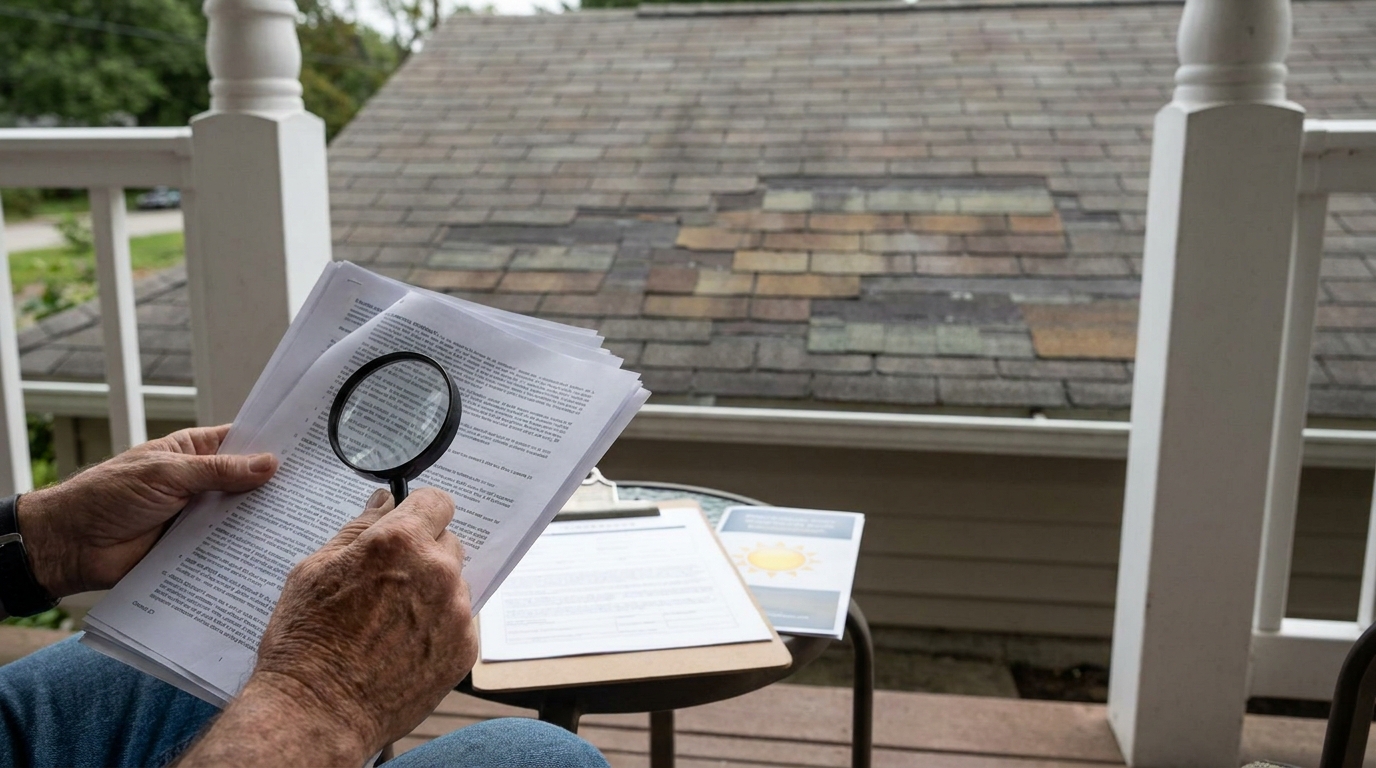
A friendly crew shows up at your door. They say a new government program will pay for solar panels, and while they are at it, you can get a free roof replacement too. No cost to you. Just sign here to check if you qualify. It sounds like found money, especially if your roof is tired and your electric bill keeps climbing.
Here is the hard truth a neighbor would tell you across the fence: that pitch is one of the fastest-growing consumer complaints in the country right now, and the paperwork you are asked to sign is often not an application at all. It is a loan for tens of thousands of dollars.
On March 17, 2026, New York Attorney General Letitia James sued home solar installer Attyx (formerly SUNco), its two CEOs, and lending partners Solar Mosaic and WebBank over exactly this kind of scheme. The Attorney General alleges the operation generated nearly $275 million in New York alone, much of it from low-income homeowners and seniors on fixed incomes. This article walks you through what happened, how solar financing actually works, and how to protect yourself before a pen ever touches paper.
What New York says actually happened
According to the Attorney General's office, Attyx salespeople told homeowners that government incentives and tax credits would cover the cost of roof replacements and solar systems, so the work would effectively be free. In reality, the office alleges, customers signed sales contracts and loans worth tens to hundreds of thousands of dollars, often believing they were only filling out an application or agreeing to a credit check.
The Attorney General makes two points that matter for every homeowner, not just New Yorkers. First, there were no government programs handing out free roofs, and many customers did not qualify for the tax-credit amounts the salespeople promised. Second, the lawsuit alleges the lenders concealed fees inside the inflated price of the solar system, which understated the loan's true APR and total cost while overstating the amount actually financed. That is the kind of thing federal truth-in-lending rules exist to prevent.
The case also shows how persistent these operations can be. The Attorney General alleges that after New York's Public Service Commission ordered Attyx to stop operating in 2025, the company kept going under the alias LGCY Power. The state is seeking voided contracts, restitution for customers, an injunction, and civil penalties. Solar trade outlet pv magazine and investigative outlet New York Focus have both reported on the suit and the sales tactics involved.
This is not an isolated story. Secondary reporting indicates the FTC logged more than 7,000 solar-fraud complaints in 2025, among the fastest-growing consumer-fraud categories. (That specific figure traces to trade and secondary sources rather than a verified FTC primary dataset, so treat it as an indicator of scale rather than an exact count.) The pattern was common enough that the FTC, CFPB, and Treasury Department launched a joint consumer-awareness effort warning homeowners about deceptive solar sales.
How solar financing really works
Most of the confusion in these deals comes from one thing: homeowners do not realize there are very different ways to pay for solar, and each one changes who owns the system, who gets the tax credit, and what you actually owe. Here are the three you will run into.
-
Cash purchase. You buy the system outright. You own it, you are responsible for it, and if you owe federal income taxes you may be able to claim the residential clean-energy tax credit yourself. No monthly financing payment.
-
Secured loan. You borrow to buy the system and pay it back over years, with interest. You own the panels, but the loan often comes with a lien tied to your home or the equipment. You are the one who claims any tax credit, and you are the one on the hook for the full amount financed.
-
Lease or power purchase agreement (PPA). A third party owns the panels on your roof. With a lease you pay a fixed monthly amount to use them; with a PPA you pay for the power they produce. Because you do not own the system, the company, not you, generally claims the tax credit. Many of these agreements include an escalator that raises your payment every year.
None of these are inherently a scam. The trouble starts when a salesperson blurs the lines, calls a 25-year loan a free upgrade, or never tells you there is an escalator quietly increasing your bill year after year.
The fee and incentive trap
Two ideas get twisted in bad solar deals, and understanding them protects you better than almost anything else.
Dealer fees baked into the price. Low-interest or no-interest solar loans are frequently not free to you. The lender's fee can be folded into the quoted price of the system, so the sticker looks higher than a cash deal for the same hardware. The New York case centers on exactly this: the Attorney General alleges fees were hidden inside an inflated system price, which made the financing look cheaper than it was. Always ask what the cash price would be versus the financed price. A large gap is the dealer fee.
The tax credit is not free money. The federal residential clean-energy tax credit reduces what you owe in federal income tax. If you do not owe enough tax, you cannot use the full credit, and it is not a rebate or a check in the mail. Salespeople in abusive deals routinely promise a specific dollar amount back as if it were guaranteed cash. The New York Attorney General alleges many Attyx customers simply did not qualify for the amounts they were told. If anyone guarantees you a tax-credit windfall without asking a single question about your tax situation, that is your cue to slow down.
The FTC has published plain-language guidance on these exact tactics, including how solar scams work and how to avoid getting burned before you sign.
Red flags at the door
Door-to-door is where a lot of this starts, and seniors are a particular target. A 2025 AARP analysis cited in coverage of these cases found homeowners 65 and older were more than twice as likely as younger homeowners to be approached by door-to-door solar sales teams. Watch for these warning signs:
-
Urgency and today-only pricing. Real solar economics do not expire at midnight. Pressure to sign now is a tactic, not a deadline.
-
"It's just an application." If the form commits you to a purchase, a loan, or a long-term agreement, it is a contract. Ask directly: is this a binding agreement or not?
-
Vague government program claims. Ask for the exact name of the program and where to verify it. Genuine incentives can be looked up. Invented ones cannot.
-
E-signing on the salesperson's tablet. Signing on someone else's device, fast, without time to read, is how people end up bound to terms they never saw.
-
Reluctance to leave paperwork. A legitimate company will gladly leave you a full copy of every document to review on your own time. Hesitation here is a serious red flag.
Questions that expose a bad deal
You do not need to be an expert to protect yourself. You just need to ask a handful of direct questions and write down the answers. If a salesperson dodges any of these, walk away.
-
Is this a loan, a lease, or a PPA?
-
What is the total amount financed, and what is the APR?
-
What dealer or origination fee is included in the price, and what would the cash price be?
-
Is there an escalator, and how much will my payment rise each year?
-
Will a lien, such as a UCC-1 or fixture filing, be placed on my home or the equipment?
-
What is covered by the workmanship warranty versus the equipment warranty, and how long does each last?
That last question is more important than most homeowners realize, and the next section explains why.
The orphaned-warranty risk: a real-world case study
Even an honest installer can leave you stranded if the business fails. On April 15, 2026, Freedom Forever, the top residential contractor on the 2025 Top Solar Contractors list by kilowatts installed, filed for Chapter 11 bankruptcy in Delaware. The company listed estimated assets of $100 million to $500 million and liabilities of $500 million to $1 billion, as confirmed by Solar Power World. For its customers, the filing put workmanship warranties and ongoing service at real risk.
Here is the distinction that matters when an installer goes under:
-
Equipment warranties come from the manufacturer who built the panels and inverters, typically lasting 10 to 25 years. These usually survive your installer's bankruptcy because they are the manufacturer's obligation, not the installer's.
-
Workmanship and service warranties are tied to the installer. If that company disappears, the promise to fix a leaky roof penetration or a bad wiring job can disappear with it. These are the warranties most at risk.
If your installer fails, you are not automatically out of luck on the hardware. You may need to contact the equipment manufacturer directly and find a different local company willing to service an orphaned system.
What to do if your installer goes under or you suspect fraud
If you are already in one of these situations, take it step by step:
-
Document everything. Gather your contract, financing documents, warranty paperwork, and any written or recorded sales promises.
-
Contact the equipment manufacturer. Equipment warranties usually survive an installer's failure, so go straight to the source for panel and inverter coverage.
-
Check your loan servicer's obligations. The loan does not vanish if the installer does, but you should understand exactly what you owe and to whom, and flag any discrepancy between what you were promised and what the paperwork says.
-
Report it. File with the FTC at ReportFraud.ftc.gov, contact the CFPB, and notify your state Attorney General. Coordinated reporting is part of what built the New York case. The FTC has signaled it is actively watching deceptive solar sales and financing.
A helpful-neighbor checklist before you sign anything
-
Get multiple written bids from separate companies so you can compare cash price, financed price, and terms.
-
Never sign at the door. Take every document inside and read it on your own schedule.
-
Read the full contract and the financing disclosures, especially the amount financed, the APR, the dealer fee, and any escalator.
-
Verify licensing and reviews, and confirm the company is who they say they are.
-
Get the warranty terms in writing, both workmanship and equipment, before you commit.
Solar can be a smart move for the right home. The difference between a good decision and a costly one almost always comes down to the same boring habit: reading the contract before you sign it. A real opportunity will still be there tomorrow. A pressure pitch usually will not survive a second look, and that is exactly the point.
Related reading
-
[Your AC Now Runs on R-454B, and That's Why a 2026 Replacement Costs 10 to 20% More Than Last Year's](/guides/r-454b-ac-replacement-cost-2026)
Sources
-
pv magazine USA: New York Attorney General files $275 million lawsuit against Attyx
-
New York Focus: New York Sues Solar Company, Says It Cheated New Yorkers
-
E&E News by POLITICO: New York sues solar company over alleged fraud
-
pv magazine USA: Residential solar company Freedom Forever files Chapter 11 bankruptcy
-
Solar Power World: Residential solar installer Freedom Forever files bankruptcy
-
FTC Consumer Advice: Solar energy is rising in popularity. So are the scams
-
FTC Consumer Advice: How to avoid getting burned by solar or clean energy scams
-
FTC Business Guidance Blog: Don't waste your energy on a solar scam
Note: This article contains AI-assisted content and has been reviewed by our editorial team.
ABOUT THIS SERVICE: CallTheLocal.com is a directory and lead generation service, not a contractor or service provider. Submitting this form does not obligate you to hire anyone or purchase any service. Your information will be shared with licensed, insured home service professionals in your area who may provide quotes for your project. CallTheLocal.com does not guarantee the quality, timeliness, or outcome of any work performed by service providers you connect with through this service. Always verify licensing, insurance, and references before hiring. Get everything in writing before work begins.