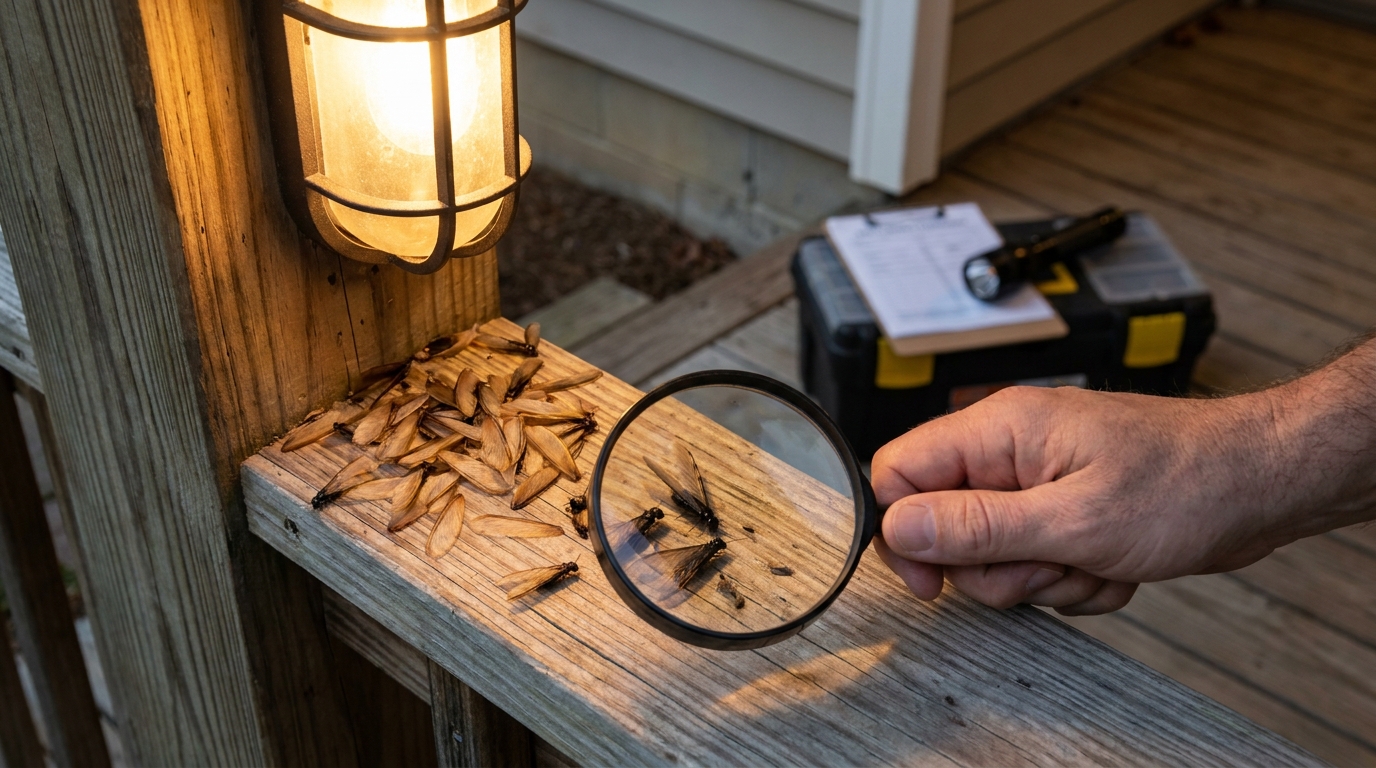
If you spotted a cloud of winged insects around your porch light earlier than usual this year, you were not imagining things. In 2026, termite swarm season showed up early in several warm-winter regions, and pest professionals in coastal Southern California reported swarms starting in late February, roughly two to three weeks ahead of typical timelines (AG Pest). For homeowners, an early swarm is not just a nuisance. It is the most visible sign of a pest that quietly causes billions of dollars in damage every year, and one that standard insurance will not pay to fix.
Here is the practical breakdown: what swarm season actually is, why it shifted earlier, the spreading 'super termite' story making headlines, and most importantly, what it costs you and how to catch a problem before it becomes a five-figure repair bill.
What 'swarm season' actually is
The clouds of insects people notice in spring are not the termites doing the damage. They are reproductive termites called alates, or swarmers. When a colony matures, it releases winged males and females to fly off, pair up, shed their wings, and start new colonies nearby. Subterranean termites typically swarm in spring as temperature and humidity rise, which is why these flights are seasonal and often tied to warm, damp weather (Terminix).
So a swarm near your home is a warning sign worth taking seriously. It usually means a mature colony is established somewhere close by, and it may already be feeding on wood in or around a structure.
Why the timing shifted earlier in 2026
The early 2026 swarms in coastal Southern California were attributed to a specific weather pattern: winter moisture followed by early warm temperatures, a combination that nudges colonies to release swarmers ahead of schedule (AG Pest). More broadly, warmer and wetter winters plus early spring moisture extend the windows during which termites stay active.
It is worth being precise here. The clearest early-onset reporting this year is regional, not a single national figure. But the underlying mechanism, longer warm and moist periods lengthening termite activity, applies broadly, and it is part of why this story is getting attention beyond the usual hot spots.
Meet the 'super termites'
Most structural termite damage in the United States comes from subterranean termites, which account for roughly 90 percent of it (Orkin). Within that group, one species earns extra concern: the Formosan subterranean termite, widely nicknamed the 'super termite.'
It earned the nickname for good reason. Formosan colonies are very large and consume wood rapidly compared to many native subterranean termites. The species likely entered the country through the Port of New Orleans around the mid-20th century, and it is now established across the Gulf and Southeast and parts of the West, including Louisiana, Florida, Georgia, Alabama, Mississippi, Tennessee, Texas, Hawaii, and California (background reference). The takeaway for a homeowner is simple: a large, fast-feeding colony can do meaningful damage faster than you might expect.
AI workflows for revenue teams
Placeholder house ad for Conservus.ai. Swap with final creative when brand assets are ready.
Partner with Conservus.aiThe hybrid escalation in South Florida
The newer development that has entomologists paying close attention is interbreeding. In South Florida, the Formosan subterranean termite and the Asian subterranean termite have begun crossbreeding in the wild. A wild hybrid colony was confirmed in Fort Lauderdale in October 2024, with the findings published in Proceedings of the Royal Society B in May 2025 by researchers including Thomas Chouvenc at the University of Florida (Smithsonian Magazine).
Why does this matter? In the lab, hybrid colonies grow larger and faster than colonies of either parent species. And there is a climate angle: Asian termites need tropical conditions, while Formosans tolerate more temperate zones, so a hybrid could inherit broader climate tolerance and potentially spread beyond the subtropics (Smithsonian Magazine).
One important caveat so nobody panics: the confirmed wild hybrid is currently a South Florida phenomenon. The concern about wider spread is a possibility researchers are studying, not a documented nationwide event.
How far is this spreading?
Separate modeling from UF/IFAS, published in February 2026, projects how the two invasive species could spread within Florida. The models suggest the Asian subterranean termite could reach all 24 of Florida's southernmost counties by around 2040, and the Formosan termite could be distributed throughout Florida by around 2050. The modeling also estimates that roughly half of structures in urban South Florida could be at risk of one or both species by around 2040 (University of Florida News, corroborated by Phys.org).
These are projections from models, not certainties, and they are focused on Florida. Coverage in local news has framed Florida as the most termite-infested state with a worsening invasive picture (ClickOrlando/News6). For homeowners outside the Gulf and Southeast, the realistic message is to stay aware rather than alarmed: subterranean termites already exist across much of the warmer United States, and an early swarm in your area is your cue to get an inspection regardless of where you live.
The $5 billion problem and the insurance gap
The financial scale here is what should grab a homeowner's attention. The National Pest Management Association estimates that termites cost roughly $5 billion annually in the United States for control and repair combined, affecting around 600,000 homes per year (Orkin, citing NPMA).
Now the part that surprises people most: standard homeowners insurance almost always excludes termite damage. Insurers classify it as a preventable, gradual maintenance issue, grouped with problems like rot, mold, and neglect, rather than a sudden, accidental loss that policies are designed to cover (Progressive, Nationwide). In plain terms, if termites eat your floor joists, that repair is on you.
AI workflows for revenue teams
Placeholder house ad for Conservus.ai. Swap with final creative when brand assets are ready.
Partner with Conservus.aiWhat it costs homeowners
Repair costs vary widely depending on how far the damage has progressed. Minor issues can run around $3,000, while major structural damage can climb to $50,000 or more. Some sources cite an average in the $8,000 to $25,000 range for untreated infestations that have had time to spread (Orkin).
That spread between $3,000 and $50,000-plus is the entire argument for catching a problem early. The difference between a minor treatment and a major structural repair is mostly time, specifically how long the colony fed before anyone noticed.
Identify the threat: swarmer vs. flying ant
Before you call anyone, it helps to know whether you are looking at termite swarmers or harmless flying ants. The two are easy to confuse but have clear differences (Orkin):
-
Antennae: Termite swarmers have straight, bead-like antennae. Flying ants have bent, elbowed antennae.
-
Waist: Termites have a broad, uniform waist with no pinch. Flying ants have a clearly pinched waist.
-
Wings: Termites have two pairs of equal-length, translucent wings that shed quickly. Flying ants have wings of unequal length.
Beyond the insects themselves, watch for the three classic warning signs of subterranean termites (Orkin):
-
Mud tubes: Pencil-width tubes of dried mud running along foundations or walls, which the termites use to travel.
-
Discarded wings: Small piles of shed wings on windowsills, floors, or near light sources after a swarm.
-
Hollow or sagging wood: Wood that sounds hollow when tapped or appears to sag.
Treatment options compared
If an inspection confirms termites, you generally have two main treatment approaches. Here are realistic 2026 cost and effectiveness ranges (HomeGuide):
Liquid barrier treatment. Roughly $500 to $1,500 upfront, or about $3 to $16 per linear foot of foundation. It is about 95 to 98 percent effective and offers roughly 5 to 8 years of protection, with optional renewals around $100 to $300 per year. The barrier treats the soil around the structure to block and kill termites.
Bait systems. Roughly $800 to $2,000 upfront plus about $300 to $600 per year for monitoring. Bait systems are about 80 to 90 percent effective, and protection lasts as long as the monitoring contract stays active. Stations are placed around the property and checked over time.
The tradeoff is straightforward. A liquid barrier costs less over time but is a more intensive treatment up front. A bait system is lower-impact and continuously monitored but relies on an ongoing contract to keep working. A reputable professional can recommend which fits your home, soil, and termite type.
As for inspections, standalone inspections typically run $75 to $150, and many companies offer free quotes (HomeGuide). A professional inspection generally includes checking the foundation and accessible wood for mud tubes, looking for discarded wings and active swarmers, sounding wood for hollow spots, and identifying the species so treatment can be matched to it.
AI workflows for revenue teams
Placeholder house ad for Conservus.ai. Swap with final creative when brand assets are ready.
Partner with Conservus.aiBottom line
Here is the action box, neighbor to neighbor:
-
An early or unexpected swarm near your home is a signal, not background noise. Treat it as your cue to schedule an inspection.
-
An annual inspection, often $75 to $150 or free as a quote, is cheap insurance against repairs that commonly run $3,000 to $50,000 and that your homeowners policy will not cover.
-
Risk is highest in the Gulf and Southeast, and the invasive hybrid story is currently centered in South Florida, but subterranean termites exist across much of the warmer United States, so regional awareness matters everywhere.
-
If you find mud tubes, piles of shed wings, or hollow-sounding wood, call a licensed pest professional rather than waiting to see if it gets worse. With termites, time is the expensive variable.
The honest framing is this: termites are common, manageable, and very treatable when caught early. The danger is not that they are unstoppable. It is that they work quietly, your insurer will not help, and the bill grows the longer you wait.
Related reading
Sources
-
University of Florida News: New study shows invasive termites threatening homes in Florida are spreading farther than predicted (Feb 2026)
-
Smithsonian Magazine: Two Invasive Termites Are Interbreeding in Florida
-
Phys.org: Invasive termites threatening homes in Florida are spreading farther than predicted
-
ClickOrlando/News6: Florida is now the most termite-infested state in America (Feb 2026)
-
Orkin: Termite Statistics & Damage Costs
-
Progressive: Are termites covered by home insurance?
-
Nationwide: Does homeowners insurance cover termite damage?
-
HomeGuide: How Much Does Termite Treatment Cost? (2026)
-
Orkin: Flying Ants vs. Termites
-
AG Pest: Termite Control Southern California, 2026 Swarm Season Guide
-
Terminix: Termite Season, When Termites Are Most Active
-
Formosan subterranean termite (background reference)
Note: This article contains AI-assisted content and has been reviewed by our editorial team.
ABOUT THIS SERVICE: CallTheLocal.com is a directory and lead generation service, not a contractor or service provider. Submitting this form does not obligate you to hire anyone or purchase any service. Your information will be shared with licensed, insured home service professionals in your area who may provide quotes for your project. CallTheLocal.com does not guarantee the quality, timeliness, or outcome of any work performed by service providers you connect with through this service. Always verify licensing, insurance, and references before hiring. Get everything in writing before work begins.