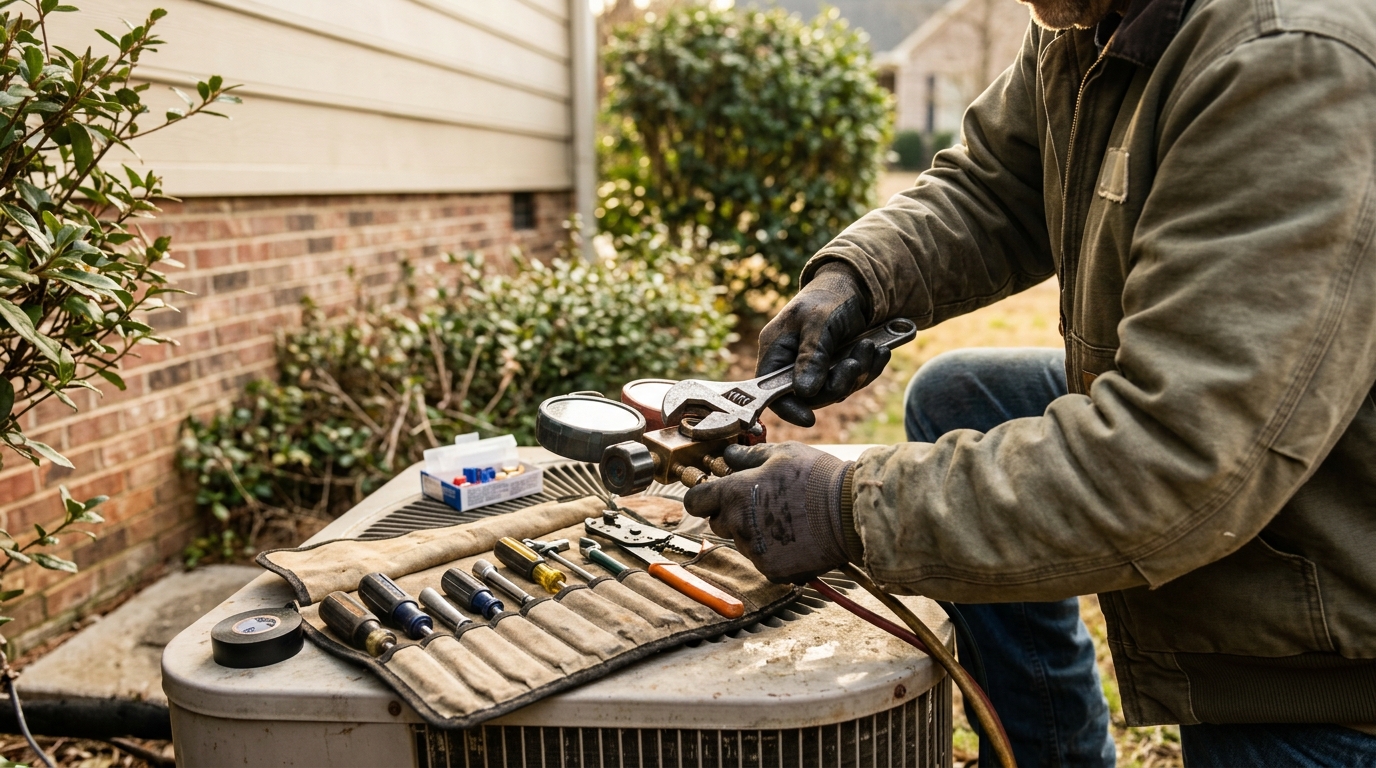
A homeowner in suburban Atlanta waited almost three weeks for one of the big franchise HVAC outfits to send a technician to look at a failing heat pump. On a neighbor's recommendation, she called a two-truck shop run by a former Navy machinist mate. He came out the next morning, quoted the job on the spot, and started work that afternoon. The bid came in noticeably below the franchise estimate she had been chasing.
That pattern is becoming more common in 2026, and it is not an accident. The country is running out of skilled tradespeople, and a quiet pipeline of veterans is moving in to fill the gap. For homeowners, knowing how to find and verify these shops is turning into a real money-and-time advantage.
The trades gap is bigger than most homeowners realize
A 2026 report from real estate services firm JLL warns that the U.S. skilled-trades shortage could drive roughly $1 trillion in annual economic losses, with the construction industry alone short more than 500,000 workers this year. Fortune's coverage of the same report pegs the long-term gap at roughly 2.1 million unfilled trade positions by 2030.
The pipeline problem is demographic. Trade-press reporting on the workforce describes an industry where roughly one in four skilled tradespeople is expected to retire by 2030 and nearly one-fifth of the construction workforce is already over 55, with only about two new entrants for every five retirees.
For a homeowner, the practical translation is simple: longer waits for routine quotes, higher prices, and franchise crews triaging easier jobs first. That is the backdrop for what is happening with veterans.
Why veterans are emerging as the answer
The trade press has spent the past year quietly making the case that military-to-trades is the most underused workforce pipeline in the country. Contractor Magazine profiled the transition in detail, and PHCP Pros highlighted Wounded Warrior Project data showing that roughly one-third of veterans struggle to find full-time work post-service, often taking roles below their skill level.
The fit is technical, not just symbolic. Military occupational specialties in HVAC-R aboard ships, Seabee construction, electronics, and hydraulics map directly onto civilian electrical, plumbing, and HVAC competencies, which is why Military.com has framed the next trades workforce wave as veteran-led.
The pipelines feeding the wave
Several programs are pulling separating service members directly into licensed trade careers:
-
Helmets to Hardhats. Administered with North America's Building Trades Unions, the program places veterans into 3-to-5-year registered union apprenticeships in plumbing/pipefitting, electrical, sheet metal, and related trades at no cost to the veteran, and the apprenticeships stack with the GI Bill.
-
United Association Veterans In Piping (VIP). The UA's accelerated route into plumbing and pipefitting, widely cited in plumbing/HVAC trade coverage as the dominant union-route pipeline for transitioning service members.
-
GI Bill-eligible trade academies. Non-union accelerated programs covering HVAC, plumbing, and electrical that run on shorter timelines than traditional cold-start apprenticeships.
The net effect is that veteran-owned residential shops are showing up in markets where they did not exist five years ago, and they are bidding on the same kitchen-faucet swap and panel upgrade work the big franchises chase.
AI workflows for revenue teams
Placeholder house ad for Conservus.ai. Swap with final creative when brand assets are ready.
Partner with Conservus.aiState licensing is increasingly veteran-friendly
A handful of states have built formal credit for military training into their contractor licensing process. Three concrete examples worth naming:
-
California: The Contractors State License Board has dedicated staff that evaluate transferable military training and experience for applicants.
-
Florida: The Department of Business and Professional Regulation credits up to three years of military service toward certified contractor experience requirements.
-
Virginia: The Department of Professional and Occupational Regulation accepts substantially equivalent military training and experience for honorably discharged veterans.
If you live somewhere else, the U.S. Department of Labor's CareerOneStop maintains a state-by-state licensing lookup for veterans that you can use to check your own state's policy.
What changed in veteran certification (and why a badge on a website isn't enough)
If you have seen a contractor's site display a Service-Disabled Veteran-Owned Small Business (SDVOSB) or VOSB badge, the rules behind that badge changed recently and homeowners should know the difference.
Self-certification is no longer a valid path. The Small Business Administration's direct final rule eliminated SDVOSB self-certification as of December 22, 2024. The only valid certification today is issued through the SBA's VetCert program.
For federal contracting, the verification flow is also locked down. Under FAR Subpart 19.14, contracting officers have been required since January 1, 2024 to verify SDVOSB status through SAM.gov before awarding set-aside work. The SBA's broader overview of the program, including the federal spending goal that now sits at 5%, is published on SBA.gov.
The underlying eligibility rules (ownership, control, and what counts as service-disabled) are codified in 13 CFR Part 128, which is the legal definition behind any legitimate VetCert listing.
How to verify a vet-owned contractor in about ten minutes
You do not need a procurement background to check a contractor properly. Use this short flow:
-
Ask for the legal business name and EIN or DUNS/UEI. A serious shop will hand this over without flinching.
-
Search the SBA VetCert database at veterans.certify.sba.gov. This is the only authoritative database for SDVOSB and VOSB status. If a website displays a VetCert badge but the business is not in the database, that is a red flag, because self-certification has not been allowed since December 22, 2024.
-
Cross-check SAM.gov. If the business does any government-adjacent work, the SDVOSB designation should appear in their SAM record per FAR 19.14.
-
Confirm the state license. Look up the license number on your state's licensing board portal. California, Florida, and Virginia all publish active license lookups.
-
Request a current certificate of insurance. Ask for general liability and, where applicable, workers' compensation, with effective dates that cover your project window.
AI workflows for revenue teams
Placeholder house ad for Conservus.ai. Swap with final creative when brand assets are ready.
Partner with Conservus.aiWhy vet-owned shops sometimes quote lower
Operators in the space describe a few structural reasons their bids land below the big franchise quotes: no royalty or national marketing fee load, smaller paid-search and TV budgets, and owner-operator labor on the truck instead of layered management. We have not found a primary dataset that confirms a specific percentage discount, so treat any "10 to 20 percent under franchise pricing" claim you see online as anecdotal rather than verified. The right way to test it is to get three written bids on the same scope, with one of them from a vet-owned shop.
What to ask on the call
If you want to keep it tight, a productive first call sounds like this:
-
What is your state license number, and can I look it up?
-
Are you VetCert-listed, and under what legal business name?
-
Can you email a current certificate of insurance before we schedule?
-
What is the warranty on parts and on labor, in writing?
-
Who pulls the permit, you or the homeowner, and what is the permit cost?
Vague answers, refusal to provide a license number, or a VetCert badge with no matching record in the SBA database are all reasons to keep shopping.
Where to actually find these crews
Three practical starting points:
-
The SBA VetCert search lets you browse certified vet-owned businesses by NAICS code and location.
-
Local Veterans Business Outreach Centers (VBOCs), which are part of the SBA's veteran contracting assistance program ecosystem, can often point you at vet-owned contractors in your county.
-
If you live in a union-strong market, ask your local building trades council whether they place Helmets to Hardhats alumni with residential signatory contractors.
AI workflows for revenue teams
Placeholder house ad for Conservus.ai. Swap with final creative when brand assets are ready.
Partner with Conservus.aiThe bottom line for homeowners
The trades shortage is real, the wait times are real, and the price pressure on franchise pricing is real. The veteran pipeline is one of the few sources of new licensed labor entering residential trades at scale right now, and the verification tools are public and free. Spending ten minutes on VetCert and your state license portal before you sign anything is the single highest-leverage move a homeowner can make in 2026.
Related reading
Sources
-
JLL: Critical skilled trades shortage threatens $1T in economic losses (2026)
-
Fortune: America's 'silent army' of skilled trades workers is vanishing (Apr 21, 2026)
-
Contractor Magazine: Skilled Trades Easing the Transition from Military to Civilian Life
-
Military.com: The Next Skilled Trades Workforce Revolution Will Be Veteran-Led
-
13 CFR Part 128 (eCFR): Veteran Small Business Certification Program
-
NASBP: SBA Direct Final Rule ending SDVOSB self-certification
-
CareerOneStop (U.S. DOL): Get licensed (state-by-state lookup for veterans)
Note: This article contains AI-assisted content and has been reviewed by our editorial team.
ABOUT THIS SERVICE: CallTheLocal.com is a directory and lead generation service, not a contractor or service provider. Submitting this form does not obligate you to hire anyone or purchase any service. Your information will be shared with licensed, insured home service professionals in your area who may provide quotes for your project. CallTheLocal.com does not guarantee the quality, timeliness, or outcome of any work performed by service providers you connect with through this service. Always verify licensing, insurance, and references before hiring. Get everything in writing before work begins.
AI workflows for revenue teams
Placeholder house ad for Conservus.ai. Swap with final creative when brand assets are ready.
Partner with Conservus.ai