
Short answer: for an attached garage, manufacturers usually recommend a garage door R-value somewhere between R-10 and R-18. Clopay recommends R-12 to R-18 or higher. Garaga sets the minimum at R-10, R-12 for a heated garage and R-16 for a workshop. R-value is calculated rather than tested, so also ask for the door's DASMA-verified U-factor.
Here's the situation this article is for. You have two quotes for a new garage door. One lists R-12, the other R-18, and the R-18 door costs more. Does the higher number get you a warmer garage and a cooler bedroom over it, or does it mostly look better on the brochure? To answer that you need to know what the number measures and what it leaves out.
What garage door R-value tells you (and what it doesn't)
R-value measures how well the insulation resists heat. On a garage door, though, it's a narrower number than most people assume.
-
It's calculated, not tested. Amarr explains that R-value is worked out from the thickness and chemical properties of the insulation.
-
It only covers the middle of one panel. According to Haas Door, the calculated R-value covers only the "center" of one door section, not the whole door. It's "independently calculated by each manufacturer - not validated."
-
It skips the weak spots. Heat gets out through the joints between sections, around windows, through hardware and past the seals. None of that goes into the R-value.
So an R-18 door with leaky joints and a worn bottom seal can perform worse in your garage than the label suggests. R-value tells you about the foam. It doesn't tell you about the whole door.
U-factor: the number measured on the whole door
U-factor is the number to look at alongside R-value. Haas Door says U-factor tests "the whole installed assembly which includes section joint, lites, stile attachment, etc." and is third-party tested. A lower U-factor means less heat gets through, per Amarr.

Don't try to convert one number into the other. Amarr says R-value and U-factor "are not mathematically associated, as the testing methods are completely different." Its R-value and U-factor explainer puts it this way: they "are not comparable and are obtained by entirely different methods."
Using one standard test is what lets you compare brands fairly. Haas Door notes that every manufacturer in the DASMA program uses the same test method, ANSI/DASMA 105. Its advice: "For accurate data and product comparison, choose products that have been tested through this program." Look for the DASMA thermal performance badge or label. Amarr says all of its insulated doors have been tested by a certified third-party lab under the DASMA Thermal Performance Verification Program.
How to read a garage door spec sheet
When the installer hands you a brochure or quote, check these four things:
-
The DASMA thermal performance badge or label. If it's there, the U-factor was measured under the shared test method.
-
The tested U-factor for that exact model. Use this to compare doors from different brands. Lower is better.
-
The R-value. Read it as a rough guide to how much insulation is in the panels, nothing more. Clopay says garage door R-values "typically range from around R-6 to R-18."
-
Insulation type and layer count. Clopay says polyurethane offers "the highest R-value per inch of any insulation material" but usually costs more. Polystyrene is the budget-friendly option. Also check whether the door is double-layer or triple-layer, because that has a big effect on price (more on that below).
What R-value should an attached garage door have?
No single number fits everyone, and the guidance below comes from door manufacturers. It isn't building code. Two of them put it like this:
| Garage type | Clopay recommendation | Garaga recommendation |
|---|---|---|
| Attached garage | R-12 to R-18 or higher | At least R-10 |
| Heated garage | Not broken out separately | At least R-12 |
| Workshop or home gym | Not broken out separately | At least R-16 |
| Detached, not heated or cooled | R-6 or R-9 "may be sufficient" | "A lightly insulated or non-insulated door should be enough" |
Sources: Clopay's figures come from a Stacker story produced by Clopay (published on KEYT, Oct. 6, 2026). Garaga's come from its R-value FAQ.
Garaga sets a lower bar than Clopay, and that's worth knowing when a salesperson calls R-18 the minimum. For a typical attached garage, a door around R-10 to R-12 meets both manufacturers' baseline. Higher ratings make more sense in the situations below.
When paying for a higher R-value makes sense
-
There's a bedroom or living space over the garage.
-
The garage shares a wall with the house.
-
You heat or cool the garage.
-
You use it as a workshop or gym (Garaga's R-16 tier).
-
You live somewhere with long, harsh winters or very hot summers.
When it probably doesn't
If you have a detached garage that only holds the car, both Clopay and Garaga say a lightly insulated door is enough. The Garage Guide agrees: the payback on an insulated door is longest for a detached garage used only for car storage.
Seals matter as much as the R-value
Garaga's warning is the most useful line in any of these sources: "The thermal resistance value of a garage door doesn't mean much if the door isn't equipped with effective thermal breaks and suitable weatherstripping around and between the door sections."
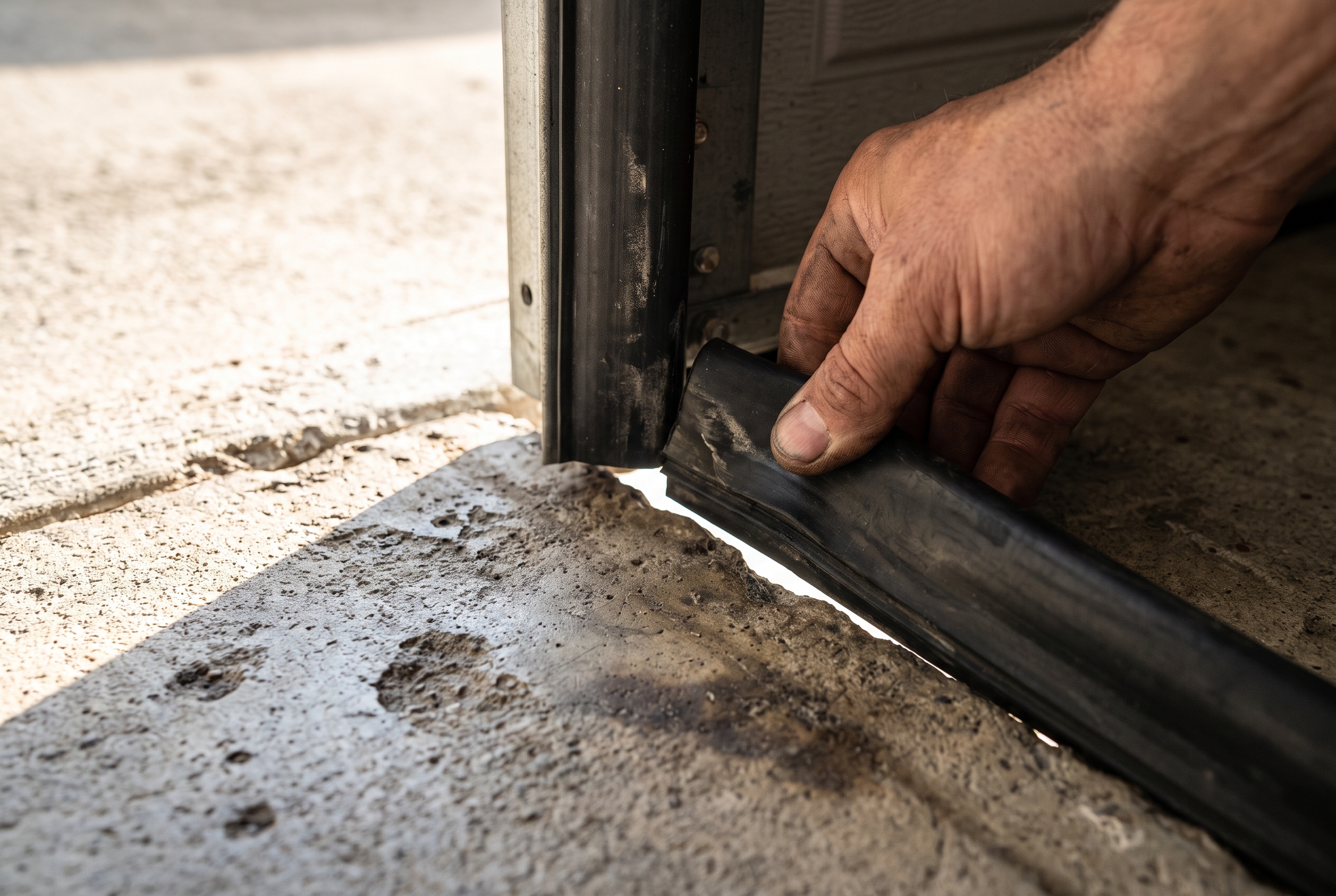
Before you pick a door, ask the installer:
-
What kind of bottom seal comes with it, and does it seal well on an uneven slab?
-
Do the sections have seals between them?
-
Is there a thermal break between the inner and outer steel skins?
-
Is new perimeter weatherstripping around the frame included?
A well-sealed R-12 door can be a better buy than a poorly sealed R-18 door. This is also why the DASMA-tested U-factor matters: it includes the section joints.
How much does an insulated garage door cost?
None of the sources we checked break prices out by region, so your local quotes may land above or below these national figures. Use them as a starting point:
-
Homewyse (September 2026): the national average to install an insulated garage door "starts at $1,332 - $2,127 per door." That covers removing the old door and installing tracks, panels, springs and seals. It doesn't cover structural changes, permits, sales tax, or general-contractor overhead, which can add 13-22% if you need one. (Homewyse)
-
The Garage Guide (April 2026): an installed 16x7 double door runs $1,100 to $2,200 in double-layer construction and $1,800 to $4,200 in triple-layer. (The Garage Guide)
The cheaper option: a retrofit kit
If your door is fairly new and in good shape, a foam retrofit kit costs $90 to $300 to install yourself, or $250 to $600 with a pro, per The Garage Guide. The same source suggests replacing the door instead if it's over 15 years old or damaged. Keep in mind that a kit adds insulation to the panels but does nothing for worn seals or drafty section joints.
Does an insulated door help at resale?
Garage door replacement came in first in Zonda's 38th annual Cost vs. Value report (2025). The national figures were a $4,672 job cost, $12,507 in value at sale, and 267.7% of the cost recouped. It was the second year in a row at number one. Steel entry door replacement came second at 216.4%. Zonda's Clay DeKorne said, "Exterior replacement projects remain the clear winners when it comes to adding resale value."
The door in that report is insulated. Amarr's breakdown describes the project as steel doors with heavy-duty galvanized steel tracks, "insulated to a minimum of R-12." Zonda built its numbers from real estate professional surveys plus Verisk XactRemodel estimating data across 115 U.S. markets, but its public report page doesn't break out garage door figures by region.
What to ask before you sign
Back to the two quotes, one for R-12 and one for R-18. Put them side by side and get answers to these questions in writing:
-
What is the DASMA-verified U-factor for this exact model? This is the fairest way to compare the two doors.
-
What insulation is it? Polyurethane or polystyrene.
-
Double-layer or triple-layer?
-
Which seals are included? Bottom seal, seals between sections, perimeter weatherstripping, thermal break.
-
Is removal and haul-away of the old door included?
-
Are permits included, or billed separately? Homewyse's estimate leaves permits out, so ask.
-
Are tracks, springs and the opener being replaced or reused?
If the R-18 door also has the lower tested U-factor and better seals, and you have living space over or next to the garage, the extra cost is easier to justify. If the U-factors are close, or the cheaper quote includes better weatherstripping, the R-12 door may be the better deal.
The easiest way to know if your price is fair is to get at least two local bids and compare them line by line. Call The Local can connect you with licensed, insured garage door pros in your area.
Related reading
Sources
-
Garage Door R-Value and U-Factor 101 (Amarr blog, May 8, 2024)
-
How Energy Efficient Garage Doors Can Lower Your Energy Bills (Amarr)
-
Improve Energy Efficiency With Insulated Garage Doors (Clopay blog, 2024)
-
What is R-value and what level do I need for my garage? (Garaga)
-
Cost to Install Insulated Garage Door, 2026 Cost Calculator (Homewyse)
-
Zonda's 38th Annual Cost vs. Value Report (PR Newswire, Sept 18, 2025)
This article contains AI-assisted content and has been reviewed by our editorial team.
ABOUT THIS SERVICE: CallTheLocal.com is a directory and lead generation service, not a contractor or service provider. Submitting this form does not obligate you to hire anyone or purchase any service. Your information will be shared with licensed, insured home service professionals in your area who may provide quotes for your project. CallTheLocal.com does not guarantee the quality, timeliness, or outcome of any work performed by service providers you connect with through this service. Always verify licensing, insurance, and references before hiring. Get everything in writing before work begins.