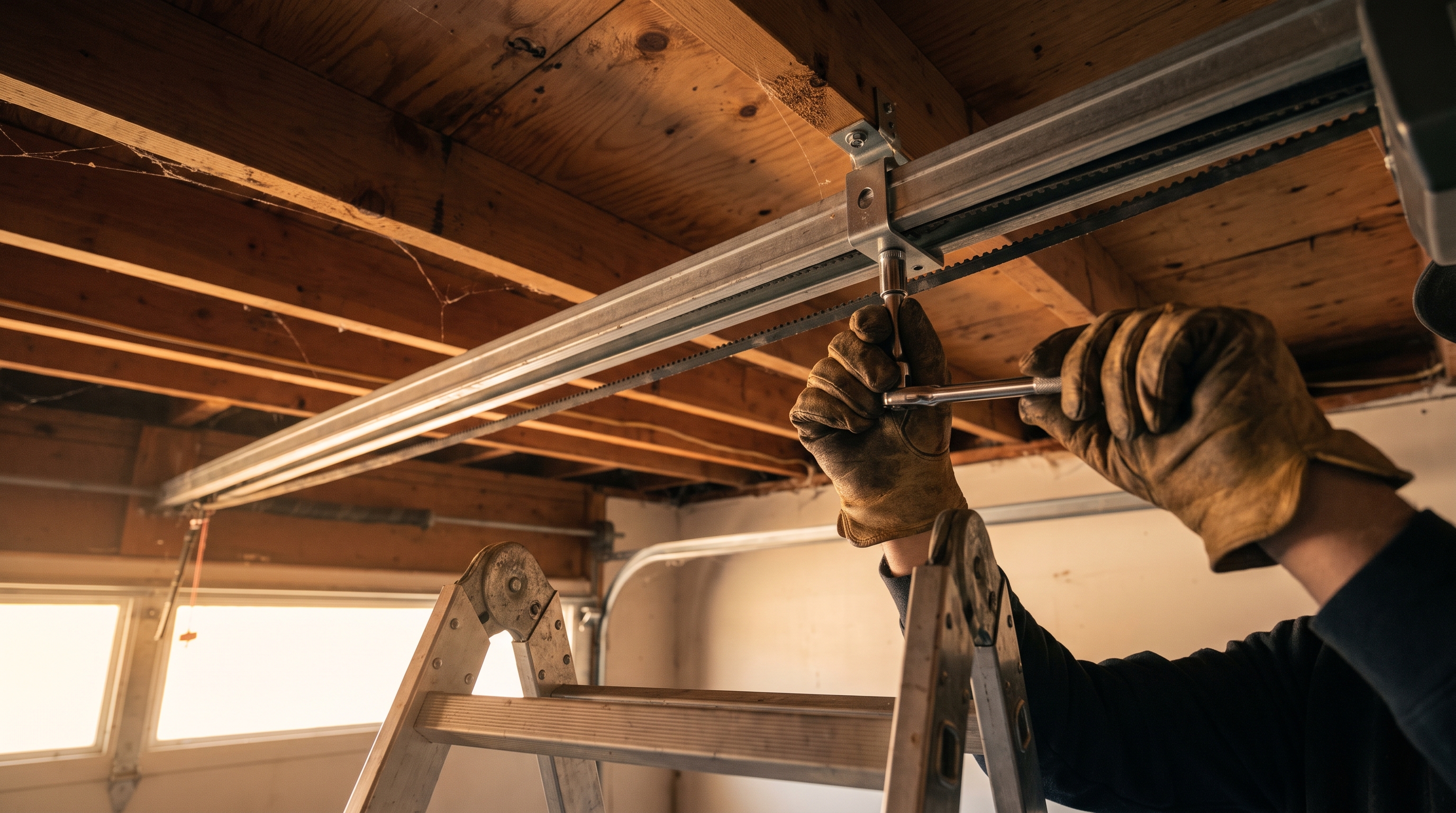
Most homeowners choose between three garage door opener types: chain drive, belt drive and wall-mount (jackshaft). Chain is the cheapest and loudest, at about $130-$200 for the unit. Belt is quieter and costs $170-$350. Wall-mount costs the most, around $550-$640. It frees up the ceiling and cuts vibration, but it only fits doors that meet strict requirements.
Picture a teenager, a guest or a new baby sleeping in the room over the garage. Someone leaves for work at 6 a.m., presses the button, and the whole room hums. Which opener you pick decides whether that happens every morning. This guide compares the three main types on price, noise, lifespan and fit, so you know which one to ask your installer to quote.
How each opener type works
-
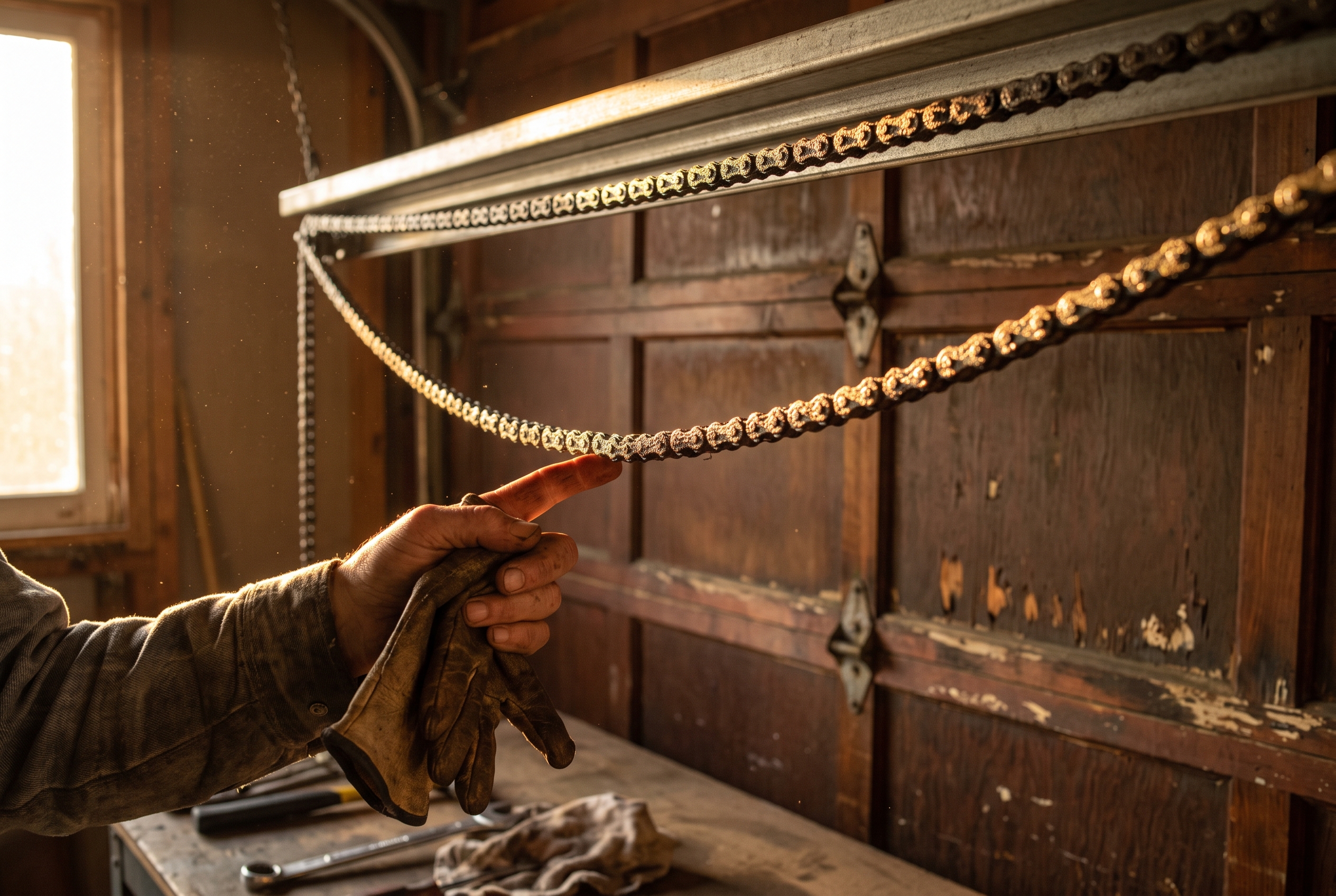
Chain drive: A motor on the garage ceiling pulls a metal chain along a rail to raise and lower the door.
-
Belt drive: The same ceiling motor and rail, with a reinforced belt instead of a chain.
-
Wall-mount (jackshaft): Mounts on the wall beside the door and turns the torsion bar directly. There is no motor or rail on the ceiling.
You will also see screw drive and direct drive openers. Fixr lists those units at $150-$250 and $300-$500. This article sticks to the three types most people are deciding between.
Price side by side
The most recent full cost breakdown we used comes from Fixr, last updated January 31, 2025. Its unit-only prices (the opener alone, not installed) are:
| Opener type | Unit only (Fixr) | Installed benchmark (Fixr) |
|---|---|---|
| Chain drive | $130-$200 | About $230 for a 1/2 HP chain drive (low end) |
| Belt drive | $170-$350 | About $480 for a 3/4 HP belt drive (typical project) |
| Wall-mount (jackshaft) | $550-$640 | Up to $1,100 for a 1 HP jackshaft with smart features (high end) |
Fixr puts the national average for an installed opener at $300-$600. For labor, it says a technician can usually finish in two to six hours at about $65 to $85 an hour, so labor alone comes to roughly $130-$510.
Older numbers for comparison: Bob Vila's cost guide was last updated in June 2023, so its figures are older. It puts typical installation at $218-$525, with a national average of $368. Its materials-only ranges are $150-$250 for chain, $160-$450 for belt and $250-$515 for jackshaft, with the same $65-$85 hourly labor rate.
What contractors are told to charge: The Housecall Pro garage door price guide (March 11, 2026) is written for contractors. It gives a typical opener replacement range of $300-$800, depending on motor type and smart features. A quote in that range is normal. If a quote lands well above it, ask the installer to explain why.
None of these sources break prices down by region. Labor rates in your area will move the total, so get at least two local quotes.
Noise: which opener belongs under a bedroom?
Chain drive is the loudest. Every source agrees. Bob Vila calls chain drive "the noisiest type of garage door opener." Metal chain on a metal rail rattles, and that sound travels.
Belt drive is the manufacturers' pick for living space. LiftMaster's buyer's guide says, "If you have a bedroom near an attached garage and want ultra-quiet operation, a belt drive opener provides virtually silent performance." Chamberlain, LiftMaster's sister brand, calls belt drive "ideal for garages close to living areas." Bob Vila says belt drive is "much quieter than a chain-driven opener."
Wall-mount is where the sources disagree. LiftMaster says the wall-mount design "frees up ceiling space in your garage, reduces noise and vibration." Bob Vila calls jackshaft "one of the quietest options on the market." Fixr disagrees and says jackshaft openers "are also quiet, although typically not as quiet as a belt-driven model." There is no consensus here, so be wary of anyone who says one is clearly quieter.
The practical difference is where the machine sits. A belt or chain opener hangs its motor and rail from the ceiling, which is the floor of the room above. A wall-mount puts the motor on the side wall, so less vibration travels up into that room. If the problem is a hum or shake you feel through the floor more than sound you hear, that detail matters. LiftMaster's quiet-openers page features both a belt drive (the WLED) and a wall mount (the 8500W). It says quiet openers suit "attached garages, homes with living spaces above the garage, and townhomes where you share a common wall."
Lifespan and warranty
Lifespan does not change much by type. InterNACHI's life expectancy chart lists garage door openers at 10 to 15 years and garage doors at 20 to 25 years. It notes that "the quality and frequency of use will affect the longevity of garage doors and openers." Fixr also says 10-15 years, and Bob Vila says openers can last longer with proper maintenance.
Warranties differ more. Here are two Chamberlain models:
-
Chamberlain B4505T (3/4 HP belt drive): lifetime on the motor, lifetime on the belt, 5 years on parts, 1 year on accessories.
-
Chamberlain C2212T (1/2 HP chain drive): 6 years on the motor, 1 year on parts, 1 year on the chain.
Those are two example models, not a rule for every brand. They do show why you should ask for the warranty terms (motor, belt or chain, and parts) in writing on your quote.
Which garages suit each type
-
Chain drive: A detached garage, a heavy door that gets used many times a day, or a tight budget. LiftMaster says, "If you have a heavy door that you use frequently, a chain drive opener may be an ideal choice."
-
Belt drive: An attached garage, a bedroom next to it, or a room over it. For most homes with living space nearby, this is the safe middle choice on price and noise.
-
Wall-mount: High ceilings, overhead storage racks, a car lift, or a room above where vibration bothers people. LiftMaster puts it this way: "If you want to minimize vibration and free up ceiling space in your garage, a jackshaft opener is right for you." It only works if your door passes the checklist below.
Wall-mount checklist to go through with your installer
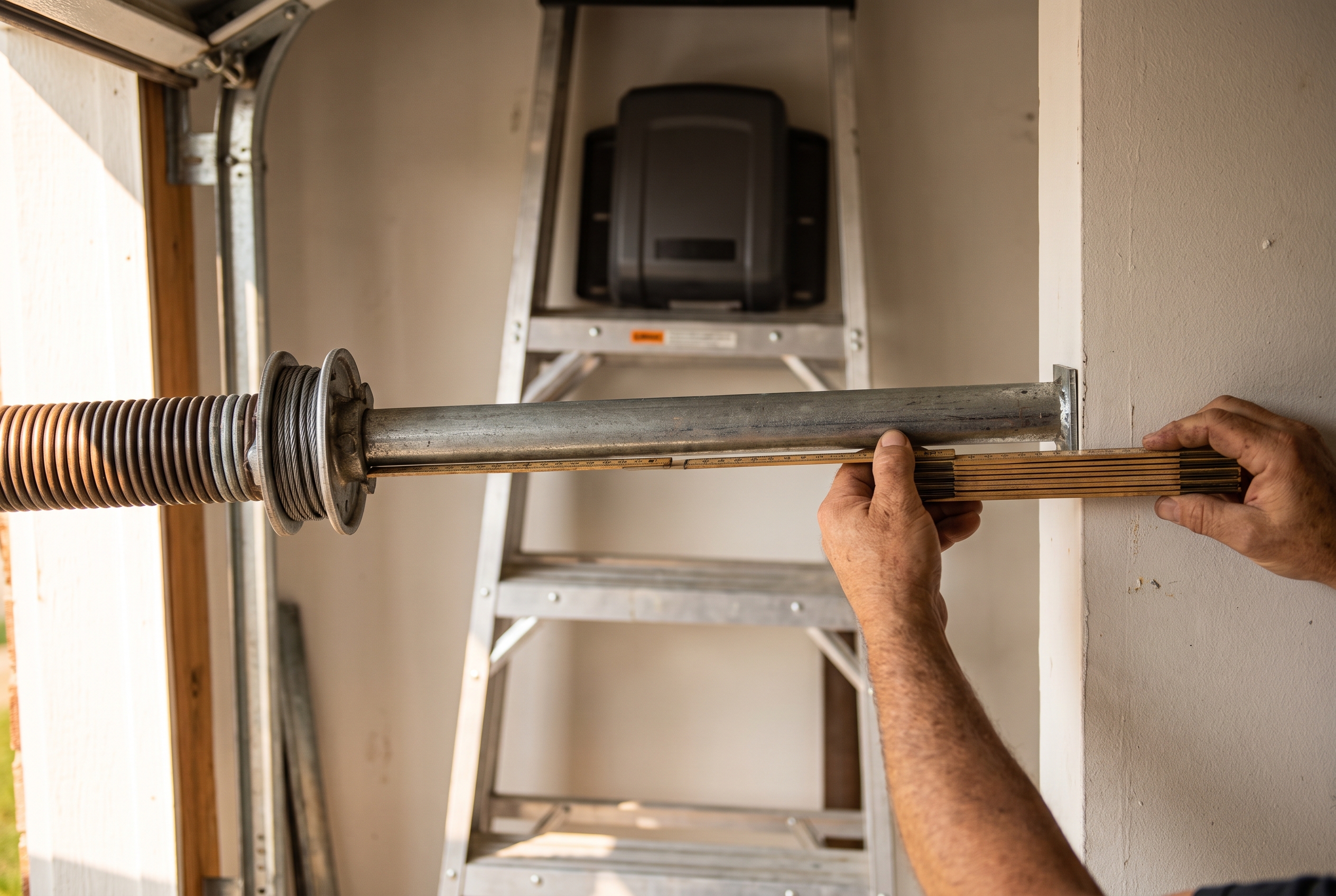
Based on Chamberlain's jackshaft installation requirements, your door needs:
-
A torsion-spring setup with a 1-inch diameter torsion bar that extends at least 1-1/2 inches past the bearing plate.
-
At least 8.5 inches between the end of the torsion bar and the side garage wall.
-
A properly balanced door.
-
A door no more than 14 feet tall, 18 feet wide and 180 square feet.
-
High lift, if you have it, of no more than 54 inches.
-
Not a full vertical lift door. Wall-mount units will not work on those.
If your door fails any of these, go with a belt drive. Don't let anyone talk you into forcing a wall-mount onto a door it was not designed for.
What to ask for on the quote
-
Drive type and horsepower (for example, 3/4 HP belt drive)
-
The exact model number, so you can look up the warranty yourself
-
Whether the price includes removing and hauling away the old opener
-
Whether labor is included, or billed hourly and for how many hours
-
Warranty terms for the motor, belt or chain, and parts
-
Any smart features or battery backup, since these raise the price
-
For a wall-mount: written confirmation that your door passed the requirements above
The bottom line: which one to ask for
If your garage is detached or you are on a tight budget, ask for a chain drive quote. If a bedroom or living space is next to or above the garage, ask for belt drive, since that is what both LiftMaster and Chamberlain recommend. If you need the ceiling for storage or a lift, or the quietest room in the house is above the garage, ask for a wall-mount, but only after the installer confirms your door passes the checklist. Whichever you choose, get the model number, labor and warranty in writing before any work begins.
Related reading
-
Should You Still Replace the Furnace Before a Warm Winter Forecast?
-
What a Fair Flooring Installation Quote Includes, Line by Line
Sources
-
Fixr: Garage Door Opener Installation Cost (updated January 31, 2025)
-
Bob Vila: How Much Does Garage Door Opener Installation Cost? (updated June 12, 2023)
-
Chamberlain Group Support: Jackshaft Opener Installation Requirements
-
Chamberlain: C2212T Chain Drive Wi-Fi Battery Backup Garage Door Opener
-
InterNACHI: Standard Estimated Life Expectancy Chart for Homes
Note: This article contains AI-assisted content and has been reviewed by our editorial team.
ABOUT THIS SERVICE: CallTheLocal.com is a directory and lead generation service, not a contractor or service provider. Submitting this form does not obligate you to hire anyone or purchase any service. Your information will be shared with licensed, insured home service professionals in your area who may provide quotes for your project. CallTheLocal.com does not guarantee the quality, timeliness, or outcome of any work performed by service providers you connect with through this service. Always verify licensing, insurance, and references before hiring. Get everything in writing before work begins.