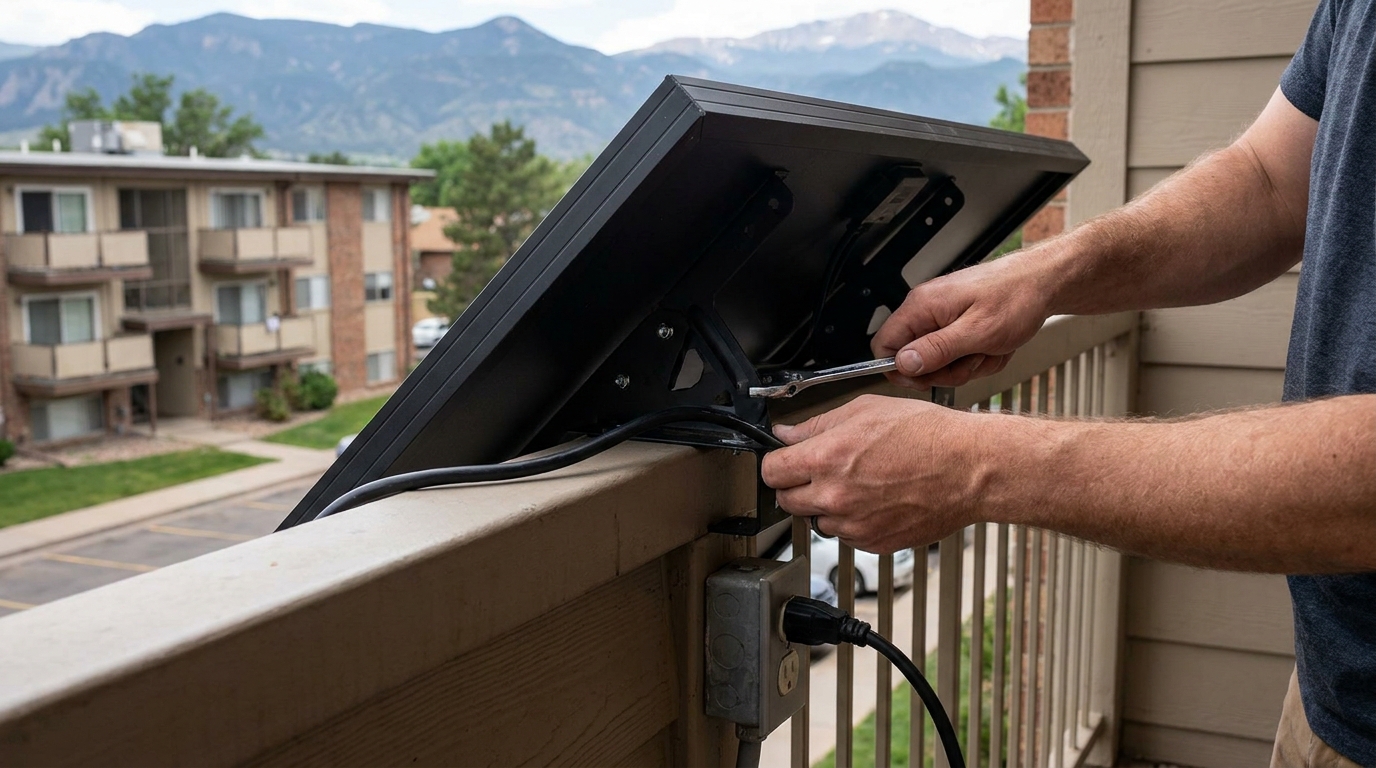
On May 7, 2026, Colorado Governor Jared Polis signed HB26-1007 into law, making Colorado the third state in the country to legalize plug-in "balcony" solar and require utilities to accept customer-owned meter collar adapters. The Governor's Office framed the law as a way to let renters, condo owners, and homeowners with older electrical panels generate their own power without committing to a full rooftop install.
If you have watched what happened in Germany, where balcony solar is now everywhere, this is a small but real shift in U.S. residential energy policy. Here is what the law actually does, what a kit costs in 2026, and the gaps that mean you probably cannot legally plug one in tomorrow.
What Polis Just Signed
HB26-1007 does three main things, according to the bill text and the Governor's Office summary:
-
Defines "portable-scale solar devices" and creates a legal framework for plugging them in.
-
Requires Colorado's investor-owned utilities, municipal utilities, and electric co-ops to allow customer-owned meter collar adapters that are listed by a nationally recognized testing laboratory.
-
Directs the Colorado Public Utilities Commission to revise interconnection rules by December 31, 2026.
The law also limits HOA and covenant restrictions that would unreasonably block portable-scale solar. The bill text references a 10 kW production-meter threshold for the simplified rules, well above what any plug-in kit produces.
What "Plug-In" Solar Actually Is
A balcony solar setup is usually one to four panels (typically 300W to 800W of total nameplate capacity) wired to a micro-inverter that plugs into a standard 120V outlet, or alternatively connects through a meter collar adapter that sits between your utility meter and the meter socket. There is no rooftop work, no service-panel upgrade, and in many cases no permit. The Solar.com 2026 guide describes 800W as the standard configuration and pegs realistic annual production at 1,000 to 1,400 kWh per year, enough to cover roughly 15 to 25 percent of a typical apartment's monthly electric use.
The big functional difference from a rooftop system: there is no battery backup unless you add one, and the inverter is required to shut off automatically during a grid outage (anti-islanding). Plug-in solar offsets your bill while the grid is up. It does not keep the lights on when the grid is down.
The 2026 Price Stack
Per the Solar.com guide, current 800W kits run roughly $600 to $2,500. Specific examples cited in 2026 buyer guides include the Deye SUN800G3 around $1,325, the Hoymiles HMS-800-2T around $1,400, and the CraftStrom 800W around $2,031. Smaller 300W to 600W kits start in the $400 to $1,000 range.
If you are going the meter collar route, ConnectDER's Solar Meter Adapter retails around $500, and Solar Builder reports installed cost is roughly $600, with a qualified electrician typically taking 15 to 30 minutes. That compares to $2,500 or more for a typical service-panel upgrade, and up to $10,000 in extreme cases. The Governor's Office cites $2,000 to $5,000 in panel-upgrade savings as part of the rationale for the meter collar mandate.
AI workflows for revenue teams
Placeholder house ad for Conservus.ai. Swap with final creative when brand assets are ready.
Partner with Conservus.aiPayback Math, and Why 2026 Is Different
Payback depends almost entirely on local electricity rates. HowToGoSolar.org's city-by-city analysis of 800W kits shows roughly 2.8 years in SDG&E territory at about $0.46 per kWh, four to five years across much of California, and nine to sixteen years in Utah at around $0.137 per kWh. The Solar.com guide cites a typical three-to-six-year payback range for balcony kits in moderate-rate markets.
One important change for 2026 buyers: the federal residential clean energy credit under IRC Section 25D expired on December 31, 2025. There is no 30 percent federal credit available on plug-in solar kits purchased in 2026. That changes the math compared to most online calculators built before the expiration.
Where It Makes Sense, and Where It Doesn't
Balcony solar is built for situations where rooftop solar does not pencil out:
-
Renters and condo owners who cannot modify a roof.
-
Homes with shaded roofs, north-facing exposures, or older electrical panels that would need an expensive upgrade for a full system.
-
Households with sub-3kW electric needs where a full rooftop array would be oversized.
If you own a single-family home with high consumption (8 kW or more of typical load), strong sun exposure, and access to net metering, a rooftop system will almost always produce more lifetime savings than a plug-in kit. The point of plug-in solar is not to replace rooftop. It is to give households who cannot install rooftop a path to any solar at all.
The State Map
Colorado is the third state to legalize plug-in solar:
-
Utah went first with HB 340, signed by Governor Cox and effective May 1, 2025, with a 1,200W cap, per CleanTechnica.
-
Virginia was second. SB 250 passed the legislature, was signed by Governor Spanberger, and takes effect January 1, 2027 with a 1,200W cap, per pv magazine USA.
-
Maine passed LD 1730, which was signed in April 2026 and takes effect July 2026, per the Solar.com guide.
-
Colorado followed with HB26-1007 on May 7, 2026.
Vermont's S.202 has cleared the state Senate and is moving in the House, per pv magazine USA. The Bright Saver tracker counts roughly 30 states with introduced plug-in solar bills.
AI workflows for revenue teams
Placeholder house ad for Conservus.ai. Swap with final creative when brand assets are ready.
Partner with Conservus.aiRed Flags Every Buyer Should Know
UL listing is in flux. UL Solutions launched UL 3700 in January 2026 as the first U.S. safety standard purpose-built for complete plug-in solar systems, covering anti-islanding, shock, overload, and weatherproofing. As of April 2026, no products had been certified to UL 3700 yet, and CPR News noted on the day of signing that approved units are not widely available. Today's kits rely on UL 1741-listed inverters as the current floor, as pv magazine explains. UL 3141, sometimes mentioned in press coverage, is actually the Power Control Systems standard for smart electrical panels and is unrelated to plug-in solar, per Solar Power World.
Permit-exempt is not inspection-exempt. Even Utah's 1,200W exemption still requires UL or equivalent listing, NEC compliance, and anti-islanding inverter behavior.
HOA, landlord, and lease language matters. Colorado limits unreasonable restrictions, but if you rent, your lease and your landlord's electrical insurance terms still apply. Get permission in writing before you spend money on hardware.
Skip uncertified imports. Cheap online listings without verifiable UL listing on the inverter are not worth the risk to your home, your insurance, or your warranty.
What Still Has to Happen in Colorado
The signing is not a green light to plug in tomorrow. According to the bill text and Solar Power World's coverage:
-
The Colorado PUC has to revise interconnection rules by December 31, 2026.
-
Utilities will need to update tariffs to reflect the new meter collar requirements.
-
Meter collar products and complete kits will need certification under UL 3700, or continue relying on the UL 1741 inverter listing in the interim.
If you are a Colorado homeowner thinking about it, the practical move is to wait for the PUC's interconnection rules later this year, then talk to a licensed electrician about whether a plug-in setup or a meter collar is the better fit for your home.
FAQ
Will my homeowners or renters insurance cover it? Ask your carrier in writing before you install. Insurance treatment of plug-in solar varies by policy.
What about my circuit breaker? A 120V outlet shared with other loads can trip if the combined draw exceeds the breaker's rating. The cleanest setup is a dedicated outlet, or a meter collar adapter that bypasses your panel entirely.
Does it work in a power outage? No. By code, the inverter has to shut off when the grid goes down (anti-islanding). If you want backup power, you need a battery system, which is a different product.
Is there a tax credit? The federal residential clean energy credit (Section 25D) expired on December 31, 2025, so there is no federal 30 percent credit on 2026 kit purchases. State and utility incentives vary.
AI workflows for revenue teams
Placeholder house ad for Conservus.ai. Swap with final creative when brand assets are ready.
Partner with Conservus.aiThe Bottom Line
Colorado's law is meaningful because it tackles two of the biggest non-hardware barriers to plug-in solar at once: the interconnection rule that says you cannot connect, and the panel-upgrade cost that prices a lot of households out before they start. Whether you buy a kit in 2026 or wait for UL 3700-certified products to ship, the bigger story is that a path now exists for the homeowners, renters, and condo owners who have been locked out of the rooftop economy.
Related reading
Sources
-
HB26-1007 Improve Customer Use Distributed Energy Resources (Colorado General Assembly)
-
Colorado approves balcony solar, but approved units aren't widely available yet (CPR News)
-
Colorado approves balcony solar, requires utilities to accept meter collars (Solar Power World)
-
Plug-in Solar Bill Becomes Law in Colorado (Energy Changemakers)
-
Virginia legislature passes balcony solar bill (Utility Dive)
-
Virginia becomes second U.S. state to advance plug-in solar (pv magazine USA)
-
Plug-in solar legislation momentum spreads to Vermont (pv magazine USA)
-
UL Solutions Debuts Testing and Certification Framework for Plug-In Solar
-
How to design a UL-certified balcony solar kit (pv magazine)
-
Span smart electrical panels certified to UL 3141 (Solar Power World)
-
Lower solar installation costs with meter collar connection (Solar Builder)
-
Balcony Solar Savings: How Much Can You Actually Save? (HowToGoSolar.org)
Note: This article contains AI-assisted content and has been reviewed by our editorial team.
ABOUT THIS SERVICE: CallTheLocal.com is a directory and lead generation service, not a contractor or service provider. Submitting this form does not obligate you to hire anyone or purchase any service. Your information will be shared with licensed, insured home service professionals in your area who may provide quotes for your project. CallTheLocal.com does not guarantee the quality, timeliness, or outcome of any work performed by service providers you connect with through this service. Always verify licensing, insurance, and references before hiring. Get everything in writing before work begins.