Note: This article contains AI-assisted content and has been reviewed by our editorial team.
If your search history this spring includes phrases like "is a Froth-Pak worth it" or "can I spray-foam my own attic," you are not alone. Episode 738 of the Fine Homebuilding Podcast dug into the secrets of two-part DIY spray-foam kits and the cautionary tales that come with them, and homeowners have been doing the math ever since. With contractor quotes for closed-cell foam climbing into the thousands, a $600 box from the home center looks awfully tempting.
Sometimes those boxes are the right call. Often they are not. Here is what the 2026 numbers actually look like, where these kits genuinely shine, and the failure modes that turn a Saturday project into a tear-out job.
2026 Kit Pricing, Tier by Tier
DIY two-part kits come in three rough sizes, and the price gap between them is wide. Numbers below are 2026 retail ranges pulled from HomeGuide's DIY spray-foam kit pricing data and current big-box listings.
-
Starter kits (12 to 15 board-feet): roughly $40 to $70. The Touch 'n Foam 15 board-foot kit (model 4006002506) is the anchor here. Think small gaps, sealing around a few penetrations, or filling a stubborn cold spot.
-
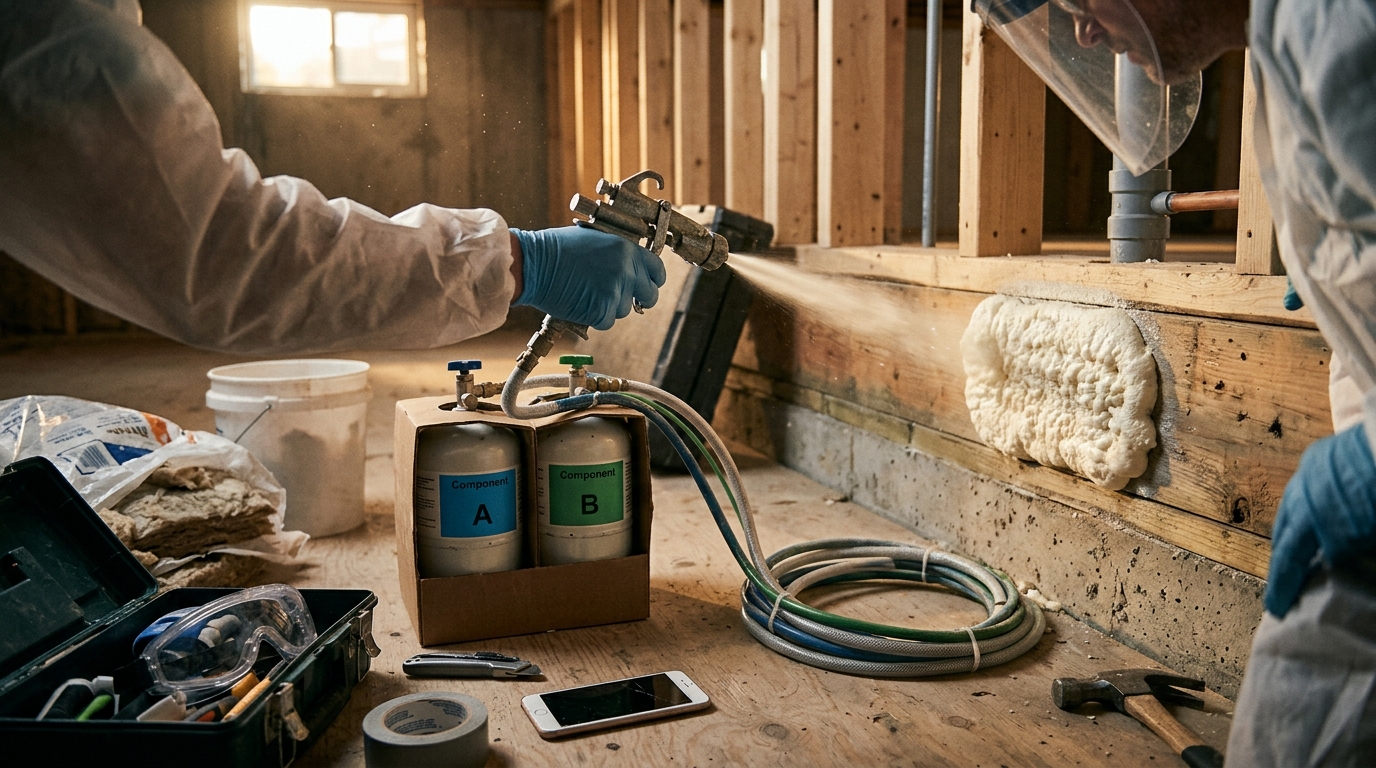
Mid-size kits (around 200 board-feet): roughly $300 to $700. The DuPont Froth-Pak 200 is the best-known example, marketed for gaps, penetrations, rim joists, and small assemblies.
-
Large kits (around 600 to 650 board-feet): roughly $900 to $1,500. The Touch 'n Foam 600 board-foot kit and the DuPont Froth-Pak 650 set this tier. Both are closed-cell, nominally around R-6 per inch, and explicitly aimed at small assemblies rather than whole-house work.
The Board-Foot Math Most Homeowners Get Wrong
One board-foot equals one square foot at one inch thick. That sounds obvious, then it bites people the moment they try to insulate at real-world depths.
A 600 board-foot kit covers 600 square feet at one inch, 300 square feet at two inches, or only about 100 square feet at the six inches a cold-climate exterior wall really needs to hit a meaningful R-value. So that $1,300 box you were going to use on the whole attic deck? It barely touches a 12 by 12 foot section if you are insulating to depth.
The pro benchmark for comparison: HomeGuide's 2026 installed pricing puts closed-cell at roughly $1.00 to $1.50 per board-foot for material and labor at the low end, with Angi's 2026 cost data and Modernize's 2026 pricing guide landing in the $1.30 to $3.10 per board-foot range, and $1.50 to $3.50 per board-foot common in retrofit work where access is tight.
Run those numbers and the picture clears up fast:
-
Rim joist around a 1,500 sq ft house (roughly 150 to 200 board-feet at 2 inches): pro quote often $300 to $600. A single Froth-Pak 200 covers it for $300 to $700. Wash.
-
Small unvented crawlspace band (say 250 board-feet): pro quote often $400 to $900. A 200 or 600 board-foot kit is competitive.
-
1,500 sq ft attic deck at 5 inches (7,500 board-feet): pro quote $7,500 to $20,000. You would need 12-plus large kits at $1,200 each, which is $14,000 in materials alone, not counting wasted product, PPE, and your weekend. Not a wash.
Where DIY Kits Actually Make Sense
Manufacturer guidance and editorial coverage from Fine Homebuilding's rim joist guide line up on the same short list of good-fit jobs:
-
Rim joists and sill plates in a basement or crawlspace.
-
Small unvented crawlspaces with manageable square footage.
-
Sealing mechanical penetrations, plumbing chases, and electrical boxes on exterior walls.
-
Isolated cold spots in a small mechanical room or knee wall.
The common thread: small square footage, contained area, easy to ventilate, and you can keep the substrate warm.
AI workflows for revenue teams
Placeholder house ad for Conservus.ai. Swap with final creative when brand assets are ready.
Partner with Conservus.aiWhere They Backfire
The same kits routinely fail on:
-
Whole attic decks or ceiling planes over conditioned space.
-
Full exterior wall cavities, especially in Climate Zones 5 through 7 where you need real depth.
-
Any application that requires a code-required thermal or ignition barrier (commonly a 15-minute thermal barrier such as half-inch drywall, or an approved ignition barrier over exposed foam in accessible areas). Kit instructions tend to gloss over this and your inspector will not.
-
Cold garages, unheated attics in winter, or any space you cannot hold at the recommended substrate temperature.
The Four Failure Modes Pros See Most Often
When a DIY kit job goes wrong, it almost always traces back to one of these four issues. The Froth-Pak refill system manual and Fine Homebuilding's installation guide cover the technical side in detail.
-
Off-ratio mixing. Two-part foam is a 1-to-1 chemical reaction between an A-side and a B-side. A-rich foam comes out yellow or brown and brittle. B-rich foam stays soft and sticky and never fully cures. Either one is a tear-out.
-
Cold tanks or cold substrate. Manufacturer guidance puts the sweet spot for both chemical and surface temperatures at 75 to 90 degrees F. Anything below about 65 degrees F produces off-ratio foam regardless of how careful you are with the trigger. System pressure should not exceed 220 PSI on either side, which becomes hard to control if the tanks are cold.
-
Over-thick lifts. Closed-cell foam should be applied in passes of about two inches or less, with cure time between lifts. Push past that and you get scorching, shrinkage, and pull-back from the stud or sheathing. The cavity ends up with foam that looks fine on the surface and is gapping behind the scenes.
-
Clogged or aged hose. Once a hose or gun tip starts clogging, one side starts running short, the ratio drifts, and the foam quality follows. This is why pros change tips often and why a kit that has been sitting on a garage shelf for a year is a gamble.
The Smell Test
If your cavity smells fishy or like ammonia 24 hours after the spray, that is not just curing. That is the signature of a failed batch, usually B-rich, and the off-gassing can linger for weeks. The standard response is to cut the foam out, ventilate the space heavily, document everything with photos and lot numbers, and contact the manufacturer. Painting over it or hoping it cures away does not work.
AI workflows for revenue teams
Placeholder house ad for Conservus.ai. Swap with final creative when brand assets are ready.
Partner with Conservus.aiR-Value Claims vs. Cold-Cavity Reality
Closed-cell foam is marketed at roughly R-6 to R-7 per inch. Real-world performance drifts. As blowing agents diffuse over five to ten years, expect to lose 5 to 10 percent of the nameplate R-value. A poor mix, a cold substrate, or rushed lifts can knock another 10 to 20 percent off the effective R-value. In a Climate Zone 6 wall where the labeled R is doing most of the work, that drop matters. In a rim joist, less so.
The PPE Gap Nobody Talks About
This is the part the box does not advertise. The EPA flags Side A as containing isocyanates (specifically MDI), which are highly reactive chemical sensitizers. According to EPA's exposure guidance, inhalation exposures during spray-foam application typically exceed OSHA occupational exposure limits and require respiratory, skin, and eye protection. Once you are sensitized to isocyanates, future exposures can trigger asthma-like reactions at much lower doses.
What the kit usually ships with:
-
Nitrile gloves
-
Basic goggles
-
Sometimes a dust mask
What EPA's workplace practices guidance and health-concerns page actually recommend:
-
A supplied-air respirator, or at minimum a full-face air-purifying respirator with organic-vapor and P100 cartridges
-
A Tyvek-style chemical suit covering arms, legs, and head
-
Sealed eye protection
-
A ventilation plan for the work area
-
A re-entry window for other occupants; manufacturers commonly cite 24 hours, but the recommended time varies
Budget another $150 to $400 for proper PPE if you do not already own it. Skipping it is the single biggest reason home inspectors and remediators recommend against DIY foam for anything bigger than a few rim joists.
The Five-Question Checklist Before You Buy a Kit
-
How many square feet, at what depth? Multiply them. If you are over about 100 board-feet, start pricing pros for comparison.
-
Can you hold the substrate and the tanks between 75 and 90 degrees F for the whole spray? If not, wait for warmer weather or hire it out.
-
Can you ventilate the space and keep other occupants out for at least 24 hours?
-
Will the finished foam need a code-required thermal or ignition barrier? If yes, you also need a plan to cover it with drywall or an approved coating.
-
Do you have, or are you willing to buy, the respirator, suit, and eye protection EPA actually recommends?
If any of those are a "no," the math almost always tips back toward a contractor quote.
AI workflows for revenue teams
Placeholder house ad for Conservus.ai. Swap with final creative when brand assets are ready.
Partner with Conservus.aiWhat to Ask a Contractor If You Decide to Hire Out
Whether you are doing a rim joist or a full attic, the questions that separate a good crew from a sloppy one are the same:
-
How thick are your lifts, and how long between passes?
-
What substrate and tank temperatures do you require before you spray?
-
What is the thermal-barrier plan once the foam is in?
-
What is your warranty if the foam shrinks, pulls back, or smells after 24 hours?
-
Can you show me the data sheet for the system you are using?
A contractor who answers all five confidently is worth the quote. A contractor who waves off the temperature question is the one whose work shows up on tear-out forums six months later.
The Bottom Line
DIY two-part kits earn their place on small, contained, well-ventilated jobs where you can control temperature and you are willing to gear up properly. For rim joists, a few penetrations, or a tight crawlspace band, a $300 to $700 kit can match a pro quote and finish in an afternoon. For attic decks, full wall cavities, or anything needing a code-compliant thermal barrier, the kit math stops working and the failure modes get expensive. Spend the money where it matters: kits for the 30 square-foot jobs, pros for the 300-plus square-foot ones.
Related reading
AI workflows for revenue teams
Placeholder house ad for Conservus.ai. Swap with final creative when brand assets are ready.
Partner with Conservus.aiSources
-
The Fine Homebuilding Podcast (Episode 738 segment on DIY spray-foam kits)
-
Fine Homebuilding: Insulate Rim Joists Like a Pro Using Rigid Foam or Spray Foam
-
Fine Homebuilding Podcast Segment: When Spray Foam Makes Sense (and When It Doesn't)
-
EPA Safer Choice: Health Concerns About Spray Polyurethane Foam
-
EPA Safer Choice: Potential Chemical Exposures From Spray Polyurethane Foam
-
EPA Safer Choice: Safer Workplace Practices for Spray Polyurethane Foam Installation
ABOUT THIS SERVICE: CallTheLocal.com is a directory and lead generation service, not a contractor or service provider. Submitting this form does not obligate you to hire anyone or purchase any service. Your information will be shared with licensed, insured home service professionals in your area who may provide quotes for your project. CallTheLocal.com does not guarantee the quality, timeliness, or outcome of any work performed by service providers you connect with through this service. Always verify licensing, insurance, and references before hiring. Get everything in writing before work begins.