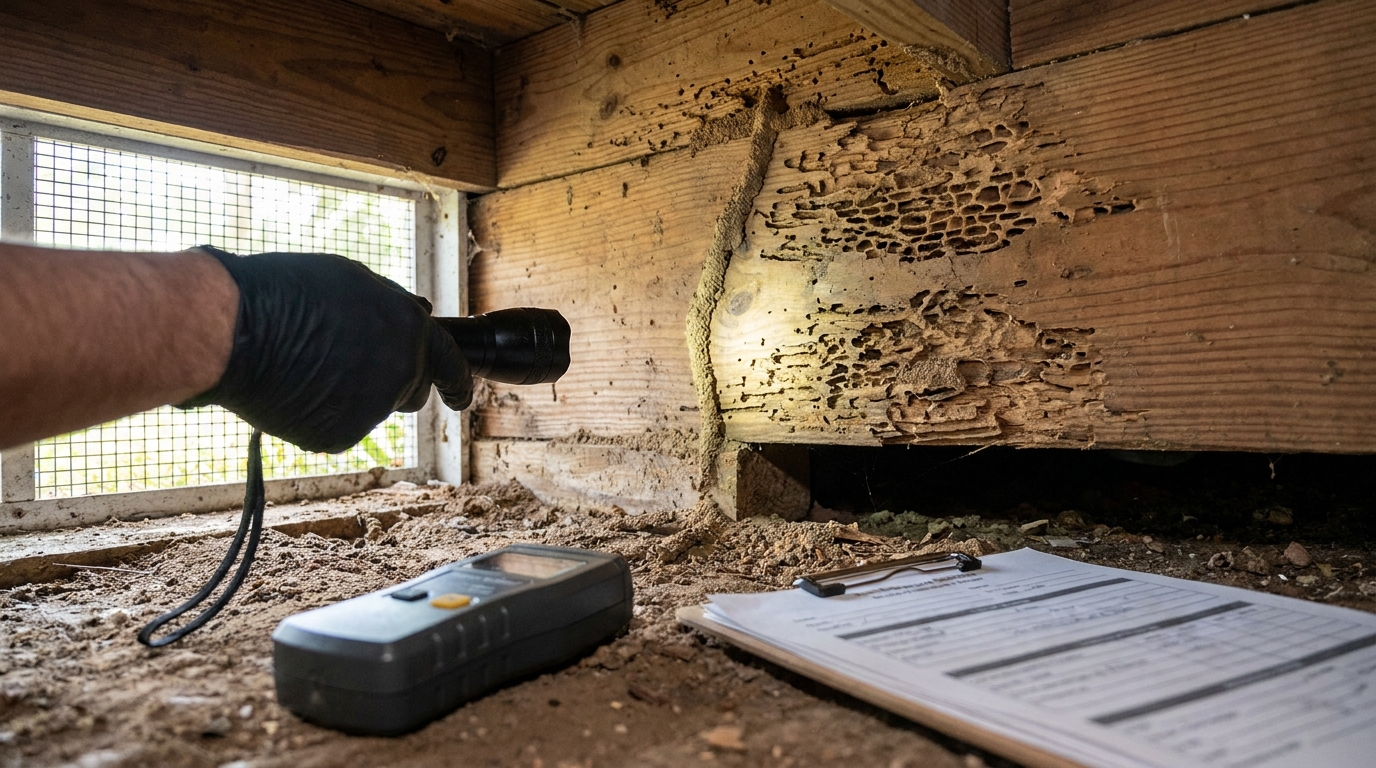
If you own a home anywhere in Florida or the Gulf South, a new University of Florida study is worth a few minutes of your attention. Two invasive termite species are spreading north and inland faster than researchers expected, and a crossbred version of the pair has now been confirmed living in the wild. The headlines have leaned hard on the phrase 'super termite.' The reality is more useful and less scary than that, so let's walk through what the science actually found, what it means for your house, and the part nobody warns new homeowners about: your insurance almost certainly won't pay to fix the damage.
What the February 2026 UF study actually found
Researchers at UF/IFAS, led by urban entomology associate professor Thomas Chouvenc, analyzed 35 years of records from the University of Florida Termite Collection, covering 1990 through 2025. The study, published in February 2026 in the Journal of Economic Entomology, tracked where two invasive subterranean termites have actually been found over time and compared that against where earlier models predicted they would be.
The short version: both species are ahead of schedule.
-
The Asian subterranean termite (Coptotermes gestroi) has now been documented as far north as Brevard County on the Atlantic coast and Hillsborough County on the Gulf side near Tampa. The study projects it across all 24 of Florida's southernmost counties by roughly 2040.
-
The Formosan subterranean termite (Coptotermes formosanus) is already established across most coastal counties and urban centers and is projected to reach throughout the entire state of Florida by 2050.
Chouvenc estimates that about half of the structures in the South Florida metro area could face infestation risk by around 2040. You can read the full write-up in the UF News release, with independent coverage of the same findings from Phys.org.
The two species and the hybrid, in plain English
Both of these are subterranean termites, meaning they nest in the soil and tunnel up into wood, often out of sight until the damage is done. The Formosan and the Asian subterranean termite are both aggressive, fast-growing invaders, which is why pest professionals in the Southeast take them seriously.
The new wrinkle is that the two species hybridize. UF scientists first observed the two species swarming at the same time back in 2013 in Broward County, and hybrid winged reproductives have been found since 2019. UF has now confirmed that hybridization is happening in the field, not just in a lab. You can see the confirmation from UF Innovate and the peer-reviewed field evidence in Heredity.
Here is the honest caveat the scary headlines tend to skip: the hybrid is still rare. According to UF/IFAS, hybrids currently make up less than 1% of swarmers and are confined to parts of Broward County. This is a notable scientific development, not a statewide invasion of a new creature.
A reality check on the 'super termite'
This is the part homeowners most need to hear clearly. UF/IFAS states plainly that the professional products currently used for termite control 'will be as effective on hybrid colonies as they would be for either' parent species. In other words, the hybrid is not harder to treat. If you hire a licensed pest professional, the same treatments work.
You may also see claims that the hybrid reproduces faster or is more destructive. Be careful here. Early lab work by Chouvenc in 2015 found larger young hybrid colonies, but a 2023 study found colony growth equivalent to the parent species. So 'faster-reproducing' is not a settled fact, and UF's own extension guidance, Hybrid Coptotermes Termites: Separating Fact from Fiction, exists specifically to keep these claims accurate.
The genuine concern is not an untreatable monster pest. It is range expansion. These termites are reaching new counties and pushing inland into areas that historically did not worry much about them. UF/IFAS has also asked the public to help track the hybrid, since visual identification is unreliable. If you want a colony identified, you can submit samples to UF at termiteidservices@ifas.ufl.edu, as explained in their June 2026 homeowner guide.
AI workflows for revenue teams
Placeholder house ad for Conservus.ai. Swap with final creative when brand assets are ready.
Partner with Conservus.aiThe insurance gut-punch
Now the expensive part. If termites eat through your floor joists or a load-bearing wall, do not assume your homeowners policy has your back. It almost certainly does not.
Standard homeowners insurance excludes termite damage. Insurers treat it as gradual, preventable, and a maintenance issue, rather than something 'sudden and accidental,' which is the standard a claim generally has to meet. That reasoning is consistent across Forbes Advisor, NerdWallet, and Bankrate. The logic is that you had time to catch and prevent it, so it is on you.
There is one narrow exception worth knowing. If termites chew through electrical wiring and that causes a fire, the fire damage itself may be covered, because a fire is a sudden covered peril. The termite damage that led to it still is not. So the repair bill for the structural damage, which can easily reach five figures on a whole-home or foundation job, typically comes out of your own pocket.
The dollars: what protection actually costs
Because insurance won't cover the repair, the practical financial hedge is prevention plus a termite bond. Here are realistic numbers, drawn from HomeGuide and HomeAdvisor:
-
One-time treatment: commonly $275 to $863, averaging around $558. Whole-home or foundation-level jobs run considerably higher.
-
Termite bond or warranty: typically $500 to $2,000 upfront, which usually includes the inspection and initial treatment, then roughly $200 to $400 per year to renew. The U.S. average annual bond runs about $1,035.
A termite bond is a contract with a pest control company. In exchange for the annual fee, they inspect and re-treat as needed. Read yours carefully, because bonds vary. Some are 'retreatment only,' meaning they'll re-treat but won't pay to repair damage. Others include a repair or damage-warranty component. Know which one you have before you sign.
The single most valuable feature to ask about is transferability. A transferable bond can pass to a buyer when you sell, which is a genuine selling point in termite country, and it protects you against a gap in coverage if you move.
Which areas are newly at risk, and which have dealt with this for years
For the confirmed hybrid, the affected zone right now is small: parts of Broward County in South Florida. That's it. Don't let anyone tell you the hybrid is loose across the Southeast.
The parent species are a different story. The Formosan subterranean termite is well established across the Gulf South, including Louisiana, Mississippi, Alabama, Georgia, South Carolina, and Texas. Florida is on a trajectory toward statewide Formosan presence by 2050 and broad Asian subterranean termite presence across its southern counties by 2040. If you're in the Gulf South, subterranean termites are simply part of homeownership, and the UF study is a reminder to stay current rather than a signal to panic.
AI workflows for revenue teams
Placeholder house ad for Conservus.ai. Swap with final creative when brand assets are ready.
Partner with Conservus.aiWhen to inspect
Timing matters more than most homeowners realize:
-
Annually: get a professional inspection every year, especially if you're in Florida or the Gulf South.
-
Spring: stay alert during swarm season, when winged reproductives leave the colony to start new ones. This is often the first visible sign.
-
Before you buy: always get a Wood-Destroying Organism (WDO) inspection before purchasing a home in these regions. It's cheap insurance against inheriting someone else's problem.
Red flags that mean call now
Land-grant extension guidance from Mississippi State University Extension and industry identification from Orkin point to a short list of warning signs:
-
Mud tubes: pencil-width tunnels, roughly 1/4 to 1 inch in diameter, running up foundations, walls, or crawl space piers. Subterranean termites build these to stay moist while they travel.
-
Discarded wings: small piles of shed wings near windows and doors in spring, left behind by swarmers.
-
Hollow or blistered wood: wood that sounds hollow when tapped or looks blistered, because the termites eat it from the inside out.
If you spot any of these, don't wait. Call a licensed pest professional. If you're in Florida and curious whether you're dealing with the hybrid, you can also submit a sample to UF at termiteidservices@ifas.ufl.edu, but treatment shouldn't wait on identification.
A simple action checklist for Southeast homeowners
-
Schedule an annual professional termite inspection, plus a WDO inspection before any home purchase.
-
Get a termite bond, or renew the one you have, and confirm whether it's retreatment-only or includes damage repair.
-
Verify that the bond is transferable to a future buyer.
-
Reduce moisture around the foundation: fix leaks, direct downspouts away from the house, and improve crawl space ventilation.
-
Eliminate wood-to-soil contact: keep mulch, firewood, and wooden structures from touching bare soil against the house.
-
Walk your foundation each spring looking for mud tubes and discarded wings.
The takeaway isn't that a super termite is coming for your house. It's that these pests are reaching more of the map, your insurer won't foot the repair bill, and a modest yearly investment in inspection and a transferable bond is the smart, boring hedge that keeps a five-figure surprise off your kitchen table.
AI workflows for revenue teams
Placeholder house ad for Conservus.ai. Swap with final creative when brand assets are ready.
Partner with Conservus.aiRelated reading
-
[The 2026 Electrical Code and Home EV Charging: What DIY Installs, Pre-Wired Homes, and Level 2 Costs Really Look Like Now](/article/2026-nec-ev-charger-diy-rules-level-2-costs)
-
[One in Three Skilled Tradespeople Are Immigrants: How the 2026 Labor Crackdown Is Stretching Your Project Timeline and Quote](/article/immigration-crackdown-construction-labor-shortage-homeowner-timelines-2026)
Sources
-
Invasive termites threatening homes in Florida are spreading farther than predicted — Phys.org
-
Here's what homeowners need to know about hybrid termites in Florida — UF/IFAS News
-
UF/IFAS Scientists Confirm Hybrid Termites Established in Florida — UF Innovate
-
Hybrid Coptotermes Termites: Separating Fact from Fiction — UF/IFAS EDIS
-
Hybrids of two destructive subterranean termites established in the field — Heredity (Nature)
-
Is Termite Damage Covered By Homeowners Insurance? — Forbes Advisor
-
Does Homeowners Insurance Cover Termite Damage? — NerdWallet
-
When Does Homeowners Insurance Cover Termite Damage? — Bankrate
-
[How Much Does Termite Treatment Cost? (2026) — HomeGuide](https://homeguide.com/costs/termite-treatment-cost)
-
Signs of Termite Infestation — Mississippi State University Extension
This article contains AI-assisted content and has been reviewed by our editorial team.
ABOUT THIS SERVICE: CallTheLocal.com is a directory and lead generation service, not a contractor or service provider. Submitting this form does not obligate you to hire anyone or purchase any service. Your information will be shared with licensed, insured home service professionals in your area who may provide quotes for your project. CallTheLocal.com does not guarantee the quality, timeliness, or outcome of any work performed by service providers you connect with through this service. Always verify licensing, insurance, and references before hiring. Get everything in writing before work begins.