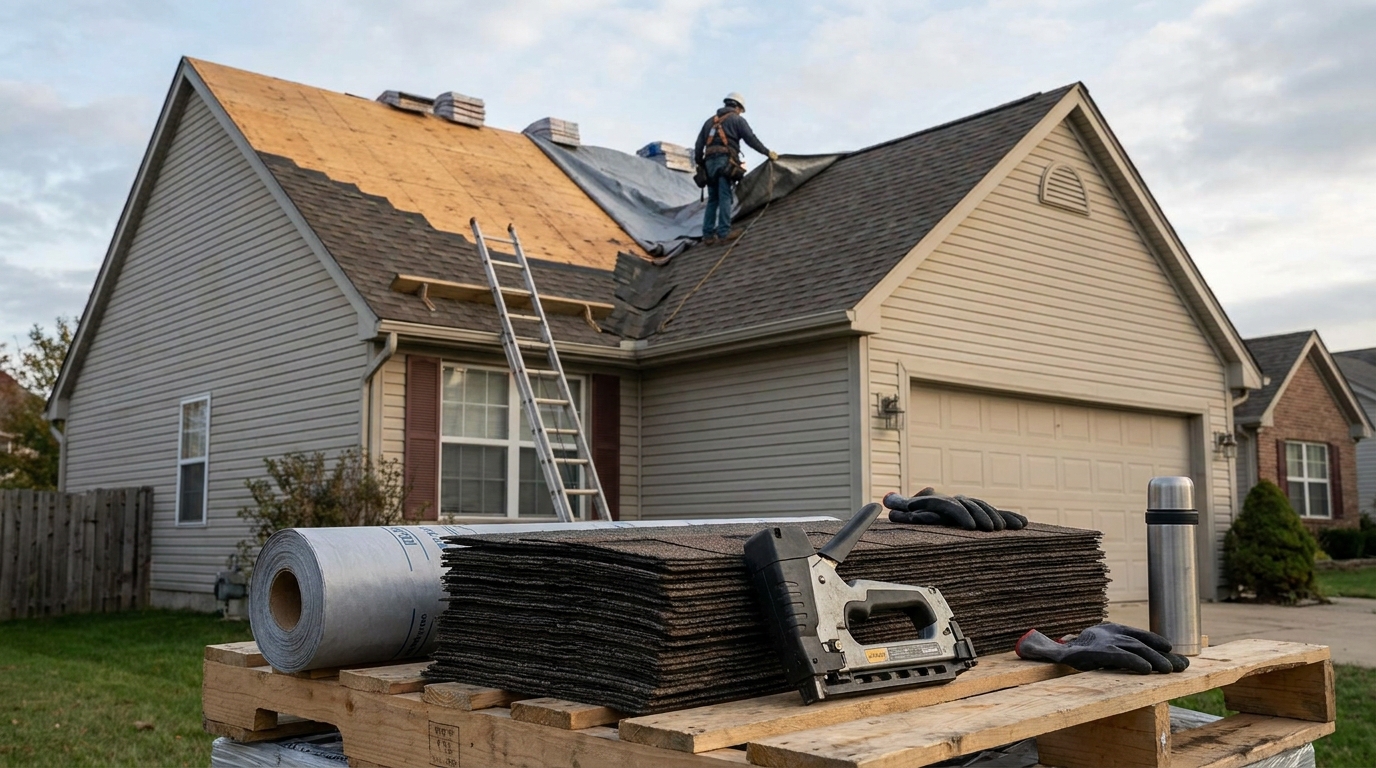
Picture this. Your roof tear-off was booked for a Monday. The crew of eight that walked your property last month has turned into a crew of three, and your contractor is suddenly vague about the finish date. You are not imagining it, and you are not being singled out. In 2026, thinner crews and slipping start dates have become one of the most common frustrations homeowners run into, especially on the trades that touch the outside and inside of a house: roofing, drywall, plastering, and painting.
Here is the honest version of what is going on, why it is happening, and what you can actually do about it when you are the one waiting on a crew.
Who Actually Builds and Finishes Your House
Foreign-born workers made up a record 26.3% of the entire U.S. construction workforce in 2024, according to a National Association of Home Builders analysis of Census data published in April 2026. Among skilled construction craftsmen specifically, roughly one in three is an immigrant.
That share climbs a lot higher in the finishing trades, the ones you hire directly for a remodel or a repair. Based on 2024 data, immigrants make up about 57% of drywall and ceiling-tile installers, 56% of plasterers and stucco masons, 53% of roofers, and 53% of painters. So when the labor supply for these trades gets squeezed, homeowners feel it faster than almost anyone, because these are the crews standing in your yard and your living room.
What Changed in 2025 and 2026
Two things are happening at once. There is the immigration enforcement surge itself, and there is what economists and builders keep calling the chilling effect, which is often the bigger day-to-day factor.
The chilling effect is simple to picture. When enforcement activity is happening in an area, workers stay home. Not just undocumented workers, but documented workers and even citizens who would rather not risk a stressful encounter on a job site. The Dallas Fed and multiple news outlets have documented this pattern. In one striking example reported by NPR in November 2025, a Minnesota homebuilder watched the number of contracted roofers showing up drop from 80 to 6 while enforcement was active nearby.
The industry data backs up the disruption. In the Associated General Contractors of America and NCCER 2025 Workforce Survey, which polled nearly 1,400 firms in late July and early August 2025, 28% of firms said they had been affected directly or indirectly by immigration enforcement in the prior six months. In that same survey, 92% of hiring firms reported difficulty finding qualified workers, and 45% said they had already hit project delays because of worker shortages, whether their own or their subcontractors'.
The Data, Told Straight
It is worth being clear-eyed here, because the headline numbers that circulate online are often bigger than what careful research supports. The measurable employment effects are real but more modest than the scary versions suggest.
A Brookings analysis by Escobari, Seyal, and Beach estimated that the 2025 enforcement surge cut employment by about 0.73% across 86 surge cities, rising to about 1.48% in the cities they observed for six months or more, for a total of roughly 668,000 jobs. Construction saw the steepest decline of any sector at about 2.2%. Separately, a National Bureau of Economic Research working paper found that employment among likely-undocumented workers fell about 4% on average in areas with recent enforcement raids.
One more finding is worth sitting with, because it shows the effect does not stay contained to immigrant labor. Brookings estimated that somewhere between 51,000 and 297,000 of the lost jobs would have been held by U.S.-born workers. When a trade loses a chunk of its crew, the whole operation slows down, and that ripples across everyone on the site.
The Second Squeeze: An Aging Workforce
Even if enforcement were not a factor, the construction trades were already heading into a staffing crunch. The median age of construction workers reached 42.5 in 2024, up from 40.5 seven years earlier. Roughly 40% to 45% of workers are 45 or older, and about one in four is over 55.
That matters because a large share of the most experienced tradespeople are approaching retirement, and there simply are not enough younger workers coming up behind them. Industry analysts project a shortfall approaching 1 million construction workers by 2030. Training helps, but it is slow. A full apprenticeship can take 5 to 7 years to turn out a genuinely skilled tradesperson. So the pipeline that would replace retiring workers cannot be turned on overnight, enforcement or not.
What This Feels Like From Your Side of the Project
You do not experience labor economics. You experience a calendar and a quote. Here is how each mechanism above tends to show up for a homeowner:
-
Longer waits to book a crew. When 92% of hiring firms are struggling to find qualified workers, the good contractors are booked further out. Expect to get in line rather than get an immediate slot, particularly for roofing and drywall.
-
Upward pressure on the labor line of your quote. Thinner labor supply pushes up what crews can charge for their time. The materials portion of your project is a separate market, but the labor line is where a tight workforce shows up most directly.
-
Mid-job pauses. This is the chilling effect landing on your driveway. A crew that was full on Monday can be short on Thursday if enforcement activity flares up nearby, which stretches a job that should have taken days into one that takes weeks.
A Practical Playbook to Protect Your Timeline
You cannot fix the labor market, but you can write a smarter contract and ask better questions. This is where a little upfront effort pays off.
-
Lock a written start date and a written timeline. A verbal we should be able to start soon is worth nothing when crews are tight. Get the start date and the expected completion window in the contract.
-
Get labor and materials broken out separately in the quote. This tells you where your money is going and gives you a real basis for comparing bids. It also helps you see if a later change order is a materials issue or a labor issue.
-
Ask directly about crew size and staffing. How many people will be on your job, are they in-house or subcontracted, and who is responsible if a subcontractor comes up short. A confident contractor will answer this plainly.
-
Build buffer into your own schedule. If you are timing a project around a move, an event, or another trade, give yourself slack. In a tight labor year, the realistic timeline is the quoted timeline plus a cushion.
Red Flags a Contractor Is Quietly Short-Staffed
None of these guarantee a problem on their own, but together they are worth paying attention to:
-
Vague or shifting start dates, with no willingness to commit in writing.
-
Refusal to put a completion timeline in the contract at all.
-
A crew that visibly shrinks week to week without an explanation.
-
Heavy reliance on rotating day-labor with no continuity, so different faces show up each morning and nobody seems to own the job.
The Bottom Line
This is a structural labor story, not a one-season hiccup. Between enforcement pressure on the finishing trades and a retirement wave that was coming regardless, the crews that build and fix homes are stretched thin, and the data suggests that will not reset quickly. The homeowners who come out ahead in 2026 are not the ones who find a magic loophole. They are the ones who book early, get everything in writing, and plan their projects with the real timeline in mind.
Related reading
-
[The Heat Pump Tax Credit Just Vanished: Why a 2026 Install No Longer Qualifies for the $2,000 You Were Counting On](/guides/heat-pump-tax-credit-vanished-2026-install)
Sources
-
The States and Construction Trades Most Reliant on Immigrant Workers, NAHB (Eye On Housing)
-
Shock, Awe, and Economic Fallout: ICE Enforcement Employment Effects in US Cities, Brookings
-
ICE Enforcement Cut Construction Labor Supply, NBER Paper Finds, ConstructConnect
-
Trump's Immigration Crackdown Is Hurting the Construction Industry, NPR
-
Report: Construction's Average Age Rises, Retirement Plans Lag, Equipment World
This article contains AI-assisted content and has been reviewed by our editorial team.
ABOUT THIS SERVICE: CallTheLocal.com is a directory and lead generation service, not a contractor or service provider. Submitting this form does not obligate you to hire anyone or purchase any service. Your information will be shared with licensed, insured home service professionals in your area who may provide quotes for your project. CallTheLocal.com does not guarantee the quality, timeliness, or outcome of any work performed by service providers you connect with through this service. Always verify licensing, insurance, and references before hiring. Get everything in writing before work begins.
Related reading
- Home Insurance Is Now 9% of the Average Mortgage Payment: The Five Home-Service Upgrades That Actually Lower Your Premium in 2026
- The $200 Fine Just Became $1,500: What California, Florida, and New Jersey's 2026 Unlicensed Contractor Rules Mean for Your Wallet
- Canadian Lumber Duties Just Roughly Doubled: Why Your 2026 Deck, Fence, and Framing Quotes Are Climbing Again
- The Crew That Didn't Show Up: 349,000 Missing Workers and Why Your Start Date Keeps Sliding
- Florida's License Lookup Says 'Active.' A New Investigation Explains Why That Doesn't Mean 'No Complaints.'