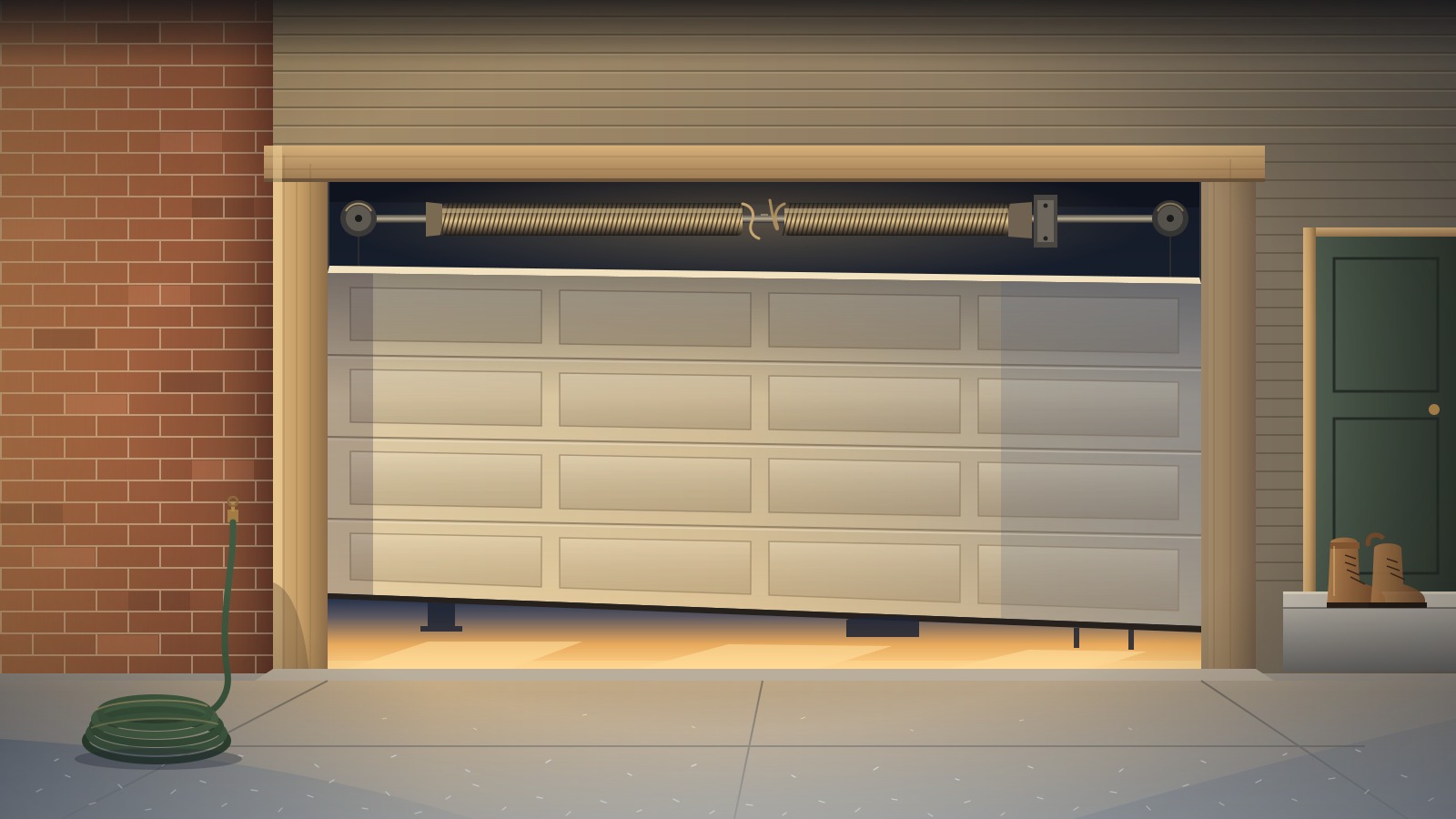
It's a cold morning. You hear a loud bang from the garage, and when you hit the opener, the door strains, barely lifts, or doesn't move at all. Odds are you have a broken garage door spring. First step: stop using the door, and don't try to force it open by hand. Second step: know what a fair fix costs. National quotes for spring replacement often land somewhere between about $120 and $540, depending on the source, the spring type and where you live. Here's why it happened, how to confirm it, and how to judge the quote you get.
Why do garage door springs break in cold weather?
Springs mostly wear out from years of opening and closing. Each trip up and down puts a little more fatigue into the steel. Cold weather is often what finishes off a spring that was already near the end of its life.
Clopay, a garage door manufacturer, says broken springs are more common in winter because "spring wire becomes more brittle and therefore weakens in colder temperatures." That's the manufacturer's explanation for the winter pattern. The practical takeaway is the same either way: if your springs are old, a cold snap is when you're most likely to find out.
How long do garage door springs last?
Most springs are built for a set number of cycles, not a set number of years. Clopay says springs are "usually rated for 10,000 cycles, with each cycle being an open and close." Its rule of thumb: if you've owned the home 7 or more years, used the door daily and never replaced the springs, it's time to replace them.
Lifespan also depends on the type of spring. This Old House puts the numbers at:
-
Extension springs: 7 to 12 years, about 10,000 cycles
-
Torsion springs: 8 to 15 years, up to 20,000 cycles
Bob Vila gives similar year ranges, rating torsion springs at 10,000 to 20,000 cycles and extension springs at 8,000 to 15,000 cycles. If your household uses the garage as the main entry and the door goes up and down several times a day, expect to land near the short end of those ranges.
How do I know if my garage door spring is broken?
The two clearest signs, according to Clopay, are a popping noise when the door was opened or closed, and the long coil above the door visibly split into two pieces.
Bob Vila lists a few more warning signs:
-
The door won't open, or it closes too fast
-
The door hangs crooked
-
The springs show visible rust
You can look at the springs from a safe distance. Don't touch, adjust or try to unwind anything.
Torsion or extension: which spring do you have?
Knowing your spring type helps you understand the quote. eLocal describes the difference in plain terms:
-
Torsion springs are "coils that fit around the rod that sits above your garage door."
-
Extension springs "hang at each side of the door or along the ceiling tracks."
If you have extension springs, there's an extra safety item to check. DASMA, the door industry trade group, says: "If your garage door has extension springs, you need a safety cable that runs through the spring and secures to the wall or ceiling at each end." It also warns that extension springs are under high tension when the door is down, and a break can cause injury.
How much does it cost to fix a broken garage door spring?
Short answer: most national sources put a typical job between roughly $150 and $540, but the ranges differ a lot from source to source. Here's how each one breaks it down.
| Source | National cost range | Notes |
|---|---|---|
| Yelp (October 2026) | $119 to $279, average $200 | Based on 26,118 quotes from US businesses; includes parts and labor |
| Bob Vila (2024) | $150 to $350, average $250 | Notes that "repair rates in urban areas tend to be higher" |
| This Old House (updated March 2026) | $300 to $540 | Installed pricing |
Torsion vs. extension pricing
Torsion jobs usually cost more. This Old House puts extension spring replacement at $300 to $400 installed and torsion at $350 to $540 installed. Yelp's quote data runs lower: $180 to $320 for torsion spring replacement, and about $170 to $240 to replace both extension springs.
The parts themselves are a small share of the bill. This Old House lists parts-only costs of $20 to $60 for extension springs and $80 to $120 for torsion springs. eLocal puts torsion springs at $30 to $70 each and extension springs at $20 to $40 each. Most of what you're paying for is a trained tech's time and the risk they take on.
Yelp also notes that most companies charge a $75 to $100 minimum service call, which often covers the first hour. After that, labor runs $40 to $100 an hour.
What does spring replacement cost in Boston, Minneapolis and Phoenix?
Handoff.ai publishes a 2026 cost model with per-spring estimates by city. It doesn't disclose its method, so treat these as modeled estimates, not quotes. They're useful because they apply the same formula everywhere (materials plus labor plus a 20% contractor markup), which makes the cities easy to compare.
| Market | Average per spring | Range | Labor portion |
|---|---|---|---|
| Boston, MA | $373.20 | $218 to $476 | $196 |
| Minneapolis, MN | $354.00 | $204 to $454 | $180 |
| Phoenix, AZ | $322.80 | $182 to $420 | $154 |
| National | $313.20 | $178 to $412 | $146 |
The model uses the same $115 for materials in every market, so the whole gap between cities comes from labor. In Phoenix, for example, labor is figured at $77 an hour for two hours of installation plus $68 for an hour of removal. If you live in a higher-cost metro, expect your quote to run above the national figures, which lines up with Bob Vila's note about urban rates.
One caution: these are per-spring numbers. If your door has two springs and you replace both, the total will be higher, so ask how the quote is structured.
Should you replace both garage door springs?
Yes, if your door has two. DASMA says plainly: "If your door has two springs, replace both, even if one is not broken." This Old House explains why: "when one fails, its partner isn't far behind." Both springs have been through the same number of cycles, so the survivor is close to failing too. Replacing both now saves you a second service call later.
Pair pricing from the sources:
-
Two torsion springs: $200 to $350 in labor, according to eLocal, plus $50 to $100 for the pair of springs
-
Two extension springs: about $170 to $240 total, according to Yelp; eLocal puts labor at $100 to $120 a pair and parts at $30 to $50 a pair
Can I replace a garage door spring myself?
This is one job to leave to a pro. DASMA calls springs "arguably the most important and most dangerous part of your door" and says spring systems "should be repaired only by trained professionals." Clopay agrees: "This repair must be handled by a professional, as attempting to repair this on your own could result in serious injury."
This Old House adds that "torsion springs are generally more dangerous to replace than extension springs" and recommends hiring a garage door technician. With parts at $20 to $120 and installed jobs often a few hundred dollars, the savings from DIY aren't worth the risk.
What you can do yourself: DASMA recommends monthly homeowner checks, plus an annual visit from a trained door systems technician. Yelp puts a tune-up (lubricating springs and making adjustments) at $50 to $100, which is a good thing to book before winter if your springs are getting old.
Questions to ask before you book
When you call for a quote, ask:
-
Is this price per spring or for the pair? Many regional estimates are per spring. If you have two, make sure the quote covers both.
-
What's the service-call minimum, and what does it cover? Yelp says $75 to $100 is common, often including the first hour.
-
Are safety cables included? On extension spring systems, DASMA says a safety cable should run through each spring.
-
What cycle rating are the new springs? Standard springs are often rated around 10,000 cycles. If you use the door heavily, ask what options are available and what they cost.
-
Is it torsion or extension, and is the price itemized? Parts are a small share of the job, so an itemized quote shows you where the money goes.
The bottom line
If you heard a bang and the door won't lift, leave it closed and call a garage door technician. Ask whether the quote covers one spring or both, then compare it to the ranges above: roughly $119 to $279 based on Yelp's quote data, $150 to $350 from Bob Vila, and $300 to $540 from This Old House, with higher-cost metros like Boston running above the national average. A quote that falls in those ranges and covers both springs, safety cables and a clear labor charge is a fair one to book.
Related reading
-
What to Do in the First Three Days After Floodwater Gets Inside
-
Bent Shingles and Vanished Deposits: October's Roofing Scams
-
Burst Pipe Repair Cost, From the Plumber's Visit to Drying Out the Drywall
-
Belt, Chain or Wall-Mount Garage Door Opener: Which Is Quietest for the Money?
Sources
-
Fixing Garage Door Problems from Cold Weather (Clopay blog, Jan 2024)
-
Cost to update garage door spring in Minneapolis, MN, Handoff.ai
-
Cost to update garage door spring in Phoenix, AZ, Handoff.ai
ABOUT THIS SERVICE: CallTheLocal.com is a directory and lead generation service, not a contractor or service provider. Submitting this form does not obligate you to hire anyone or purchase any service. Your information will be shared with licensed, insured home service professionals in your area who may provide quotes for your project. CallTheLocal.com does not guarantee the quality, timeliness, or outcome of any work performed by service providers you connect with through this service. Always verify licensing, insurance, and references before hiring. Get everything in writing before work begins.
Note: This article contains AI-assisted content and has been reviewed by our editorial team.